
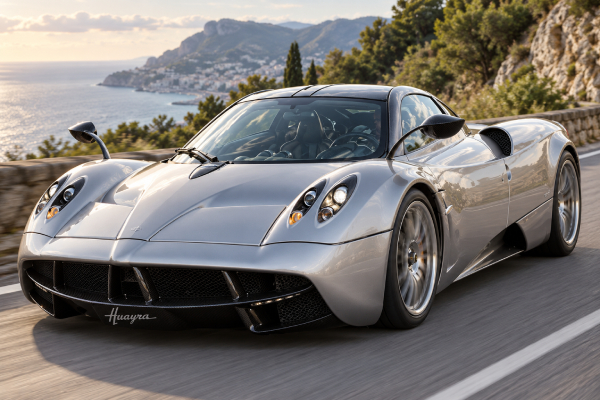
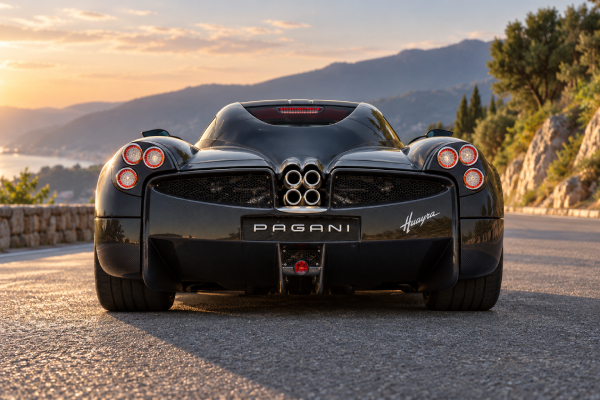
The original Pagani Huayra Coupé is the car that reset Pagani’s engineering direction after the Zonda. Instead of simply refining a naturally aspirated formula, the C9 introduced a bespoke Mercedes-AMG twin-turbo V12, four active aerodynamic flaps, a carbon-titanium monocoque, and a lightweight seven-speed automated manual transmission. It also became the first Pagani designed around global homologation from the start, opening markets that had been difficult for earlier Zondas. Those choices still define how a used Huayra should be judged today. The 730 hp engine is only one part of the story; active aero calibration, hydraulic shift quality, carbon condition, software history, tires, brakes, and factory documentation can have just as much influence on how the car feels and what it is worth. This guide covers the 2011–2018 Coupé scope in the assignment, explains the verified factory specifications, and focuses on the difference between a visually impressive Huayra and one that is mechanically, historically, and financially well sorted.
Table of Contents
- From Zonda Successor to Global C9
- Huayra Coupé Factory Specifications
- Why Four Active Aero Flaps Matter
- M158 V12 and Single-Clutch Driving Character
- Materials, Packaging, and the Cabin Experience
- Service, Aging, and Common Inspection Priorities
- Buying a C9 Huayra With the Right History
From Zonda Successor to Global C9
The Huayra was not conceived as a faster Zonda; Pagani treated project C9 as a fresh platform with new proportions, aerodynamics, power delivery, and homologation goals. The concept began in 2003, and Pagani publicly unveiled the production car in 2011 after years of development.
That long gestation explains why the Huayra feels like a collection of systems designed to work together rather than a body wrapped around a large engine. Horacio Pagani described the wind as a central design theme. The body was shaped as an aerodynamic surface, and active flaps were planned from early in the project rather than added later as a performance accessory.
Packaging changed too. Pagani says the Huayra was designed with a wider track than the Zonda and a passenger compartment shifted rearward to create more cabin space. The visual language remained unmistakably Pagani—central exhaust, exposed mechanisms, sculpted carbon, jewel-like metal parts—but the car’s proportions and safety engineering were developed for a broader regulatory environment.
The global focus was significant. At the Huayra’s tenth-anniversary celebration in 2021, Pagani described the original model as its first globally homologated car and credited it with opening the North American market. That makes early U.S.-market paperwork, homologation specification, emissions equipment, and import history especially important when evaluating cars that have moved between regions.
The assignment covers 2011 through 2018. Within that span, individual Coupés can differ substantially because Pagani built cars to customer specification and continued to offer technical and aesthetic updates. Color, interior materials, exposed-carbon treatment, wheel designs, exhaust details, software state, and later factory upgrades can all vary without making a car non-original in the broader sense. The correct question is not whether two Huayras match each other; it is whether a specific chassis matches its own documented history.
The scale of the project is easy to underestimate from the exterior. Pagani’s current Huayra page describes more than 10,000 components when the engine and gearbox are counted as individual assemblies. That complexity is relevant to used-car inspection because systems that appear unrelated can share sensors, control logic, packaging space, or service access. A battery-voltage problem can create electronic faults; a body repair can disturb an aero actuator; an exhaust or heat-shielding change can affect nearby wiring. The car should therefore be diagnosed as an integrated system rather than as a collection of isolated supercar parts.
Supplier relationships were also part of the original engineering plan. Mercedes-AMG developed the M158 specifically for Pagani, while Pirelli worked on a tire with the progressive breakaway behavior Pagani wanted for a powerful mid-engine car. Those partnerships help explain why substituting a merely compatible component can alter the character of the car. On a C9, the correct tire specification, software state, and factory-approved hardware are not concours trivia; they affect how the chassis was intended to respond.
For 2011–2018 cars, build date is only the starting point for understanding specification. Pagani continued developing the Huayra family after launch, and the factory has long supported client-specific updates. A later-installed factory exhaust, suspension change, software revision, wheel set, or aero package should be documented as a change in configuration rather than silently treated as original-delivery equipment. That chronology becomes particularly important when a seller uses informal names such as “760” for a personalized car.
Huayra Coupé Factory Specifications
The standard Huayra Coupé is an ICE hypercar with a 5,980 cc Mercedes-AMG M158 twin-turbo V12 mounted longitudinally behind the cabin, driving the rear wheels through a transverse seven-speed automated manual gearbox. Pagani’s current technical page lists 730 hp, 1,000 Nm, a 1,350 kg dry weight that changes according to model specification, and a 44:56 front-to-rear weight distribution.
| Specification | Factory figure |
|---|---|
| Engine | Mercedes-AMG M158 V12 twin-turbo |
| Displacement | 5,980 cc (6.0 L) |
| Maximum power | 544 kW (730 hp) at 5,800 rpm |
| Maximum torque | 1,000 Nm (738 lb-ft) from 2,600 to 4,200 rpm |
| Layout | Longitudinal mid-engine |
| Drivetrain | Rear-wheel drive |
| Specification | Factory configuration |
|---|---|
| Gearbox | Seven-speed transverse sequential automated manual |
| Shift system | Robotized AMT with selectable driving programs |
| Aerodynamic control | Four independently managed active flaps |
| Front chassis control | Active front suspension integrated with dynamic behavior |
| Structure | Composite monocoque using Pagani carbon-titanium technology |
| Specification | Factory figure |
|---|---|
| Length | 4,605 mm (181.3 in) |
| Height | 1,169 mm (46.0 in) |
| Body width | 2,036 mm (80.2 in) |
| Width including mirrors | 2,356 mm (92.8 in) |
| Dry weight | 1,350 kg (2,976 lb), changing according to specification |
| Weight distribution | 44% front / 56% rear |
Pagani also published a 0–100 km/h time of 3.3 seconds and a 370 km/h top speed in period Middle East launch material for the 730 hp Coupé. Those figures are useful as factory-period performance references, but they should not be treated as a condition test for an individual used car. Tire type, surface, temperature, fuel load, alignment, software, and later upgrades can all alter real-world results.
| Measure | Pagani figure |
|---|---|
| 0–100 km/h (0–62 mph) | 3.3 seconds |
| Top speed | 370 km/h (230 mph) |
| Power-to-mass context | 730 hp with a nominal 1,350 kg dry weight |
The car’s specification should always be checked against its VIN-specific build documents. Pagani’s model page itself notes that dry weight changes by model, and customer personalization means an individual car can differ from a headline launch specification.
Why Four Active Aero Flaps Matter
The Huayra’s active aerodynamics are not decorative; they are part of the car’s basic dynamic architecture. Two flaps at the nose and two at the rear can move independently to influence downforce, drag, pitch response, and left-to-right aerodynamic balance.
This approach was unusually ambitious for a road car launched in 2011. Instead of relying on a fixed wing or a single movable rear spoiler, the Huayra can change the airflow at multiple corners of the body. Pagani also linked the aero strategy to the active front suspension, allowing the car’s attitude and aerodynamic surfaces to work together under braking and cornering.
For an owner, that means the aero system must be treated like a functional chassis component. A flap that opens during a showroom demonstration but binds at speed is not “mostly working.” Correct operation depends on actuators, sensors, wiring, software, alignment, and the physical condition of the carbon panels and hinges.
Under braking, the system can use the front and rear surfaces to help manage aerodynamic pitch and stability; in a bend, left and right flap behavior can differ according to the control strategy. The driver does not command individual flap angles, so healthy operation is judged by system behavior and diagnostics rather than by whether all four panels move identically at a standstill. This is one reason videos of a stationary car cycling its flaps are useful but incomplete evidence.
Owners should also resist treating the flaps as convenient handholds or cleaning surfaces. Their hinges, actuators, and panel edges are precision components. When detailing the car, support should never be placed on a movable aero element, and high-pressure water should not be directed into actuator or hinge areas. After paint-protection film work, verify that film edges do not catch as a flap moves through its range. A tiny installation mistake can become a repeated mechanical load every time the system cycles.
A pre-purchase inspection should therefore include a commanded functional test through the appropriate diagnostic procedure, a visual check of hinge and panel gaps, and a review of fault history. Inspect the leading edges for chips and repaired impact damage. Small body alignment changes after a minor incident can matter when a movable panel has tight clearances.
Active aero also changes the way accident repairs should be judged. A conventional cosmetic shop may be able to produce a smooth carbon repair, yet the part must also retain the correct stiffness, mounting geometry, finish, and movement. Evidence of repaired mounting points, non-standard fasteners, altered stops, or inconsistent panel gaps deserves specialist review.
The system is one reason a Huayra should be road-tested after service rather than merely started in a workshop. Some faults appear only with speed, heat, steering input, or repeated actuator cycles. A static inspection can confirm basic movement; it cannot fully reproduce the dynamic environment the control strategy was designed for.
M158 V12 and Single-Clutch Driving Character
The M158’s defining trait is not simply its 730 hp peak; Pagani and Mercedes-AMG worked to make a very high-torque turbocharged V12 deliver power progressively. The factory specifically emphasized linear response and reduced lag because an abrupt torque step would be difficult to manage in a lightweight rear-drive car.
Peak torque arrives across a broad 2,600–4,200 rpm band. That means the Huayra does not need extreme engine speed to feel fast. It can accelerate hard on midrange torque, then build toward the 5,800 rpm power peak. For a buyer, smoothness matters: uneven boost, misfire under load, smoke, abnormal turbo noise, or hesitation should not be dismissed as “old-school character.”
The gearbox is intentionally different from the dual-clutch transmissions common in later hypercars. Pagani chose a transverse seven-speed automated manual partly to reduce weight. Because a single clutch is opened and re-engaged during shifts, the driver feels an interruption in torque. The best technique is to work with that rhythm rather than demand the uninterrupted thrust of a modern DCT.
Clutch behavior should be assessed from cold start through full operating temperature. Watch for excessive slip when moving away, abrupt engagement that changes unpredictably, slow or refused shifts, warning messages, and a clear difference between left and right paddle requests. Ask for clutch-wear data or adaptation information if the diagnostic system provides it, but interpret any percentage with the specialist who understands Pagani’s calibration rather than applying generic automated-manual assumptions.
Low-speed use can be harder on a single-clutch system than open-road mileage. A car that spent years creeping through city traffic, loading ramps, concours queues, and garage maneuvers may have more clutch stress than its odometer suggests. That is why service invoices and diagnostic history are more informative than mileage alone.
Cooling deserves equal attention. A twin-turbo V12 packages significant thermal load into a compact engine bay. Inspect radiator and intercooler airflow paths, hose connections, dried coolant traces, heat shielding, turbo oil and coolant lines, and evidence of repeated high-temperature operation. A clean engine bay should not prevent a careful leak inspection from below.
| System | Healthy behavior to confirm | Warning signs |
|---|---|---|
| Engine | Clean start, stable idle, progressive boost | Misfire, smoke, hesitation, abnormal turbo noise |
| AMT | Consistent engagement and deliberate shifts | Refused gears, erratic clutch take-up, repeated warnings |
| Cooling | Stable temperatures under normal use | Coolant odor, residue, unexpected temperature rise |
| Active aero | Correct commanded movement and no faults | Binding, asymmetry, damaged hinges or gaps |
| Brakes | Firm pedal and smooth deceleration | Judder, cracking concerns, fluid-age issues |
Materials, Packaging, and the Cabin Experience
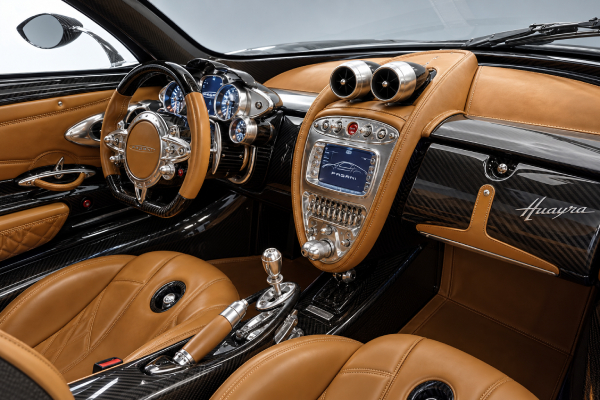
The Huayra cabin is part structural showcase and part luxury object, so interior condition can reveal how carefully the whole car has been treated. Exposed carbon, milled metal, leather, switchgear, and mechanical-looking linkages are intentionally visible; careless detailing can damage surfaces that are expensive to reproduce correctly.
Pagani built the C9 around a carbon-titanium composite monocoque. The material strategy aimed at stiffness and low mass while allowing the car to meet safety requirements across more markets. Front and rear structures, suspension attachments, body panels, and the central cell should be inspected as a system after any recorded impact.
The gullwing doors create drama but also add inspection points. Check that each door opens and holds correctly, clears adjacent panels, latches cleanly, and has even gaps. Gas struts or support systems weaken with age, while previous adjustment can leave evidence around hinges and fasteners. Weather sealing matters because water entry can affect leather, electronics, and hidden connectors.
Inside, test every switch and display rather than assuming rare use preserves electronics. Climate control, windows, mirrors, lighting, reversing functions, infotainment, parking aids where fitted, and steering-wheel controls should be demonstrated. A low-voltage battery event can create stored faults that disappear after charging, so ask whether warning lights were cleared immediately before inspection.
Seating position and visibility are unusually important on a car this wide. The factory lists 2,356 mm including mirrors, which makes narrow entrances and transport loading a genuine ownership consideration. Before purchase, confirm that the intended garage, lift, trailer, or enclosed transporter can accommodate width, door swing, ride height, and approach angle without improvisation.
The underbody is vulnerable even when the visible upper surfaces are pristine. Inspect the front splitter, floor edges, diffuser, jacking areas, and lower carbon for scraping or repairs. Transport damage can occur without any road accident, especially when loading angles are steep.
Service, Aging, and Common Inspection Priorities
A Huayra should be maintained by time, condition, and use—not mileage alone. Public Pagani pages do not provide a complete workshop schedule, so exact oil grades, fluid capacities, torque values, replacement intervals, and software procedures should come from the VIN-specific service documentation and the authorized service network.
The main aging risks are predictable for a complex, lightly used exotic. Tires harden. Batteries weaken. Brake fluid absorbs moisture. Seals can shrink. Hydraulic systems may become sticky. Fuel ages. Coolant hoses and clamps experience heat cycles even when annual mileage is low. Carbon bodywork can be cosmetically damaged by poor film removal or polishing.
Service records should also show who had access to the car. On a rare vehicle, a long invoice from a general exotic-car shop is not automatically equivalent to shorter but continuous records from a Pagani-authorized center. The useful questions are whether the technician had the correct diagnostic access, whether software updates were logged, whether parts can be traced to Pagani, and whether work that required factory procedures was actually performed to those procedures.
When a car has been stored for a long period, recommissioning should be planned before aggressive driving. That can include inspecting fuel condition, bringing the battery system back to health, checking for leaks before heat cycles, verifying tire age and pressure, exercising the AMT and active aero, and confirming that cooling fans and temperature sensors behave normally. A low-mileage odometer should never be used as a shortcut around these checks.
Owners who drive regularly should keep a simple event log in addition to invoices. Record mileage, tire changes, track or high-speed events, battery replacements, software updates, paint-protection-film work, and any unusual warning message. Years later, that record can help a technician distinguish a recurring issue from a one-off event and can reassure a buyer that the car’s use was controlled rather than undocumented.
A disciplined ownership routine should include:
- regular battery conditioning with the correct equipment;
- tire age and pressure checks, not only tread-depth checks;
- brake-fluid inspection and replacement according to Pagani guidance;
- engine and gearbox leak inspection from below as well as above;
- active-aero function checks after storage or bodywork service;
- cooling-system inspection before demanding summer use;
- diagnostic scans that preserve fault history before codes are cleared;
- documentation of software updates, clutch adaptation, and replacement parts;
- careful cleaning of radiator openings, vents, and underbody aero surfaces.
Carbon-ceramic brakes deserve a specialist condition assessment. A disc may have plenty of apparent thickness yet still require evaluation for surface damage, heat history, or manufacturer-specific wear criteria. Replacement cost is high enough that buyers should obtain measurements and condition comments in writing rather than accept “brakes look good.”
The same logic applies to tires. Pagani worked with Pirelli on Huayra development, and correct tires are part of the chassis calibration. Confirm model, size, homologation marking where specified, production date, repair history, and storage condition. Mixing old front tires with new rears or fitting visually similar alternatives can change breakaway behavior in a car whose aero and stability systems were tuned around a specific tire response.
Storage should avoid repeated short engine starts that never bring the car fully to temperature. If the car will not be driven, follow the factory or service center’s storage procedure. If it will be exercised, use a route long enough to warm the drivetrain, brakes, and exhaust, then allow appropriate cool-down. “Starting it once a month” is not automatically a maintenance plan.
Buying a C9 Huayra With the Right History
The strongest used Huayra is the car with a coherent story: original build specification, continuous service records, transparent repair history, and documented factory changes. Because Pagani actively supports personalization and upgrades, originality should be described precisely rather than as a yes-or-no label.
Begin by matching the VIN to the factory build record and delivery specification. Identify exterior finish, carbon treatment, interior materials, wheel design, major options, and market configuration. Then create a chronology of later work. Separate normal maintenance from accident repair, cosmetic refurbishment, and performance or design upgrades.
Pagani’s current ownership programs help define those categories. Puro uses factory records and an extensive inspection process to certify authenticity. Rinascimento is a preservation and restoration program intended to return cars toward their original factory condition. Unico allows more extensive aesthetic and mechanical personalization. A Huayra can therefore be factory-authentic without remaining exactly as delivered, which is why a seller should specify whether the car is preserved, restored, upgraded, or reconfigured.
Before money changes hands, obtain an inspection that covers at least the following:
| Area | Evidence to request |
|---|---|
| Identity | VIN, build sheet, invoice, market and delivery records |
| Service | Dated invoices, mileage history, software and diagnostic records |
| Carbon structure | Impact history, repair documentation, panel and mounting inspection |
| Powertrain | Cold start, hot road test, leak check, fault scan, clutch assessment |
| Chassis | Alignment data, suspension inspection, brake and tire condition |
| Active systems | Aero-flap test, sensor status, stored-fault review |
| Upgrades | Pagani invoices or correspondence identifying factory-authorized work |
Be careful with cars advertised simply as “760” or “Tempesta” without documentation. Pagani has offered continuous updating and personalization, but names used by owners, dealers, and social media do not necessarily define a standardized factory trim. The invoice trail should identify what was actually installed and by whom.
Insurance and transport planning should be completed before delivery. Agreed value, approved repair facilities, parts sourcing, enclosed transport terms, and geographic use restrictions can matter more than on a normal collector car. Measure the home garage and confirm ramp angles; an avoidable splitter or floor strike on delivery is an expensive way to begin ownership.
Finally, decide how the car will be used. A low-mileage collection piece and a touring Huayra need different plans, but both benefit from documented exercise and professional inspection. The C9 was engineered as a functioning hypercar, not a static sculpture. Its value is easiest to protect when mechanical health and historical clarity are treated as the same ownership project.
References
- Huayra | Pagani 2011
- WORLD PREMIERE PAGANI HUAYRA | Pagani 2011
- PAGANI AUTOMOBILI EXCLUSIVE EVENT IN THE MIDDLE EAST | Pagani 2013
- Pagani Automobili celebrates the tenth anniversary of the Huayra at Monterey Car Week 2021 | Pagani 2021
- “Pagani Puro”, the program created to certify the authenticity and enhance the value of our exclusive cars over time | Pagani 2021
- Pagani Rinascimento | Pagani 2022
Disclaimer
The Huayra C9 spans years of production changes, so this guide is background information rather than a substitute for professional diagnosis or repair. Never carry a specification, torque value, interval, or workshop procedure from one car to another merely because both are Huayras. VIN, market, and installed equipment can change what applies. Check the official Pagani service documentation assigned to the individual vehicle before servicing it.
If this long-form C9 guide answered a question, sharing it through Facebook, X/Twitter, or a relevant owners’ group helps other readers find the research.