
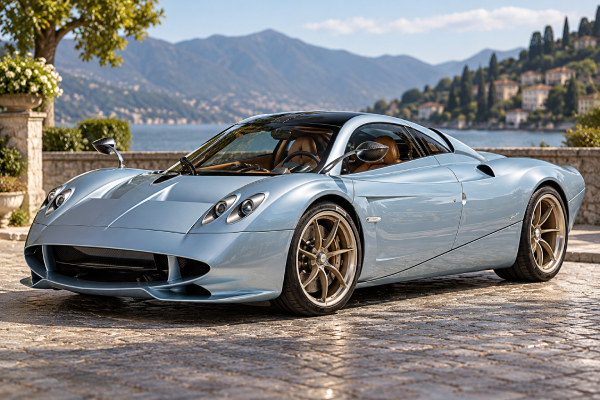
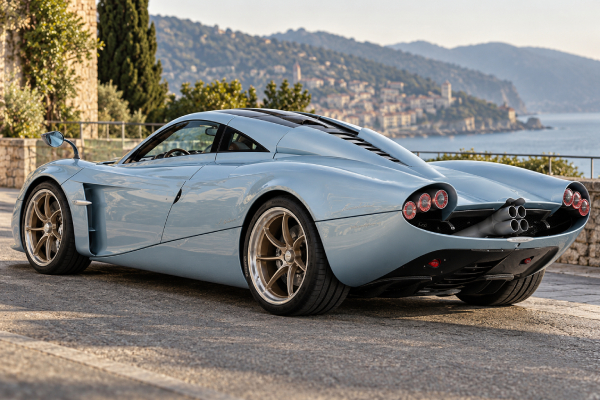
The Pagani Huayra Codalunga is a five-car long-tail project shaped as much by two collectors as by Pagani itself. The idea began in 2018, when the clients asked for a cleaner, longer Huayra inspired by 1960s endurance racers and Italian coachbuilding. Four years later, Pagani presented a globally homologated car with an 840 hp twin-turbo V12, 1,100 Nm, 1,280 kg dry weight, a rear engine cover more than 3.7 square meters in area, and a tail 360 mm longer than the Huayra Coupé’s. Its visual simplicity hides difficult engineering: active aerodynamic flaps remain, the carbon-composite structure carries modern crash and stiffness demands, and the titanium exhaust weighs only 4.4 kg. For an owner or buyer, the Codalunga is therefore not just a styling exercise or investment object. It is a highly specific mechanical package whose condition, original commission, matte finishes, exposed carbon, long rear body, and documentation all require careful preservation. This guide explains the car from that coachbuilt perspective.
Table of Contents
- How Two Clients Created a Modern Long-Tail Pagani
- Codalunga Factory Specifications and Key Measurements
- Engineering Through Simplification: Tail, Aero, and Exhaust
- Materials, Trim, and the Coachbuilt Character
- How the Codalunga’s Mechanical Package Shapes the Drive
- Care, Storage, and Service for a Long-Tail Pagani
- Buying One of Five: Commission History and Authenticity
How Two Clients Created a Modern Long-Tail Pagani
The Codalunga began as a direct request from two Pagani collectors, not as a conventional model-planning exercise. They wanted a long-tail Huayra with cleaner surfaces and the visual calm of 1960s competition and coachbuilt cars, and Pagani’s Grandi Complicazioni division turned that brief into five road-legal examples.
The development path is important because it explains why the finished car feels different from a normal limited edition. Pagani spent about two years refining the design concept with the clients, using both a 1:4-scale model and a full-size model before committing to production components. The result was not a set of add-on panels fitted to an existing Huayra; the proportions, rear body, trim philosophy, exhaust presentation, and aero treatment were conceived as a coherent whole.
Only five cars were planned, all sold, with an announced starting price of €7 million. Pagani also stated that one example would be certified for the U.S. market. That illustrates the unusual cost of few-off development: even when production is counted on one hand, the vehicle still has to satisfy the relevant homologation, emissions, lighting, safety, and market requirements.
The Codalunga name literally points to the long tail, but the design philosophy was broader than extra length. Pagani described the process as removing rather than adding. Rear grilles were deleted, visual interruptions were reduced, and large continuous surfaces replaced the more visibly complex treatment seen on some track-focused Huayras. Active aerodynamic flaps remained, but they were integrated into the smooth body rather than turned into a stylistic statement.
That makes authenticity unusually dependent on proportion and finish. A replacement panel can be dimensionally correct yet still look wrong if the curvature, weave, paint sheen, gap, or surface transition differs from the original commission. On a five-car project, there is also no assumption that one car’s material or color combination matches another’s.
The 2022–2024 date range covers the public launch and the delivery era identified by the assignment. Individual build and registration dates can differ. A buyer should treat the factory chassis file, final specification, and delivery documents as the definitive record rather than forcing the car into mass-market model-year conventions.
Codalunga Factory Specifications and Key Measurements
The Huayra Codalunga is a rear-wheel-drive ICE hypercar powered by Pagani’s Mercedes-AMG-developed 5,980 cc twin-turbo V12 and a transverse seven-speed Xtrac sequential transmission. Its specification combines 840 CV, 1,100 Nm, and 1,280 kg dry weight with a longer rear body and unusually light titanium exhaust.
| Specification | Factory value |
|---|---|
| Engine | Pagani V12, 60-degree, 36-valve, twin-turbo |
| Engine family | Mercedes-AMG M158 architecture developed for Pagani |
| Displacement | 5,980 cc (6.0 L) |
| Maximum power | 840 CV (618 kW) at 5,900 rpm |
| Maximum torque | 1,100 Nm (811 lb-ft) from 2,000 to 5,600 rpm |
| Drive type | Rear-wheel drive |
| Specification | Configuration |
|---|---|
| Gearbox | Pagani by Xtrac transverse 7-speed sequential |
| Monocoque | Carbon-Titanium HP62 G2 and Carbon-Triax HP62 |
| Suspension | Active independent double wishbone in forged aluminum alloy |
| Springs and dampers | Variable-pitch helical springs with coaxial dampers |
| Dry weight | 1,280 kg (2,822 lb) |
| Active aerodynamics | Four variable-profile flaps |
| Component | Front | Rear |
|---|---|---|
| Brake discs | 410 × 38 mm carbon-ceramic | 390 × 34 mm carbon-ceramic |
| Calipers | 6-piston monobloc | 4-piston monobloc |
| Wheel diameter | 20 in | 21 in |
| Wheel construction | One-piece forged Avional by APP Tech | One-piece forged Avional by APP Tech |
| Warm-weather tires | Pirelli P Zero Corsa 265/30 R20 | Pirelli P Zero Corsa 355/25 R21 |
| Cold-weather option | Pirelli SottoZero | Pirelli SottoZero |
| Item | Published detail |
|---|---|
| Rear engine-cover area | More than 3.7 m² (about 39.8 sq ft) |
| Tail extension | Rear cover 360 mm longer than the Huayra Coupé’s |
| Exhaust material | Titanium with special ceramic coating |
| Exhaust weight | 4.4 kg (9.7 lb) |
| Rear grille treatment | Open presentation that exposes the exhaust assembly |
| Body theme | Long-tail form inspired by 1960s race cars and coachbuilders |
| Item | Factory detail |
|---|---|
| Production | 5 cars |
| Project request | Initiated by two collectors in 2018 |
| Development division | Pagani Grandi Complicazioni |
| Original starting price | €7 million |
| Homologation | Developed for road approval worldwide, with one car announced for U.S. certification |
These are factory-published model figures, not a substitute for the final build specification of an individual chassis. Pagani does not publish enough public workshop data to justify filling a general article with guessed fluid capacities, wheel torques, or service intervals.
Engineering Through Simplification: Tail, Aero, and Exhaust
The Codalunga’s clean appearance required more engineering, not less. Extending the rear body while removing grilles and visual clutter changed airflow, cooling, panel stiffness, service access, exhaust heat management, and the way active aero had to blend into the surface.
The rear engine cover is the clearest example. With an area exceeding 3.7 m² and an extra 360 mm of length compared with the Huayra Coupé’s cover, it is a very large composite part. Large panels need stiffness without excessive weight, precise hinge and latch geometry, and careful support when open. They also magnify small alignment errors: a few millimeters that would be hard to see on a compact panel can interrupt the long visual line of the Codalunga.
The longer tail is not simply empty bodywork. A long-tail shape can allow airflow to remain attached as the body narrows, reducing abrupt wake formation and potentially improving aerodynamic efficiency. Pagani does not publish a drag coefficient for the Codalunga, so it would be wrong to invent a numerical benefit, but the company explicitly linked the extra length and shape to high aerodynamic efficiency.
Four active flaps allow the car to adjust its aerodynamic behavior rather than relying on large fixed appendages. This is essential to the design language: the surfaces can remain visually simple while the car still changes aero balance as speed and driving conditions vary. Owners should therefore regard flap operation, actuator health, position sensors, and panel alignment as part of routine technical inspection.
The exhaust is both engineering and theater. Removing rear grilles leaves the four central outlets and surrounding hardware visible, while the 4.4 kg titanium system reduces mass high and behind the cabin. The ceramic coating helps manage heat and creates the pale finish that visually references competition cars.
That exposed layout also creates care requirements. Cleaning chemicals, road salts, moisture, and careless polishing can alter the ceramic coating. Heat shields, mounts, surrounding carbon, and wiring should be inspected for signs of heat damage or contact. An aftermarket exhaust may be lighter or louder, but it could change thermal behavior and erase one of the Codalunga’s defining factory components.
Because the tail is long and low, practical clearance matters too. Garage ramps, transport trailers, parking blocks, and workshop lifts can threaten surfaces that are difficult to see from the driver’s seat. A spotter and measured loading plan are cheaper than repairing a bespoke rear diffuser or engine cover.
Materials, Trim, and the Coachbuilt Character
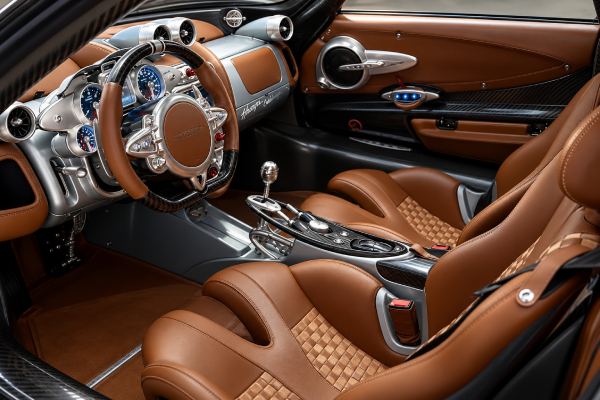
The Codalunga was deliberately finished to look less aggressive than many exposed-carbon hypercars. Neutral colors, matte or semi-matte paint, aged-looking suede and leather, woven upholstery, exposed structural carbon, and hand-finished aluminum create a period-influenced atmosphere without using period technology.
That distinction is important for preservation. Matte paint should not be polished to remove every mark because abrasive correction can permanently change gloss level. Spot repairs can also create visible patches if the sheen does not match adjacent panels. Before any paint correction, the detailer should know the exact factory coating and whether the surface is painted composite, exposed carbon, clear-coated carbon, or a mixed transition.
The interior uses woven leather and nubuck-like materials that are intended to have texture. Heavy conditioning products can darken or flatten those surfaces. Likewise, aluminum pieces machined from solid material and hand-finished should not automatically be machine-polished to a mirror shine. The correct finish may include a softer hand-worked appearance.
The exposed carbon structure provides another preservation challenge. Owners often focus on the glossy exterior body, but structural carbon around door apertures, cabin surfaces, and engine-bay areas can be scratched by jewelry, luggage, tools, or incorrect service covers. A protective workshop protocol is particularly important because replacement may involve far more than cosmetic refinishing.
Every commission can differ. One Codalunga’s paint, upholstery, stitching, exposed weave, luggage, or presentation pieces should not be used as a template for another. The factory build book and delivery photography are the best guides when a surface needs restoration.
This is where Pagani’s coachbuilding analogy becomes practical. In the 1960s, a special-bodied car might have hand-formed aluminum that varied subtly from one chassis to the next. The Codalunga uses modern composites and digital engineering, but the client-led nature of the commission still means individual specification is central to identity.
For concours preparation, restraint is preferable to over-restoration. A light crease in aged leather, a hand-finished aluminum texture, or a matte surface should not be “improved” until it no longer matches the factory intent. Preservation aims to retain the original character, not make every material look newly chrome-plated and glossy.
How the Codalunga’s Mechanical Package Shapes the Drive
The Codalunga’s calmer styling does not make it a relaxed conventional grand tourer. It still combines 1,100 Nm, rear-wheel drive, a single-clutch seven-speed Xtrac transmission, carbon-ceramic brakes, active aero, and a 1,280 kg dry weight.
The engine’s torque plateau from 2,000 to 5,600 rpm means the car does not need to be kept near redline to accelerate strongly. On public roads, that broad torque can make short throttle openings more significant than the driver’s ear suggests, especially in a low gear or on cool tires. Progressive inputs matter.
The Xtrac gearbox gives the drive a distinct rhythm. Unlike a dual-clutch unit, it interrupts torque during a shift. A small lift of the accelerator during road-speed upshifts can smooth the transition, while full-throttle shifts feel much more abrupt. Low-speed crawling should be minimized because repeated partial clutch engagement generates heat.
The P Zero Corsa tire choice is also revealing. Compared with the Roadster BC’s Trofeo R fitment, the Codalunga was specified with a road-oriented high-performance tire and a SottoZero option for low temperatures. That supports the car’s broader road and grand-touring intent without turning it into a comfort-first GT.
The active suspension and four aero flaps help control the body as speed changes. A driver experiences the result rather than individual actuator commands: the car stays composed under braking, turn-in, and acceleration while the electronic systems support the mechanical platform. For an owner, this means diagnostics should include the interaction of ride-height sensors, dampers, aero actuators, and wheel-speed information rather than treating each warning in isolation.
Braking hardware is substantial: 410 mm front and 390 mm rear carbon-ceramic discs. These components tolerate heavy use but require correct inspection and warm-up. On a gentle road drive they can feel different from conventional iron brakes, especially when cold or after washing. Consistent pedal feel matters more than judging them by one low-speed stop.
The long body changes how the car must be placed in tight spaces even if wheelbase and steering behavior remain familiar to a Huayra driver. The rear overhang is easy to forget from the cockpit. Use cameras, mirrors, and a spotter around lifts, ramps, loading decks, and low walls rather than relying on intuition developed in a shorter sports car.
Care, Storage, and Service for a Long-Tail Pagani
Codalunga maintenance should focus on preserving both function and the original commission. There is no credible public database of common failures for five cars, so owners should build a detailed baseline for their own chassis and update it after every significant drive, transport, or service event.
The highest-priority checks include:
- engine and cooling-system leaks, boost behavior, and stored diagnostic faults;
- clutch engagement, gearbox actuation, and differential behavior;
- active-aero flap operation and alignment;
- suspension sensors, electronic dampers, ride height, and wheel alignment;
- carbon-ceramic disc and pad condition using approved measurement methods;
- tire age, specification, damage, pressure history, and seasonal suitability;
- rear engine-cover hinges, latches, supports, panel gaps, and heat shielding;
- underbody, diffuser, and long-tail clearance after transport or steep ramps;
- condition of matte paint, exposed carbon, ceramic-coated exhaust, and hand-finished trim.
Battery management matters because infrequently driven cars can suffer low-voltage problems long before they show mechanical wear. Use the factory-approved maintainer and connection points. If the car has been stored for an extended period, a controlled recommissioning with fluid, tire, brake, battery, and diagnostic checks is preferable to starting it and immediately driving hard.
The engine cover deserves a specific handling routine. Open it only on level ground, verify supports or latches as required, and keep wind away from the panel. Never use the cover as a shelf for tools, towels, removed fasteners, or detailing bottles. A light object can slide across a large matte surface and leave a mark that is difficult to correct invisibly.
Transport should be planned around body length and clearance. Measure trailer breakover angles, ramp transitions, wheel-stop positions, and door opening space. Use approved tie-down points or wheel-strapping methods and photograph the car before loading. This creates evidence if transport damage is discovered later.
For storage, maintain stable humidity and temperature, keep the tires away from direct sunlight and chemical fumes, and inspect the floor beneath the car for new fluid traces. Avoid leaving the car under a dirty cover or in a space where the rear body is close to walls or equipment.
A service invoice should identify what was measured, not just what was “checked.” Brake wear, tire dates, diagnostic codes, software versions, clutch data, alignment, and photographs make future decisions far easier. On a five-car model, each owner effectively contributes to the chassis’s long-term technical record.
Buying One of Five: Commission History and Authenticity
A Codalunga purchase should begin with the original commission file because the car’s individuality is part of its value. The buyer needs to know not only that the chassis is one of five, but exactly how Pagani and the first client specified it.
Match the chassis number to the final build sheet, invoice, delivery documents, market certification, and any Pagani presentation material. Confirm paint type and sheen, exposed-carbon areas, upholstery, stitching, aluminum finish, wheels, brake-caliper specification, luggage, covers, charger, tools, books, keys, plaques, and other accessories.
The body requires a specialist inspection under multiple lighting conditions. Matte paint can hide or exaggerate repairs depending on angle, while large carbon panels can reveal weave or clear-coat differences in direct sunlight. Look for changed fasteners, uneven gaps, lifting protective film, overspray, sanding marks, repaired edges, or altered aero-flap alignment.
Inspect the tail from below as well as above. The extended body increases the chance of low-speed contact during loading or parking. A small scrape may be cosmetic, but damage near diffuser mounts, exhaust supports, suspension points, or structural composite needs a deeper assessment.
The mechanical inspection should include cold and hot operation. Verify stable engine temperature, clean gearbox engagement, predictable clutch behavior, active-aero function, damper response, steering, brake consistency, and the absence of new warnings after a full drive cycle. Diagnostic data should be reviewed before clearing stored faults so their timing and recurrence remain visible.
If the car has been altered, determine who performed the work and why. Pagani Unico offers a factory path for later personalization; Puro supports authenticity certification; Rinascimento provides factory-led conservation and restoration. Changes through those programs should still be documented so a future owner can distinguish delivered specification from later factory evolution.
Third-party changes require more caution. A different exhaust can alter heat behavior around the open rear structure. Non-standard ride height can affect active aero. Wheels with different dimensions can change tire circumference and sensor behavior. Software changes can affect emissions legality and mechanical protection strategies. Reversibility alone does not prove compatibility.
The transaction itself may need specialist legal and tax advice. Verify title, VAT or sales-tax position, import status, emissions compliance, registration, export permissions, insurance valuation, and any contractual limits on transfer. With cars at this level, paperwork can be as consequential as a mechanical inspection.
Finally, budget for correct stewardship. The Codalunga was conceived to be driven on roads and displayed at concours events, and maintaining that dual role means keeping it mechanically ready while preserving exceptionally sensitive surfaces. The strongest example is not necessarily the lowest-mileage car. It is the one whose long-tail body, 4.4 kg exhaust, active systems, finishes, accessories, and history remain coherent with the original client-Pagani commission.
A buyer should also separate reversible age from lost originality. Old tires, a tired auxiliary battery, or overdue fluid service can usually be corrected without changing the car’s identity. A refinished matte panel in the wrong sheen, missing delivery accessories, an undocumented carbon repair, or a discarded original exhaust is harder to put right because the reference point may be gone. That distinction helps prioritize negotiation and inspection: mechanical consumables should be costed realistically, while authenticity gaps should be investigated before the transaction proceeds. For a five-car program, the documentary record can be as valuable as a rare physical part because it tells a future owner exactly what “original” means for that chassis.
References
- Huayra Codalunga | Pagani 2022
- “Pagani Huayra Codalunga, Grandi Complicazioni on Wheels” | Pagani 2022
- PAGANI AUTOMOBILI AT THE GOODWOOD FESTIVAL OF SPEED 2022 WITH THE NEW PAGANI HUAYRA CODALUNGA, DESIGNED IN PARTNERSHIP WITH CUSTOMERS | Pagani 2022
- Pagani Puro | Pagani 2021
- Pagani Rinascimento | Pagani 2022
- Pagani Unico | Pagani 2022
Disclaimer
This article is for informational purposes only and does not replace professional diagnosis, inspection, maintenance, or repair. Specifications, torque values, service intervals, software, and procedures can vary by VIN, market, and equipment; confirm them in the official Pagani service documentation for the individual Codalunga.
If you found this guide useful, please share it on Facebook, X/Twitter, or with another Pagani owner or enthusiast to support our work.