
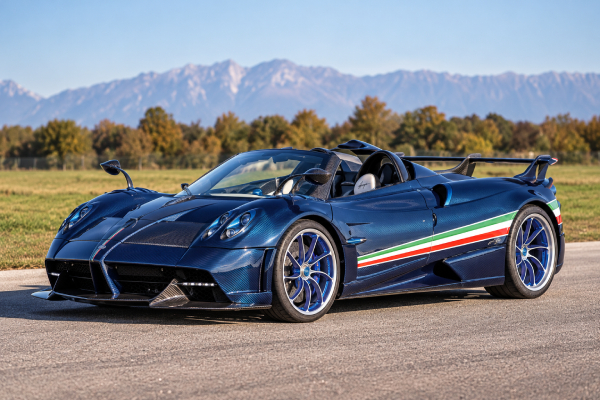
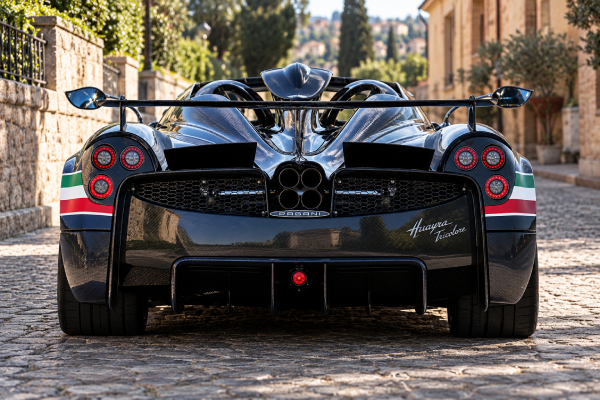
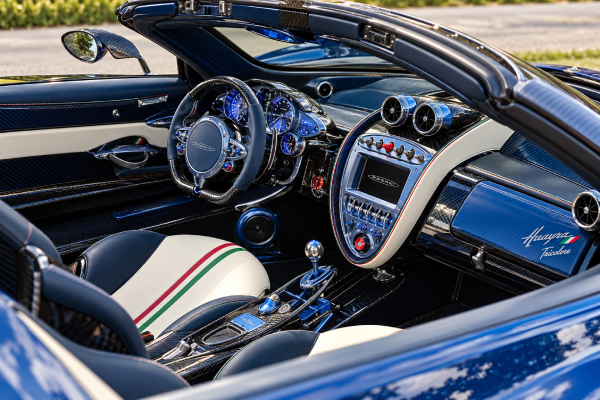
The Pagani Huayra Tricolore is not merely a Huayra with an Italian tricolor stripe. Built in only three examples to mark the 60th anniversary of the Frecce Tricolori, it translates aviation themes into both decoration and working hardware. A nose-mounted Pitot tube feeds an anemometer in the cabin, the body uses a more aggressive splitter, revised cooling extraction, a roof air scoop, an optimized diffuser, and a rear wing integrated into the engine cover, while the 5,980 cc twin-turbo V12 produces 840 hp and 1,100 Nm. Pagani also lightened the transmission hardware and used its Carbo-Titanium HP62 G2 and Carbo-Triax HP62 monocoque technology to keep dry weight to 1,270 kg. Because every example is highly bespoke and identified with a Frecce formation number, ownership depends as much on provenance and preservation as on mechanical health. This guide explains the Tricolore’s exact specification, its aviation-derived details, the systems that need careful maintenance, and the checks that matter when one of the three cars changes hands.
Table of Contents
- Three Cars, Three Formation Numbers
- Huayra Tricolore Specifications and Hardware
- Pitot Tube, Cooling, and Aerodynamic Design
- Lightweight Transmission and Chassis Engineering
- Aviation-Inspired Cabin, Livery, and Bespoke Details
- Preservation and Service Strategy for a Three-Car Model
- Provenance and Buying Checks for a Huayra Tricolore
Three Cars, Three Formation Numbers
The Huayra Tricolore exists because Pagani wanted to commemorate the Frecce Tricolori’s 60th anniversary in 2020, ten years after creating the Zonda Tricolore for the patrol’s 50th anniversary. Only three Huayra Tricolores were built, and each carries a number connected to a specific leadership role in the formation.
Those identifiers are 0, 1, and 10. Number 0 represents the commander, who directs the display from the ground. Number 1 represents the formation leader. Number 10 represents the solo pilot. On a normal limited-edition car, a plaque number mainly establishes production sequence. Here, the number is part of the design concept and should be traceable through exterior details, interior trim, factory records, and provenance.
The connection to the Frecce Tricolori is unusually specific. The patrol operates Aermacchi MB-339A P.A.N. aircraft, and Pagani referenced their shapes, instrumentation, colors, and visual language throughout the car. The translucent blue carbon body, tricolor graphics, wing supports, turbine-like wheels, anodized aluminum details, and cockpit hardware all contribute to the theme.
The original base price was €5.5 million plus VAT. That historical figure should not be confused with current market value, which depends on the exact car, transaction circumstances, provenance, condition, taxes, and whether all original components remain with the chassis. With only three cars, there is no broad transaction pool from which to derive a reliable generic market price.
The 2020–2022 scope in the assignment covers introduction and the period in which these cars entered private collections. An individual example may have a later registration date or a market-specific delivery history. As with other coachbuilt Pagani projects, the chassis file matters more than a conventional model-year convention.
The Tricolore also represents a point where Huayra engineering moved beyond a commemorative specification. Pagani did not simply borrow the Roadster BC’s mechanical package unchanged. The company described a revised V12 output, a lighter flywheel-clutch assembly, new bodywork, a different aero balance, and cabin instrumentation unique to the aviation theme. That makes the car technically distinct enough that replacement parts, software, body panels, or trim should not be assumed interchangeable with another Huayra simply because they appear similar.
Huayra Tricolore Specifications and Hardware
The Huayra Tricolore is a rear-wheel-drive, petrol-only hypercar with a 5,980 cc Mercedes-AMG-developed Pagani V12 and a seven-speed Xtrac automated manual. Its core numbers are 840 hp, 1,100 Nm, and 1,270 kg dry, but the aero and transmission details are equally important to understanding the model.
| Specification | Factory value |
|---|---|
| Engine | Pagani V12, 60-degree, 36-valve, twin-turbo |
| Engine family | Mercedes-AMG M158 architecture developed for Pagani |
| Displacement | 5,980 cc (6.0 L) |
| Maximum power | 618 kW (840 hp) at 5,900 rpm |
| Maximum torque | 1,100 Nm (811 lb-ft) from 2,000 to 5,600 rpm |
| Drive type | Rear-wheel drive |
| Specification | Configuration |
|---|---|
| Gearbox | Xtrac 7-speed transverse AMT |
| Differential | Electro-mechanical differential |
| Clutch assembly | Ultra-light tri-disc flywheel-clutch unit |
| Coupling | Racing-derived tripoid coupling system |
| Factory weight claim | Complete transmission system 35% lighter than a dual-clutch gearbox |
| Updated clutch-unit claim | 4 kg lighter than the preceding two-disc unit |
| Specification | Configuration |
|---|---|
| Monocoque | Carbo-Titanium HP62 G2 and Carbo-Triax HP62 |
| Subframes | Front and rear tubular steel |
| Dry weight | 1,270 kg (2,800 lb) |
| Suspension layout | Independent double wishbones in forged aluminum alloy |
| Damping | Electronically controlled coil springs and shock absorbers |
| Aero integration | Active suspension behavior coordinated with active aerodynamic functions |
| Component | Front | Rear |
|---|---|---|
| Brake discs | 398 × 36 mm carbon-ceramic | 380 × 34 mm carbon-ceramic |
| Calipers | 6-piston monobloc | 4-piston monobloc |
| Wheel diameter | 20 in | 21 in |
| Wheel construction | Monolithic forged aluminum alloy | Monolithic forged aluminum alloy |
| Tires | Pirelli P Zero Trofeo R 265/30 R20 | Pirelli P Zero Trofeo R 355/25 R21 |
| Item | Published detail |
|---|---|
| Production | 3 cars |
| Original base price | €5,500,000 plus VAT |
| Anniversary | 60 years of the Frecce Tricolori |
| Car numbers | 0, 1, and 10 |
| Central instrument theme | Anemometer linked to the external Pitot tube |
| Body finish theme | Translucent blue carbon with Italian tricolor graphics |
No public Pagani source provides a complete owner-level service schedule, fluid-capacity chart, or workshop torque list for the Tricolore. Those values should come from the documentation for the exact chassis rather than being borrowed from another M158-powered Huayra.
Pitot Tube, Cooling, and Aerodynamic Design
The Tricolore’s most recognizable technical detail is the Pitot tube in the center of the front hood, but the important engineering change is the entire airflow package around it. The car combines a more pronounced front splitter, revised front extraction, a roof air scoop, a new diffuser, and an integrated rear wing to increase performance while maintaining front-to-rear balance.
A Pitot tube measures dynamic air pressure and is a basic element of aircraft airspeed systems. On the Huayra Tricolore, the tube has a genuine display function: it feeds the dedicated anemometer in the center console. That does not mean the car’s primary electronic control systems depend on a single exposed tube the way a simplistic “aircraft technology” description might imply. Its role is best understood as functional instrumentation embedded in a commemorative design.
Because the tube protrudes into the airflow, it should be treated as delicate hardware. During washing, transport, cover installation, detailing, or service, it can be more vulnerable than a flush body surface. A bend, blockage, loose mounting, or contamination can affect the displayed reading and can also damage an irreplaceable model-specific detail.
The front splitter is more conventional in purpose but no less important. Pagani enlarged and reshaped it to increase front downforce. That creates a balance problem: if only the front gains aerodynamic load, the car can become too front-biased at speed. The integrated rear wing and revised diffuser help restore the pressure balance over the rear axle.
Cooling is part of the same system. The front bumper uses side extractors to improve intercooler heat exchange, while the roof-mounted air scoop channels more cold air toward the engine. On a twin-turbo car producing 840 hp, efficient heat rejection is not optional. Any protective film, repair material, debris, or aftermarket grille that restricts those openings deserves scrutiny.
The rear wing is integrated with the rear hood as one carbon-fiber assembly rather than presented as a generic bolt-on element. Its supports echo the tail fin of the MB-339A, and the outer surfaces carry the car’s identifying number in a style linked to the patrol aircraft. This is a good example of why cosmetic and structural authenticity are inseparable on the Tricolore: a damaged support is simultaneously an aero component, a bespoke carbon part, and an identity-bearing design feature.
Underbody condition is just as important as the visible surfaces. The diffuser has to extract air cleanly from beneath the car, so damage to the floor, missing fasteners, distorted strakes, or incorrect ride height can alter the intended flow. A pre-purchase inspection should put the car on an appropriate lift and examine the underside in strong light rather than evaluating only the show surfaces.
Lightweight Transmission and Chassis Engineering
The Tricolore’s engineering focus is not raw output alone; it is the way mass is removed from components that influence response. Pagani paired a 1,270 kg dry weight with a transmission architecture that it said was 35% lighter than a dual-clutch alternative, then reduced the flywheel-clutch assembly by another 4 kg versus the earlier two-disc design.
That choice affects how the car drives. A dual-clutch gearbox can overlap gear engagement and deliver nearly uninterrupted torque, but it adds hardware and mass. The Xtrac AMT uses one clutch and makes each shift a distinct mechanical event. The engine’s torque is interrupted, the next ratio is selected, and the clutch is re-engaged. At high load, this feels deliberate rather than seamless.
The lower rotating mass of the revised clutch assembly can improve response because the powertrain has less inertia to accelerate or decelerate during a shift. It also means driving technique matters. A slight throttle lift during an upshift can make road driving smoother, while constant creeping at partial clutch engagement creates unnecessary heat.
The transverse gearbox layout helps keep mass from extending farther rearward. Pagani specifically linked this packaging to lower polar inertia, the resistance of the car to changing its rotational motion around the vertical axis. In plain language, keeping heavy components close to the center can help the car change direction more readily.
The monocoque uses Carbo-Titanium HP62 G2 and Carbo-Triax HP62, materials developed to combine low mass with high stiffness and impact performance. The Tricolore’s open Huayra-derived architecture therefore depends on more than visible carbon bodywork. The structural composite is part of the safety cell, while tubular steel subframes carry major mechanical assemblies.
This matters after an impact. A scraped carbon panel may be cosmetic, but damage close to a suspension pickup, monocoque edge, subframe mount, or bonded joint requires specialist assessment. Conventional body-shop methods are not enough. A repair should be traceable to Pagani-approved processes and, where relevant, accompanied by dimensional checks and material documentation.
The electronic dampers and suspension geometry work with the chassis to control dive and roll. Because active aero also changes load with speed, an alignment that is “close enough” for ordinary use can still produce a different balance in fast driving. Factory ride height, sensor calibration, tire specification, and correct wheel dimensions are therefore part of the engineered system rather than cosmetic preferences.
Aviation-Inspired Cabin, Livery, and Bespoke Details
The Tricolore’s cabin is a major part of its authenticity, and replacing a damaged decorative item can be more complicated than replacing a mechanical consumable. Aerospace-grade aluminum, blue anodizing, special upholstery, composite floor mats, embroidered emblems, and the dedicated anemometer make the interior highly model-specific.
The gear knob is a useful example. Pagani machined it from a single block combining aluminum and carbon, using five-axis CNC work followed by hand finishing and a transparent treatment. An owner should not treat scratches, clouding, or coating wear the same way as ordinary polished metal. Aggressive refinishing could remove the original surface character and make the part less authentic even if it appears shinier.
The seat design uses white and blue as a reference to the earlier Zonda Tricolore, with red, white, and green details. Frecce Tricolori emblems appear on the four-point belt hardware and headrests. Any retrimming should reproduce the original stitch pattern, material, foam shape, embroidery, and color specification. A generic “close match” is a poor solution on a three-car model.
Outside, the translucent blue carbon finish is particularly sensitive to repair quality. Exposed weave, tint, clear coat, and adjacent tricolor graphics all have to line up visually across panel boundaries. A local repair that is structurally sound but slightly wrong in color or weave orientation may be obvious under sunlight and can complicate future authenticity certification.
The turbine-inspired wheels and anodized intake and headlamp frames are similarly easy to damage through routine servicing. Wheel mounting equipment should protect the finish, and any refinishing should preserve the original profile, markings, color, and surface treatment. Anodized components should not be polished as if they were bare aluminum because the anodic layer is part of the finish.
Cabin care should be conservative. Use products approved for the exact leather, textile, carbon, and coated metal. Test any cleaner on an inconspicuous area. Avoid saturating stitched or embroidered sections, and do not allow detailing products to enter the anemometer or switchgear.
The biggest preservation mistake is assuming rarity means the car should never move. Long inactivity can age tires, discharge batteries, allow seals to dry, and leave fuel and fluids sitting for extended periods. A well-planned drive cycle or a factory-guided storage program is better than occasional short starts that never warm the drivetrain fully.
Preservation and Service Strategy for a Three-Car Model
A Huayra Tricolore should be maintained around evidence and condition because there are too few cars to support meaningful “common problem” statistics. Every service event should create a record that makes the next diagnosis easier.
For routine ownership, the highest-value habits are straightforward:
- Keep chassis-specific service instructions, invoices, software records, and inspection photographs together.
- Maintain the 12-volt system with the approved charger and connection procedure.
- Track tire date codes, fitment dates, puncture history, and any circuit use rather than relying on tread depth alone.
- Measure carbon-ceramic brake wear using the approved method and record the results.
- Inspect the Pitot tube, splitter, floor, diffuser, wing, and active-aero hardware after transport or any low-speed contact.
- Keep the cooling paths free of insects, rubber, leaves, and detailing residue.
- Record clutch adaptation or condition data when gearbox behavior changes.
Before a serious road drive, the car should be checked for fluid leaks, tire pressure and condition, warning messages, aero function, brake feel, steering, and obvious underbody contact. Warm it progressively. High boost on cold oil and full-load braking on cold tires add stress without delivering the performance the car was designed to provide.
After track use, inspect before washing away evidence. Photograph tire surfaces, rubber pickup, wheel barrels, brake discs, splitter edges, floor contact, fluid traces, and exhaust heat effects. Record any change in shift timing, pedal feel, steering effort, or engine response while the driver’s memory is fresh.
Storage conditions matter as much as mileage. Stable temperature and humidity reduce condensation and finish movement. Tires should be protected from direct sunlight and chemical contamination. The car should not sit on a wet or dusty floor, and the cover should be clean, breathable as specified, and free from seams or grit that can mark the paint.
Pagani Puro is relevant when an owner wants factory-supported authenticity certification. Rinascimento provides a manufacturer-led conservation and restoration path, while Unico is the factory’s program for later customization and updating. Those programs matter because a three-car model can lose historical clarity quickly if changes are made without preserving the original configuration.
A good service file should therefore include not just “annual service completed” but component measurements, update descriptions, replaced-part numbers, photographs, and the reason for each intervention. That level of documentation turns future maintenance from detective work into a continuation of an established history.
Provenance and Buying Checks for a Huayra Tricolore
Buying a Huayra Tricolore is first an identity-verification exercise and only then a conventional vehicle inspection. With three cars, the buyer should be able to establish which numbered example is being offered, how it was originally configured, and whether every important change since delivery is documented.
Start with factory records. Match the chassis number, formation number, exterior carbon finish, tricolor graphics, wheel finish, interior colors, embroidery, belt hardware, anemometer, plaques, keys, luggage, covers, charger, manuals, and any presentation material. Photographs from delivery or factory events can help, but they should support—not replace—formal documentation.
The inspection should then establish mechanical readiness. Important areas include engine leaks and cooling, boost and stored faults, clutch engagement, AMT operation, differential behavior, active-aero calibration, damper function, ride height, alignment, brake wear, tire age, wheel damage, underbody condition, and evidence of composite repair.
The Pitot system deserves its own functional check. Confirm that the external tube is secure and undamaged, the connecting system has not been blocked or altered, and the cabin anemometer behaves normally. A fault here may not prevent the car from driving, but it affects one of the model’s defining features.
Bodywork needs expert lighting and close inspection. Look for mismatched weave, tint differences, sanding halos, edge repairs, lifting protective film, graphics disturbance, overspray on fasteners, and inconsistent panel gaps. Because the blue carbon finish is unusual, a repair that would be nearly invisible on painted bodywork may stand out clearly here.
Ask for transport records and details of public display use. Concours appearances, dealer showcases, and events can involve repeated loading, unloading, cold starts, cleaning, and temporary installation of display hardware. None of that is inherently damaging, but it should explain marks or service events rather than leave gaps in the history.
If the car has been modified, determine whether the work came through Pagani Unico or an independent party. Factory modifications can still change originality, but they are easier to trace. Independent software, exhaust, suspension, wheel, or body changes should be assessed for legality, safety, compatibility with aero calibration, and impact on Puro certification.
Legal due diligence is equally important. Verify title, taxes, export status, registration eligibility, insurance valuation, and any restrictions connected to the transaction. A car that is mechanically perfect but difficult to register or move between jurisdictions can become a costly administrative problem.
Finally, preserve all removed original components. On a mass-produced car, a replaced trim piece can often be sourced again. On a Huayra Tricolore, a numbered wing support, special wheel, anodized frame, embroidered interior piece, or model-specific instrument may be effectively unique. Ownership quality is therefore measured not just by how the car looks today, but by how completely its story can still be reconstructed.
A sensible acquisition also includes a controlled road evaluation after the static inspection. The objective is not to chase maximum acceleration, but to verify that the car behaves consistently as temperatures rise. Steering should remain centered, damping should not develop knocks, the gearbox should engage cleanly both cold and hot, brake feel should stay stable, and the cooling system should manage normal traffic without warnings. Cabin instruments—including the anemometer—should remain functional, and no new fault messages should appear after a complete ignition cycle. A short drive performed methodically can reveal issues that a concours-level visual presentation hides. The findings should then be tied back to diagnostic data and the service record before price or delivery terms are finalized.
References
- Huayra Tricolore | Pagani 2020
- The Pagani Huayra Tricolore | Pagani 2020
- Zonda Tricolore | Pagani 2010
- Pagani Puro | Pagani 2021
- Pagani Rinascimento | Pagani 2022
- Pagani Unico | Pagani 2022
Disclaimer
This article is for informational purposes only and is not a substitute for professional diagnosis, maintenance, or repair. Specifications, torque values, service intervals, software, and procedures can vary by VIN, market, and equipment; verify them against the official Pagani service documentation for the exact Huayra Tricolore.
If this guide was helpful, please share it on Facebook, X/Twitter, or with another collector or enthusiast to support our work.