
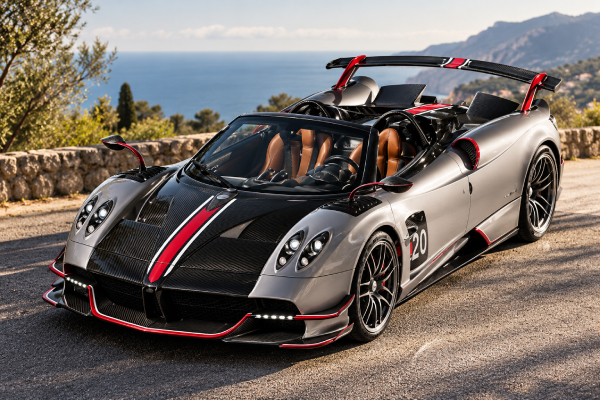
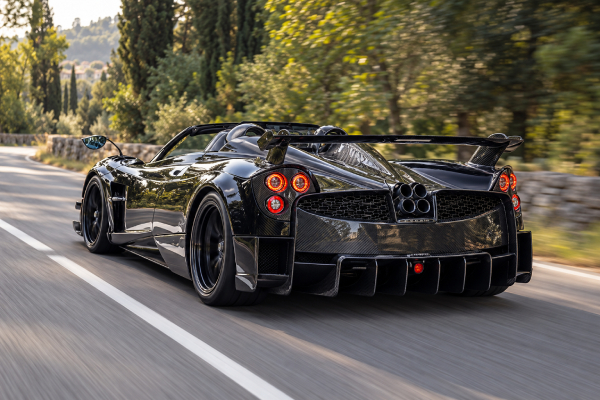
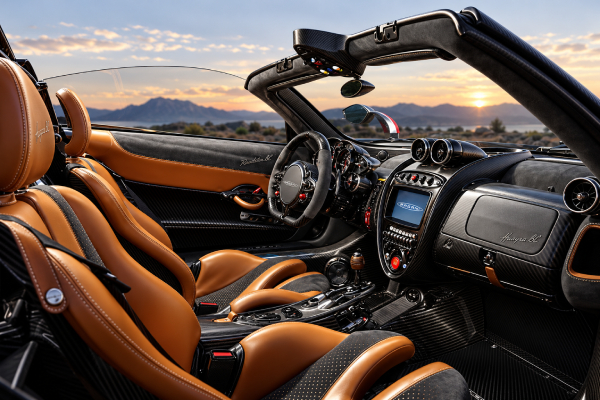
The Pagani Huayra Roadster BC is the rare case where removing the roof did not turn a high-performance coupé into a softer derivative. Developed as its own 40-car program, the Roadster BC uses a 5,980 cc twin-turbo V12, a seven-speed Xtrac automated manual, active aerodynamics, electronically controlled dampers, and a composite monocoque that Pagani engineered specifically for the open body. Factory figures include 590 kW of power, 1,050 Nm of torque, a 1,250 kg dry weight, and an aerodynamic target of 500 kg of downforce at 280 km/h. Those numbers matter, but the ownership story is equally important: this is a low-production car whose tires, carbon-ceramic brakes, clutch system, aero hardware, and provenance all deserve specialist attention. The guide below explains the Roadster BC as an integrated road-and-track machine, shows which specifications are factory-confirmed, and outlines how to inspect, operate, maintain, and buy one without treating rarity as a substitute for condition.
Table of Contents
- Roadster BC Model Scope and Production Context
- Roadster BC Technical Data and Factory Specifications
- How the Aero Package and Open Body Work Together
- V12, Xtrac Gearbox, and the Driving Character
- Grip, Brakes, and Chassis Control at High Load
- Maintenance for Road, Storage, and Track Use
- Buying a Huayra Roadster BC: Condition, History, and Authenticity
Roadster BC Model Scope and Production Context
The Roadster BC should be treated as a standalone Pagani model, not simply as an open Huayra BC. Pagani launched it in 2019 after a development program that began in 2017, limited production to 40 cars, and priced the car from €3.085 million plus VAT when new.
That distinction matters because nearly every major system was reconsidered around the roadster brief. The open structure uses Carbo-Titanium HP62 G2 and Carbo-Triax HP62, the engine received new turbochargers and intake hardware, the active aero was calibrated around an open cabin, and the suspension electronics were integrated with the aerodynamic controls. Pagani also developed a six-outlet titanium exhaust that does more than make noise: two additional outlets from the catalytic-converter area were used to support a blown-diffuser effect.
The production years in this article cover the 2019 introduction through the 2022 period in which customer cars were being delivered and the model remained part of the contemporary Huayra range. Individual cars can have different build, delivery, registration, and market dates, so a chassis number and factory build record are more reliable than an advertisement’s model-year label.
The Roadster BC also sits at an important point in Huayra development. It predates later Grandi Complicazioni cars such as the Tricolore, Codalunga, and Imola Roadster, but many themes that became more visible in those cars are already present here: advanced composite layups, high aero load without a fixed-roof race-car silhouette, close integration of suspension and aero, and a willingness to keep the single-clutch automated manual because of its low mass.
Pagani’s validation work is unusually relevant to understanding the car. The company reported more than 350,000 km of real-world development, including over 45,000 km on demanding circuits. In September 2020, the final validation phase at Spa-Francorchamps produced a 2:23.081 lap in damp conditions. That figure is best read as evidence of the development envelope rather than as an invitation to reproduce it on the road.
For owners and buyers, three facts follow from this background. First, the Roadster BC is designed for serious dynamic use, so track mileage is not automatically a negative. Second, the systems that make that performance possible are expensive and condition-sensitive. Third, low mileage alone does not prove excellent condition; heat cycles, age, storage quality, tire dates, software status, and service documentation are equally important.
Roadster BC Technical Data and Factory Specifications
The Huayra Roadster BC is an ICE, rear-wheel-drive hypercar with a longitudinal Mercedes-AMG-developed Pagani V12 and a transverse seven-speed Xtrac automated manual. The most useful factory data is concentrated around output, low mass, active aero, carbon-ceramic braking, and the staggered Pirelli tire package.
| Specification | Factory value |
|---|---|
| Engine | Pagani V12, 60-degree, 36-valve, twin-turbo |
| Engine family | Mercedes-AMG M158 architecture, developed for Pagani |
| Displacement | 5,980 cc (6.0 L) |
| Maximum power | 590 kW at 5,900 rpm |
| Maximum torque | 1,050 Nm (774 lb-ft) from 2,000 to 5,600 rpm |
| Induction | Twin turbochargers with four water-to-air intercoolers |
| Fuel | Premium unleaded petrol |
| Specification | Configuration |
|---|---|
| Drive type | Rear-wheel drive |
| Gearbox | Xtrac 7-speed transverse AMT |
| Clutch | Lightweight triple-disc clutch |
| Differential | Electro-mechanical differential |
| Transmission layout | Transverse gearbox behind the mid-mounted engine |
| Factory weight claim | Complete transmission system 35% lighter than a dual-clutch alternative |
| Specification | Factory value or configuration |
|---|---|
| Monocoque | Carbo-Titanium HP62 G2 and Carbo-Triax HP62 |
| Subframes | Front and rear tubular steel |
| Dry weight | 1,250 kg (2,756 lb) |
| Suspension | Forged-aluminum independent double wishbones |
| Dampers | Electronically controlled shock absorbers with coil springs |
| Aerodynamic load target | 500 kg (1,102 lb) at 280 km/h (174 mph) |
| Composite stiffness improvement | 12% torsional and 20% flexional increase versus Pagani’s prior benchmark |
| Component | Front | Rear |
|---|---|---|
| Brake discs | 398 × 36 mm carbon-ceramic | 380 × 34 mm carbon-ceramic |
| Calipers | 6-piston monobloc | 4-piston monobloc |
| Wheel diameter | 20 in | 21 in |
| Wheel construction | Forged APP aluminum alloy | Forged APP aluminum alloy |
| Tires | Pirelli P Zero Trofeo R 265/30 R20 | Pirelli P Zero Trofeo R 355/25 R21 |
| Item | Published figure |
|---|---|
| Production limit | 40 cars |
| Original base price | €3,085,000 plus VAT |
| Reported development distance | More than 350,000 km |
| Reported track-development distance | More than 45,000 km |
| Spa-Francorchamps validation lap | 2:23.081 in September 2020 |
| Published lateral acceleration | 1.9 g continuous, with peaks up to 2.2 g during development |
Pagani does not publish a conventional mass-market service manual or a complete public maintenance schedule for the Roadster BC. That is a reason to omit speculative fluid capacities, torque settings, or replacement intervals from a general guide and to use the chassis-specific factory documentation supplied with the car.
How the Aero Package and Open Body Work Together
The Roadster BC’s aerodynamic story is about balance rather than one giant wing. Pagani targeted 500 kg of aerodynamic load at 280 km/h while retaining road-usable ground clearance, which required the underbody, body outlets, active flaps, suspension, exhaust flow, and rear wing to work as one system.
At the front, the body has to solve two competing problems: create useful pressure differences for grip and feed enough cooling air to a high-output twin-turbo V12. Ducts and extractors route air through heat exchangers and then remove it without allowing the front axle to become light. At the rear, the body and diffuser manage the expanding underbody flow while the wing contributes to rear-axle load.
The active aerodynamic system is especially important because a fixed aero setup is always a compromise. At lower speed, a car may need stability and cooling without huge drag. Under braking, pitch changes the floor’s angle to the road. Through a fast corner, steering angle, lateral load, ride height, and body motion alter the pressure map. Pagani links active aero to the electronically controlled suspension so the car can respond to those changing conditions rather than relying only on static spring and damper settings.
The six-outlet exhaust adds another layer. Four outlets provide the familiar Pagani central-exhaust look, while two direct outlets from the catalytic-converter area were developed to energize flow around the diffuser. The practical lesson is that exhaust geometry on this car is not purely cosmetic. A non-factory exhaust can alter heat paths, noise, back pressure, emissions compliance, and the airflow environment the original aero package expected.
Open-body aerodynamics also affects the cabin. Air passing the windscreen and cockpit opening can disturb the flow reaching the rear body. That is one reason an open hypercar cannot simply reuse every aero assumption from a coupé. Windscreen height, mirror position, roof-off turbulence, seat location, and rear deck geometry all influence comfort and stability.
Owners should therefore treat body alignment as functional. A splitter repair, incorrectly fitted floor panel, damaged diffuser edge, missing fastener, or misadjusted active flap can alter performance even if the car still looks acceptable from standing height. After any underbody strike, transporter contact, wheel-off excursion, or body repair, the inspection should include the aero hardware and its calibration rather than stopping at paintwork.
Ride height deserves similar attention. The suspension and aero were developed together, so lowering the car for appearance can move the floor and diffuser away from the intended operating window. On a car capable of generating hundreds of kilograms of load, millimeters of ride-height change at speed are not just styling decisions.
V12, Xtrac Gearbox, and the Driving Character
The Roadster BC’s character comes from a high-torque V12 paired with a single-clutch automated manual, not from the seamlessness of a modern dual-clutch gearbox. The design favors low mass, compact packaging, and a more mechanical shift event.
The 5,980 cc engine produces its 1,050 Nm plateau from 2,000 to 5,600 rpm, so it does not need constant high revs to feel urgent. New turbochargers, twin throttle bodies, a hydroformed manifold, and four water-to-air intercoolers were part of the Roadster BC engine package. The broad torque curve means the driver can make substantial progress in a taller gear, which is useful on the road where traction and visibility often matter more than maximum acceleration.
The Xtrac transmission is transversely mounted and uses a triple-disc clutch plus an electro-mechanical differential. Pagani’s reason for keeping this architecture was not nostalgia. The company said the system was 35% lighter than a dual-clutch alternative, and placing the gearbox transversely helps centralize mass around the car’s center rather than extending it rearward.
The tradeoff is shift feel. An AMT opens the clutch, changes gear, and re-engages it, so torque interruption is part of the event. At full acceleration, the shift can feel dramatic; at low speed, poor throttle timing can make it abrupt. A driver who lifts slightly during an upshift can often make the process smoother because the clutch and engine are not fighting to exchange load at the same instant.
Creeping in traffic is less friendly to a single-clutch system than to a torque-converter automatic. The clutch may spend more time partially engaged, creating heat without covering much distance. On a steep garage ramp or transporter, the correct approach is deliberate: use the brake to hold the car, create a clear path, then make one controlled movement rather than balancing the vehicle on clutch slip.
The differential is another reason transmission condition matters. It has to manage more than 1,000 Nm through very wide rear tires, while the stability systems and active suspension are also trying to keep the chassis settled. Software, actuator calibration, clutch adaptation, and tire circumference all affect how naturally the system behaves.
A road test should therefore include more than hard acceleration. Check cold engagement, reverse selection, parking maneuvers, part-throttle upshifts, downshifts, manual paddle response, hot behavior, and warning history. Any clutch judder or delay should be interpreted with diagnostic data rather than guesswork because the fault could be mechanical, hydraulic, electronic, or adaptation-related.
Grip, Brakes, and Chassis Control at High Load
The Roadster BC’s tire, brake, suspension, and aero systems must be evaluated together because each changes the load seen by the others. Pagani reported 1.9 g of continuous lateral acceleration during development, peaks up to 2.2 g, and braking deceleration up to 2.2 g, figures that place unusual stress on consumables and mounting hardware.
The Pirelli P Zero Trofeo R package is staggered at 265/30 R20 front and 355/25 R21 rear. These are performance-focused tires, so age, heat history, storage temperature, puncture repair, and surface condition are as important as tread depth. A six-year-old tire with deep tread is not equivalent to a fresh one. Conversely, a recently fitted tire can still be unsuitable if it is the wrong specification, has been stored poorly, or has been overheated.
For road use, cold and wet conditions require restraint. A track-oriented tire can provide exceptional dry grip yet take longer to reach an effective operating temperature and have limited standing-water capability. Tire pressures should come from Pagani’s chassis-specific documentation, not from generic values copied from another Huayra.
The carbon-ceramic brake package uses 398 × 36 mm front discs with six-piston monobloc calipers and 380 × 34 mm rear discs with four-piston calipers. Carbon-ceramic discs tolerate extreme temperature but are not maintenance-free. Surface condition, thickness or wear measurement method, edge damage, impact marks, pad condition, and heat history all matter. A disc that looks clean can still be outside its approved wear criteria.
After circuit use, brake inspection should include the inside faces, not only the visible outer surface through the wheel. Caliper boots, pad retention hardware, brake lines, cooling ducts, and wheel barrels should also be checked. Gravel picked up during an off-track moment can damage a disc or become trapped around shielding.
The double-wishbone suspension and electronic dampers manage roll, squat, and dive while the active aero adds speed-dependent load. That means a worn damper, ride-height sensor error, bent arm, or alignment change can have a larger effect than the same defect would on a conventional road car. The vehicle may still feel fast while no longer matching its validated balance.
For owners who drive on circuit, baseline measurements are extremely valuable. Record alignment, ride height, corner condition, tire age, wheel condition, brake measurements, and relevant diagnostic values before the first event. Afterward, compare them rather than relying on memory. The car’s rarity makes this level of documentation useful for resale as well as safety.
Maintenance for Road, Storage, and Track Use
Roadster BC maintenance should be condition-led and factory-led, not based on generic supercar intervals. The most expensive mistakes usually come from deferred age-related work, undocumented track use, battery problems, incorrect lifting, or assumptions that low mileage means no service is needed.
Start with the basics that can be checked without inventing workshop specifications:
- Keep every factory service invoice, software-update record, campaign document, and diagnostic report with the chassis history.
- Record tire manufacturing dates, fitment dates, heat-intensive events, puncture repairs, and replacement reasons.
- Have carbon-ceramic discs and pads measured using Pagani/Brembo-approved criteria rather than visual judgment alone.
- Document clutch condition and adaptation values when the car receives transmission service or shows a change in engagement behavior.
- Inspect the front splitter, underfloor, diffuser, active-aero mechanisms, and mounting points after any contact with a ramp, curb, or transporter.
- Check cooling inlets and heat exchangers for debris because the V12 depends on several air and liquid cooling paths.
Battery care deserves more attention than it gets. Cars that sit for long periods can develop low-voltage faults that confuse control modules, interrupt actuator initialization, or shorten auxiliary-battery life. Use the approved maintainer and connection method. Do not assume that an aftermarket charger is safe simply because it has a low-current mode.
Storage should be dry, secure, temperature-stable, and spacious enough to open doors and inspect the body without contact. Avoid repeated cold starts solely to “circulate fluids.” If the engine never reaches stable operating temperature, short running can add condensation and fuel dilution without exercising the transmission, wheel bearings, brakes, steering, and suspension.
A better strategy is either proper storage or a complete drive cycle. When the car can be used legally and conditions are suitable, bring fluids and tires up to temperature progressively, operate the gearbox through its range, use the brakes enough to keep surfaces clean, and let the car cool in a controlled way afterward.
Track days require a separate pre- and post-event routine. Before driving, confirm tires, brake condition, wheel security, fluid levels, leaks, underbody integrity, aero operation, cooling, diagnostic status, and any factory-specific track preparation. After driving, record pressures and symptoms before they disappear, then inspect the car while evidence such as rubber pickup, fluid misting, heat discoloration, or fresh impacts is still visible.
Transportation can create its own damage. The Roadster BC is low and aerodynamically complex, so loading angles, tie-down locations, wheel-strapping methods, and clearance under the nose and diffuser must be planned. A specialist enclosed transporter is preferable to improvisation, especially when the route includes steep ramps.
Cosmetic care is also mechanical preservation on this car. Exposed carbon, painted composite panels, milled aluminum, leather, and carbo-wood can require different products. Aggressive polishing can change matte finishes; strong chemicals can stain anodized metal; pressure washing can drive water into seams or connectors. Preserve the original finish specification instead of applying one universal detailing process.
Buying a Huayra Roadster BC: Condition, History, and Authenticity
A Roadster BC purchase should be evaluated as a specific chassis with a documented life, not as one of “only 40” cars. Rarity supports collectability, but the strongest example is the one whose identity, specification, maintenance, and condition can be traced continuously.
Begin with the factory build sheet and chassis number. Confirm the original exterior finish, exposed-carbon configuration, interior materials, wheels, brake-caliper finish, luggage, covers, keys, tools, charger, books, plaques, and any bespoke components. A highly customized Pagani can be correct even when it differs from every press car, so factory records are more useful than visual comparison with online photographs.
Then establish the timeline. Important dates include build completion, first delivery, registration, warranty start, export or import, major service, tire changes, software updates, paint-protection-film installation, accident or cosmetic repair, and any use at factory or track events. Mileage should make sense against that record.
A pre-purchase inspection should be performed by Pagani or a specialist with access to appropriate diagnostic and factory information. At minimum, the inspection should cover:
- engine cold start, leaks, boost and cooling behavior;
- clutch engagement, gearbox actuation, differential, and stored transmission faults;
- active-aero operation and calibration;
- damper, ride-height, steering, and alignment condition;
- carbon-ceramic disc and pad measurements;
- tire specification, date codes, damage, and heat history;
- wheel cracks, repairs, or refinishing;
- composite structure, underbody, splitter, diffuser, and jacking areas;
- open-top seals, drains, trim, electronics, air conditioning, and supplied roof equipment;
- evidence of paintwork, carbon repair, or replacement body panels.
Track use should be investigated, not automatically penalized. A car with several documented circuit events, fresh approved consumables, and post-event inspections may be a safer purchase than a supposedly unused example with old tires, stale fluids, weak batteries, and no recent diagnostic record. The key is evidence.
Modifications require extra scrutiny. Pagani’s own Unico program provides a factory route for updating and personalizing existing cars, while Puro is designed to certify authenticity. A third-party exhaust, suspension change, software calibration, wheel change, or body alteration may affect emissions legality, aero balance, insurance, warranty support, and future certification even when the parts are beautifully made.
Insurance and logistics should be arranged before purchase closes. Confirm agreed value, geographic limits, transport cover, track exclusions, named repair facilities, and whether the policy pays for return to Pagani if a specialist repair is required. Customs, VAT, title, emissions compliance, and registration can be more complicated than the vehicle inspection when a car moves between jurisdictions.
Finally, budget for ownership rather than only acquisition. Tires, brake components, annual inspection, specialist transport, climate-controlled storage, insurance, paint and carbon care, and occasional factory work can be significant even when the car covers few miles. The Roadster BC is at its best when maintained as the 1,250 kg, aero-active, track-developed machine it was designed to be—not preserved so passively that age becomes its largest source of deterioration.
References
- Huayra Roadster BC | Pagani 2019
- PAGANI HUAYRA ROADSTER BC | Pagani 2019
- The Pagani Huayra Roadster BC sets a new lap record at Spa Francorchamps during the last days of its validation testing. | Pagani 2020
- Huayra Roadster | Pagani 2017
- Pagani Puro | Pagani 2021
- Pagani Unico | Pagani 2022
Disclaimer
This article is for informational purposes only and is not a substitute for professional diagnosis, maintenance, or repair. Specifications, torque values, service intervals, software, and procedures can vary by VIN, market, and equipment; verify all work against the official Pagani service documentation for the exact car.
If this guide was useful, please consider sharing it on Facebook, X/Twitter, or with another Pagani enthusiast to support our work.