
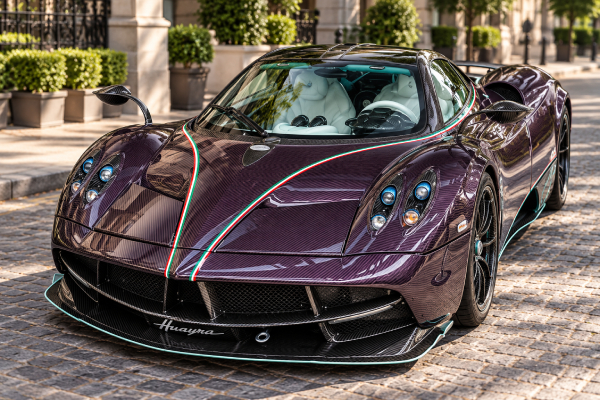
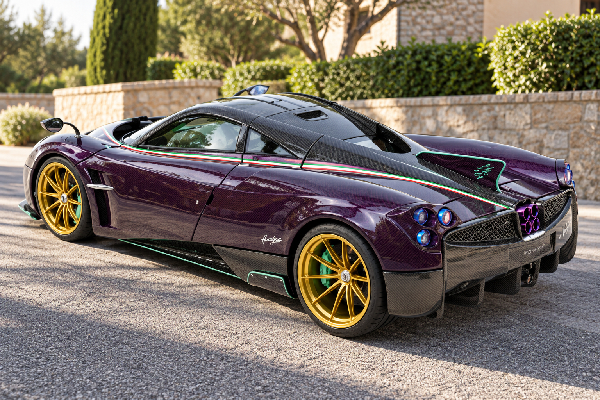
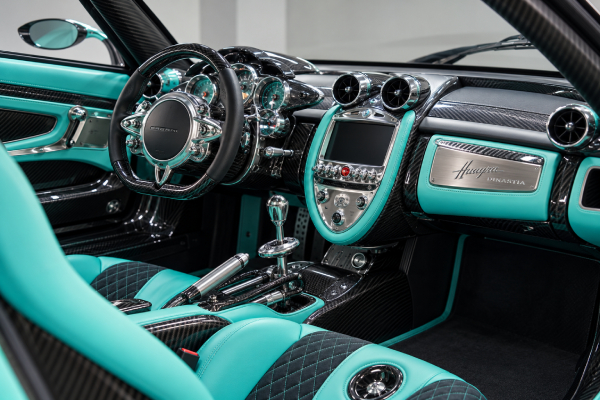
The Pagani Huayra Dinastia is best understood as a three-car factory commission rather than a conventional trim. Created for Greater China and unveiled as Pagani expanded its Asian presence, it combines the Huayra C9 platform with individual dragon-themed finishes, a documented 750 hp calibration, and body details that distinguish the cars from a standard early Huayra Coupé. That rarity changes the ownership question. On an ordinary performance car, condition can outweigh provenance; on a Dinastia, the exact factory specification, later Pagani upgrades, restoration history, and continuity of original components all matter at the same time. Buyers therefore need to evaluate two things in parallel: the mechanical health of a complex twin-turbo V12 hypercar and the authenticity of a hand-built collectible whose paint, carbon tint, embroidery, trim, and aero pieces may be unique to one chassis. The guide below focuses on what Pagani has publicly confirmed, what should be verified car by car, and how to preserve both performance and historical integrity.
Table of Contents
- Three Cars, One Dinastia Concept
- Dinastia Powertrain and Technical Data
- Dragon Design, Carbon, and Aero Details
- How the Dinastia Uses the Huayra Chassis
- Maintenance for a Low-Volume Collector Hypercar
- Authenticating a Dinastia Before Purchase
- Ownership, Value, and Long-Term Preservation
Three Cars, One Dinastia Concept
The defining fact is simple: Pagani announced only three Huayra Dinastia cars, created specifically for the Chinese market and tied to the opening of its first Asian showroom in Shanghai in October 2015. That makes the Dinastia a numbered concept in spirit, but not three identical copies of one specification.
Pagani linked the series to Chinese cultural imagery and to the number three. Its launch material says the design theme drew inspiration from the Nine Dragon Wall in Beijing’s Forbidden City. The blue carbon car shown in Shanghai represented Baxia, described by Pagani as a dragon associated with water. Its pale dragon graphic flowed over the blue-tinted carbon body, while gold-finished wheels and embroidered calligraphy carried the theme into the cabin.
A later Pagani publication from Taiwan added important mechanical and identity details. It described the Dinastia as a Greater China special edition, confirmed that output had been increased by 20 hp to 750 hp through ECU optimization, and showed two of the three cars together. It identified the blue car as Ba Xia and the purple car as Ya Zi, with the latter equipped with Huayra Tempesta components intended to improve aerodynamic performance. That matters to buyers because it proves that the three-car story was not frozen at the moment of the Shanghai unveiling. Individual cars could receive factory-approved development parts while remaining authentic Paganis.
The series therefore needs to be researched chassis by chassis. Color alone is not enough to establish identity, and online summaries do not always agree on the final color or configuration of the third car. The safest hierarchy is the car’s factory build record, original invoice, certificate and delivery documents, then later Pagani paperwork for any approved changes. Photographs are useful supporting evidence, especially period photographs, but they should not overrule factory documentation.
Production dates also require careful wording. The Dinastia debuted in late 2015 and the assignment spans 2015–2016, but a hand-built Pagani can have different dates for specification sign-off, completion, delivery, registration, and later upgrade work. A buyer should record each date separately rather than forcing the car into a normal mass-market “model year” framework.
| Item | Confirmed detail |
|---|---|
| Series size | Three cars |
| Market focus | China / Greater China |
| Public launch | Shanghai, October 17, 2015 |
| Design inspiration | Nine Dragon Wall, Forbidden City, Beijing |
| Blue car identity | Baxia / Ba Xia water-dragon theme |
| Purple car identity | Ya Zi, later shown with Tempesta components |
| Dinastia output | 750 hp after a 20 hp ECU optimization |
A three-car series also changes what “model history” means. There is no large population from which to infer a normal configuration, and even period photographs may show different moments in a single chassis’s evolution. Build records, delivery images, Pagani invoices, and dated event photography should be assembled into a timeline for each car. This is especially important for the Ya Zi example because Pagani later publicized it with Tempesta parts; the presence of factory-added aero should be dated rather than treated as proof that every Dinastia left the atelier with identical hardware.
Ownership geography can matter as well. Pagani used the Dinastia launch to mark its first Asian showroom in Shanghai and later displayed two of the three cars at the opening of its Kaohsiung center. Those events connect the cars to specific milestones in Pagani’s regional expansion. For a collector, retaining invitations, delivery material, event photographs, market-specific documents, and correspondence can therefore add historical context that a normal service booklet cannot capture. The documentation should remain with the chassis and be digitized before fragile originals are handled repeatedly.
Dinastia Powertrain and Technical Data
The Dinastia remains an internal-combustion Huayra: a rear-wheel-drive, mid-engine C9 coupé built around the Mercedes-AMG M158 5,980 cc twin-turbo V12 and Pagani’s seven-speed automated manual transaxle. The important Dinastia-specific mechanical fact is the factory-published 750 hp ECU calibration; other figures should be separated from standard-Huayra reference data unless the individual car’s records confirm them.
| Specification | Value | Context |
|---|---|---|
| Engine family | Mercedes-AMG M158 | Huayra-specific twin-turbo V12 |
| Displacement | 5,980 cc (6.0 L) | Shared C9 Huayra architecture |
| Induction | Twin turbochargers | Gasoline internal-combustion engine |
| Dinastia output | 750 hp | Pagani states a 20 hp increase through ECU optimization |
| Engine position | Longitudinal mid-engine | Behind the passenger cell |
| Driven wheels | Rear | Huayra C9 layout |
The standard Huayra page remains useful for understanding the hardware under the Dinastia. Pagani lists the regular Huayra at 730 hp at 5,800 rpm and 1,000 Nm from 2,600 to 4,200 rpm. Because the Dinastia publication confirms the power change but does not publish a revised torque curve, it is better not to present 1,000 Nm as a verified Dinastia-specific torque figure. A factory engine record or later dyno documentation supplied by Pagani is the correct source if exact calibration details matter for a particular chassis.
| System | Configuration |
|---|---|
| Gearbox | Seven-speed transverse sequential automated manual |
| Shift operation | Electro-hydraulic automated manual with driver programs and paddle control |
| Aerodynamic control | Four independently operated active flaps on the Huayra body |
| Front chassis control | Active front suspension works with the aero strategy |
| Primary structure | Pagani composite monocoque with carbon-titanium construction |
For the Dinastia itself, the most useful factory technical record is unusually narrow: Pagani confirms the 750 hp calibration and the C9 foundation, but its public Dinastia announcements do not publish a Dinastia-specific torque curve, dry weight, dimensions, 0–100 km/h time, or top speed. Those omissions should stay omissions. Using standard Huayra values to fill the gaps would make a table look complete while weakening its accuracy for a three-car bespoke series.
| Item | Verified Dinastia detail |
|---|---|
| Global debut | Shanghai, October 17, 2015 |
| Production | 3 cars worldwide |
| Original market description | China-only special edition; later Pagani Taiwan material describes the series for Greater China |
| Design inspiration | Nine Dragon Wall in Beijing’s Forbidden City |
| Published output | 750 hp after a 20 hp increase through ECU optimization |
| Baxia car | Blue carbon, white flying-dragon artwork, gold wheel details, and Baxia seat embroidery |
| Ya Zi car | Purple Dinastia shown in Taiwan with Pagani Tempesta aerodynamic parts |
The difference between “China-only” in the 2015 launch material and “Greater China” in the later Taiwan announcement is a useful provenance clue rather than a contradiction to erase. It shows how Pagani presented the same three-car program as its Asian retail network expanded. When researching an individual Dinastia, note which event, market document, and point in the car’s life a description comes from. A later Taiwan specification can legitimately include factory work that was not present in a Shanghai launch photograph.
The same discipline applies to performance claims. Pagani’s Dinastia releases do not provide an official special-edition acceleration time or maximum speed, and they do not state that the 20 hp ECU change altered peak torque. Secondary figures can easily blend the standard Huayra, a later Tempesta-equipped car, or another owner configuration. For insurance, sale documentation, or concours research, use the Dinastia publication for what it actually confirms and the chassis file for everything more specific.
Dragon Design, Carbon, and Aero Details
The Dinastia’s most valuable “specification” may be its exact visual configuration, because the series was conceived around individual artwork and colored carbon rather than a single catalog paint code. Repairs that look cosmetically acceptable can still reduce historical integrity if the tint, weave visibility, graphic position, or finish no longer matches the factory record.
The blue Baxia car illustrates the approach. Pagani’s Shanghai material describes blue carbon, a white flying-dragon graphic on the front bodywork, gold wheel hubs, and Baxia calligraphy embroidered into the seats. These details were not generic accessories. They formed the identity of that individual commission and should be treated like matching-number components on an older competition car.
Dinastia bodywork also needs to be separated from decoration. Period imagery and factory material show additional aerodynamic styling compared with a basic Huayra, including a prominent central rear fin and more aggressive lower-body treatment. On the purple Ya Zi car, Pagani later stated that Tempesta parts had been fitted to upgrade aerodynamic performance. That means a buyer cannot simply compare two Dinastias and decide one is “wrong” because their aero packages differ. Factory chronology matters.
Colored exposed carbon is especially difficult to repair well. A local clear-coat repair can change depth, gloss, and the way the weave reads under sunlight. Sand-through at an edge can damage the tint layer or carbon surface. Replacement panels may be structurally correct yet visually wrong if their weave orientation or resin color differs from the original. Before any refinishing, photograph the panel in diffuse light and direct light, document the weave direction, measure graphic placement, and confirm whether Pagani recommends repair or replacement.
The same care applies to anodized and machined hardware. Pagani interiors deliberately expose mechanical-looking components, fasteners, switchgear, and metal finishes. Harsh polishing can round edges or alter the original surface. Re-trimming a seat in material that merely looks similar can erase the specific embroidery, stitch pattern, perforation, or leather treatment that identifies the car.
| Area | What should match the factory record |
|---|---|
| Exterior carbon | Color tint, weave orientation, gloss level, panel identity |
| Dragon artwork | Graphic design, position, color, and panel continuity |
| Wheels | Design, finish, serial or part identification, period configuration |
| Cabin | Leather, stitching, embroidery, carbon tint, metal finishes |
| Aerodynamics | Original Dinastia pieces plus documented Pagani upgrades |
| Engine software | Factory 750 hp calibration or documented later Pagani state |
How the Dinastia Uses the Huayra Chassis
The Dinastia’s driving character is rooted in the original Huayra’s unusual combination of high torque, low mass, an automated single-clutch gearbox, and active aerodynamics. The result is not the seamless behavior of a modern dual-clutch supercar; its appeal comes from mechanical event, throttle response, chassis communication, and the way the car actively manages airflow.
Pagani designed four active flaps into the Huayra body, two at the front and two at the rear. They move independently according to the car’s dynamic needs. The front suspension also participates in controlling attitude. In practical terms, that allows the Huayra to alter aerodynamic balance during braking, cornering, and acceleration rather than relying only on a fixed wing setting.
The seven-speed automated manual is equally important to the experience. It is fundamentally a single-clutch sequential transmission, chosen partly because a heavier dual-clutch unit would have added mass. Shifts are therefore more physical than in many later hypercars. A clean, well-calibrated system should make deliberate shifts rather than feel random or excessively harsh. During a pre-purchase drive, inconsistent engagement, unexpected warning messages, repeated failed gear selections, or a clutch that behaves differently hot versus cold deserves specialist diagnosis rather than assumption.
The M158 V12 was engineered by Mercedes-AMG specifically for the Huayra program. Pagani emphasized a linear torque delivery and reduced turbo lag because abrupt boost in a powerful rear-drive mid-engine car can make traction management difficult. The Dinastia’s 750 hp calibration increases the headline output, but the more important ownership question is whether the engine-management state is factory documented and whether boost, cooling, fuel delivery, and exhaust hardware remain consistent with that software.
Tires are a major part of the chassis. Pagani worked with Pirelli on the Huayra, and a collector car that has covered few miles can still be unsafe if its tires are old, heat-cycled, flat-spotted, or hardened. Matching model names on the sidewall are not enough; check production date codes, correct Pagani homologation markings where applicable, size, load and speed ratings, and any record of storage conditions.
A Dinastia should also be evaluated in the context of how it will be used. A car intended for static display needs careful fluid, seal, battery, and tire management. A car that will be driven needs regular exercise and a maintenance plan that brings every system to operating temperature. Neither extreme—constant hard use or indefinite storage—is automatically best for a complex low-volume machine.
Maintenance for a Low-Volume Collector Hypercar
Maintenance should follow the individual Pagani service documentation, not a generic Huayra internet schedule. Public factory material does not provide a complete owner-level service table for Dinastia cars, and exact fluids, quantities, torque values, software procedures, and intervals can change with VIN, market, and factory upgrades.
For this model, condition-based inspection is especially important because elapsed time can matter as much as mileage. A car driven 500 km in five years may have less brake wear than a touring car, but it can have older fuel, a weak battery, dried seals, tire flat spots, corrosion at electrical connections, or sticky hydraulic components. Service history should therefore show what was inspected and replaced, not merely an odometer reading and invoice total.
A sensible annual or pre-season review by an authorized or highly experienced Pagani specialist should pay attention to:
- engine oil condition and evidence of fuel dilution or contamination;
- coolant level, hose condition, radiator cleanliness, and signs of dried coolant residue;
- turbocharger oil and coolant lines, charge plumbing, and clamps;
- automated-manual hydraulic operation, clutch behavior, and stored fault codes;
- suspension joints, dampers, ride-height or active-control functions, and alignment evidence;
- carbon-ceramic brake-disc condition, pad wear, caliper seals, and brake-fluid age;
- tire age, pressure history, flat spotting, sidewall condition, and homologation markings;
- battery health, charging behavior, tender compatibility, and low-voltage fault history;
- active-aero operation and panel/flap alignment;
- underbody, splitter, diffuser, and exposed carbon for impact damage.
Low battery voltage can create misleading symptoms on electronically controlled exotics. Before diagnosing a major fault, a specialist should confirm battery state, charging voltage, and stored fault history. Repeated jump-starting is not a good storage strategy, and using an unsuitable charger can be risky on a car with sensitive electronics.
Fuel age deserves similar attention. Long-term storage with untreated or unsuitable fuel can create starting, injector, pump, and combustion-quality problems. Owners who drive only a few times a year should discuss storage fuel strategy with the servicing Pagani center rather than improvising additives or draining procedures.
The body requires its own maintenance plan. Exposed and tinted carbon should be washed with non-abrasive products, dried carefully around vents and fasteners, and protected from careless machine polishing. Paint-protection film can be useful, but the installation should respect panel edges, removable aero pieces, graphics, and existing finishes. If older film is present, removal risk should be assessed before pulling it from rare graphics or repaired clear coat.
Finally, every intervention should be documented. Keep dated photographs before and after work, parts invoices, software printouts, alignment reports, tire records, and correspondence describing any factory-approved change. For a three-car series, that paper trail can be nearly as important as the physical component.
Authenticating a Dinastia Before Purchase
A Dinastia purchase should begin with identity verification before condition inspection. Confirm that the chassis is recognized by Pagani as one of the three Dinastia commissions, then determine its original specification and every subsequent factory-authorized change.
Pagani’s Puro program is particularly relevant. The company describes Puro as an authenticity certification process based on the history stored in its records and more than 400 checks by trained professionals. For a car this rare, a current Puro review can help answer questions that an auction catalog cannot: whether major components correspond to factory records, whether later parts were supplied through approved channels, and whether the car’s current appearance reflects an authorized evolution.
A thorough pre-purchase inspection should still be independent in purpose. Certification establishes authenticity; mechanical inspection establishes present condition. The two overlap, but they are not identical.
| Priority | Evidence to obtain | Why it matters |
|---|---|---|
| Chassis identity | VIN, factory build record, delivery documentation | Confirms the car is one of the Dinastia commissions |
| Current specification | Pagani invoices, Puro findings, upgrade records | Separates authorized evolution from undocumented modification |
| Carbon body | Paint-depth context, repair photos, panel inspection | Rare tinted carbon is costly and difficult to reproduce faithfully |
| Powertrain | Diagnostic scan, service history, leak inspection, road test | Confirms health of the M158 and AMT systems |
| Aero systems | Functional test, alignment, fault history | Active flaps are part of the Huayra’s dynamic control strategy |
| Consumables | Tire dates, brake measurements, battery and fluid records | Low mileage does not prevent age-related deterioration |
Watch for gaps between a seller’s wording and the paperwork. “Factory style,” “period correct,” “upgraded to later specification,” and “refreshed” can each describe legitimate work or non-original changes. Ask who performed the work, when, to which Pagani part number or specification, and whether the change appears in the manufacturer’s records.
The same discipline applies to accident history. A repaired carbon panel is not automatically disqualifying if Pagani or a qualified specialist carried out the repair correctly, but the scale and method should be known. Structural composite work, replaced subframes, repaired mounting points, and extensive repainting deserve more scrutiny than a replaceable lower splitter.
Ownership, Value, and Long-Term Preservation
The best Dinastia to buy is not necessarily the one with the lowest odometer reading; it is the one whose identity, condition, and history are easiest to prove. For a three-car series, undocumented originality problems can matter more than modest mileage, while sympathetic factory upgrades may be entirely legitimate when their provenance is clear.
Pagani itself recognizes several different paths for older cars. Puro focuses on authenticity certification. Rinascimento is aimed at restoration and preservation, using original drawings and materials to return a car toward its original condition. Unico takes the opposite creative direction by allowing a customer to update and personalize an existing Pagani, including mechanical and aerodynamic changes. These programs are useful because they create a language for understanding what a car has become.
That distinction should influence valuation. An untouched Dinastia with complete documentation may appeal to a buyer prioritizing historical purity. A Dinastia restored through Pagani may have stronger condition but a different conservation story. A car transformed through Unico can be authentic to Pagani yet no longer match its delivery configuration. None of those states should be described with the same shorthand word “original.”
Insurance should reflect the exact car, not a generic Huayra database entry. Agreed-value coverage, specialist repair authorization, transport terms, spare-parts sourcing, and geographic restrictions deserve review. The policy should also address the real replacement difficulty of unique carbon graphics, bespoke trim, and model-specific parts.
Storage requires similar specificity. Stable temperature and humidity, tire management, battery conditioning, protection from ultraviolet exposure, and careful pest control are basic requirements. The car should be stored clean and dry, with no cover material likely to abrade exposed carbon. If it is started, it should be used according to a specialist-approved routine; repeated short idling sessions that never fully warm the engine and exhaust can be worse than leaving the car correctly stored.
For owners who intend to drive, preservation does not mean avoiding the road. A properly serviced Huayra is engineered to operate dynamically. The key is to warm fluids, use suitable tires, avoid debris-heavy routes when possible, allow brakes and drivetrain to cool after demanding use, and record meaningful events in the history file. A Dinastia with documented, careful use can tell a clearer mechanical story than a static car with long maintenance gaps.
The central buying principle is provenance with context. Confirm what the car was when delivered, what Pagani changed later, what has been repaired, and what remains consumable or time-sensitive today. That approach protects both the experience of driving a 750 hp V12 Huayra and the cultural identity that makes the Dinastia more than a standard C9 in a rare color.
References
- FIRST PAGANI SHOWROOM IN ASIA | Pagani 2015
- PAGANI BUILDS ITS LARGEST ASIAN CENTRE IN SOUTHERN TAIWAN | Pagani 2016
- Huayra | Pagani 2011
- “Pagani Puro”, the program created to certify the authenticity and enhance the value of our exclusive cars over time | Pagani 2021
- Pagani Rinascimento | Pagani 2022
- Pagani Unico | Pagani 2022
Disclaimer
Nothing in this Dinastia overview should be treated as a repair instruction. It is informational material, while diagnosis and repair belong with qualified professionals. Before work begins, establish the car’s VIN, delivery market, equipment, and present factory configuration; those details can change the correct specification, torque setting, service interval, or procedure. Use the official Pagani service documentation for that chassis as the controlling technical source.
If the Dinastia provenance research proved useful, consider sharing the article on Facebook, X/Twitter, or a specialist enthusiast community.