
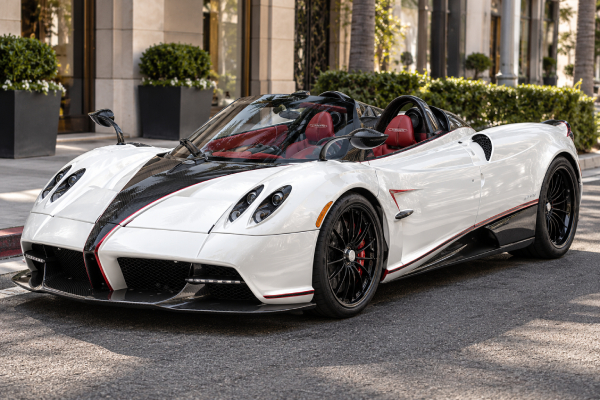
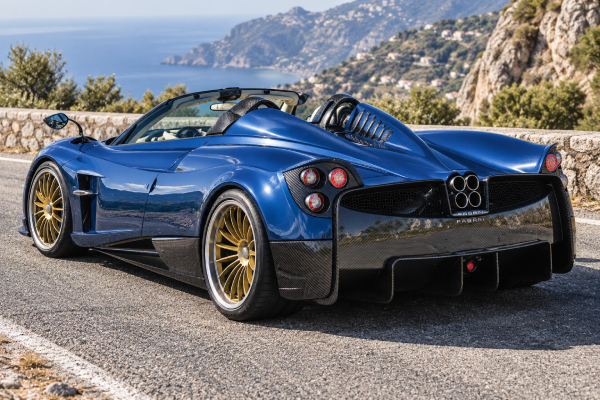
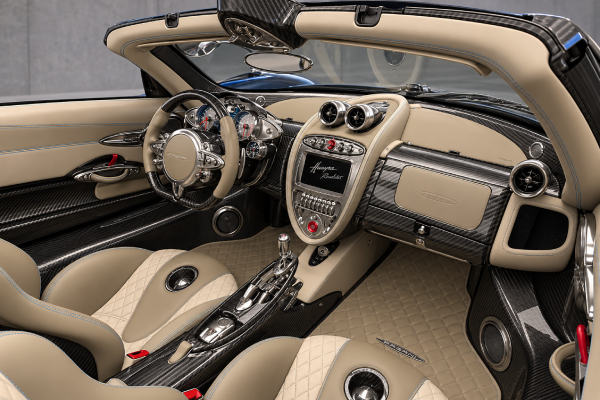
The Pagani Huayra Roadster is unusual even by hypercar standards because opening the roof did not make it heavier. Pagani spent six years reworking the C9 platform, combined Carbo-Titanium with Carbo-Triax HP52, adopted hardware developed through the Huayra BC program, and published a 1,280 kg weight—80 kg below the original Coupé figure cited by the factory in later historical material. The result pairs open-air theater with a 5,980 cc AMG twin-turbo V12 producing 764 hp and 1,000 Nm, a seven-speed automated manual, rear-wheel drive, active aerodynamics, and a production run limited to 100 cars. Those facts make the Roadster easy to identify on paper but harder to evaluate in the market. Roof equipment, factory specification, service continuity, composite condition, tire age, and documented updates all matter. This guide focuses on the standard Huayra Roadster, not the later Roadster BC, and separates verified factory data from the practical checks that determine whether an individual car is ready to drive, tour, or collect.
Table of Contents
- 100 Build Slots and the Roadster’s Identity
- Factory Data for the 764 hp C9 Roadster
- How Pagani Made the Open Car Lighter
- V12, Active Aero, and Open-Top Driving
- Two Roofs and the Realities of Touring
- Condition-First Service, Storage, and Purchase Checks
100 Build Slots and the Roadster’s Identity
The standard Huayra Roadster is a 100-car open version of the C9 Huayra, but it is better understood as a substantial engineering revision than as a roof-delete derivative. Pagani described the project as a six-year effort and later emphasized that it became the rare roadster that weighed less than the coupé from which it evolved.
That distinction matters because several later open Huayras can be confused with it in listings, social media, or casual conversation. The standard Roadster covered here has the 764 hp AMG V12 specification, a 1,280 kg published weight, 20-inch front and 21-inch rear wheels, and the next-generation seven-speed AMT. The Huayra Roadster BC is a different model with its own monocoque formulas, bodywork, output, production run, and track-focused development. A standard Roadster that has received later Pagani work should be described by its documented configuration rather than relabeled as another model.
Production history also deserves precision. Pagani announced that only 100 Roadsters would be built, and by early 2018 the company said the entire run was already sold out while production was ramping up. The years in this article—2017 through 2020—are therefore useful for identifying the broad production era, but they should not substitute for a chassis-specific chronology. On a hand-built car, the date a specification was finalized, the build date, delivery date, registration date, and dates of later factory work can differ.
Customization makes visual identification even less reliable. Paint, exposed-carbon patterns, upholstery, stitching, metal finishes, wheels, and personalized details were part of Pagani’s customer process. A rare color combination may be original; an apparently conservative car may have been retrimmed or reconfigured later. For buying or insuring one, obtain the original build specification and compare it with the car as it sits today.
The Roadster’s engineering lineage is clearer than its cosmetics. Pagani openly stated that technology developed for the Huayra BC was incorporated into the open car. That helps explain why the Roadster arrived with a lighter structure, a more advanced material mix, the later AMT architecture, and suspension hardware intended to preserve control despite losing a fixed roof. It is not a BC in softer clothes, but it benefited from the same period of development.
A useful way to frame the model is therefore as a bridge. It retains the recognizable Huayra ingredients—AMG V12, rear-wheel drive, active aero flaps, single-clutch automated transmission, intricate exposed mechanisms, and grand-touring intent—while pushing composite construction and weight reduction further. For an owner, the consequence is that authenticity depends on more than matching a paint code. The car’s structure, roof equipment, drivetrain software, service history, and factory interventions are all part of its identity.
Factory Data for the 764 hp C9 Roadster
The Huayra Roadster is an ICE hypercar with a mid-mounted 5,980 cc Mercedes-AMG twin-turbo V12, rear-wheel drive, and a seven-speed automated manual transmission. Pagani’s model page publishes 561 kW (764 hp) at 5,500 rpm, 1,000 Nm from 2,300 to 4,300 rpm, and a 1,280 kg vehicle weight; those are the appropriate baseline figures for the standard Roadster.
| Specification | Factory value |
|---|---|
| Engine | Mercedes-Benz AMG V12, 60°, 36 valves |
| Displacement | 5,980 cc (6.0 L) |
| Induction | Twin turbochargers |
| Maximum power | 561 kW (764 hp) at 5,500 rpm |
| Maximum torque | 1,000 Nm (738 lb-ft) from 2,300 to 4,300 rpm |
| Engine position | Longitudinal mid-engine |
| Driven wheels | Rear-wheel drive |
| Component | Factory specification |
|---|---|
| Transmission type | Next-generation automated manual transmission |
| Forward ratios | 7 |
| Reverse | Included |
| Differential | Electronic mechanical differential |
| Shift actuation | Electro-hydraulic |
| Synchronizers | Carbon-fiber design developed for the later Huayra transmission architecture |
| Area | Factory specification |
|---|---|
| Monocoque | Pagani Carbo-Titanium and Carbo-Triax HP52 |
| Front and rear structures | Steel tube frames |
| Suspension layout | Four-wheel independent double wishbone |
| Upper suspension hardware | HiForg forged and CNC-machined arms |
| Uprights | Forged and machined |
| Published vehicle weight | 1,280 kg (2,822 lb) |
| Position | Factory hardware |
|---|---|
| Front discs | Brembo CCM ventilated, 380 × 34 mm |
| Front calipers | 6-piston monolithic |
| Rear discs | Brembo CCM ventilated, 380 × 34 mm |
| Rear calipers | 4-piston monolithic |
| Item | Factory specification |
|---|---|
| Front wheels | 20-inch forged aluminum alloy APP monolithic |
| Rear wheels | 21-inch forged aluminum alloy APP monolithic |
| Road-focused tire family | Pirelli P Zero Corsa |
| Track-focused tire family | Pirelli P Zero Trofeo R |
These factory values are more useful than internet performance estimates because Pagani does not publish every acceleration, top-speed, fluid-capacity, alignment, or service value on the public model page. Missing workshop data should remain missing in a general article rather than being borrowed from another Huayra. For servicing, wheel fastening, alignment, fluids, software procedures, or component tolerances, use the VIN-specific Pagani documentation and current authorized-service information.
The 764 hp figure also prevents a common classification error. Later Huayras received different calibrations and factory upgrades, and current Pagani displays sometimes feature older cars that have been updated. A present-day photographed Roadster may therefore not represent the launch specification. When documenting a particular chassis, distinguish its original build from any later Pagani-authorized modifications.
How Pagani Made the Open Car Lighter
Pagani’s biggest Roadster achievement was structural: it removed the fixed roof while reducing mass instead of adding reinforcement weight. The company credits a redesigned composite monocoque and technology developed through the BC program, later describing the Roadster as 80 kg lighter than the Coupé and 52 percent more rigid in its historical material.
That result starts with materials rather than a simple brace. Carbo-Titanium combines carbon-fiber composites with titanium elements, while Carbo-Triax HP52 added a triaxial carbon-fiber architecture to the Roadster’s monocoque. The purpose was not merely to make a marketing-grade exotic material. An open car has to control bending and torsional loads around a cabin that no longer has a permanent roof closing the structure. The material system and layup therefore become central to both stiffness and crash structure.
The suspension was part of the same mass-and-response program. Pagani specifies forged HiForg arms and forged uprights with a double-wishbone layout. Reducing mass in suspension components is especially valuable because some of it is unsprung or closely tied to wheel control. Less inertia allows the damper, spring, tire, and steering system to manage road inputs with less resistance, which can improve the sense of precision without relying only on very high spring rates.
The Roadster also inherited the newer seven-speed AMT concept developed through the BC. A single-clutch automated manual can feel more mechanical than a modern dual-clutch gearbox, but the architecture aligns with Pagani’s packaging and weight priorities. The transverse gearbox layout concentrates mass close to the vehicle’s center, and the electro-hydraulic system handles clutch and gear selection while the driver uses paddles. In practice, it should be judged as an intentional part of the car rather than criticized for not imitating a torque-converter automatic.
Structural condition is consequently a first-order ownership issue. Exposed carbon can make surface damage visible, but not every important area is easy to inspect. A pre-purchase examination should look underneath the car, at jacking and lifting points, around suspension pickups, at floor and diffuser interfaces, and wherever prior repairs could have disturbed bonded or composite structures. Paint or clearcoat perfection is not proof that the underlying structure has never been affected.
Repair quality matters more than the mere fact of repair. A documented factory or specialist repair following Pagani procedures can be preferable to an untouched-looking panel with hidden damage. Ask for before-and-after photographs, invoices, replaced-part numbers, and any factory correspondence. If a carbon component was refinished only for cosmetic reasons, the record should say so. On a 100-car model with highly visible weave and personalized finishes, an unexplained change in carbon pattern or clearcoat can become both a technical and provenance question.
The lighter-than-coupé achievement also changes how mileage should be interpreted. This was engineered as a road car, not a static sculpture. A carefully used example with consistent service, correct tires, and documented wear may preserve the qualities Pagani designed more faithfully than a nearly unused car that has spent years on old tires, stale fluids, and an intermittently charged battery. Weight and stiffness are engineering advantages only when the hardware attached to the monocoque remains healthy.
V12, Active Aero, and Open-Top Driving
The Roadster’s character comes from the interaction of its 1,000 Nm V12, low mass, AMT, and active aerodynamics rather than from the power number alone. With the roof removed, the driver also receives more intake, turbocharger, exhaust, and mechanical sound, so small changes in throttle and gear choice feel more dramatic than they do on paper.
The M158’s broad torque plateau—from 2,300 to 4,300 rpm in Pagani’s published data—means the car does not need constant high-rpm operation to accelerate hard. That is useful on real roads, where measured throttle application matters more than chasing a maximum-speed number. The rear tires must transmit a large torque load, and tire temperature, age, road surface, steering angle, and electronic-control status all affect how usable that performance is.
The AMT reinforces deliberate driving. At parking speeds, avoid holding the car on the throttle against clutch slip; use the brake and allow the system to engage cleanly. During normal shifts, smooth pedal inputs help the electro-hydraulic system complete the event without unnecessary clutch work. At higher load, the shift has a more physical rhythm than a seamless dual-clutch unit. That sensation is part of the car’s design, but shuddering, repeated engagement faults, abnormal noises, or warning messages are not features and should be diagnosed.
Active aerodynamics add another layer. The Huayra family uses movable flaps to influence aerodynamic balance, and the Roadster retained that approach while Pagani reworked the open body’s airflow. Their condition should be checked functionally, not only visually. Confirm that the flaps move through their commanded range, sit consistently when parked, and do not show damaged hinges, disturbed panel gaps, or recurring faults. Battery-voltage problems can create misleading electronic symptoms, so diagnostics should be interpreted alongside electrical condition.
Open-air driving makes wind management and cabin condition more relevant too. Listen for unusual turbulence or whistles that appear only above certain speeds, especially if the roof seals, windshield surround, mirrors, or body panels have been disturbed. Not every sound signals a problem, but a change after repair or roof work deserves investigation. Water traces around trim, carpeting, seat mounts, electronics, or storage areas deserve similar attention even if the car is rarely intentionally driven in rain.
Brake and tire condition determine whether the chassis can deliver its intended precision. Carbon-ceramic discs should be inspected according to the applicable Pagani/Brembo procedure rather than judged by surface appearance alone. Tire date codes matter on low-mileage cars because tread depth can remain excellent long after the compound has aged. The available P Zero Corsa and Trofeo R families also serve different use cases; the more track-oriented tire demands sensible temperature and weather judgment.
If the car is used on circuit, document the event like maintenance rather than entertainment. Record the wheel-and-tire set, pressures, alignment, brake condition, fluid status, warnings, and post-session inspection. A Roadster can be genuinely capable on track without being a Roadster BC, but its value and future serviceability improve when the history explains how it was used and what was checked afterward.
Two Roofs and the Realities of Touring
Roof equipment is one of the most Roadster-specific parts of an inspection because the car was conceived with distinct open-air and weather-cover solutions. Pagani also worked with Dainese on a technically complex soft top whose structure uses highly elastic carbon-fiber elements connected by machined aluminum and titanium joints to tension the fabric.
That soft top should be treated as engineered equipment, not a generic emergency cover. Confirm that all pieces are present, correctly labeled where applicable, undamaged, and demonstrated by someone familiar with the car. Look for stretched or abraded fabric, damaged joints, bent hardware, worn contact surfaces, and evidence that the top has been folded or stored incorrectly. The mechanism should tension predictably without forcing parts into position.
Many Roadster discussions also reference a rigid roof solution, so the inventory for a specific chassis should be checked against its original delivery record rather than an online list. If a hard roof is present, inspect its finish, latches, seals, protective storage equipment, and fit on the car. If it is absent, establish whether that is correct for the delivered specification or whether an original component was separated from the vehicle during prior ownership.
The seal surfaces deserve close attention because low annual mileage does not prevent rubber and bonded interfaces from aging. Clean them only with products approved for the materials involved, and avoid silicone-rich dressings or aggressive solvents unless Pagani documentation specifically allows them. A roof that is rarely installed can still suffer from compressed seals, dusty mating surfaces, or improperly stored components that no longer sit as intended.
Touring requires planning around the roof system. Before a long trip, practice installation in a clean, dry environment rather than learning beside a road in bad weather. Know where each roof component will be carried, how luggage must be arranged, and whether installing the weather cover changes available storage. Check the forecast with the actual roof solution in mind; an emergency soft top is not a reason to treat the car like an all-season convertible.
Cleaning technique matters because the Roadster combines exposed composites, painted surfaces, machined metal, leather, fabric, and sensitive seals in close proximity. High-pressure water directed at roof interfaces or vents can create problems that normal rain might not. After washing, inspect the cabin and storage areas rather than assuming no water entered simply because nothing is visible on the seats.
Storage should preserve both car and roof equipment. Keep removable components supported as intended so their shape is not distorted, protect finished surfaces from rubbing, and avoid placing weight on composite roof pieces. Maintain the vehicle battery with the approved procedure, control humidity, and keep records of when the car is exercised. If the vehicle will sit for a long period, the recommissioning plan should cover tires, fluids, seals, battery health, brakes, and diagnostics before a high-load drive.
Road trips are where the Roadster’s design makes the most sense, but they also reveal weak preparation quickly. Carry the appropriate tire-inflation or mobility equipment specified for the car, know the dimensions and limitations of local recovery vehicles, and avoid allowing an unfamiliar tow operator to improvise lifting points. Low aero surfaces and composite underbody pieces can be damaged by ramps that would be harmless to an ordinary sports car.
Condition-First Service, Storage, and Purchase Checks
A Huayra Roadster should be bought on verified configuration and condition, not mileage alone. The strongest candidate has a continuous chronology showing original specification, routine servicing, tire and brake history, roof equipment, battery care, software or factory updates, body repairs, and any periods of storage or recommissioning.
Begin with identity documents. Match the VIN and chassis identifiers to the original invoice or build record, then confirm exterior color, carbon finish, interior materials, wheel finish, and personalized details. If the specification changed later, request dated Pagani or authorized-service records explaining what was altered. A bespoke car can legitimately evolve, but that evolution should be traceable.
Before the dynamic inspection, inventory and physically examine both roof solutions supplied with the Roadster. The rigid roof should seat evenly without chipped carbon edges, stressed glazing, damaged latches, or compressed seals; the emergency fabric top deserves a close look at its flexible carbon elements, joints, stitching, and storage condition. Confirm that the related bags, tools, and accessories accompany the car. Roof completeness is part of this model’s specification, not a cosmetic extra, and replacement of missing bespoke pieces can be far more complicated than correcting an ordinary wear item.
Use a lift for the underbody. Check splitter edges, floor sections, diffuser surfaces, suspension pickups, wheel barrels, brake cooling areas, and signs of incorrect lifting. On a low car, ordinary road crests and loading ramps can leave evidence. The aim is not to reject every scrape; it is to distinguish superficial contact from damage to a structural or aerodynamic component.
Use the wheel-and-brake package to reconstruct how the Roadster has been used. Have the specialist inspect inner wheel barrels and rims for impact evidence, verify the fitted tire specification and age, and assess the carbon-ceramic discs with the measurement method appropriate to the system rather than by appearance alone. Alignment sheets, tire replacements, and brake invoices can reveal repeated hard use or simple age-related renewal. Where a second wheel set accompanies the car, match its history and condition to the same chronology instead of treating it as unrelated spares.
Electrical and diagnostic health is equally important. Low-voltage events can produce secondary faults, but recurring messages involving the transmission, active aero, sensors, or engine management should not be dismissed as “Italian electronics.” Obtain a complete scan before codes are erased, compare it with service records, and investigate patterns. A battery replacement immediately before sale may be sensible maintenance, but it can also hide how long the car sat with unstable voltage.
| Area | Evidence to request |
|---|---|
| Original specification | Build sheet, invoice, configuration records, period photographs |
| Roof equipment | Delivered-component list, condition inspection, storage accessories |
| Routine service | Dated invoices with odometer readings and performed work |
| Factory updates | Pagani or authorized-center invoices and correspondence |
| Composite or paint repair | Before/after photographs, invoices, repair description |
| Track use | Event history, tire and brake records, alignment sheets |
| Current electronics | Full diagnostic report before fault-code clearing |
| Authenticity | Pagani factory records and Puro documentation where applicable |
Service planning should account for time as well as distance. A car that covers only a few hundred kilometers each year still ages through fluids, elastomers, battery cycles, tire chemistry, corrosion exposure, and environmental storage conditions. Do not create a generic annual checklist from another Huayra; obtain the VIN- and market-specific schedule, then add condition-based inspections appropriate to the car’s usage.
Pagani Puro can strengthen the provenance picture because the factory program uses company records and an extensive inspection process to evaluate authenticity. It does not replace a current mechanical pre-purchase inspection. Puro helps answer whether the car and components correspond to Pagani’s records; the independent condition inspection answers whether those components are healthy today. For a model whose individualization can be extensive, both questions matter.
Rinascimento is relevant when a car has aged, been damaged, or needs deeper restoration. Pagani describes the program as a conservative restoration effort intended to preserve and refurbish original components where possible. That philosophy is especially appropriate for a Roadster with distinctive leather, exposed carbon, machined hardware, and bespoke finishes that can lose historical value if casually replaced.
Finally, price the next service and recommissioning needs before agreeing on the car, not afterward. Tires approaching age limits, brake work, a weak battery, missing roof equipment, cosmetic carbon repair, or deferred factory updates can each be manageable when identified clearly. The expensive scenario is uncertainty. A complete Roadster with transparent history, correct equipment, and a specialist inspection gives the buyer a usable baseline for both driving and preservation.
References
- Huayra Roadster | Pagani 2017
- Dainese and Pagani Automobili develop sophisticated materials for the Huayra Roadster Soft Top | Pagani 2018
- The Pagani Huayra Roadster at Tokyo Auto Salon and the New Pagani Showroom in Tokyo | Pagani 2018
- PAGANI AUTOMOBILI CELEBRATES ITS FIRST 25 YEARS IN THE MIDDLE EAST | Pagani 2023
- “Pagani Puro”, the program created to certify the authenticity and enhance the value of our exclusive cars over time | Pagani 2021
- Pagani Rinascimento | Pagani 2022
Disclaimer
Workshop decisions for a Huayra Roadster require more than a general model guide. The material here is for information, not a replacement for professional diagnosis or repair. Roof equipment, VIN-specific build details, delivery market, and other fitted equipment may all affect the relevant specification, torque value, service interval, or procedure. Verify the planned work in the official Pagani service documentation that corresponds to the particular Roadster.
Readers who found the open-top engineering and inspection guidance useful can support the work by sharing it on Facebook, X/Twitter, or a focused automotive forum.