
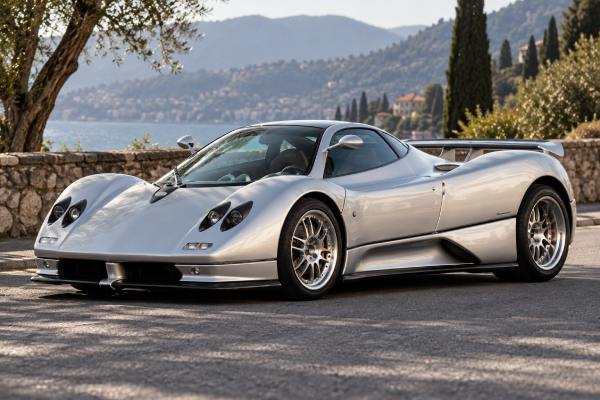
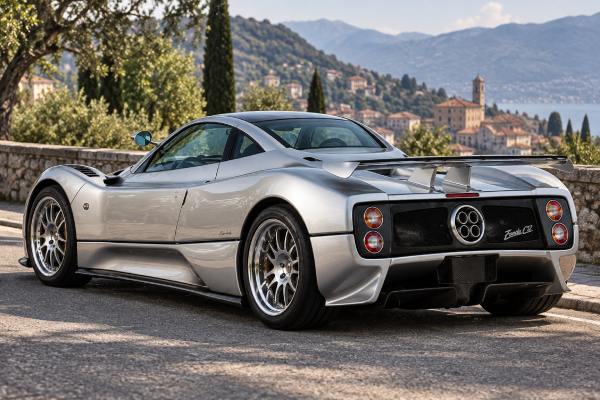
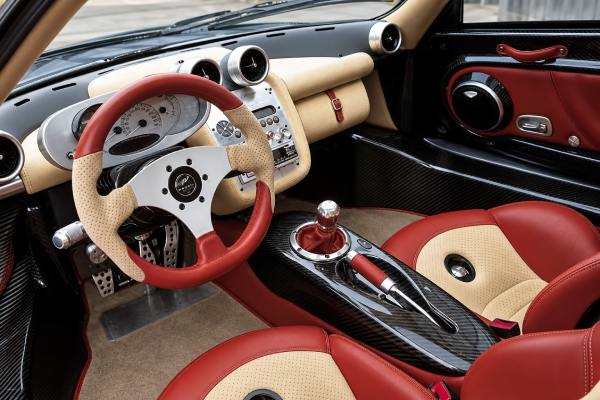
The 1999–2000 Pagani Zonda C12 is the car that established Pagani’s engineering language before the company had a long history to lean on. Its formula now sounds familiar—carbon-fibre structure, a naturally aspirated Mercedes-Benz V12, rear-wheel drive, exposed mechanical craftsmanship—but in 1999 it arrived from a tiny new manufacturer with very little precedent. In the launch specification covered here, the 5,987 cc M120 V12 is rated at 394 hp and 570 Nm, paired with a six-speed manual gearbox and a dry weight around 1,250 kg.
That simplicity is also what makes an early C12 unusually difficult to evaluate today. Very few were built, individual cars evolved, and Pagani has legitimate factory programmes that can restore, certify, or substantially update older cars. A correct buying decision therefore depends less on a generic model checklist than on proving what a specific chassis was when new, what has happened to it since, and whether its present mechanical and cosmetic state matches the documentation.
Table of Contents
- Defining the 394 hp Launch-Spec C12
- Core Specifications and Mechanical Layout
- How the M120 and Manual Gearbox Shape the Drive
- Carbon Structure, Suspension, Brakes, and Aero
- Maintenance Strategy for a Hand-Built Early Zonda
- Inspection, Provenance, and Factory Authenticity
- Who the Early C12 Suits—and How to Buy One
Defining the 394 hp Launch-Spec C12
The safest way to understand the first Zonda is to treat the 394 hp C12 as a specific early configuration, not as a catch-all label for every six-litre Zonda. Pagani’s own historical material describes the launch car as a 6.0-litre, 394 hp, 570 Nm machine, while later factory evolutions and restorations can carry different output figures.
The C12 debuted publicly at the 1999 Geneva International Motor Show and introduced the visual and technical ideas that would remain recognizable throughout the Zonda family. The cabin was pushed forward, the nose and tail were formed as broad composite clamshells, and four exhaust outlets were grouped in the center. The construction was equally distinctive: a carbon-fibre central cell joined to chrome-molybdenum steel structures that supported the suspension and powertrain.
The first C12 was also developed when Pagani was still proving itself as a manufacturer. That matters because many features later associated with the brand were already present, but they had not yet become expected luxury-hypercar conventions. Carbon fibre was structural, not merely decorative. Machined aluminium, exposed linkages, leather, and carefully finished hardware were used where ordinary manufacturers would have hidden components behind molded trim. The result was not just visual theatre; it was a design method in which structure and finish were intentionally visible.
Production numbers are very small. Period histories commonly identify five C12 coupes in the original 6.0-litre phase, and one early roadster-type car is also discussed in specialist histories. More important than the headline count is the survival state of individual chassis. Some early Zondas were demonstrators, homologation cars, development cars, customer cars, or later recipients of factory changes. Pagani’s own 2019 restoration of chassis 001 illustrates the point: an early Zonda can have a complicated life yet still be returned to a documented historical configuration by the factory.
That makes model-year shorthand less useful than it is with a mass-produced sports car. “1999 C12” does not automatically tell you everything about engine calibration, trim, body detail, later updates, or whether the car remains in the same configuration it had at delivery. For a collector, the important identity chain is chassis number, original build specification, factory records, ownership history, documented work, and current configuration.
There is also a genuine source inconsistency worth understanding. Pagani’s current C12 page describes the early concept as producing 394 hp and 570 Nm, but its expanded technical area also displays higher M120 E60 figures associated with a later evolution. For this article, the assignment scope is the 394 hp launch-specification car. A real vehicle should be checked against Pagani’s chassis records rather than matched blindly to a web table.
Core Specifications and Mechanical Layout
The launch-spec C12 is a naturally aspirated ICE supercar with a longitudinal mid-mounted V12, six-speed manual transmission, and rear-wheel drive. Its standout engineering feature is the combination of a carbon-fibre central structure with relatively low mass and a large-displacement engine delivering power without turbocharging.
| Specification | Value |
|---|---|
| Engine family | Mercedes-Benz M120 E60 |
| Layout | 60-degree V12, longitudinal mid-rear |
| Displacement | 5,987 cc (6.0 L) |
| Induction | Naturally aspirated |
| Maximum power | 394 hp (about 290 kW) |
| Maximum torque | 570 Nm (420 lb-ft) |
| Fuel | Petrol/gasoline |
| Specification | Value |
|---|---|
| Transmission | Six-speed manual |
| Clutch | Twin-plate |
| Drive type | Rear-wheel drive |
| Differential | Self-locking limited-slip type |
| Engine position | Longitudinal, behind the passenger cell |
| Component | Factory configuration |
|---|---|
| Central structure | Carbon-fibre safety cell/monocoque |
| Front and rear structures | Chrome-molybdenum steel spaceframes |
| Suspension | Independent double A-arm layout with coil springs, dampers, and anti-roll bars |
| Suspension arms | Aluminium alloy |
| Steering | Power-assisted rack and pinion |
| Front brakes | 355 mm ventilated discs, four-piston calipers |
| Rear brakes | 335 mm ventilated discs, four-piston calipers |
| Specification | Front | Rear |
|---|---|---|
| Wheel type | OZ aluminium alloy | OZ aluminium alloy |
| Tyre | Michelin Pilot 255/40 ZR18 | Michelin Pilot 345/35 ZR18 |
| Specification | Value | Context |
|---|---|---|
| Length | 4,345 mm (171.1 in) | Period specification |
| Width | 2,055 mm (80.9 in) | Published body width |
| Height | 1,151 mm (45.3 in) | Period specification |
| Wheelbase | 2,730 mm (107.5 in) | Period specification |
| Empty/dry mass | About 1,250 kg (2,756 lb) | Pagani historical figure; definitions can differ among period sources |
| 0–100 km/h | About 3.9 seconds | Period factory-claim figure reported by technical catalogs |
| Top speed | About 298 km/h (185 mph) | Period published figure |
Those numbers need to be read in the context of the era. A modern performance car can exceed 394 hp easily, but the C12 combines that output with low mass, minimal electronic filtering, a manual gearbox, and a power delivery that does not depend on boost. The appeal is therefore not a single benchmark; it is how the systems interact.
How the M120 and Manual Gearbox Shape the Drive
The 6.0-litre M120 gives the early C12 a smoother and more progressive personality than later, more powerful Zondas. Its naturally aspirated response and broad torque make the car fast without turning every throttle movement into a sudden traction event.
A large V12 has several practical effects. Twelve cylinders produce closely spaced combustion events, so the engine can feel unusually smooth at low and medium speed. Because there is no turbocharger between throttle demand and airflow response, the driver gets a clear change in engine output as the throttles open. That does not mean the response is perfectly linear under every condition, but the connection is easier to read than in a high-boost engine.
The torque figure—570 Nm—also explains why the car does not need to be driven like a peaky small-capacity engine. It can pull from moderate revs, then build intensity as road speed rises. On an open road, that means the driver can use a higher gear and still have meaningful acceleration. On a circuit, the engine’s progressive delivery gives more room to balance the rear tyres with throttle rather than waiting for a large boost threshold.
The manual gearbox is as important to the experience as the engine. The six-speed mechanism turns every acceleration run into a sequence of deliberate inputs: clutch, lever, throttle, and load transfer. In a healthy car, the shift should feel positive rather than loose or vague, but the exact effort and synchro feel should be judged only after the lubricant and driveline are warm.
For inspection, pay attention to behavior rather than expecting a modern-car feel. A heavy clutch is not automatically a fault, and some mechanical noise is normal in a lightly insulated exotic. Warning signs are different: repeated gear crunching at the same shift, a clutch that engages inconsistently, a pedal that does not return smoothly, driveline shunt that has recently worsened, or a transmission leak that reappears after cleaning.
Engine behavior deserves the same method. A cold start should be observed from genuinely cold, not after the seller has already run the car. Look for stable oil pressure, clean response to light throttle, even idle, and a normal transition as temperatures rise. Smoke, fuel odor, coolant smell, hunting idle, or persistent misfire should be investigated before the car is driven hard.
Heat management is especially important in any mid-engine V12. The engine, exhaust, gearbox, rear suspension, wiring, hoses, and bodywork all live in a confined area. After a drive, the inspection should include evidence of fluid weeping, baked hoses, heat-damaged insulation, discolored electrical connectors, and abnormal smells. On a rare car, small neglected heat-related problems can become expensive because access and part availability are unlike those of the Mercedes models that originally used the M120 family.
Carbon Structure, Suspension, Brakes, and Aero
The C12’s key engineering achievement is not simply that it uses carbon fibre; it is how carbon, steel structures, aluminium suspension parts, and composite body panels are combined into a serviceable road car. That mixed-material construction gives low mass and rigidity, but it also changes how accident damage and aging should be evaluated.
The central passenger cell provides the main structural core. Front and rear spaceframes carry major mechanical loads and give the car areas that can be repaired or replaced without automatically condemning the central carbon structure. That is useful in principle, but it does not make crash assessment easy. A bent frame can transfer load into attachment areas, and composite damage can remain hidden beneath paint, lacquer, undertrays, or bonded interfaces.
A proper inspection therefore starts with geometry and evidence. Panel gaps should be consistent with the car’s hand-built nature, but left-to-right differences still matter. The front and rear clamshells should open and close cleanly. Mounting hardware should make sense for the car’s known history. Fresh paint around a pickup point, mismatched fasteners, repaired carbon weave, or uneven clear coat is not proof of serious damage, but each is a reason to ask for documentation.
The suspension uses independent double wishbones and keeps the basic architecture familiar to anyone who understands racing and high-performance road cars. What matters is condition. A low-mileage collector car can still need extensive work if bushings, dampers, seals, boots, or tyres have aged while the car sat stationary. Conversely, a higher-mileage car with regular factory-supported maintenance can be mechanically healthier than a museum piece.
The brakes are steel ventilated discs with four-piston calipers in this early specification, not the later carbon-ceramic hardware associated with newer Zondas. Inspect rotor condition, pad age, caliper seals, flexible lines, hard-line corrosion, and brake-fluid history. A firm pedal on a stationary car does not prove the system is ready for repeated high-energy stops.
Tyres are another age-sensitive component. The original sizes are unusual, especially the 345-section rear fitment. Correct size alone is not enough; check production dates, storage history, sidewall condition, flat-spotting, and whether the exact tyre has suitable speed and load ratings. A collector car on visually perfect but old tyres is not ready for performance use.
Aerodynamically, the first C12 is less visually aggressive than later Zondas. That is part of its importance. The body already uses the forward canopy, low nose, broad rear body, underbody management, and compact central exhaust that would become Zonda signatures, but without the larger wings, dive planes, and more explicit track influences of later versions. The cleaner shape makes originality of clamshells, splitters, ducts, and trim especially easy to disturb with later cosmetic updates.
Maintenance Strategy for a Hand-Built Early Zonda
An early C12 should be maintained by condition, documented history, and factory guidance—not by copying a Mercedes M120 service schedule. The engine family may be familiar, but the installation, cooling, exhaust, electrical integration, gearbox, chassis, and body systems are Pagani-specific.
The first step is to establish a baseline. If the car has incomplete recent history, assume nothing from low mileage. Fluids age, rubber hardens, batteries sulfate, seals dry, fuel degrades, and plated or polished hardware can corrode in storage. A baseline inspection should cover the engine and gearbox for leaks, cooling-system integrity, belts and hoses, brake fluid and hydraulic condition, tyre age, suspension joints, electrical charging health, air-conditioning operation, and all lighting and instruments.
For a car that has been stored for years, recommissioning is better than simply starting and driving it. Old fuel can damage pumps and injectors. A dry bearing or seal can fail after appearing acceptable at idle. Brakes may drag. Tyres can have internal deterioration that is invisible from the tread. The correct process is to inspect first, replace time-expired consumables, bring systems to temperature progressively, then recheck for leaks and abnormal behavior.
Regular use is usually healthier than long static periods if the car is used correctly. Short starts that never warm the engine and exhaust fully are not useful exercise. A proper drive should bring oil, coolant, gearbox, brakes, and tyres into their normal operating range while avoiding high load until temperatures stabilize. Afterward, give the car time to cool in a dry environment and inspect for new fluid traces or smells.
Storage conditions matter because the C12 mixes carbon composites, steel frames, aluminium hardware, leather, adhesives, electronics, and painted finishes. A stable, dry garage is preferable to repeated temperature and humidity swings. Battery support should use equipment suitable for the installed battery and electrical system. The car should be kept clean underneath, especially if it has been driven on wet or salted roads, but pressure washing around vents, connectors, or bonded areas is not a substitute for careful cleaning.
Cosmetic preservation should also be conservative. The visible carbon and lacquer are part of the car’s historical material. Aggressive polishing can thin clear coat or change the appearance of weave edges. Leather can be damaged by strong cleaners or over-conditioning. An early Zonda’s value is tied closely to detail, so cosmetic work should be documented just as carefully as mechanical work.
Pagani’s present-day support structure is unusually relevant to these cars. Pagani Puro is the company’s authenticity and condition certification programme and includes more than 400 checks against factory records. Pagani Rinascimento is aimed at restoration and conservation using original documentation, materials, molds, and methods. Pagani Unico serves a different goal: it allows a customer to update or personalize a car, including major mechanical and aerodynamic changes.
Those programmes create an important ownership distinction. “Factory work” can mean restoration toward originality, certification of current authenticity, or deliberate transformation into a unique later configuration. None of those is automatically better in every context. A buyer who wants a museum-correct launch C12 should prefer traceable original or Rinascimento-restored specification. A buyer who wants a Pagani-sanctioned evolution may value Unico work. The crucial point is to know which type of work was done and to have the paperwork that proves it.
Inspection, Provenance, and Factory Authenticity
On a 394 hp C12, provenance is a mechanical issue as much as a collector issue. The car’s value, specification, and even the meaning of its model name can depend on documented factory changes, so a pre-purchase inspection should start with records before it starts with paint depth.
First, obtain the chassis identity and ask Pagani or an authorized specialist what the factory record shows. The original exterior and interior configuration, engine specification, gearbox, major component serials, delivery market, and subsequent factory work should form the baseline. If the seller cannot provide a clear chain of documentation, that uncertainty belongs in the purchase decision.
Next, compare the physical car with the record. An upgraded engine, later wheel design, revised aero parts, different interior trim, or altered suspension may be entirely legitimate if performed by Pagani. The problem is not change; the problem is undocumented change or a claim that the car is “original” when it is actually a later interpretation.
The composite structure needs specialist attention. Look at the visible carbon around sills, bulkheads, floor areas, suspension attachments, and underside. Search for whitening, cracks, resin disturbance, patched weave, sanding marks, or paint transitions. On a hand-built composite car, appearance alone cannot determine structural integrity, so suspicious areas should be evaluated using the inspection methods appropriate to the material and repair history.
The mechanical inspection should include a cold start, warm running, diagnostic checks available for the car, clutch and gearbox operation, brake performance, steering free play, suspension noise, damper leakage, wheel condition, and tyre age. The car should also be raised correctly so the underbody, frame structures, fluid lines, exhaust, and mounting points can be inspected without damaging the chassis.
Electrical systems deserve patience. Verify every gauge, warning lamp, switch, exterior light, fan function, window, lock, air-conditioning control, and any model-specific accessory. Rare handmade cars can have small electrical problems that are time-consuming rather than catastrophic, but intermittent faults should never be dismissed because a car is old or exotic.
Finally, inspect the loose items and documents. Original keys, books, tools, luggage, covers, period invoices, delivery documents, restoration books, and Puro certification can all matter. On a car built in tiny numbers, missing accessories may be difficult to replace and can affect both usability and historical completeness.
A useful purchase file should answer these questions:
- What exact specification did this chassis leave the factory with?
- Which major components remain original to that configuration?
- Which changes were made later, and by whom?
- Is there documented accident, structural, or composite repair history?
- When were tyres, fluids, hoses, dampers, brakes, and battery last renewed or inspected?
- Has the car been certified, restored, or upgraded through a Pagani programme?
- Are all current mechanical issues described and costed before purchase?
Who the Early C12 Suits—and How to Buy One
The first C12 suits a buyer who values historical importance, mechanical interaction, and documented originality more than maximum Zonda performance. Later versions are faster and more dramatic, but the 6.0-litre car shows the concept before the Zonda became an established icon.
That distinction should guide the search. If the goal is the purest early form, prioritize a chassis with a clear launch-era specification, strong factory documentation, and conservative restoration. If the goal is driving, a car with higher mileage but continuous specialist care may be preferable to a static showpiece. If the goal is a factory-updated one-off, then later Pagani work should be treated as the car’s defining feature rather than hidden as a deviation from originality.
Do not buy primarily from a published horsepower figure, auction estimate, or rarity claim. Each of those can distract from condition. A car with perfect provenance but overdue recommissioning can require major spending before safe use. A beautifully presented car can still have aged tyres, tired dampers, hydraulic leaks, or undocumented composite repair. The best examples combine identity, condition, and service history.
A sensible buying sequence is straightforward. Establish factory identity first. Review the complete records second. Inspect the car with Pagani-level expertise third. Price any corrective work fourth. Only then decide how much the particular chassis is worth to you.
The early C12 rewards that discipline because it is not simply an old exotic with a Mercedes engine. It is the starting point for a small manufacturer’s entire design philosophy, built in numbers so low that every surviving car has effectively become its own case study. For an owner, that means responsibility as well as privilege: preserve the documentation, maintain the systems as an integrated Pagani, and resist the temptation to treat generic web specifications as a substitute for the history of the actual chassis.
References
- Zonda C12 | Pagani 2026 (Manufacturer Specifications)
- A NEW EXHIBITION TO CELEBRATE PAGANI AUTOMOBILI’S 25TH AT THE MAUTO | Pagani 2023 (Model History)
- 20TH ANNIVERSARY OF PAGANI ZONDA TO BE CELEBRATED AT NEW YORK’S GRAND CENTRAL TERMINAL | Pagani 2019 (Chassis 001 and Zonda History)
- Pagani Puro | Pagani 2026 (Authenticity and Maintenance Programme)
- Pagani Rinascimento | Pagani 2026 (Factory Restoration Programme)
- 1999 – 2000 Pagani Zonda C12 – Images, Specifications and Information 2011 (Model History and Period Specification Context)
Disclaimer
This article is for informational purposes only and is not a substitute for professional diagnosis, inspection, maintenance, or repair. Specifications, torque values, service intervals, procedures, and installed components can vary by chassis, VIN, market, production date, and later factory work. Verify all work and technical data against the official Pagani documentation for the specific car. If this guide was useful, please consider sharing it on Facebook, X/Twitter, or your preferred enthusiast community to support our work.