
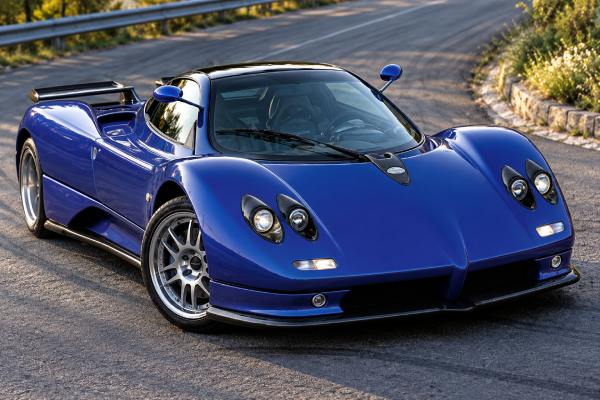
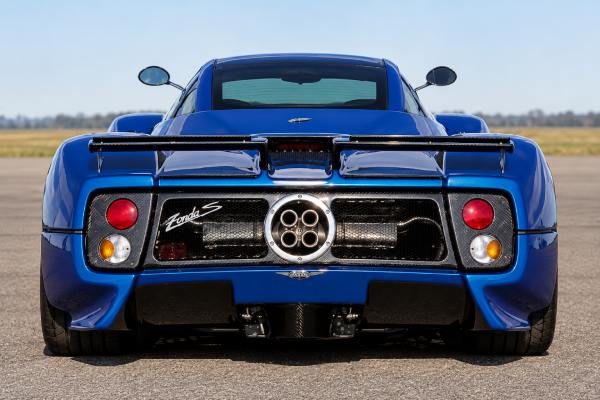
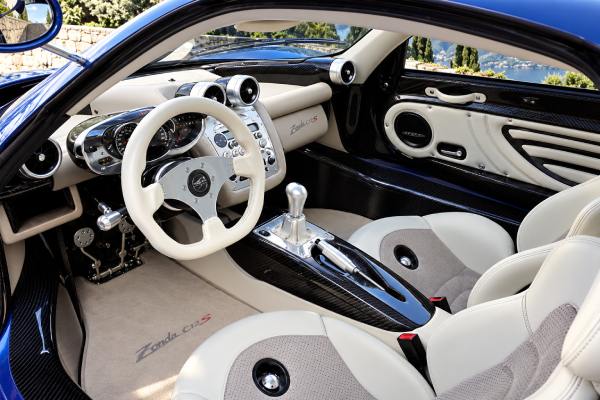
The 2000–2002 Pagani Zonda C12 S 7.0 is the model that turned the original Zonda idea into a genuinely high-output supercar. The basic architecture remained recognizably Pagani—carbon-fibre central structure, a naturally aspirated Mercedes-AMG V12, six-speed manual transmission, and rear-wheel drive—but the 7.0-litre engine raised output to 550 hp and torque to about 750 Nm. That change transformed the car more than the modest visual evolution suggests.
For today’s buyer, the C12 S 7.0 is also one of the hardest Zondas to describe with a single generic specification sheet. Pagani built very few cars, individual examples were tailored, and some have since been restored or reworked by the factory. The useful question is not simply whether a car is called a C12 S. It is whether the chassis, engine specification, body details, factory records, and present condition all support the exact 7.0-litre identity being advertised. This guide focuses on that verification as much as on the headline performance.
Table of Contents
- Why the 7.0-Litre C12 S Was a Major Step
- C12 S 7.0 Technical Specification
- What 550 hp and 750 Nm Feel Like Through a Manual Gearbox
- Aero, Cooling, Chassis, and Braking Changes
- Ageing Risks and a Sensible Service Strategy
- How to Prove a Car’s Factory History
- Buying a C12 S 7.0 for Driving or Collecting
Why the 7.0-Litre C12 S Was a Major Step
The C12 S 7.0 is important because it kept the original Zonda’s light, manual, naturally aspirated layout while adding the power and torque that made the platform competitive with the fastest supercars of its period. It is best viewed as the first major mechanical evolution of the Zonda rather than a simple trim upgrade.
Pagani’s first C12 introduced the concept in 1999, but the S version quickly pushed the engine capacity to roughly seven litres. Pagani’s own historical technical page identifies a Mercedes-Benz M120 E70 AMG V12 of 7,010 cc, producing 550 hp at 5,500 rpm. Period and specialist references put peak torque at about 750 Nm near 4,100 rpm. The car remained naturally aspirated, so the extra capacity increased the amount of air and fuel moved per engine cycle without relying on forced induction.
That is a meaningful difference in a car with a dry mass around 1.25 tonnes. The stronger engine did not require a completely different driving philosophy; it amplified the existing one. The driver still managed traction with the right foot, selected gears manually, and relied on the chassis rather than modern torque-vectoring or multi-mode hybrid systems. The result was more urgent acceleration and much stronger in-gear performance without replacing the mechanical character that defined the early Zonda.
The C12 S also sits in a narrow part of the model chronology. It followed the 6.0-litre C12 and preceded the better-known 7.3-litre Zonda S. That makes naming important. Auction listings, older magazine features, and web databases sometimes compress the early cars into “C12 S” without clearly distinguishing 7.0- and 7.3-litre versions. A 7.0-litre car should therefore be identified through its build records and engine specification, not from exterior appearance alone.
Production was tiny. One respected period-specification archive records 15 coupes from 2000 to 2002, while later histories sometimes use slightly different totals depending on what they count as original production, prototypes, or transformed cars. The exact number is less useful to a buyer than the individual chassis history because Pagani has continued to support, restore, and personalize older Zondas long after their initial delivery.
That ongoing factory involvement changes how “originality” should be discussed. A C12 S can be historically correct, factory restored, or factory reimagined, and all three may be legitimate Pagani products. They are not the same thing for a collector. If the goal is a period-correct 7.0-litre example, the owner should be able to show that the present engine, body configuration, interior, and major hardware correspond to the documented 7.0-litre build or to a transparent factory restoration of it.
C12 S 7.0 Technical Specification
The C12 S 7.0 is a petrol-powered ICE supercar with a longitudinal mid-mounted V12, six-speed manual gearbox, self-locking differential, and rear-wheel drive. The defining technical change from the first C12 is the 7,010 cc AMG-developed engine and its substantially higher output.
| Specification | Value |
|---|---|
| Engine | Mercedes-Benz M120 E70 AMG V12 |
| Configuration | 60-degree V12, naturally aspirated |
| Displacement | 7,010 cc (7.0 L) |
| Maximum power | 550 hp (405 kW) at 5,500 rpm |
| Maximum torque | About 750 Nm (553 lb-ft) at roughly 4,100 rpm |
| Engine position | Longitudinal mid-rear |
| Fuel | Petrol/gasoline |
| Specification | Configuration |
|---|---|
| Gearbox | Six-speed manual plus reverse |
| Clutch | Twin-plate |
| Driven wheels | Rear |
| Differential | Self-locking limited-slip type |
| Powertrain layout | Mid-engine, rear-wheel drive |
| Component | Factory layout |
|---|---|
| Central structure | Carbon-fibre monocoque/safety cell |
| Front and rear frames | Chrome-molybdenum steel spaceframes |
| Body panels | Carbon-fibre composite |
| Suspension | Independent double wishbones |
| Springing and damping | Coil springs with hydraulic dampers and anti-roll bars |
| Suspension arms | Aluminium alloy |
| Steering | Power-assisted rack and pinion |
| Component | Front | Rear |
|---|---|---|
| Brake discs | 355 mm ventilated | 335 mm ventilated |
| Calipers | Four-piston | Four-piston |
| Wheels | OZ aluminium alloy | OZ aluminium alloy |
| Tyres | 255/40 ZR18 | 345/35 ZR18 |
| Specification | Published figure | Notes |
|---|---|---|
| Length | About 4,345 mm (171.1 in) | Period specification |
| Height | About 1,151 mm (45.3 in) | Period specification |
| Wheelbase | 2,730 mm (107.5 in) | Period specification |
| Dry weight | About 1,250 kg (2,756 lb) | Dry-weight terminology varies by source |
| 0–100 km/h | About 3.7 seconds | Common period claim |
| Top speed | About 335 km/h (208 mph) | Common period claim |
The numbers are impressive, but the ratio between them tells the more useful story. Roughly 550 hp in a 1,250 kg dry-weight car gives the C12 S performance that still demands respect, while the 750 Nm torque peak arrives low enough that the car does not need constant high-rpm operation to feel fast.
What 550 hp and 750 Nm Feel Like Through a Manual Gearbox
The defining sensation of the C12 S 7.0 is not merely stronger acceleration; it is the way a very large naturally aspirated engine loads a lightweight rear-drive chassis through a manual gearbox. There is no turbo boost event to wait for and no dual-clutch transmission to hide the shift process.
At modest revs, the V12 should feel smooth and substantial rather than nervous. The engine’s displacement gives it enough torque to accelerate without immediately downshifting, which makes the car surprisingly flexible in normal road use. Press harder and the delivery intensifies progressively. That progression gives the driver a chance to sense available rear grip before full power arrives.
The manual gearbox makes speed more deliberate. A correctly adjusted clutch and shift linkage should allow clean changes once the drivetrain is warm, but this is not a light modern hatchback mechanism. The clutch can require meaningful effort, and the exposed mechanical linkage is part of the car’s character. What matters is consistency: the same shift should feel broadly the same from one attempt to the next.
During a test drive, distinguish normal mechanical character from faults. Synchro wear can show as repeated resistance or grinding on a particular gear. A clutch nearing the end of its service life may have a high or inconsistent engagement point, slip under heavy load, or judder when moving away. Worn engine or gearbox mounts can add movement and clunks that are sometimes mistaken for “race-car feel.”
The self-locking differential also affects behavior. On corner exit, it helps both rear tyres contribute to traction, but a mechanical differential can make low-speed turning feel different from a conventional open differential. Any chatter, binding, or abrupt locking behavior should be assessed in the context of oil condition, tyre size, tyre circumference, and the exact differential specification.
Tyres are critical because the car’s performance depends on two very wide rear contact patches. The original rear size is 345/35 ZR18, which is not a commodity fitment. An owner should plan tyre supply before the existing set ages out rather than waiting until replacement becomes urgent. Matching type, age, speed rating, and condition across the axle matters more than preserving an old set simply because it looks original.
The C12 S rewards mechanical sympathy. Warm the engine, gearbox, and tyres before using full load. Avoid resting a foot on the clutch pedal. Do not force a reluctant shift when cold. Let temperatures stabilize after hard use rather than shutting the car down immediately after repeated high-load operation. These habits are simple, but they are especially valuable in a car whose replacement parts and specialist labor are scarce.
Aero, Cooling, Chassis, and Braking Changes
The C12 S used its added power within the same basic lightweight chassis philosophy, so airflow, cooling, braking, and suspension condition became even more important. A buyer should inspect these systems as one performance package rather than as independent components.
The body remains recognizably early Zonda, but the S received more assertive aerodynamic treatment than the first C12. The front and rear bodywork, wing elements, ducts, and underbody management were intended to improve stability and cooling as speeds increased. Because later Zondas adopted progressively more dramatic aero, an early C12 S can easily be made to look newer with factory or aftermarket parts. That is another reason to compare the car against its original build record.
Cooling deserves close attention. The mid-mounted V12 concentrates heat behind the cabin, while radiators, hoses, fans, ducts, and coolant lines must manage engine temperature under both traffic and high-speed load. A car that behaves perfectly on an open road can still reveal a cooling problem in slow traffic if a fan, relay, sensor, or low-speed airflow path is not working correctly.
Inspect the cooling system cold and hot. Cold checks include coolant level, hose condition, staining around joints, radiator condition, and evidence of prior leaks. Hot checks include fan operation, temperature stability after a drive, coolant smell, and whether pressure produces seepage that was not visible beforehand. Repeated topping-up is not normal maintenance; it is a symptom that needs a cause.
The double-wishbone suspension should feel controlled without making the car skitter over broken surfaces. Age can change that balance. Dampers can lose performance even when they are not visibly leaking. Bushings and spherical joints can develop play. Ride-height or alignment changes can make a car feel nervous, wear tyres unevenly, or reduce braking stability.
Braking hardware is comparatively straightforward by later hypercar standards: steel ventilated discs and four-piston calipers. That simplicity is an advantage for inspection because wear can often be measured directly. Check disc thickness and condition, pad material, caliper seals, hose age, and brake-fluid history. A long pedal after repeated braking, pulling under deceleration, or vibration through the pedal or steering wheel deserves investigation.
Underbody condition can reveal how the car has been used. Scraping on sacrificial surfaces is not unusual on a low supercar, but impact near suspension pickups, frame attachments, cooling lines, or structural carbon is different. Any repaired composite area should have documentation explaining the damage, method, materials, and responsible workshop.
Ageing Risks and a Sensible Service Strategy
A C12 S 7.0 is now old enough that calendar age can matter as much as mileage. Low use does not preserve every component; seals, hoses, tyres, fluids, batteries, dampers, and fuel-system parts can deteriorate while the odometer barely changes.
The best maintenance strategy begins with a complete baseline rather than a generic annual checklist. Review the factory history first, then inspect the car system by system. If recent service evidence is incomplete, the owner should establish known dates and condition for engine oil, gearbox oil, brake fluid, coolant, tyres, battery, filters, belts, hoses, brake components, and suspension wear items.
Do not import service data from a Mercedes road car simply because the engine belongs to the M120 family. Pagani’s installation, intake, exhaust, cooling, ECU calibration, ancillaries, and packaging are different. The gearbox and chassis are also specific to the Zonda. Exact fluids, capacities, torque values, and procedures should come from Pagani documentation for the chassis being serviced.
Cars that sit for long periods need a different approach from cars used every month. Before recommissioning a stored example, inspect the fuel system, battery, brake condition, tyre dates, fluid levels, leaks, and evidence of rodents or moisture. Rotate and exercise systems only when it can be done safely. A short idle session in a garage is not a substitute for a proper heat cycle and can create condensation without bringing the drivetrain fully to operating temperature.
When the car is driven, warm-up should be progressive. Keep engine load moderate until oil and coolant are stable, then allow the gearbox and tyres time to reach useful temperatures. After a spirited drive, inspect the engine bay and underside for fresh leaks rather than assuming that a warning lamp will identify every problem.
The interior and exposed finishes require maintenance too. Early Paganis use leather, machined aluminium, visible fasteners, carbon fibre, and bespoke trim in areas that mass-produced cars would hide. Strong cleaners, careless polishing, or generic trim coatings can permanently alter finishes. Preservation work should be gentle, documented, and reversible wherever possible.
Pagani’s current aftersales programmes are particularly relevant to a C12 S. Puro can certify authenticity and condition by comparing the car with factory data. Rinascimento is designed to restore older cars using original records, materials, and processes. A documented factory restoration can therefore be far more meaningful than a cosmetic “nut-and-bolt restoration” performed without access to the original build information.
How to Prove a Car’s Factory History
The strongest evidence for a C12 S 7.0 is a chain that connects the chassis number to its original factory specification and then documents every significant change. Visual inspection alone cannot establish that chain because Pagani itself has legitimately modified and restored older Zondas.
Start by confirming the chassis identity with Pagani or an authorized specialist. Ask what engine specification, exterior color, interior trim, wheel design, and delivery configuration the factory record shows. If the car has a Puro book, Rinascimento record, or other factory documentation, compare those documents with the physical components on the car.
The engine deserves specific attention because the early Zonda family moved quickly from 6.0 to 7.0 and then 7.3 litres. Engine numbers, factory invoices, ECU information, intake and exhaust details, and service records should all support the claim that the car is a 7.0-litre C12 S. A later factory engine may be desirable to some owners, but it changes how the car should be described.
Bodywork should be treated the same way. Later Zonda panels, wings, wheels, and trim can fit within the broader family look, and Pagani’s Unico programme can create major bespoke evolutions. A buyer should therefore ask whether an aero change is original, period factory work, later factory work, or aftermarket work. The category matters more than whether the change is attractive.
Look for consistency in small details. Fastener types, carbon weave direction, leather patterns, switchgear, wheel markings, glass dates, labels, and hardware finishes can reveal whether a restoration was careful or merely cosmetic. These details are not proof by themselves, but mismatches provide useful questions for the documentation review.
A professional pre-purchase inspection should include composite structure, steel frame condition, engine leak-down or other health checks where approved, cooling operation, gearbox and clutch behavior, brake measurements, wheel and tyre condition, alignment, electrical functions, and a road test. Because the car is so rare, the inspector should know Pagani construction rather than simply specialize in European exotics generally.
Buying a C12 S 7.0 for Driving or Collecting
The best C12 S 7.0 is not automatically the lowest-mileage or most visually perfect one. The right car is the example whose specification, condition, history, and intended use match the buyer’s priorities.
A collector seeking period correctness should value original configuration, factory records, intact early details, and documented conservation. A driver may reasonably accept more mileage if the car has been maintained continuously and major age-related items have already been addressed. A buyer attracted to Pagani’s continuing bespoke philosophy may prefer a factory-updated car, but should understand that it is a different proposition from a preserved 2000–2002 example.
Budget for post-purchase work even when the inspection is good. Rare tyres, bespoke trim, composite repairs, gearbox work, specialist shipping, and factory-level service can make apparently small issues expensive. A reserve fund is more useful than stretching the purchase price to obtain a car with a better cosmetic presentation but weaker mechanical history.
Avoid four shortcuts: do not assume a low odometer means low maintenance needs; do not accept “factory upgraded” without paperwork; do not use a 7.3-litre specification sheet for a 7.0-litre car; and do not skip a structural inspection because the paint looks excellent. Each shortcut can hide exactly the kind of issue that matters most on an early Zonda.
The C12 S 7.0 occupies an unusually appealing point in Pagani history. It has far more output than the first C12, yet it retains the early body language, steel-brake simplicity, manual transmission, and naturally aspirated response that later versions progressively intensified. Buy the individual chassis rather than the legend, document what it is, and maintain it as a complete Pagani system. That approach preserves both the driving experience and the historical value that make the seven-litre car distinctive.
References
- Zonda C12 | Pagani 2026 (Manufacturer Specifications)
- Pagani Automobili on Lake Como: the Pagani Zonda C12S 7.0L officially debuts at the Concorso d’Eleganza Villa d’Este 2026 | Pagani 2026 (Manufacturer History)
- PAGANI AUTOMOBILI TO PARTICIPATE IN AUTO E MOTO D’EPOCA | Pagani 2024 (Rinascimento C12 S Example)
- Pagani Puro | Pagani 2026 (Authenticity Certification)
- Pagani Rinascimento | Pagani 2026 (Factory Restoration Programme)
- 2000 – 2002 Pagani Zonda C12 S Specifications – Ultimatecarpage.com 2026 (Period Specifications)
Disclaimer
Use this guide as model-level background, not as a diagnostic or workshop procedure for a C12 S 7.0. Early hand-built cars can differ in components, calibration, service history, and later Pagani work, so the correct fluids, intervals, settings, torque values, and repair methods must be confirmed for the individual VIN through current factory information and qualified specialists.
If the C12 S 7.0 detail here is useful, feel free to pass the article along to other owners or enthusiasts on Facebook, X, or a marque community.