
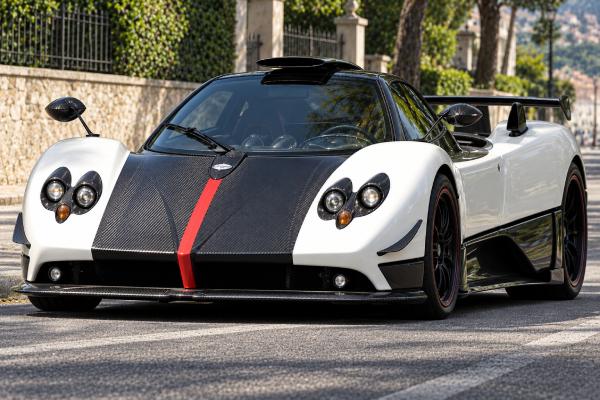
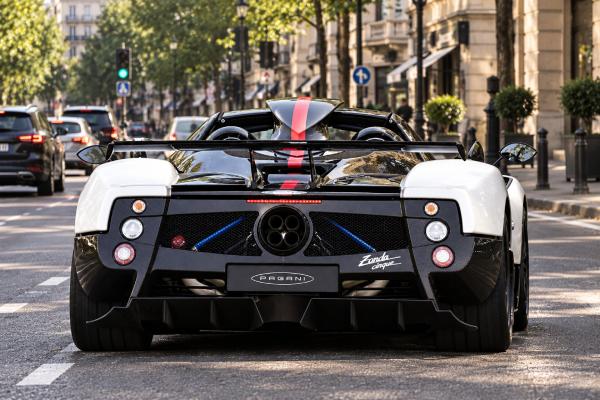
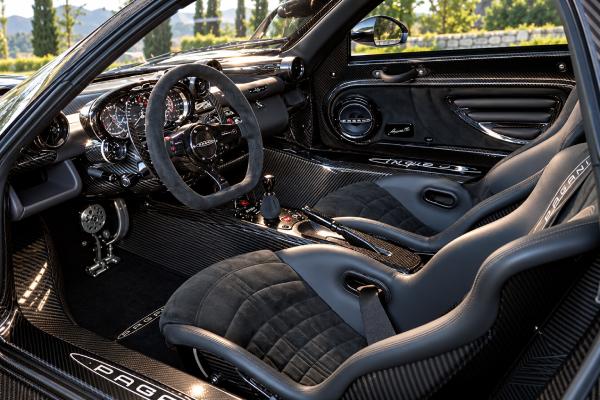
The 2009 Pagani Zonda Cinque is a five-car road-going special that translated selected lessons from the track-only Zonda R into a homologated Zonda without turning it into a race car with number plates. Pagani paired the naturally aspirated 7.3-litre AMG V12 with a six-speed Cima sequential transmission, its new carbo-titanium central structure, carbon-ceramic brakes, model-specific Pirelli tyres, extensive lightweight hardware, and an aero package quoted at 750 kg of load at 300 km/h. Factory output is 678 CV and 780 Nm, while the published dry mass is 1,210 kg.
Those headline numbers are only part of the ownership story. A Cinque depends on the integrity of rare composite panels, centre-lock wheel hardware, hydraulic shift actuation, ceramic brakes, bespoke cooling ducts, and chassis-specific provenance. For a buyer, the important questions are therefore not simply whether the car is fast or visually correct, but whether it remains one of the five original coupés in documented factory configuration and whether specialist care has preserved the systems that make it a Cinque.
Table of Contents
- How the Five-Car Road Brief Defined the Cinque
- Factory Specification: Powertrain, Chassis, Brakes, and Performance
- Carbo-Titanium, Downforce, and Lightweight Hardware
- Living with the Six-Speed Sequential Transmission
- Heat, Carbon-Ceramic Brakes, Tyres, and Centre-Lock Wheels
- Service and Preservation Priorities for a Cinque
- Authenticating and Buying One of the Five Coupés
How the Five-Car Road Brief Defined the Cinque
The Zonda Cinque was commissioned around a precise idea: create an exceptionally focused road Zonda for five customers, using knowledge developed during the Zonda R programme while retaining road legality. That limited brief explains why so many of its details are functional rather than cosmetic.
Pagani says the project began with a request from its official Hong Kong dealer for the most extreme road-legal Zonda it could build. The resulting coupé was limited to five examples. In 2024, when Pagani displayed Cinque Coupé 1 of 5 at the Shanghai Museum, the company again described the car as a five-unit model unveiled at the 2009 Geneva International Motor Show. That factory record matters because later Zondas have worn Cinque-style paint, aero pieces, wheels, or upgraded mechanical components without becoming original Cinque production cars.
The Zonda R supplied ideas, not a complete mechanical package. The R is a track-only car with a different 6.0-litre racing V12, different dimensions, a stressed-engine installation, and a transversely arranged racing gearbox. The Cinque instead remained a road machine based on the Zonda family, using the large-displacement AMG road V12 and equipment suitable for traffic. Describing the Cinque simply as a road-legal Zonda R therefore blurs important technical differences.
What transferred was the philosophy of reducing mass while increasing control. The Cinque received Pagani’s carbo-titanium central structure, magnesium and titanium suspension elements, an Inconel-and-titanium exhaust, forged wheels with central retention, carbon-ceramic brakes, a robotized sequential transmission, and more assertive airflow management. The dashboard, seats, four-point restraints, rear roll protection, and paddle controls reinforced the racing influence without stripping away Pagani’s detailed cabin craftsmanship.
Aerodynamics were redesigned as a system. Pagani enlarged the front splitter, added or revised air-management surfaces, changed the flat floor and rear diffuser, and fitted an adjustable rear wing. Roof and rear-body inlets support engine breathing and cooling around the brakes and wheel hubs. The company quotes 750 kg of aerodynamic load at 300 km/h, a figure that illustrates the scale of the package but should not be interpreted as available grip at normal road speed.
Rarity also creates an unusual maintenance problem. There is no broad parts pool from which an owner can casually replace model-specific panels, forged wheels, interior pieces, or aerodynamic hardware. Correctness, repair quality, and documentation consequently have mechanical as well as collecting importance. A part that merely resembles the original may differ in mass, stiffness, fit, or airflow.
Factory Specification: Powertrain, Chassis, Brakes, and Performance
The Cinque is a naturally aspirated petrol internal-combustion hypercar with a longitudinal mid-mounted AMG V12, rear-wheel drive, and a six-speed Cima sequential gearbox robotized by Automac Engineering. Pagani’s own technical data provides the strongest baseline for mass, braking hardware, tyres, controls, and performance.
| Specification | Value |
|---|---|
| Engine family | Mercedes-AMG M297 V12 |
| Displacement | 7,291 cc (7.3 L) |
| Induction | Naturally aspirated |
| Factory-rated power | 678 CV / PS (499 kW; about 669 bhp) |
| Maximum torque | 780 Nm (575 lb-ft) |
| Exhaust | Ceramic-coated Inconel and titanium |
| Component | Factory specification |
|---|---|
| Gearbox | Cima six-speed sequential |
| Shift actuation | Robotized by Automac Engineering; steering-wheel paddles |
| Driven wheels | Rear |
| Differential | Self-locking type |
| Engine/control electronics | Bosch Engineering ECU, traction control, and ABS |
| Specification | Value |
|---|---|
| Central structure | Pagani carbo-titanium monocoque |
| Suspension concept | Independent double-wishbone layout |
| Lightweight suspension materials | Magnesium and titanium, with lightweight alloy hardware |
| Dampers | Öhlins units developed to Pagani requirements |
| Published dry weight | 1,210 kg (2,668 lb) |
| Driving-condition weight distribution | 47% front / 53% rear |
| Component | Front | Rear |
|---|---|---|
| APP forged wheel | 9 × 19 in | 12.5 × 20 in |
| Pirelli P Zero tyre | 255/35 R19 | 335/30 R20 |
| Brembo carbon-ceramic disc | 380 × 34 mm | 380 × 34 mm |
| Monobloc caliper | 6-piston | 4-piston |
| Wheel fastening | Single central nut | Single central nut |
| Measure | Factory figure |
|---|---|
| 0–100 km/h (0–62 mph) | 3.4 seconds |
| 0–200 km/h (0–124 mph) | 9.6 seconds |
| 100–0 km/h | 2.1 seconds |
| 200–0 km/h | 4.3 seconds |
| Maximum quoted lateral acceleration | 1.45 g on road tyres |
| Aerodynamic load | 750 kg at 300 km/h (186 mph) |
The assignment identifies the car as “678 hp,” while Pagani publishes 678 CV. Metric horsepower and mechanical horsepower are not numerically identical: 678 CV is approximately 669 bhp. Buyers comparing catalogues should therefore check the unit before treating a small numerical difference as evidence of a different engine calibration.
Carbo-Titanium, Downforce, and Lightweight Hardware
The Cinque’s engineering is most distinctive where structural material, aerodynamic load, and unsprung mass meet. Its speed is not based on a large power increase alone; Pagani sought a car that would respond more rapidly to steering, braking, and vertical wheel movement while remaining stable at very high speed.
Carbo-titanium was central to that strategy. Pagani describes the Cinque as the first road car to adopt its carbon-titanium frame, and the 2024 Shanghai presentation again highlighted the material as a defining innovation. The purpose is structural rather than ornamental. For an owner or inspector, that means exposed weave should never be treated as ordinary cosmetic carbon fibre. Suspected impact damage, drilled holes, delamination, heat exposure, or previous structural repair requires expertise familiar with Pagani’s construction and factory records.
The same philosophy appears in the suspension. Magnesium and titanium reduce component mass, while Öhlins dampers control the wheel more precisely. Weight saved close to the wheel has a different effect from weight removed from cabin trim: lower unsprung mass can help the tyre stay in contact with uneven pavement and reduces the inertia the damper must manage. That benefit disappears if replacement wheels or hardware are substantially heavier than original specification.
The aero surfaces also need to remain a matched set. The front splitter determines how air is introduced beneath and around the nose. Floor treatment and the rear diffuser accelerate and manage underbody flow, while the rear wing contributes load at the tail. Pagani’s 750 kg claim is quoted at 300 km/h, where aerodynamic force is vastly greater than at ordinary speeds. Changing wing angle, ride height, floor sealing, or a splitter profile can alter the intended balance even if the car still looks correct when parked.
Cooling is integrated into that airflow. The Cinque’s roof and rear intakes, plus channels around the wheel areas, do more than create visual drama. They help feed the engine and move air where heat must be controlled. During an inspection, loose ducting, blocked mesh, incorrectly installed undertrays, missing fasteners, or evidence of rubbing should be investigated because the consequence can be elevated component temperatures as well as aerodynamic disturbance.
Its centre-lock wheels illustrate how multiple objectives converge. The forged APP wheels reduce mass, the single-nut arrangement supports quick removal and a clean hub package, and titanium fasteners are used elsewhere for further savings. Such hardware demands exact service practice. Mating surfaces, thread condition, nut orientation, locking provisions, lubrication policy, and tightening procedure must follow current Pagani documentation for that chassis rather than internet torque charts.
For preservation, factory fit matters more than visual approximation. A replacement wing support, wheel, diffuser panel, or suspension item should be documented by part identity and installation history. A perfect-looking substitute can still change stiffness, wheel offset, cooling flow, or mass distribution.
Living with the Six-Speed Sequential Transmission
The six-speed Cima sequential gearbox is the Cinque system most likely to surprise a driver accustomed to either an H-pattern Zonda or a modern dual-clutch transmission. Its robotized actuation changes gears and operates the clutch for the driver, but the underlying behavior is intentionally mechanical and should be driven with that in mind.
Pagani identifies the unit as a Cima six-speed sequential transmission robotized by Automac Engineering, controlled by paddles behind the steering wheel. It was the first sequential gearbox fitted to a Zonda. Unlike a dual-clutch gearbox that preselects another ratio and overlaps clutches, a single-clutch automated sequential system must unload, disengage, change ratio, and re-engage. Shift feel therefore varies with throttle position, engine speed, hydraulic condition, calibration, and how the driver requests the change.
A healthy example should act consistently rather than necessarily imperceptibly. The useful test is repeatability: cold and warm engagement, low-speed take-up, neutral selection, reverse engagement, commanded upshifts, downshifts, and warning behavior should all be observed. Abruptness alone is not proof of a fault, while smoothness alone does not prove good health if clutch adaptation is compensating for wear.
Low-speed use deserves restraint. Holding a single-clutch automated car on the throttle against an incline or creeping for long periods can create unnecessary clutch heat because the system may need partial engagement. The appropriate technique and any model-specific operating limits should come from the owner documentation and Pagani-trained technicians. A prospective buyer should ask how the car has been used in dense traffic, loaded into transporters, moved around collections, and stored.
Service records should separate routine gearbox oil work from the actuation system. The transmission has mechanical gears and bearings, while the robotization depends on actuators, sensors, hydraulic components, software, and calibration. A fault in one area can mimic trouble in another. Diagnosis should begin with factory-capable electronic checks and documented measurements before parts are replaced.
The engine complements the gearbox by delivering substantial torque without forced induction. Pagani quotes 780 Nm, so the Cinque does not require constant high-rpm operation to accelerate hard. At the same time, the naturally aspirated V12 rewards progressive throttle control because there is no turbocharger torque step to mask small pedal movements. Traction control provides an electronic safety layer, but tyre age, surface temperature, and rear-wheel loading remain decisive.
During a pre-purchase drive, record rather than rationalize unusual behavior. Delayed engagement, repeated failed shifts, hydraulic warnings, inconsistent clutch take-up, fluid leaks, abnormal noises, or a dashboard message should be investigated with specialist equipment. On a five-car model, guessing that a symptom is “normal for a race-derived gearbox” is an expensive approach.
Heat, Carbon-Ceramic Brakes, Tyres, and Centre-Lock Wheels
The Cinque’s stopping and cornering systems are capable of extraordinary performance, but they are also sensitive to temperature, age, and correct handling. The 380 mm Brembo carbon-ceramic discs, dedicated Pirelli fitment, forged wheels, and centre-lock hardware should be inspected as one safety-critical group rather than as isolated consumables.
Carbon-ceramic discs resist repeated high-energy braking and save rotating mass, yet visual inspection alone cannot establish remaining life. Surface appearance can be misleading, and replacement cost makes unsupported assumptions especially risky. A specialist should assess disc condition using the applicable Pagani/Brembo criteria, examine the friction surfaces and edges, verify thickness or other prescribed wear measures, and check calipers, pads, hoses, fluid history, and ABS operation.
The factory braking figures—2.1 seconds from 100 km/h to rest and 4.3 seconds from 200 km/h—are performance claims produced under suitable conditions. They do not create a road guarantee. Old tyres, cool ceramic brakes, contaminated pads, incorrect pressures, rough pavement, or unsuitable ambient temperature can all lengthen real stopping distances dramatically.
Tyres are particularly important on collection cars. A Cinque may show generous tread while the rubber has aged beyond the point at which it can provide the grip expected by the chassis. Record all four date codes, exact sizes, model designation, prior puncture repairs, sidewall condition, and evidence of flat spotting. If replacement tyres differ from the original development specification, confirm Pagani’s current approved fitment rather than matching size alone.
Centre-lock wheel service must be treated as a procedure, not a conventional wheel change with a bigger torque wrench. Check the nuts and hubs for galling, impact damage, contamination, or tool marks. Confirm that any transport or tyre shop that has removed the wheels used the specified direction, preparation, locking method, and calibrated equipment. Documentation is valuable because a damaged hub can be costly even before it becomes a safety concern.
Heat affects more than brakes. The rear body surrounds the V12, exhaust, gearbox, and hydraulic equipment in a tightly packaged space. Inspect ceramic coatings and heat shields, look for discoloration beyond expected service aging, and examine nearby wiring, hoses, composite surfaces, and adhesive joints. After a drive, cooling fans and temperature behavior should be evaluated without opening pressurized systems.
Cars that have spent long periods static need a different mindset from cars that have accumulated mileage. Fluid moisture, seal hardening, battery deterioration, tyre deformation, and actuator issues can develop without adding distance. A low odometer reading is therefore not a substitute for evidence of scheduled exercise and time-based maintenance.
Service and Preservation Priorities for a Cinque
Maintaining a Cinque correctly means preserving a tightly integrated specification while keeping it genuinely usable. The safest programme is chassis-specific and factory-supported, because generic supercar intervals do not account for Pagani’s materials, low-volume components, software, or provenance requirements.
Begin with a documented annual condition review even when mileage is minimal. Fluids, flexible hoses, seals, battery condition, tyre age, brake condition, suspension joints, fasteners, leaks, electrical functions, cooling performance, and stored diagnostic faults deserve attention according to time as well as distance. The exact inspection list and replacement schedule should be verified against current Pagani documentation for the VIN.
The V12 should be checked for cold-start behavior, stable oil pressure indications, leaks, cooling-system integrity, intake sealing, exhaust condition, and evidence of previous overheating. Because the exhaust uses Inconel and titanium with ceramic coating, repairs should preserve material compatibility and thermal behavior. A conventional weld or improvised bracket may create stress or heat problems even if it appears secure.
Hydraulic and electronic systems deserve their own records. Sequential shift actuation, ABS, traction control, engine management, and sensors all depend on correct voltage and communication. A weak battery or poor charging condition can create misleading faults in a rarely used car. Battery support equipment should be appropriate for the vehicle, and electronic diagnosis should be performed with systems capable of reading Pagani-specific information.
Suspension checks should include more than leaks from the Öhlins dampers. Inspect rod ends, bushes, ball joints, wheel bearings, lightweight arms, attachment points, and alignment. Any curb strike or transport damage warrants extra scrutiny because a forged or lightweight component may be expensive and difficult to source. Alignment measurements should be compared with documented factory targets, not simply adjusted until the steering wheel is straight.
Composite preservation is equally important. Chips in exposed carbon, floor abrasion, jacking damage, stress marks around mounting points, and prior clear-coat work should be documented. Cosmetic refinishing should never conceal structural uncertainty. Pagani’s Rinascimento programme exists specifically to restore older cars using factory knowledge, original data, moulds, and processes, which is particularly relevant where ordinary repair methods could compromise originality.
Authentication and maintenance can also be linked through Pagani Puro. Pagani says the programme uses its factory database and more than 400 checks to examine condition and component authenticity, with records that can include serial numbers, photographs, and historical production information. For a Cinque, that depth is valuable because the cost of correcting a non-original or undocumented component can dwarf the cost of a routine service.
Owners who want changes should distinguish reversible preference from permanent alteration. Pagani’s own Officina programmes provide routes for restoration, certification, and factory-led updating. Keeping invoices, removed original parts where appropriate, photographs, and factory correspondence protects the history even when a car evolves.
Authenticating and Buying One of the Five Coupés
A Cinque purchase should begin with identity and history before condition or price. The model’s five-car production run, later factory specials, and numerous Cinque-inspired Zondas make chassis-level confirmation essential.
Ask for documentation that connects the VIN to Pagani’s production records and identifies the car as an original Cinque coupé. Compare that record with the current body, paint/livery, wheels, brake hardware, interior, sequential transmission, aero components, and engine specification. Factory changes are not automatically negative, but they should be traceable. A later Pagani modification and an undocumented third-party conversion are very different propositions.
The inspection should then establish whether the physical car supports its paper history. Examine the monocoque and underbody for impacts, repaired abrasion, misplaced jacking loads, or non-original fasteners. Check panel fit without expecting mass-production uniformity, then compare weave, finish, fastener style, and mounting details across repaired-looking areas. Any uncertainty around structural composite work should be escalated to Pagani or a recognized specialist.
Next, test every system from a cold start. Confirm instrument checks, battery voltage, warning lights, fans, air conditioning, windows, locks, lighting, hydraulic shift operation, clutch engagement, traction-control functions, ABS, steering assistance, and brake behavior. Re-test hot, because heat-soak can expose intermittent actuator, electrical, or cooling problems that remain invisible during a short showroom start.
Consumables must be evaluated by age and specification, not visual shine. Tyres, brake fluid, other operating fluids, belts or hoses where applicable, filters, and the condition of the carbon-ceramic system all need evidence. If the car has been displayed more than driven, verify how it was exercised and whether storage procedures included battery maintenance, climate control, tyre management, and regular system cycling.
A robust purchase file should include:
- Pagani production or authenticity evidence tied to the chassis number;
- complete service invoices and mileage history;
- records of gearbox, clutch-actuation, and electronic diagnosis;
- documentation for any composite, paint, wheel, brake, or suspension repair;
- dates and exact specifications for tyres and other age-sensitive items;
- details of any factory restoration, Puro certification, or later Pagani work;
- all supplied books, keys, tools, accessories, and removed original components.
The best use case also matters. A collector seeking untouched delivery configuration may value original finish and complete early paperwork most strongly. An owner who intends to drive the car regularly should place extra emphasis on recent hydraulic, tyre, brake, cooling, and damper condition. Neither objective changes the need for authenticity; it changes which maintenance costs should be resolved before the first serious drive.
Finally, do not let the “one of five” narrative shorten due diligence. Rarity raises the value of accurate documentation and specialist inspection rather than making them optional. A properly verified Cinque is compelling because its five-car provenance and engineering specification agree with each other. The buying process should prove both.
References
- Zonda Cinque | Pagani — Pagani Automobili, current model archive.
- At the Shanghai Museum, the temporary exhibition “The Shape of Air: from Leonardo da Vinci to Pagani Utopia” | Pagani — Pagani Automobili, 2024.
- Zonda R | Pagani — Pagani Automobili, current model archive.
- History | Pagani — Pagani Automobili, company history.
- Pagani Puro | Pagani — Pagani Automobili, authenticity and certification programme.
- Pagani Rinascimento | Pagani — Pagani Automobili, restoration programme.
Disclaimer
This article is for general information, not professional diagnosis, repair, valuation, or purchase advice. Specifications, service intervals, torque settings, software, procedures, approved parts, and inspection requirements can vary by chassis, market, equipment, and later factory work. Verify all safety-critical and service information against current Pagani documentation for the specific VIN and use appropriately qualified technicians.
If this guide helped, consider sharing it with other Pagani enthusiasts on Facebook, X, or your preferred owners’ community.