
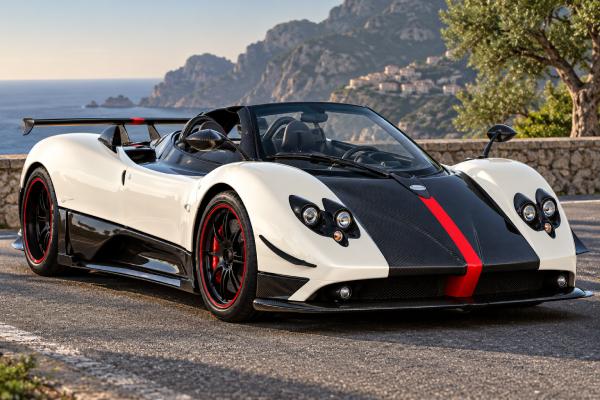
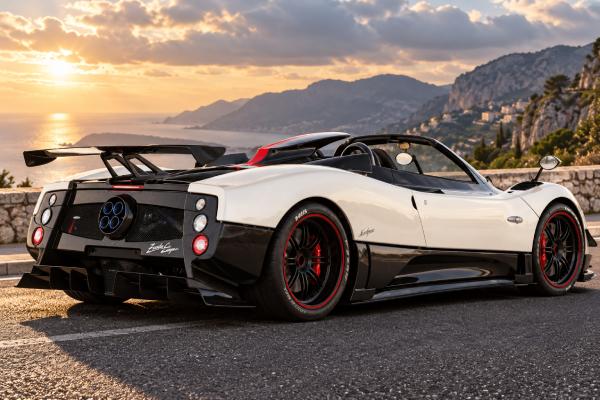
Removing the roof from a Pagani Zonda Cinque was not a matter of cutting away a panel and accepting extra mass. For the Zonda Cinque Roadster, Pagani redesigned the carbo-titanium structure around an open cockpit while preserving the coupé’s published 1,210 kg dry weight, 678 CV AMG V12 output, six-speed robotized sequential transmission, carbon-ceramic brakes, and quoted 750 kg of aerodynamic load at 300 km/h. Production was limited to five customer cars, with Pagani’s history also noting a prototype.
The result is one of the most specialized open Zondas and one that needs a roadster-specific inspection strategy. Roof fit and storage, the windscreen surround, sealing, cabin exposure, structural repair history, rear-body heat, and the condition of bespoke lightweight hardware all matter alongside the engine and gearbox. Contemporary reporting announced the Roadster in July 2009, while Pagani’s later historical material presents it as a 2010 model, which explains the 2009/2010 date range commonly attached to the version. The important buying reference is ultimately the individual chassis record.
Table of Contents
- Why the Cinque Roadster Required New Engineering
- Technical Baseline and Published Performance
- Roof Panel, Open Structure, and Weather Protection
- Airflow, Sound, and Temperature in the Open Cabin
- Sequential Driveline and Chassis Use on Real Roads
- Preservation, Provenance, and Pre-Purchase Due Diligence
Why the Cinque Roadster Required New Engineering
Pagani’s central challenge was to create an open Cinque without giving away the structural efficiency and low mass that defined the coupé. The factory says the carbo-titanium frame was specifically redesigned to compensate for the missing roof, rather than simply reinforced after the fact.
That distinction matters. In a fixed-roof monocoque, the upper structure can help connect the front and rear portions of the passenger cell. A roadster must achieve the required stiffness through the floor, sills, bulkheads, windscreen area, rear structure, and local reinforcement around openings. Every added layer or bracket has a mass penalty, so material selection and load paths become especially important in a car whose identity is tied to lightness.
Pagani nevertheless publishes the same 1,210 kg dry weight for the Roadster as for the Cinque coupé. The company also retained the 47/53 front-to-rear distribution quoted in driving condition. Those numbers do not prove that the two structures are identical—Pagani explicitly says the Roadster structure was redesigned—but they show the engineering target: open-air use without turning the Cinque into a heavier grand-tourer derivative.
The roof panel itself is part of the concept. Pagani describes it as removable and stowable under the front bonnet. This changes the ownership experience because the roof is not merely bodywork; it is a handled component that can be installed, removed, transported, and stored many times. Its condition, latching hardware, contact surfaces, seals, and storage equipment therefore deserve the same documentary attention as the car’s fixed panels.
Rarity adds another layer. Pagani’s model page states a limited run of five units. The company history describes five exclusive production cars plus a prototype. A buyer should distinguish those factory categories from later Zondas modified to resemble a Cinque Roadster. Pagani has legitimate programmes for restoration and extensive factory customization, so a later factory-evolved Zonda can be important in its own right without becoming one of the original five customer Cinque Roadsters.
The production-year story also benefits from precision. Period reports publicized the Roadster in July 2009, yet Pagani’s retrospective “Story of a Dream” material identifies the model as a 2010 Zonda Cinque Roadster. Registration, build, announcement, and delivery dates can therefore appear differently in catalogues. For a transaction, use the factory record and the specific car’s legal documents rather than treating a generic model-year label as definitive.
Finally, the open car should not be judged as a less serious Cinque. Pagani retained the same power, published acceleration, carbon-ceramic braking package, adjustable suspension concept, and high-load aero target. The Roadster changes the sensory and structural environment, not the fundamental performance brief.
Technical Baseline and Published Performance
The Cinque Roadster is a petrol-powered internal-combustion hypercar using a longitudinal mid-mounted naturally aspirated AMG V12 and rear-wheel drive. Its Cima six-speed sequential gearbox is robotized by Automac Engineering, while Bosch Engineering supplies core engine and chassis control electronics.
| Specification | Published configuration |
|---|---|
| Engine family | Mercedes-AMG M297 V12 |
| Displacement | 7,291 cc (7.3 L) |
| Induction | Naturally aspirated |
| Factory-rated power | 678 CV / PS (499 kW; about 669 bhp) |
| Maximum torque | 780 Nm (575 lb-ft) |
| Transmission | Cima 6-speed sequential, robotized by Automac Engineering |
| Drive | Rear-wheel drive |
| Item | Factory description |
|---|---|
| Central structure | Redesigned carbo-titanium monocoque for the Roadster |
| Roof | Removable panel; stows beneath the front bonnet |
| Engine/control electronics | Bosch Engineering ECU, traction control, and ABS |
| Suspension materials | Magnesium and titanium |
| Suspension adjustment | Adjustable setup |
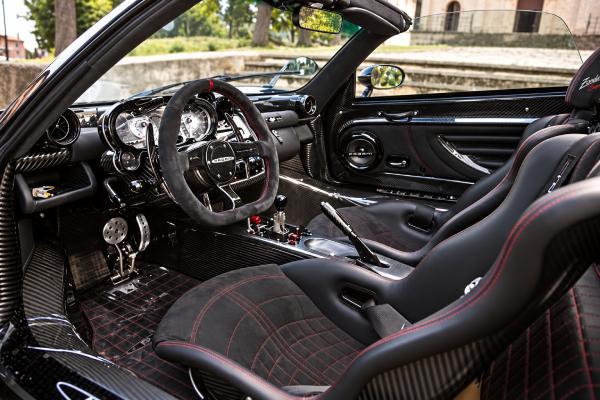
| Seats | Pagani leather/carbon-fibre racing seats |
| Component | Front | Rear |
|---|---|---|
| APP forged wheel | 9 × 19 in | 12.5 × 20 in |
| Wheel material | Aluminium/magnesium | Aluminium/magnesium |
| Brembo carbon-ceramic disc | 380 × 34 mm | 380 × 34 mm |
| Monobloc caliper | 6-piston | 4-piston |
| Measure | Factory figure |
|---|---|
| Dry weight | 1,210 kg (2,668 lb) |
| Driving-condition distribution | 47% front / 53% rear |
| Series production | 5 customer cars |
| Additional factory-history note | Pagani history mentions a prototype in addition to the five-car series |
| Test | Factory figure |
|---|---|
| 0–100 km/h (0–62 mph) | 3.4 seconds |
| 0–200 km/h (0–124 mph) | 9.6 seconds |
| 100–0 km/h | 2.1 seconds |
| 200–0 km/h | 4.3 seconds |
| Maximum quoted lateral acceleration | 1.45 g with road tyres |
| Aerodynamic load at 300 km/h | 750 kg (1,653 lb) |
Pagani’s current page describes the engine as 678 CV, despite some English-language material using “hp.” As with the Cinque coupé, 678 metric horsepower is approximately 669 mechanical bhp. This is a unit-conversion issue, not evidence that the Roadster was offered with two different output levels.
The exhaust is another defining component. Pagani specifies Inconel and titanium with a ceramic coating, a combination intended to tolerate high temperature while keeping mass low. On an inspection, its originality, mounting, heat shielding, and proximity to bodywork are more important than whether the tips remain cosmetically perfect.
Roof Panel, Open Structure, and Weather Protection
The removable roof should be treated as a fitted structural-adjacent component with its own condition history. A correct panel should locate cleanly, secure as designed, protect the cabin when installed, and survive removal and front-compartment storage without being bent, chipped, or abraded.
Start by inspecting the panel off the car in strong diffuse light. Look along both faces and all edges for clear-coat fractures, impact marks, crushed corners, delamination clues, repaired attachment points, or polishing that could conceal a former chip. Examine the hardware and contact pads for uneven wear. A panel that has been repeatedly placed directly on workshop floors may show edge damage long before the exterior surface looks poor.
Then install it. The panel should meet its locating points without being twisted into place. Latches should operate through a consistent range and should not require one person to push down on a corner while another forces the mechanism. If fit differs side to side, the cause could be as simple as aged sealing material or as significant as a repaired roof, altered latch position, or dimensional change in the surrounding structure.
The opening itself deserves a careful survey. Inspect the windscreen surround, upper door apertures, sill tops, rear bulkhead area, and any visible rollover structure for finish changes, disturbed fasteners, unusual sealant, stress marks, or evidence of previous dismantling. Because Pagani says the Roadster monocoque was redesigned specifically for open use, structural questions should be referred to technicians who understand the factory construction rather than a general carbon-fibre repair shop.
The underside matters just as much. Low splitters, flat-floor elements, and rear aerodynamic pieces are exposed to ramps, loading equipment, and road contact. Scraping on a replaceable surface is different from crushed laminate or a damaged structural edge. If a lift or transporter has contacted the wrong location, document the finding before anyone sands or refinishes it.
Weather protection should be tested carefully, not theatrically. Inspect sealing surfaces for hardening, flattening, tearing, residue, or previous adhesive work. Look inside for water tracks around the roof perimeter, door tops, windscreen base, and rear trim. Carpets, hidden cavities, connectors, seat mounts, and leather edges can reveal moisture even when the visible cabin has already been detailed.
Do not use a pressure washer as an improvised leak test. A concentrated jet can force water past seals that are designed for rain and airflow rather than a nozzle at close range. A controlled specialist test is safer and more informative if the history suggests leakage.
Storage practice is part of roof preservation. The panel should have the correct protective equipment and should be secured in the front compartment as intended before driving. Verify that nothing else is packed against it and that the compartment’s lining and retention points are intact. When the roof is stored separately, support it so no local load is carried by a corner or latch.
Completeness has real value here. Missing roof bags, tools, hardware, instructions, or bespoke storage pieces may be difficult to replace on a five-car series. Record each item individually instead of accepting a broad statement that “all accessories” accompany the car.
Airflow, Sound, and Temperature in the Open Cabin
Roof-off driving changes what the occupants hear and feel more dramatically than it changes the Cinque Roadster’s published performance. The intake above and behind the cabin, the lightweight exhaust, direct sunlight, and turbulent airflow create an environment that needs to be evaluated for both enjoyment and component care.
Pagani explicitly links the open experience to the large air inlet and the Inconel-titanium exhaust. With the roof removed, induction pulses and exhaust harmonics reach the cabin with less filtering than in a closed coupé. That makes the car spectacular at modest speed, but it also means a new rattle, metallic buzz, intake whistle, or hot-material odor can be easier to notice. Treat a changed sound as diagnostic information rather than automatically attributing it to “roadster character.”
The intake system should remain unobstructed and properly sealed. Inspect visible duct joints, mesh, fasteners, and nearby body surfaces. A loose trim piece or foreign object in the airflow path can become more than an annoyance at speed. The same logic applies to loose items inside the cabin: papers, caps, detailing cloths, and small accessories should be removed or secured before roof-off driving.
Heat soak deserves attention because the V12, gearbox, exhaust, and hydraulic systems sit close behind the occupants. The open roof can make a hot day feel cooler at speed, yet slow traffic may expose the cabin to strong radiant and convective heat. Test the air-conditioning system after the car is thoroughly warm. Its usefulness is not eliminated by an open roof; cool footwell air can materially reduce fatigue in traffic.
Interior materials face more ultraviolet light than they do in the coupé. Leather, Alcantara where fitted, exposed composite surfaces, stitching, polished metal, and switch markings can all age from sun and heat. Long static displays with the roof removed are particularly demanding because the cabin receives direct radiation without the cooling airflow available when moving.
Care products should be chosen conservatively. High-gloss dressings can change leather appearance, aggressive solvents can cloud coatings or harm printed markings, and strong cleaners may stain Alcantara or exposed composite finishes. When originality matters, preserving texture and finish is more important than making every surface look newly lacquered.
Driver comfort also has a safety dimension. Sustained wind noise can be tiring even when it feels exciting at first. For long roof-off journeys, appropriate hearing protection can reduce fatigue while still allowing the driver to hear horns, sirens, tyre noise, and passenger communication. The goal is not isolation; it is maintaining concentration.
Weather planning is unusually practical on this car. The roof may be stowable on board, but fitting it safely still takes time and a suitable stopping place. If the cabin is caught in rain, dry it methodically in a controlled environment. Strong direct heat can shrink leather or affect adhesives, while simply closing a wet car can trap moisture around electronics and trim.
The roadster experience is therefore best viewed as a system of airflow, temperature, noise, and material exposure. Owners who understand those interactions can use the car as intended without turning every open drive into accelerated cosmetic aging.
Sequential Driveline and Chassis Use on Real Roads
The Cinque Roadster combines very direct engine response with a robotized single-clutch sequential transmission and unusually capable brakes. Smooth use comes from understanding that those systems do not behave like a modern dual-clutch automatic, especially in traffic and at parking speed.
The Cima gearbox changes ratio sequentially while Automac Engineering’s actuation system manages the clutch and shift process. That architecture can produce a distinct interruption in acceleration because one clutch must disengage and re-engage around the gear change. A healthy system should be predictable, but it need not erase every mechanical event from the cabin.
Low-speed driving is where poor habits can create disproportionate wear. Repeated inching forward may require sustained clutch slip. When possible, leave space and move in a deliberate step rather than continuously creeping. On gradients, use the braking system according to the operating instructions instead of balancing the car with throttle and clutch engagement. Exact procedures and adaptation limits should be confirmed from Pagani documentation for the individual car.
During a pre-purchase test, observe first-gear take-up, reverse, neutral selection, hot restart behavior, pump or actuator noise, warning messages, and shift consistency at more than one load. A car that behaves well during one dramatic full-throttle upshift can still have low-speed hydraulic, sensor, clutch, voltage, or calibration problems.
The V12’s 780 Nm arrives without turbocharging, so throttle position has an immediate relationship with rear-wheel demand. Traction control is valuable, but cold or old tyres can reduce the available margin long before the electronics appear busy. On a collection car, tyre date codes and compound condition matter as much as tread depth.
Carbon-ceramic brakes also need context. Their published stopping performance assumes suitable operating conditions. Before driving hard, establish a firm pedal, confirm the absence of warning lights, and build temperature progressively. After high-energy use, follow the applicable cooldown guidance rather than parking immediately with unnecessary localized heat in one area of the disc.
Suspension condition should be judged by symmetry and control. The Roadster should not exhibit unexplained steering pull, repeated bouncing, clunks, or a difference in response from left to right. Inspect dampers, joints, wheel bearings, lightweight arms, attachment hardware, and alignment records. Magnesium and titanium components may require specific inspection and fastener practices that are not interchangeable with conventional steel parts.
Road height deserves planning. A long front overhang, deep splitter, flat-floor components, and rear diffuser can be damaged by ramps or transport equipment before the driver ever approaches the car’s performance envelope. Use a spotter when necessary and make sure the person remains visible to the driver. If the car has any lifting assistance, use it only within documented operating limits.
The most informative drive is not a top-speed demonstration. A route that includes a cold start, gentle traffic, a few gear changes under moderate load, broken pavement, normal braking, a warm stop, and a restart will reveal more about drivability and condition while exposing the car to less risk.
Preservation, Provenance, and Pre-Purchase Due Diligence
For a Cinque Roadster, preservation and authentication are inseparable. With only five customer cars, originality is not just a matter of resale presentation; it is the record that connects unusual parts and repairs to the specific chassis.
Begin with factory identity. The VIN should be confirmed through Pagani records as an original Cinque Roadster, not merely a Zonda that now carries Cinque-style equipment. Request the delivery specification, original colors and trim, relevant component identifiers, and a record of later factory work. Pagani’s Puro programme is especially useful because the company says it can compare a car with its factory database through more than 400 checks and document component authenticity and condition.
Then build a chronology. Service invoices, registration documents, photographs, transport records, insurance files, concours appearances, and sales records should tell a consistent story of mileage and configuration. A gap is not automatically a problem, but unexplained changes in color, roof, bodywork, gearbox behavior, or odometer history deserve resolution before money changes hands.
A specialist inspection should cover the whole car, with extra emphasis on roadster-specific areas:
- the removable roof panel, latches, seals, storage equipment, and fit on the car;
- the windscreen surround, upper apertures, sills, rear bulkhead, and visible rollover structure;
- underbody, splitter, diffuser, and lifting points for road or transport damage;
- V12 cold-start behavior, cooling, oil or fluid leakage, intake sealing, and exhaust heat management;
- sequential transmission hydraulics, clutch behavior, stored faults, and hot-operation consistency;
- carbon-ceramic discs and pads using approved wear criteria rather than appearance alone;
- wheel condition, correct fasteners, tyres by exact specification and age, dampers, and alignment;
- cabin electronics, air conditioning, leather/carbon seats, exposed trim, and evidence of water entry.
Age-sensitive maintenance must be evaluated independently of mileage. A low-use car can still need tyres, fluids, seals, hoses, battery work, damper service, or hydraulic attention. Ask how the car was exercised while stored and whether the gearbox, air conditioning, brakes, steering, and roof mechanisms were periodically operated. Static preservation can create its own failures.
Composite repair history requires exceptional transparency. Paintwork on a conventional metal panel can sometimes be evaluated with familiar techniques; a carbo-titanium structure cannot. If there has been an impact, insist on documentation of who evaluated it, what material was affected, how the repair was designed, and whether Pagani approved or performed the work.
Factory programmes provide useful distinctions. Rinascimento is aimed at restoration and conservation using original records, materials, moulds, and methods. Unico allows much more extensive factory-led customization and technical updating. A Cinque Roadster modified through Unico may remain a legitimate and fascinating Pagani, but a buyer focused on delivery originality should understand exactly what changed. Neither approach should be confused with undocumented aftermarket alteration.
Budget for commissioning before the first serious trip. Even a recently serviced car may need a fresh baseline of tyre dates, battery health, gearbox diagnostics, brake measurements, roof sealing, fluid status, ride height, and alignment. Having those results recorded immediately after purchase makes future changes easier to detect.
Finally, confirm legal and logistical details outside the car itself. Registration year, import status, taxes, title, roadworthiness requirements, insurance conditions, and approved transport methods can vary by jurisdiction. Because 2009 and 2010 both appear in the model’s public history, use chassis documents to establish the exact build and registration chronology rather than relying on an auction headline or generic database.
The strongest Cinque Roadster purchase is therefore one where three stories agree: Pagani’s factory record, the physical condition of the car, and the ownership documentation. When those align, the rarity becomes verifiable history instead of merely a claim attached to a very expensive Zonda.
References
- Zonda Cinque Roadster | Pagani — Pagani Automobili, current model archive.
- Zonda Cinque | Pagani — Pagani Automobili, related coupé engineering and specification.
- History | Pagani — Pagani Automobili, model-history record.
- Pagani Puro | Pagani — Pagani Automobili, authenticity and certification programme.
- Pagani Rinascimento | Pagani — Pagani Automobili, restoration and conservation programme.
- Pagani Unico | Pagani — Pagani Automobili, factory customization and technical-update programme.
Disclaimer
This article is for general information and is not a workshop manual, structural assessment, professional valuation, or repair instruction. Specifications, service intervals, torque settings, software, approved parts, registration details, and procedures can vary by VIN, market, equipment, and later factory work. Verify all safety-critical information against current Pagani documentation for the specific chassis and use appropriately qualified specialists.
If this guide was useful, consider sharing it with Pagani owners and enthusiasts on Facebook, X, or a relevant marque community.