
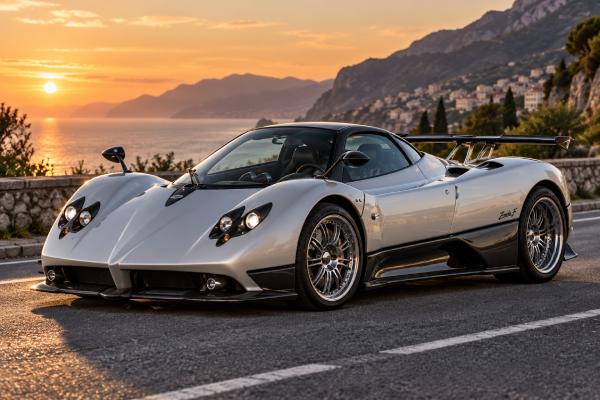
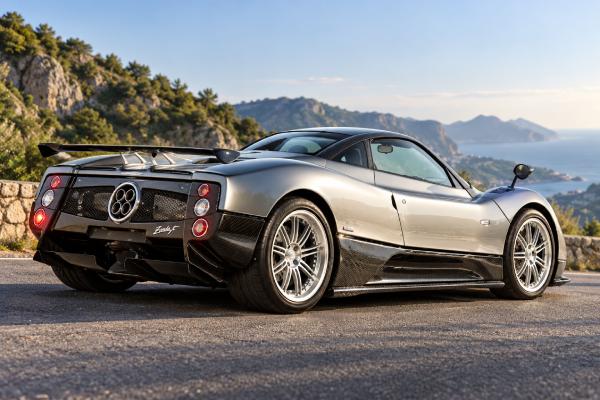
A standard Pagani Zonda F is a 602 hp car, not automatically a 650 hp Clubsport. That distinction is the starting point for understanding the 2005–2011 coupe because Pagani offered the higher-output engine and carbon-ceramic brakes on special request, while many individual cars were later upgraded, rebuilt, or personalized. In original 602 hp form, the Zonda F pairs a 7,291 cc naturally aspirated Mercedes-AMG V12 with a six-speed manual gearbox, rear-wheel drive, a carbon-fibre central safety cell, adjustable Öhlins dampers, and forged 19- and 20-inch wheels. Pagani published a 1,230 kg dry weight for the light configuration and a top speed above 345 km/h. More important than any headline number is the F’s role as the mature manual Zonda: it refined intake breathing, exhaust flow, aerodynamics, safety, and cabin craftsmanship while retaining the direct clutch-and-lever driving experience. For owners and buyers, the challenge is proving what specification a particular chassis had when new and what has changed since.
Table of Contents
- The 602 hp Zonda F and Why Specification Matters
- Zonda F Technical Specifications and Factory Data
- Fangio, Hydroformed Hardware, and the F’s Engineering Step
- What the Manual Zonda F Feels Like to Use
- Maintenance, Aging, and Long-Term Mechanical Care
- Originality, Clubsport Options, and Factory Upgrades
- How to Buy a 602 hp Zonda F with Confidence
The 602 hp Zonda F and Why Specification Matters
The standard Zonda F is defined by its 602 hp, 760 Nm AMG V12 and six-speed manual transmission. Pagani’s own specification sheet separates this from the 650 hp, 780 Nm Clubsport engine, which it labels as an option available on special request.
That one line in the factory data changes how the car should be described. “Zonda F” is the model family; “602 hp standard F” is the baseline coupe covered here. A car with the optional 650 hp engine, optional carbon-ceramic brakes, or later Pagani work can still be a genuine Zonda F, but its exact configuration needs to be stated rather than assumed.
The F appeared in 2005 as a tribute to Juan Manuel Fangio, the five-time Formula 1 world champion who had become a mentor and friend to Horacio Pagani. Pagani presents the project around four ideas shared with Fangio: lightness, safety, performance, and inventiveness. The letter F, the logo, and the concept were dedicated to him.
Compared with earlier road Zondas, the F was not simply an engine upgrade. It refined the body, cooling paths, intake and exhaust systems, suspension hardware, brakes, safety structure, and interior details. Pagani also offered visible natural-surface carbon bodywork at customer request, a treatment that later became strongly associated with the brand.
Production was extremely limited. Pagani stated in 2025 that 25 Zonda F coupes and 25 Roadster F examples were produced. That count is useful, but it does not mean all 25 coupes share the same equipment. Bespoke orders were part of the business model from the beginning, and individual cars can differ in brakes, trim, comfort equipment, finish, and later factory intervention.
The 2005–2011 range also needs sensible interpretation. A small-volume Pagani can have different build, completion, delivery, registration, or title dates. The correct year story belongs in the chassis documentation. A later registration does not by itself prove a late technical revision.
For a buyer, then, model identification should work from the car outward: confirm the chassis, obtain the factory build data, list original equipment, identify every later change, and only then apply labels such as standard, Clubsport-equipped, upgraded, or reconfigured.
Zonda F Technical Specifications and Factory Data
The 602 hp Zonda F is a naturally aspirated petrol ICE hypercar with a longitudinally mounted 60-degree AMG V12, a mechanical six-speed manual transaxle, and rear-wheel drive through a self-locking differential. The figures below use Pagani’s standard-car data and clearly separate optional Clubsport-related equipment where it matters.
| Specification | Standard Zonda F |
|---|---|
| Engine | Mercedes-Benz AMG 60-degree V12, 48 valves |
| Displacement | 7,291 cc (7.3 litres) |
| Induction | Naturally aspirated |
| Maximum power | 602 hp (443 kW) at 6,150 rpm |
| Maximum torque | 760 Nm (561 lb-ft) at 4,000 rpm |
| Gearbox | Mechanical six-speed plus reverse |
| Clutch | Twin-plate clutch |
| Drive | Rear-wheel drive with self-locking differential |
| Component | Factory specification |
|---|---|
| Central structure | Carbon-fibre safety cell |
| Front and rear frames | Chrome-molybdenum steel spaceframes |
| Body panels | Carbon-fibre MD System |
| Front suspension | Independent double A-arm, pull-rod springs, adjustable Öhlins dampers |
| Rear suspension | Independent double A-arm, pull-rod springs, adjustable Öhlins dampers |
| Suspension arms | Aluminium/magnesium alloy |
| Steering | TRW power-assisted rack and pinion |
| Driver aids | Bosch ABS and traction control |
| Item | Front | Rear |
|---|---|---|
| Standard steel brake disc | 380 × 34 mm, six-piston caliper | 355 × 32 mm, four-piston caliper |
| Optional carbon-ceramic disc | 380 × 34 mm, six-piston caliper | 380 × 34 mm, four-piston caliper |
| Forged APP wheel | 19 inches | 20 inches |
| Michelin Pilot Sport 2 tyre | 255/35 R19 | 335/30 R20 |
| Measure | Published value | Note |
|---|---|---|
| Length | 4,435 mm (174.6 in) | Factory dimension |
| Width | 2,055 mm (80.9 in) | Factory dimension |
| Height | 1,141 mm (44.9 in) | Factory dimension |
| Wheelbase | 2,730 mm (107.5 in) | Factory dimension |
| Dry weight | 1,230 kg (2,712 lb) | Without Comfort Pack and with CCM brakes |
| Weight distribution | 46% front / 54% rear | Published figure |
| Measure | Factory figure | Configuration |
|---|---|---|
| 0–100 km/h | 3.6 seconds | Zonda F published performance |
| 0–200 km/h | 9.8 seconds | Zonda F published performance |
| 200–0 km/h | 4.4 seconds | Factory braking claim |
| Maximum lateral acceleration | 1.4 g | SPORT setting |
| Top speed | More than 345 km/h | Factory claim |
| Downforce | 600 kg at 300 km/h | Clubsport version |
| Downforce distribution | About 270 kg front / 330 kg rear | Clubsport version |
The table deliberately does not assign the Clubsport downforce figure to every 602 hp car. The factory page marks that value as Clubsport-related, just as it marks 650 hp and carbon-ceramic brakes as optional. A chassis-specific build record is the right source when a particular car combines standard output with optional hardware.
Fangio, Hydroformed Hardware, and the F’s Engineering Step
The Zonda F’s engineering story is about removing mass and improving flow while making the car more mature. Pagani developed the intake, exhaust, chassis hardware, aerodynamics, and safety around the same naturally aspirated layout rather than using forced induction to create a simple power headline.
Pagani’s specification describes an aluminium hydroformed intake manifold using its MHG system and a hydroformed steel/Inconel exhaust manifold. Hydroforming uses internal pressure to shape a tube against a die, allowing complex smooth passages with controlled wall thickness. In this application, the goal was not just appearance. Pagani says intake length and airbox shape were optimized to distribute airflow across the cylinder banks, while the exhaust layout was positioned to improve gas flow.
That work suits the character of a large naturally aspirated V12. The engine develops its 760 Nm peak at 4,000 rpm and maximum power at 6,150 rpm, so performance builds with engine speed instead of arriving as a large turbocharged torque step. The driver can meter rear-tyre load with throttle position and rpm, which is part of why the old-school manual transmission still feels appropriate.
The F also uses expensive light materials where they reduce inertia or heat. Pagani highlights titanium, aluminium, magnesium alloys, Inconel, and carbon fibre throughout the car. Lower unsprung mass in wheels and suspension helps the tyres follow the road; lighter exhaust hardware reduces rear mass; carbon body panels keep weight away from the centre. These choices matter more dynamically than a single curb-weight comparison suggests.
Safety evolved at the same time. The carbon-fibre occupant cell works with front and rear energy-absorbing structures and a steel/carbon roll-bar arrangement. A 2000s hypercar still lacks many modern active-safety systems, so structural design, predictable chassis response, ABS, and traction control do most of the work.
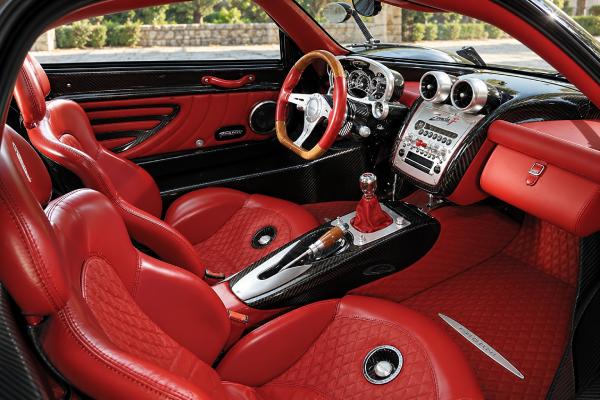
The cabin expresses the Fangio tribute differently. Pagani used a Nardi steering wheel with hand-finished wood and a dashboard inspired by antique watchmaking. The result deliberately avoids the anonymous black-plastic efficiency common to contemporary performance cars. Even the visible gear linkage makes the manual mechanism part of the visual design.
Natural-surface visible carbon was another important step. Pagani says the F was the first car for which a customer could request bodywork showing carbon fibre in its natural surface. That is now a familiar hypercar treatment, but on an F it is historically meaningful. Original lacquer, weave alignment, panel fit, and repair history deserve the same scrutiny as paint on a traditional coachbuilt car.
What the Manual Zonda F Feels Like to Use
The 602 hp F is best understood as a light manual car with a very large engine, not as an early version of today’s electronically filtered hypercar. The clutch, exposed gear linkage, steering load, tyre width, and rearward weight distribution make the driver responsible for managing the car’s balance.
The twin-plate clutch is the first mechanical conversation. A healthy clutch can still feel heavier and more deliberate than modern automated systems. Repeated slipping in traffic or on ramps creates heat, so low-speed use should be planned rather than rushed. A buyer should test engagement from cold and hot, listen for abnormal release-bearing or driveline noises, and ask for clutch replacement history instead of judging health solely by pedal feel.
The gearshift should be positive without being forced. Because the lever and linkage are such visible parts of the Zonda experience, cosmetic condition can distract from mechanical wear. Check selection of every gear, synchromesh behavior under gentle and quicker shifts, reverse engagement, and whether the lever returns cleanly. Any notchiness should be interpreted by a specialist familiar with the transaxle rather than compared with a mass-market manual.
Steering is power assisted but still tied closely to the front tyres. The 255-section front and 335-section rear Michelin package gives substantial mechanical grip, yet tyre age can radically change the car. A lightly used F on decade-old tyres may have more tread than a frequently driven car but far less safe grip. Date codes, storage history, flat spotting, cracking, and Pagani approval matter.
Brake specification changes the experience as well. Standard steel discs provide a different pedal and heat profile from the optional carbon-ceramic system. If a 602 hp F has ceramics, document whether they were ordered new or added later. If it has steels, do not call them an inferior mistake; they are the factory standard specification published for the base car.
Aerodynamics should be approached with equal precision. The dramatic 600 kg at 300 km/h figure belongs to the Clubsport configuration on Pagani’s current technical page. A standard-output car may have related or later aero equipment, but that needs proof. Spoiler angle, ride height, underbody panels, splitter condition, and alignment all affect high-speed behavior.
On ordinary roads, visibility and placement matter more than top speed. The forward cabin, broad rear body, low nose, and long doors require care in traffic and parking. The car’s best qualities appear when the road opens enough for the V12 to pull through its rev range without constant braking. It is fast by any standard, but its defining pleasure is the sequence of clutch, lever, steering, induction, and exhaust rather than launch-control numbers.
Maintenance, Aging, and Long-Term Mechanical Care
A Zonda F should be maintained by condition and time as well as mileage. Low use does not stop fluids, tyres, seals, batteries, hoses, adhesives, dampers, and fuel systems from aging, and it can make neglected problems harder to discover.
Start with the service history. The best records identify dates, mileage, exact work, parts used, software or diagnostic actions, and the technician or facility. Gaps matter more on a hand-built car because there is less room to substitute generic procedures. Pagani’s Puro program can compare the car against factory records and includes more than 400 checks of condition and authenticity.
Before recommissioning a stored car, inspect rather than simply start it. Check fluid levels and age, battery condition, fuel quality, tyre pressure and age, visible hoses, belts, leaks, rodent damage, and the engine bay for debris. A first start should be followed by observation of oil-pressure behavior, charging, cooling fans, exhaust smoke, warning lights, and leaks as temperature rises.
Engine oil and coolant specifications must come from current chassis-specific documentation. The same rule applies to gearbox oil, brake fluid, clutch hydraulics, torque values, and replacement intervals. Rare-car forums can be useful for experiences, but they are not a substitute for Pagani’s service information.
The suspension deserves more attention than its low mileage may suggest. Öhlins dampers contain seals and fluid that age; spherical joints, bushes, wheel bearings, and tie-rod ends can develop play; lightweight alloy arms should be checked for impact damage or corrosion at interfaces. Alignment should be recorded before and after work because geometry changes can affect steering feel and tyre wear significantly.
Brake maintenance depends on the installed system. Steel discs should be checked for corrosion, cracking, thickness, and pad condition. Carbon-ceramic discs need specialist inspection for impact damage and wear rather than casual visual judgment. In either case, caliper seals, hoses, fluid age, and pedal consistency matter. A museum-quality exterior does not guarantee a healthy hydraulic system.
Cooling and heat management are equally important. The F packages a large V12, exhaust, transaxle, and radiators within a light composite body. Keep ducts clear, inspect heat shielding, and investigate any temperature behavior that differs from the car’s established baseline. An unexplained hot smell or repeated fan issue is a reason to diagnose, not a quirk to normalize.
Finally, keep the car exercised properly. A full drive that brings fluids to stable operating temperature is generally more useful than frequent short starts. Store the car with appropriate battery support and environmental control, and use transport equipment that protects the low carbon bodywork. Preservation should keep the F functional, not merely static.
Originality, Clubsport Options, and Factory Upgrades
Originality on a Zonda F is a documented continuum, not a simple yes-or-no label. A 602 hp car may have left San Cesario with optional ceramic brakes, visible carbon, bespoke trim, or comfort equipment, and it may later have returned to Pagani for major changes.
The factory build book is therefore the baseline. It should establish the original power specification, brake system, exterior finish, interior materials, wheels, equipment, and identifying component data. From there, create a dated list of alterations. Separate Pagani work from independent work and distinguish reversible service replacements from permanent reconfiguration.
The difference is important because Pagani itself supports later evolution. Its Unico program can reconfigure older cars, while Rinascimento restores cars with original materials, drawings, molds, and processes. A car that became a 760-style one-off through Pagani is not “fake”; it is a different current object with a documented factory history. Conversely, a car advertised as an original 602 hp F should not quietly rely on later parts while being valued as untouched.
A useful modern example is the Zonda Riviera. RM Sotheby’s documented it in 2025 as a 2006 Zonda F that returned to Pagani and was comprehensively transformed through Unico with new bodywork, a 760-style aero package, and a seven-speed sequential transmission. That history makes the car fascinating, but it also illustrates why the original F population cannot be counted by appearance alone.
For collector purposes, retain removed original parts whenever practical and lawful. Original steel brakes, wheels, trim, exhaust pieces, panels, luggage, books, keys, covers, and tools can provide valuable evidence even after a factory upgrade. Store them correctly and link them to the chassis in written records.
Composite repair should be documented especially well. Exposed carbon can hide or reveal work depending on technique, but appearance is not enough. Ask who designed the repair, which materials and cure processes were used, whether adjacent structure was measured, and whether Pagani inspected the result. A replacement body panel and a structural monocoque repair are not equivalent events.
The best description of an F is therefore chronological: “built as X, optioned with Y, serviced at Z, upgraded by Pagani in year N.” That is more informative than forcing the car into a single marketing label.
How to Buy a 602 hp Zonda F with Confidence
Buying a standard-output Zonda F starts with proof that it is still, or was originally, the 602 hp specification you intend to acquire. The badge and current engine appearance are not enough because the factory itself offered Clubsport power and later upgrades.
Ask Pagani or an authorized specialist for a chassis-level build summary before negotiating on originality. Then compare the physical car with that record. Confirm powertrain specification, brakes, wheels, exterior carbon or paint, interior materials, comfort equipment, and any model-specific accessories. Photograph identifying marks and serial numbers where access is appropriate.
A proper inspection should include both cold and fully warm operation. On the first start, note crank speed, warning lights, idle quality, smoke, fluid pressure behavior, and leaks. During the drive, assess clutch take-up, all gear selections, steering assistance, suspension noises, brake consistency, traction-control and ABS warnings, cooling behavior, and air-conditioning. Afterward, inspect underneath for fresh leaks, heat effects, damaged aero surfaces, loose fasteners, and tyre contact.
Do not let low mileage shorten that process. An F that has covered only a few hundred kilometres in several years may need more recommissioning than a regularly serviced car with a higher odometer. Ask how it was stored, whether it was started without being driven, when the tyres were fitted, and how often fluids were changed.
Body condition needs specialist interpretation. Measure panel fit, inspect exposed weave and clear coat in different light, check the underside of clamshells, and look for stress around hinges and mounting points. Evidence of repair is not automatically disqualifying; undocumented repair is the problem. The repairer, materials, method, and post-repair verification should be known.
Value is likewise chassis specific. Production of 25 coupes is small enough that a single public sale can distort expectations. Original specification, Pagani certification, condition, mileage, famous ownership, exceptional color, factory upgrades, geography, tax status, and accompanying materials all influence the transaction. Use recent comparable evidence as context, not as an automatic price formula.
Budget after purchase for a baseline service even when the car has been inspected. Fresh fluids, tyre replacement, battery work, alignment, clutch or brake attention, and minor age-related repairs can be sensible ways to establish a known starting point. Preserve every invoice and diagnostic report from the first day of ownership.
A 602 hp Zonda F is appealing precisely because it sits before the later chase for ever larger outputs. Its manual gearbox, standard engine tune, Fangio connection, and blend of mechanical and decorative craftsmanship give it an identity of its own. The best example is not necessarily the car with the most later upgrades or the lowest number on the odometer. It is the chassis whose original specification, subsequent work, and present mechanical condition are all clearly understood.
References
- Zonda F | Pagani 2026 (Manufacturer Specifications)
- Pagani Automobili at the Historic Minardi Day 2025:a weekend celebrating emotions, performance, and passion. | Pagani 2025 (Production and Model History)
- History | Pagani 2026 (Fangio and Zonda Development)
- “Pagani Puro”, the program created to certify the authenticity and enhance the value of our exclusive cars over time | Pagani 2021 (Factory Authentication)
- Pagani Rinascimento | Pagani 2017 (Factory Restoration)
- The Rise of The Zonda | RM Sotheby’s 2025 (Model and Collector Context)
Disclaimer
This article is for informational purposes and does not replace professional diagnosis, inspection, valuation, or repair. Specifications, torque values, service intervals, procedures, options, and parts can vary by VIN, market, original order, and later factory work; verify every technical decision against the official documentation for the exact car. If this guide helps, please share it through Facebook, X/Twitter, owner communities, or specialist forums to support accurate identification and careful maintenance.