
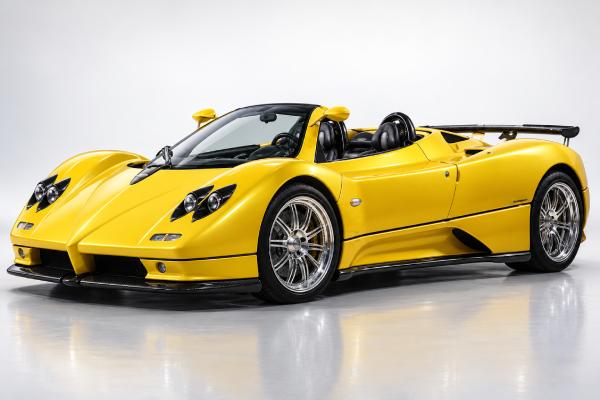
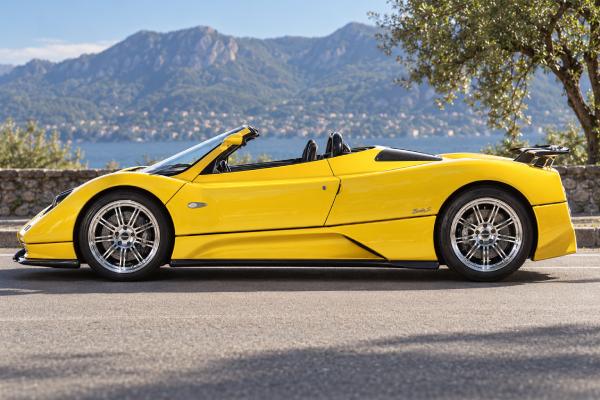
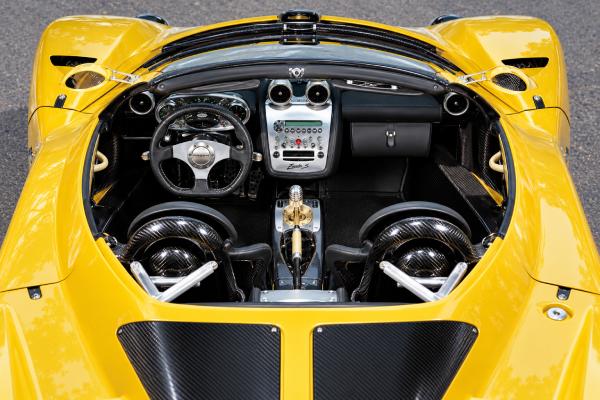
Removing the fixed roof from a carbon-chassis supercar is easy in concept and difficult in engineering. The 2003–2005 Pagani Zonda Roadster S is interesting because Pagani did not simply cut open the Zonda S coupe and accept extra mass or softness. The factory developed a roadster-specific carbon central structure, retained the 7,291 cc naturally aspirated AMG V12 and six-speed manual gearbox, and published the same 1,280 kg dry weight and 3.7-second 0–100 km/h claim as its contemporary 7.3-litre specification.
That engineering makes the Roadster a different ownership proposition, not just a different view of the sky. Roof-panel fit, seals, windscreen surround, rollover structure, drainage, cabin exposure, and composite condition all become inspection items alongside the V12, gearbox, brakes, and suspension. Production records also require care: Pagani describes a planned limited run of 40, while period auction records quote different completed totals. For a buyer, the individual chassis and its factory documentation are therefore more trustworthy than repeating a single internet production number.
Table of Contents
- The Engineering Brief Behind the Open Zonda
- Roadster S Specifications and Hardware
- Roof Panel, Structure, Sealing, and Weather Protection
- How Open-Air Driving Changes Noise, Heat, and Control
- Roadster-Specific Maintenance and Storage
- Pre-Purchase Checks That Matter Most
- Originality, Factory Work, and Ownership Priorities
The Engineering Brief Behind the Open Zonda
The Zonda Roadster S was designed to preserve the coupe’s basic dynamic character while allowing the roof to be removed. Pagani’s solution centered on a dedicated carbon-fibre monocoque with the torsional and bending strength needed for an open body, rather than relying on heavy add-on reinforcement after the fact.
The powertrain remained the familiar 7.3-litre naturally aspirated Mercedes-AMG V12. Output was 555 hp at 5,900 rpm, with 750 Nm at 4,050 rpm, sent through a twin-plate clutch and six-speed manual gearbox to the rear wheels. Traction control and ABS were standard, useful additions in a light car with a very broad torque curve.
The roadster-specific work is easiest to see around the passenger cell. The removable roof panel changes the load path through the upper structure, so the sills, windscreen frame, rear structure, rollover protection, and local carbon lay-up must carry forces that a fixed roof normally helps distribute. A period RM Sotheby’s description also identifies an elliptical rollover structure tied into the rear chassis and built from carbon fibre and chrome-molybdenum alloy.
Roadster aerodynamics were revised as well. Period descriptions note changes around the rear engine cover, including NACA ducts, while Pagani retained the distinctive Zonda proportions and central quad exhaust. The open cabin adds another airflow problem: the car must remain stable while also managing buffeting around the occupants and roof opening.
The 19-inch forged wheels are another roadster-specific visual and mechanical cue. Pagani lists forged aluminium wheels with Michelin Pilot Sport tyres sized 255/35 R19 at the front and 345/30 R19 at the rear. Compared with the 18-inch setup on the contemporary coupe, the roadster’s wheel and tyre package changes sidewall height and should be considered when judging ride, steering response, and originality.
Production quantity needs careful wording. Pagani’s current model page says the cars were produced in a limited run of 40 units. A 2011 RM Sotheby’s listing contains internally inconsistent historical statements, including an addendum reporting factory confirmation of only 12 Roadsters and body text that refers to 25 completed examples. Rather than choosing one secondary figure, a buyer should use Pagani’s chassis records to establish the exact production context of the car being inspected.
Roadster S Specifications and Hardware
The Roadster S is a naturally aspirated petrol ICE car with a mid-mounted V12, manual six-speed transmission, rear-wheel drive, and a roadster-specific carbon central structure. Its published performance closely matches the coupe despite the engineering demands of an open body.
| Specification | Factory figure |
|---|---|
| Engine | Mercedes-Benz M120 7.3 AMG V12 |
| Configuration | 60-degree naturally aspirated V12 |
| Displacement | 7,291 cc (7.3 L) |
| Maximum power | 555 hp (408 kW) at 5,900 rpm |
| Maximum torque | 750 Nm (553 lb-ft) at 4,050 rpm |
| Gearbox | Six-speed manual plus reverse |
| Clutch | Twin-plate |
| Drive | Rear-wheel drive with self-locking differential |
| Specification | Value |
|---|---|
| Body style | Two-seat roadster with removable roof panel |
| Central structure | Carbon-fibre roadster monocoque |
| Front/rear frames | Chrome-molybdenum steel spaceframes |
| Body panels | Carbon-fibre composite |
| Length | 4,395 mm (173.0 in) |
| Width | 2,055 mm (80.9 in) |
| Height | 1,151 mm (45.3 in) |
| Wheelbase | 2,730 mm (107.5 in) |
| Dry weight | 1,280 kg (2,822 lb) |
| Component | Configuration |
|---|---|
| Suspension | Independent double A-arm |
| Springing | Coil springs |
| Dampers | Adjustable Öhlins hydraulic dampers |
| Anti-roll control | Anti-roll bars |
| Suspension arms | Aluminium alloy |
| Steering | Power-assisted TRW rack and pinion |
| Traction control | Standard |
| ABS | Standard |
| Component | Front | Rear |
|---|---|---|
| Brembo brake discs | 355 mm ventilated | 335 mm ventilated |
| Calipers | Four-piston | Four-piston |
| Wheels | 19-inch forged aluminium | 19-inch forged aluminium |
| Michelin Pilot Sport tyres | 255/35 R19 | 345/30 R19 |
| Measure | Figure | Context |
|---|---|---|
| 0–100 km/h | 3.7 seconds | Pagani manufacturer claim |
| Weight-to-power ratio | 2.30 kg/hp | Pagani manufacturer figure |
| Top speed | Period sources report roughly 345–350 km/h (214–217 mph) | Not stated on the current Pagani model page |
The performance table deliberately separates Pagani’s current published figures from period top-speed reporting. A buyer does not need an uncertain maximum-speed claim to evaluate the car, and there is no value in presenting one secondary number as more precise than the underlying sources allow.
Roof Panel, Structure, Sealing, and Weather Protection
The roof system is the first roadster-specific area to inspect because it affects structural fit, water sealing, cabin security, and the completeness of the car. A removable carbon panel is not just an accessory; it is part of the engineered body system and a valuable original component.
Begin with the panel itself. Inspect both faces under good light, including edges, corners, latch areas, locating points, and the finish around any exposed carbon. A small chip on a cosmetic surface is different from a crack that runs from a fastener or an edge. Any repair should have documentation, especially if it is near a load-bearing latch or locating feature.
Fit the panel slowly. It should locate without being twisted into place, and the hardware should close with predictable effort. Unequal latch tension, a corner that sits proud, or a panel that must be forced can indicate maladjusted hardware, aged seals, a repaired roof, or a change in the opening geometry. Do not accept excessive force as normal simply because the car is hand built.
The windscreen surround deserves equal attention. It forms the leading edge of the open passenger cell and is exposed to both aerodynamic pressure and roof-panel loads. Look for surface cracking, movement, disturbed sealant, mismatched fasteners, or evidence that trim has been removed repeatedly. The rear rollover structure and its attachment areas should be inspected at the same time.
Water management is a system rather than a single rubber seal. Inspect roof seals, door seals, window alignment, drain paths, and interfaces around the windscreen and rear deck. Water intrusion may reveal itself far from the entry point, so lift removable mats and inspect hidden areas for staining, odor, corrosion on hardware, or marks on electrical connectors.
A hose test can be useful if performed carefully and only with the owner’s permission, but flooding the roof with high-pressure water proves little. The better test is controlled wetting while someone watches the inside and checks drainage. The car should then be dried thoroughly.
Completeness also matters. The roof panel’s proper storage bag or case, any tools required for installation, and factory instructions should stay with the car. On a rare roadster, replacing a missing panel or bespoke hardware is not equivalent to ordering a generic convertible-top part. It may require factory support or bespoke manufacture.
How Open-Air Driving Changes Noise, Heat, and Control
With the roof removed, the Roadster S exposes the driver more directly to the Zonda’s intake, exhaust, heat, and airflow. The engine does not change, but the sensory balance does, and that affects both comfort and how mechanical problems are noticed.
The V12 remains smooth at low load, yet induction and exhaust noise become more prominent because there is less structure separating the occupants from the outside air. Wind noise rises with speed, and its character can help reveal sealing or alignment problems when the roof is installed. A sudden whistle from one corner, for example, may point to local seal compression or window adjustment.
Heat can be more noticeable after slow driving because the open cabin does not remove the engine’s thermal load; it only changes how the occupants experience it. The engine and exhaust still sit directly behind the passenger cell. Check that cabin ventilation and air conditioning work properly, because climate control is not merely a luxury when a large V12 and hot exhaust are close to the seats.
With the roof off, loose items must be secured. Light papers, caps, or small objects can leave the cabin or interfere with controls. Seatbelts should retract and latch correctly, and the area around the rear hoops should be kept clear. These are ordinary roadster habits, but the consequences of distraction are greater in a car with 750 Nm and very wide rear tyres.
The steering and suspension should not feel loose merely because the body is open. Pagani engineered the roadster structure for rigidity, so persistent scuttle shake, unusual creaking from the windscreen area, or new alignment sensitivity deserves investigation. Some body noise over broken surfaces can be normal in a handcrafted car, but a change in noise is more important than the absolute volume.
Tyre temperature remains critical. The 345/30 R19 rear tyres have enormous grip when healthy and within an appropriate temperature range, but old or cold tyres can make the car dramatically less forgiving. Traction control is useful, not magical. Full throttle in a low gear with steering lock should be treated with respect even on dry pavement.
The manual gearbox and twin-plate clutch require the same mechanical sympathy as the coupe. Avoid aggressive cold shifts, do not hold the car on the clutch, and let drivetrain fluids warm before repeated high-load operation. A roadster encourages casual scenic driving, but that relaxed context does not reduce the mechanical demands of the powertrain.
Roadster-Specific Maintenance and Storage
A Roadster S needs all the normal Zonda maintenance plus a second maintenance track for the removable roof, seals, drainage, exposed cabin, and open-body structure. Ignoring those items can create water or fit problems that are far harder to correct after years of neglect.
At each major service, inspect the roof panel and hardware rather than storing it untouched. Clean the seal contact surfaces gently, check rubber for hardening or deformation, verify latch fasteners, and confirm that the panel still fits without force. Any lubricant used on hardware or seals should be approved for the surrounding materials; generic sprays can stain leather, attack rubber, or contaminate carbon finishes.
Drain paths should be kept clear. Dust, detailing residue, and small debris can block a channel even when the car is never left outside. Water that cannot leave the designed route may migrate into trim, wiring, or bonded areas. If the car is washed, inspect the cabin afterward rather than assuming a dry seat surface means the structure is dry.
Cabin care is different with an open top. Leather, stitching, carbon, aluminium, and instrument surfaces receive more ultraviolet exposure and airborne grit. Sunscreen and skin oils can mark leather and metal. Use the least aggressive cleaner that works and avoid silicone-heavy dressings or products that leave slippery residue on controls.
Long-term storage should be indoors with stable humidity. The roof can remain installed if that is consistent with Pagani guidance and seal condition, but it should not be clamped with unnecessary force. If stored separately, the panel needs its proper support and protection so weight cannot rest on edges or hardware.
Mechanically, age remains the bigger risk than mileage for many examples. Track fluid history, hose condition, tyre dates, battery health, brake fluid, damper condition, and signs of fuel-system deterioration. A car that has traveled very few kilometres may still need significant recommissioning after years of static storage.
Cooling-system checks are especially important before slow urban use in warm weather. Verify fan operation, inspect radiators and hoses, and watch temperature behavior after the car stops moving. Open-top driving can make the occupants feel comfortable while the engine bay remains under heavy thermal load.
Keep documentation for every intervention, including minor roof adjustments. On a rare roadster, a small change in latch position or window alignment can later become important evidence when diagnosing wind noise or water ingress. Photographs before and after work are inexpensive insurance against confusion.
Pre-Purchase Checks That Matter Most
The best Roadster S inspection starts with the body opening and chassis identity, then works outward to the drivetrain. Mechanical repairs can be expensive, but poorly documented structural or roof-system work can be even harder to assess and may affect historical value.
Confirm the chassis number and original factory specification before inspecting cosmetics. Pagani records should show exterior color, interior trim, engine specification, and the car’s original roadster configuration. Ask specifically about later factory repairs, restoration, upgrades, or body changes.
Inspect the car both with the roof fitted and removed. Check panel fit, seals, windows, windscreen surround, rear hoop area, door openings, sill surfaces, underbody carbon, and frame attachments. Look for cracks, whitening, repaired weave, unusual clear-coat transitions, or mismatched fasteners. Suspicious composite areas should be evaluated by a specialist rather than judged only from appearance.
Then perform a cold-start mechanical check. Observe oil pressure, idle quality, exhaust smoke, fluid leaks, and warning lamps. Allow the engine to warm fully, test fan operation, cycle the air conditioning, and inspect again for leaks that appear only when systems are pressurized and hot.
On the road, work through every gear, feel clutch engagement, test steering return, and build brake pressure progressively. Listen for suspension noise on low-speed bumps and body noises around the windscreen and rear structure. With the roof installed, check for wind noise. If conditions allow and the owner agrees, a controlled water test can follow.
The final inspection should include the loose equipment: roof storage solution, keys, books, tools, service invoices, factory correspondence, Puro or Rinascimento records, and any removed original parts. Missing roadster-specific items can be surprisingly difficult to source.
Before buying, the file should answer at least these points:
- Is the chassis unquestionably an original 7.3-litre Roadster S?
- Does the current roof, body, engine, and interior match the documented configuration or later factory work?
- Has any structural carbon or rollover area been repaired?
- Are the roof seals, drains, windows, and latches functioning correctly?
- Are tyre age, brakes, dampers, fluids, battery, and cooling system suitable for immediate use?
- Is there a realistic budget for corrective work that cannot be completed before delivery?
Originality, Factory Work, and Ownership Priorities
A Roadster S can be a preservation object, a regularly driven open-top supercar, or a platform for sanctioned Pagani evolution. The right example depends on which of those goals the buyer actually has.
For preservation, prioritize a clear period specification, original roadster hardware, complete accessories, and a strong history. Cosmetic perfection is less important than knowing why a part was replaced and whether the replacement is correct. Factory restoration through Pagani Rinascimento can be especially valuable when it documents the return to original materials and configuration.
For driving, condition should take priority over odometer pride. Fresh tyres, healthy dampers, a dry roof system, strong cooling, clean gearbox operation, and recent fluid service make the car easier to use confidently. A low-mileage car with old tyres and dormant seals can require more immediate work than one that has been exercised regularly.
Factory personalization needs its own category. Pagani Unico can transform older cars with new bodywork, suspension, mechanical parts, and trim. That work can be artistically and technically significant, but it should not be confused with a period-correct Roadster S. Documentation should make the car’s current identity transparent.
The Roadster S is ultimately appealing because it preserves the manual, naturally aspirated early-Zonda experience while making the cabin part of the environment around it. Owning one well means caring for the open structure with the same seriousness as the V12. Keep the roof system complete, keep water out, keep the chassis history clear, and keep the mechanical systems exercised and documented. Those habits protect both the driving experience and the meaning of a rare early Pagani roadster.
References
- Zonda Roadster | Pagani 2026 (Manufacturer History and Specifications)
- History | Pagani 2026 (Manufacturer Timeline)
- Pagani Puro | Pagani 2026 (Factory Authentication)
- Pagani Rinascimento | Pagani 2026 (Factory Restoration)
- 2005 Pagani Zonda C12 7.3 S Roadster | London 2011 | RM Sotheby’s 2011 (Roadster Construction and Chassis Context)
- 2003 – 2005 Pagani Zonda C12 S 7.3 Roadster – Images, Specifications and Information 2004 (Company-Release-Based Model Information)
Disclaimer
This Roadster S guide is informational and cannot establish the safety or condition of an individual open-top Zonda. Roof hardware, seals, rollover structure, composite repairs, brake parts, service intervals, tightening procedures, and other specifications may vary with chassis history and later factory work. Have the exact VIN and its current Pagani technical information checked by an appropriate specialist before maintenance, repair, structural assessment, or purchase decisions.
If you know another enthusiast researching a Roadster S, you can share this guide through Facebook, X, or the owners’ community you use.