
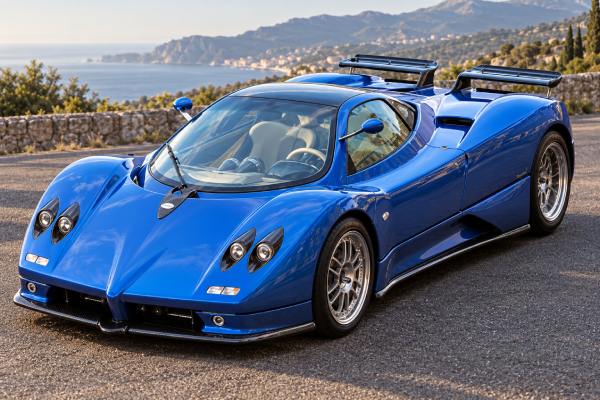
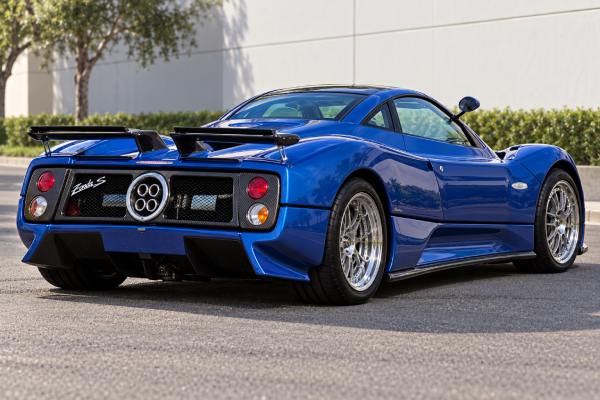
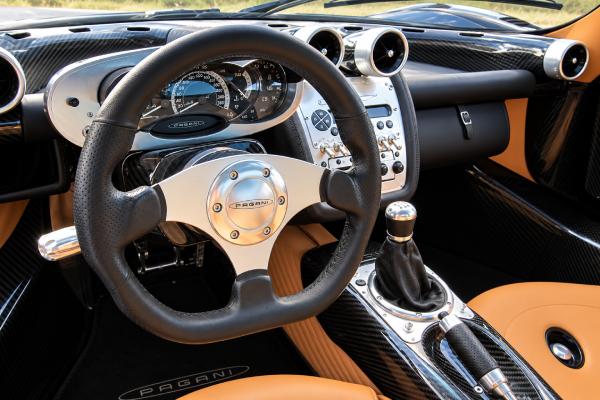
By 2002, Pagani no longer needed to prove that the Zonda concept worked; the 7.3-litre Zonda S showed how far that concept could be developed without abandoning its analog core. It paired a 7,291 cc naturally aspirated Mercedes-AMG V12 with a six-speed manual gearbox, rear-wheel drive, traction control, adjustable Öhlins dampers, and a carbon-fibre central structure. Factory output was 555 hp at 5,900 rpm and 750 Nm at 4,050 rpm, enough for a claimed 0–100 km/h time of 3.7 seconds.
What makes the 2002–2005 S 7.3 interesting today is not just speed. It is the balance between a large, flexible V12 and a chassis that still asks the driver to manage gears, brake pressure, steering, and rear-tyre grip directly. Buying one requires equal attention to that engineering and to its individual history. Zondas were bespoke when new, many have received later factory work, and even published weight figures can conflict. The car in front of you—and Pagani’s record of it—matters more than a generic database entry.
Table of Contents
- Where the 7.3-Litre Zonda S Fits
- Engine, Chassis, and Performance Data
- Torque, Traction Control, and Driver Workload
- High-Speed Aero, Suspension, and Braking Balance
- Service Priorities as the S 7.3 Ages
- A Chassis-by-Chassis Inspection and Provenance Guide
- Choosing the Right S 7.3 for Your Intended Use
Where the 7.3-Litre Zonda S Fits
The Zonda S 7.3 is the mature version of Pagani’s early manual coupe: more torque and more developed aerodynamics than the first C12s, but still without the later Zonda F’s carbon-ceramic focus or the Cinque’s automated sequential transmission. That position gives it a distinct identity rather than making it merely an interim model.
Pagani enlarged the V12 to 7,291 cc and retained natural aspiration. Titanium connecting rods, a dedicated intake system, and AMG development helped the engine produce 555 hp while maintaining a broad torque curve. Pagani states that the engine can already produce 620 Nm at 2,000 rpm and reaches 750 Nm at 4,050 rpm. That low- and mid-range strength is central to how the car works on the road.
The S 7.3 also arrived with a more developed aerodynamic package. Contemporary manufacturer-derived material describes a revised pointed nose, optimized air inlets, a dual-spoiler arrangement moved rearward, and substantial negative lift at very high speed. The goal was not styling alone. Air had to cool the engine and brakes, stabilize the body, and preserve predictable balance as speed rose.
Naming can still cause confusion. Specialist sources often call the car the “Zonda C12 S 7.3,” while Pagani’s current official page uses “Zonda S.” Both describe the same 7.3-litre early-series coupe family, but buyers should not assume that every car advertised under either name has identical equipment. These were hand-built cars, and Pagani’s later programmes can alter body, suspension, engine, interior, and other hardware legitimately.
Production references commonly place the original coupe run in the high teens. Treat that figure as context rather than a substitute for documentation. A factory-restored or factory-updated chassis may no longer look exactly like a period photograph, and a visually standard car may have a much more complicated history underneath. For a valuable, low-production Zonda, the correct question is always “what did this chassis leave the factory as, and what happened next?”
The S 7.3 therefore appeals to two different kinds of owners. One wants the period specification preserved: manual gearbox, early aero, steel brakes, 18-inch wheels, and the 555 hp engine. The other values the fact that Pagani still supports old Zondas and may accept or even prefer later factory updates. Both are valid, but they should be represented accurately when the car is sold.
Engine, Chassis, and Performance Data
The S 7.3 is a naturally aspirated petrol ICE car with a longitudinal mid-mounted V12 and rear-wheel drive. Its technical character comes from combining the 7.3-litre engine with a manual transaxle, limited-slip differential, traction control, double-wishbone suspension, and a carbon central chassis.
| Specification | Factory figure |
|---|---|
| Engine | Mercedes-Benz M120 7.3 AMG V12 |
| Configuration | 60-degree V12 |
| Displacement | 7,291 cc (7.3 L) |
| Induction | Naturally aspirated |
| Maximum power | 555 hp (408 kW) at 5,900 rpm |
| Maximum torque | 750 Nm (553 lb-ft) at 4,050 rpm |
| Low-rpm torque | Pagani states 620 Nm at 2,000 rpm |
| Fuel | Petrol/gasoline |
| Specification | Configuration |
|---|---|
| Gearbox | Six-speed manual plus reverse |
| Clutch | Twin-plate |
| Driven wheels | Rear-wheel drive |
| Differential | Self-locking limited-slip type |
| Traction control | Standard |
| ABS | Standard |
| Component | Specification |
|---|---|
| Suspension | Independent double A-arm |
| Spring/damper arrangement | Pull-rod coil springs with adjustable Öhlins dampers |
| Suspension arms | Aluminium alloy |
| Anti-roll control | Front and rear anti-roll bars |
| Steering | Power-assisted TRW rack and pinion |
| Front brakes | 355 mm ventilated Brembo discs, four-piston calipers |
| Rear brakes | 335 mm ventilated Brembo discs, four-piston calipers |
| Specification | Value |
|---|---|
| Wheels | 18-inch aluminium-alloy OZ |
| Front tyres | Michelin Pilot Sport 255/40 ZR18 |
| Rear tyres | Michelin Pilot Sport 345/35 ZR18 |
| Central chassis | Carbon-fibre structure |
| Front/rear structures | Chrome-molybdenum steel spaceframes |
| Body panels | Carbon-fibre composite |
| Specification | Factory figure | Context |
|---|---|---|
| Length | 4,395 mm (173.0 in) | Pagani specification |
| Width | 2,055 mm (80.9 in) | Pagani specification |
| Height | 1,151 mm (45.3 in) | Pagani specification |
| Wheelbase | 2,730 mm (107.5 in) | Pagani specification |
| Dry weight | 1,280 kg (2,822 lb) | Current Pagani specification |
| 0–100 km/h | 3.7 seconds | Manufacturer claim |
| Weight-to-power ratio | 2.30 kg/hp | Manufacturer figure |
Some period technical publications list a lower 1,250 kg figure. Because Pagani’s current S page states 1,280 kg, that is the figure used here. The disagreement is a reminder to preserve the source’s weight definition rather than combining “dry,” “empty,” and “curb” figures as though they were interchangeable.
Torque, Traction Control, and Driver Workload
The S 7.3’s strongest dynamic trait is its torque spread: the V12 has enough output at low rpm to make short-shifting effortless, yet it continues building power toward 5,900 rpm. That allows the driver to choose between relaxed speed and a much more intense upper-range experience without waiting for a turbocharger to wake up.
On public roads, the 620 Nm figure quoted at 2,000 rpm is arguably more useful than peak horsepower. It means a higher gear can still produce serious acceleration, reducing the need to chase revs every time the road opens. At the same time, throttle movement is mechanically important because the rear tyres have to manage up to 750 Nm with no driven front axle to help.
Traction control is therefore not an admission that the chassis is unruly; it is a sensible layer over a very light, very powerful rear-drive car. The system should be treated as a safety aid rather than a license to use full throttle regardless of tyre temperature, road surface, or steering angle. Old or mismatched tyres can overwhelm any early-2000s intervention strategy much faster than a warning light can save the situation.
The manual gearbox keeps the driver involved in load management. A downshift changes rear-axle torque and can unsettle the car if the clutch is released abruptly. A smooth heel-and-toe technique reduces that disturbance, but there is no need to perform theatrical shifts on the road. Mechanical sympathy matters more than speed of hand movement.
Clutch and gearbox condition should be judged when both cold and warm. A clutch that bites cleanly during the first maneuver may reveal slip only under high load. A gearbox that feels stiff during the first few kilometres may improve with temperature, while a worn synchro often continues to complain in the same gear. Record what changes as the drivetrain warms rather than making a verdict from the first shift.
Pedal feel is also part of the inspection. Pagani’s exposed metal pedal assembly and mechanical controls should move consistently without sticking, excessive lateral play, or fluid leaks. The accelerator should return cleanly. The brake pedal should remain firm and repeatable. Any sudden change in travel or effort deserves investigation before performance driving.
The 7.3-litre engine itself should feel exceptionally smooth for its size. Misfire, unstable idle, hesitation, or abnormal vibration is not something to excuse because the car is old. The M120 lineage has a strong reputation, but a Pagani installation has bespoke intake, exhaust, cooling, electronics, and packaging. Diagnosis must therefore treat the car as a Pagani, not as a Mercedes sedan with a familiar engine family.
High-Speed Aero, Suspension, and Braking Balance
Pagani developed the S 7.3 to remain stable at speeds where small setup errors become large problems. Its aero, damper adjustment, tyres, alignment, and brakes therefore need to be viewed as a single balance rather than as separate upgrade opportunities.
Manufacturer-derived period material describes the body as producing roughly 500 kg of negative lift at 300 km/h. Whether an owner ever approaches that speed is secondary; the figure shows the design intent. The pointed nose, air-management surfaces, rear spoiler arrangement, flat underbody work, and rear extraction were designed to push the center of aerodynamic pressure into a stable relationship with the chassis.
That makes correct ride height and body configuration important. An aftermarket splitter, altered rear wing angle, non-standard springs, or incorrect rake may change more than appearance. On a car that was developed as an integrated aerodynamic package, visual modifications should not be assumed harmless. If the car has later Pagani bodywork, the owner should have documentation showing that the corresponding setup was engineered for the chassis.
The adjustable Öhlins dampers add another variable. Adjustment is useful only when baseline condition is good. A damper with internal wear cannot be fixed by clicking a knob. Before changing settings, verify that all four dampers are healthy, springs are correct, joints have no play, tyres match, and alignment is within the proper specification.
Tyre age is a recurring concern because Zondas often cover few miles. Tread depth can look new long after rubber has hardened. Check date codes, sidewall condition, flat spots, repair history, and storage. The 345-section rear size also makes sourcing more specialized, so replacement planning should begin before the tyres become unsafe or unavailable.
The steel Brembo brakes are easier to inspect than later carbon-ceramic systems but still demand measurement. Examine disc thickness, cracking, scoring, pad wear, fluid age, caliper seals, hoses, and wheel-bearing play. Vibration during braking can come from disc condition, deposits, wheel runout, tyre issues, or suspension joints; replacing discs before diagnosing the system can waste expensive parts.
High-speed stability starts at low speed in the workshop. A car that pulls slightly under braking, carries uneven tyre wear, has a tired damper, or shows free play in a joint may feel acceptable around town and become nervous as speed rises. That is why alignment and chassis condition belong in routine ownership, not only in preparation for track use.
Service Priorities as the S 7.3 Ages
The most important maintenance fact about the S 7.3 is its age: every example is now old enough for time-dependent deterioration to matter even if mileage is low. A complete service strategy should track both distance and calendar time and should be anchored to the car’s own factory records.
Begin with fluids and leak history. Engine oil, coolant, gearbox oil, brake fluid, and other service fluids must use the specifications approved for that chassis. Do not assume that a fluid suitable for another M120 application is automatically correct for the Zonda. Keep samples or notes when something unusual is found, because recurring contamination can help trace a deeper problem.
Cooling-system health deserves special attention. Inspect radiators and heat exchangers for blockage or damage, check fans and relays, look for hose aging, and confirm temperature behavior in both traffic and open-road conditions. A V12 that stays cool at cruise but overheats while stationary may have a very different fault from one that becomes hot only under sustained load.
The fuel system can suffer when the car is stored with old fuel. Pumps, filters, injectors, seals, and hoses should be checked during recommissioning after a long lay-up. A car that has sat for years should not be treated as “preserved” simply because it starts. Starting is only one function; safe load operation requires the whole system to be healthy.
Suspension and steering components should be checked for play, corrosion, perished boots, and damper condition. The steel front and rear frames deserve visual inspection too, especially around mounts and areas exposed to moisture or road debris. Carbon does not rust, but the Zonda is a mixed-material car, and every material has its own failure modes.
Battery and electrical condition can create misleading symptoms. Low voltage may trigger warning lights, slow actuators, or poor starting behavior that disappears with a fresh battery. That does not mean every electrical issue is battery-related, so voltage should be measured rather than guessed. Clean power and good grounds are the first conditions for sensible diagnosis.
Storage should avoid large humidity and temperature swings. The cabin combines leather, carbon, aluminium, adhesives, and bespoke instrumentation; the exterior includes exposed composites and hand-finished surfaces. Gentle cleaning and controlled storage protect originality better than frequent aggressive detailing. Keep all service invoices, removed original parts, test results, and photographs with the car.
Pagani’s Puro and Rinascimento programmes are particularly useful because they address the two questions that matter most as these cars age: authenticity and correct restoration. Puro compares the car with factory data and documents condition; Rinascimento can restore mechanical, structural, and cosmetic elements using factory records and methods. Those services do not eliminate the need for normal maintenance, but they provide an authoritative framework for a car whose history may span multiple owners and configurations.
A Chassis-by-Chassis Inspection and Provenance Guide
A pre-purchase inspection for an S 7.3 should prove identity first and condition second. The mechanical state can be repaired; an unclear chassis history can be much harder to resolve after purchase.
Ask for the chassis number, original build specification, delivery documents, factory invoices, service history, and details of every known modification. If the car has been through Pagani Puro, Rinascimento, or Unico, obtain the corresponding documentation. “Factory maintained” and “factory modified” are useful statements only when records show what was actually done.
Then compare documents with the car. Check engine identity, gearbox, wheels, brakes, suspension hardware, body panels, aero pieces, interior trim, and colors. A later Pagani upgrade can be desirable, but it should not be presented as untouched 2002–2005 specification. Conversely, a car restored to its original configuration should have evidence explaining what was replaced or remade.
Composite inspection requires expertise. Look for cracking, whitening, resin disturbance, mismatched weave, localized repainting, unusual sanding, or repaired edges around the floor, sills, bulkheads, and suspension attachment areas. Visual clues identify questions; they do not establish structural integrity by themselves. Any suspicious area should be assessed with appropriate composite-inspection methods.
Road testing should be methodical. Start cold, observe oil pressure and idle behavior, let temperatures rise gradually, check clutch engagement, move through every gear, and test brakes progressively. Listen for suspension knocks on low-speed inputs, then evaluate tracking, steering return, and brake stability on a safe road. Recheck the car afterward for leaks, odors, or new warning messages.
A useful inspection file should also record tyre dates, wheel condition, disc measurements, pad thickness, damper condition, battery age, coolant behavior, diagnostic findings, and fluid leaks. Photographs of the underside and hidden structural areas are worth keeping because they establish a baseline for future ownership.
Choosing the Right S 7.3 for Your Intended Use
Choose an S 7.3 according to what you plan to do with it, then judge each chassis against that purpose. The car with the most trophies or lowest odometer is not automatically the best car for every owner.
For regular road use, prioritize recent mechanical work, fresh tyres, healthy cooling, strong dampers, predictable brakes, and a gearbox that shifts cleanly. A few additional miles are less important than evidence that the car has been exercised and serviced correctly. For collection, period-correct details and a strong originality story may carry more weight, but the car still needs to remain mechanically safe.
For a buyer interested in Pagani’s later bespoke work, a factory-evolved car can be compelling. Just value it for what it has become, not for an originality claim it no longer satisfies. The strongest cars have transparent stories: original, restored, or evolved, with documentation that makes the category clear.
Before committing, price the next two years of likely maintenance rather than only the immediate inspection findings. Rare tyres, damper service, bespoke trim, composite work, clutch or gearbox attention, and specialist transport can make ownership costs uneven. A realistic reserve turns those events into maintenance rather than emergencies.
The Zonda S 7.3 remains special because its performance comes from a combination that is increasingly rare: huge naturally aspirated displacement, low mass, rear-wheel drive, manual shifting, and a chassis designed around aerodynamic stability rather than electronic substitution. Preserve the integrity of that system, verify the individual car carefully, and the 555 hp figure becomes only one part of a much richer ownership experience.
References
- Zonda S | Pagani 2026 (Manufacturer Specifications)
- Pagani Puro | Pagani 2026 (Factory Certification)
- Pagani Rinascimento | Pagani 2026 (Factory Restoration)
- Pagani Unico | Pagani 2026 (Factory Upgrade Programme)
- 2002 – 2005 Pagani Zonda C12 S 7.3 – Images, Specifications and Information 2026 (Manufacturer-Derived Technical History)
- 2002 – 2005 Pagani Zonda C12 S 7.3 Specifications – Ultimatecarpage.com 2026 (Technical Specifications)
Disclaimer
The specifications and ownership guidance here describe the Zonda S 7.3 at model level; they are not instructions for servicing or repairing a particular chassis. Tyres, software, replacement parts, alignment targets, fastener procedures, maintenance intervals, and other technical details can depend on VIN, market specification, age, and subsequent factory changes. Confirm the applicable information with Pagani documentation and suitably experienced technicians before work is carried out.
Share this article with a Pagani club, Facebook group, X audience, or other enthusiast circle if it would help someone researching an S 7.3.