
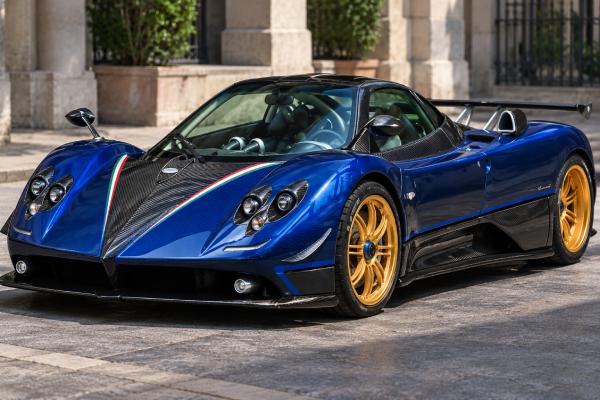
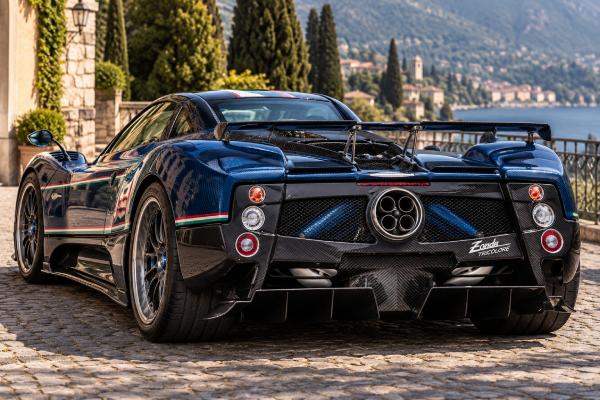
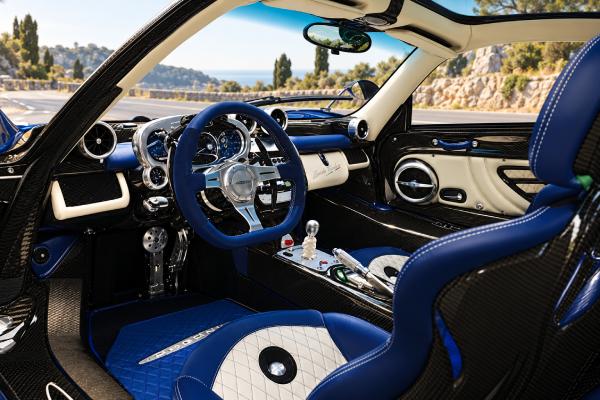
The 2010 Pagani Zonda Tricolore is a three-car road-going tribute to the Frecce Tricolori, created for the Italian aerobatic team’s 50th anniversary. It combines the late Zonda’s most advanced road hardware with a very specific commemorative identity: a 670 hp naturally aspirated AMG V12, six-speed Cima automated sequential gearbox, carbon-titanium monocoque, carbon-ceramic brakes, 1,210 kg published dry weight, blue-tinted exposed carbon, and Italian tricolour detailing. Those facts make the car easy to describe but unusually difficult to evaluate. With only three examples, small differences in build history, later Pagani work, finish condition, accessories, and documentation can matter more than broad market averages. A serious owner or buyer should therefore treat the Tricolore as both a high-performance machine and a historic object. The practical priorities are to confirm the chassis against factory records, preserve the original composite finish and model-specific details, understand the sequential transmission’s needs, and separate documented Pagani changes from undocumented alterations.
Table of Contents
- Technical Baseline: What the Tricolore Actually Is
- How the Frecce Tricolori Tribute Shapes the Car
- Cinque-Derived Hardware and the 670 hp Specification
- Driving the Sequential Car: Aero, Brakes, and Setup
- Maintenance Priorities for a Rare Sequential Zonda
- How to Authenticate One of the Three Cars
- Buying, Valuing, and Stewarding a Zonda Tricolore
Technical Baseline: What the Tricolore Actually Is
The Tricolore is a rear-wheel-drive petrol hypercar built around Pagani’s carbon-titanium central structure and a naturally aspirated Mercedes-Benz AMG V12. Its factory specification is unusually close to the Zonda Cinque in chassis hardware, gearbox, brakes, tyres, weight, and published performance, but Pagani lists the Tricolore itself at 670 hp.
| Specification | Factory data |
|---|---|
| Engine | Mercedes-Benz AMG V12 |
| Fuel and induction | Petrol, naturally aspirated |
| Displacement | 7.3 litres (7,291 cc) |
| Maximum power | 670 hp |
| Maximum torque | 780 Nm (575 lb-ft) |
| Transmission | Cima six-speed sequential gearbox, robotized by Automac Engineering |
| Drive | Rear-wheel drive |
| Electronic support | Bosch ECU, traction control, and ABS |
| Component | Factory specification |
|---|---|
| Central structure | Carbon-titanium monocoque |
| Exhaust | Inconel/titanium system with ceramic coating |
| Suspension hardware | Magnesium and titanium components |
| Front wheels | APP forged aluminium/magnesium, 9 × 19 inches |
| Rear wheels | APP forged aluminium/magnesium, 12.5 × 20 inches |
| Front tyres | Pirelli P Zero, 255/35 R19 |
| Rear tyres | Pirelli P Zero, 335/30 R20 |
| Position | Disc | Caliper |
|---|---|---|
| Front | 380 × 34 mm self-ventilated carbon-ceramic | Monobloc six-piston |
| Rear | 380 × 34 mm self-ventilated carbon-ceramic | Monobloc four-piston |
| Measure | Pagani figure | Context |
|---|---|---|
| Dry weight | 1,210 kg (2,668 lb) | Factory dry-weight figure |
| Weight distribution | 47% front / 53% rear | Published distribution |
| 0–100 km/h | 3.4 seconds | Manufacturer claim |
| 0–200 km/h | 9.6 seconds | Manufacturer claim |
| 100–0 km/h | 2.1 seconds | Manufacturer braking claim |
| 200–0 km/h | 4.3 seconds | Manufacturer braking claim |
| Maximum lateral acceleration | 1.45 g | With road tyres |
| Downforce | 750 kg at 300 km/h | Factory aerodynamic figure |
These figures describe the model, not every car’s current condition. Tyres age, brake discs wear, suspension settings change, software can be updated, and a car may have received later factory work. For a three-car series, the chassis file is more useful than assuming all surviving examples remain exactly as presented in 2010.
How the Frecce Tricolori Tribute Shapes the Car
The Tricolore’s blue carbon, flag stripe, cabin colors, and aircraft-inspired details are not cosmetic options; they are the defining reason the model exists. Pagani created the car to mark 50 years of the Frecce Tricolori, officially the Italian Air Force’s 313th Aerobatic Training Group, founded in 1961 at Rivolto.
The connection works because the Zonda was already visually mechanical. Exposed carbon, polished metal, ducts, fasteners, and the central exhaust give it the same kind of deliberate functional display seen in aircraft. For the Tricolore, Pagani pushed that language toward the aerobatic team. The exposed composite receives a blue-tinted finish, and a green-white-red stripe runs over the body. The color changes character with light because the weave remains visible beneath the clear finish rather than being hidden under opaque paint.
That finish deserves to be treated as part of the car’s provenance. A repainted blue panel that looks attractive from several metres away may still be historically wrong if the tint, weave orientation, lacquer depth, stripe position, or underlying carbon differs from the original. Matching exposed composite is harder than matching conventional paint because both color and fibre pattern affect the final appearance. Stone-chip repair, UV aging, polishing, and localized clear-coat work should therefore be documented in detail.
The tribute also lives in small features. The Tricolore’s vertical fin and aero treatment reinforce the aircraft theme, while the white-and-blue interior and tricolour accents continue it inside. These pieces matter because a rare Pagani is often personalized later in life. A factory-approved change can be legitimate, but it should not be confused with the original commemorative specification.
Pagani returned to the same theme for the Huayra Tricolore in 2020, this time for the Frecce Tricolori’s 60th anniversary. The later car’s official material specifically references the Zonda Tricolore and confirms that only three Zonda examples were made. That later factory context is useful because it establishes the Zonda as the first chapter of an ongoing Pagani–Frecce relationship rather than an isolated color scheme.
For an owner, the implication is simple: preserve all Tricolore-specific items even if a replacement looks easy to reproduce. Original plaques, luggage, tools, books, covers, keys, model-specific trim, wheel finishes, fasteners, and removable pieces can become difficult to reconstruct once separated from the car. Photographing and inventorying them is a basic stewardship task.
Cinque-Derived Hardware and the 670 hp Specification
The Tricolore uses the Cinque’s core road-racing hardware, but it should not be described by casually copying every Cinque number. Pagani’s current Tricolore page states 670 hp and 780 Nm, while the Cinque page states 678 CV and 780 Nm; the safest practice is to quote each model exactly as Pagani publishes it.
That distinction matters because “mechanically identical” in auction language can describe architecture without proving that every calibration or homologated output figure is identical. Both cars share the carbon-titanium monocoque concept, lightweight suspension hardware, Cima sequential transmission, carbon-ceramic brakes, wheel sizes, tyre sizes, 1,210 kg dry-weight figure, 47:53 distribution, and the same published acceleration, braking, lateral-g, and downforce numbers. Yet the factory model pages still use different power figures. A buyer should preserve that nuance rather than force the data into one figure.
The sequential gearbox is a major part of the character. It is not a modern dual-clutch unit that masks every shift with overlapping torque delivery. The Cima transmission is mechanically closer to a competition-style sequential gearbox whose clutch and shift actions are automated. The driver requests the next ratio; actuators carry out the shift. Under hard acceleration, a brief interruption in drive is part of the experience.
That means driving technique affects both smoothness and wear. Abrupt low-speed throttle inputs can make clutch engagement feel harsher, while a sympathetic lift during some shifts can reduce driveline shock. The correct technique depends on calibration and operating condition, so owners should follow current Pagani guidance rather than relying on internet habits developed for other automated manuals.
The naturally aspirated V12 is equally important. Its appeal comes from response, rev progression, and sound rather than turbocharged torque multiplication. A healthy engine should start cleanly, reach stable temperature, pull progressively, and show no unexplained warning messages, fluid loss, misfire, or abnormal exhaust smoke. Because these cars are often stored for long periods, a low odometer reading does not automatically mean lower mechanical risk. Seals, hoses, batteries, tyres, fluids, dampers, and clutch components still age.
The carbon-ceramic brakes also need context. They save unsprung mass and resist heat extremely well, but they are expensive components that must be inspected correctly. Visual appearance alone cannot establish remaining life. Chips, impact damage, measured wear, pad condition, caliper function, and any track use should be reviewed by a Pagani-qualified technician.
Finally, the aerodynamic figures are not a license to treat 300 km/h running as routine. The quoted 750 kg of downforce is an engineering measure achieved in a very specific vehicle configuration. Alignment, ride height, tyres, underbody condition, wing settings, and replacement body parts all affect how the car behaves. High-speed use belongs on suitable closed facilities with current technical inspection.
Driving the Sequential Car: Aero, Brakes, and Setup
The Tricolore’s speed comes from the way its light mass, aero load, brakes, tyres, and automated sequential gearbox work together, not from horsepower alone. It rewards deliberate inputs and a properly warmed, correctly set-up chassis more than the point-and-shoot approach that suits heavier modern turbocharged cars.
The first practical difference is the gearbox. At parking speed, the clutch actuator has to perform the same slipping work a driver would manage with a pedal in a conventional manual. Repeated creeping, reversing up inclines, or holding the car on throttle can therefore create unnecessary heat. On the road, leaving a little space in traffic and using the brake to hold position is kinder to the clutch than inching forward continuously. When moving briskly, the best shift rhythm is the one Pagani specifies for the car’s current calibration; owners should not assume that techniques for Ferrari, Lamborghini, or Maserati automated manuals transfer directly.
Brake feel also changes with temperature and condition. The Brembo carbon-ceramic system is designed for enormous energy capacity, but the driver still needs to build a reference point for pedal response before asking for high deceleration. After long storage, a careful first drive should confirm that the pedal is firm, the car stops straight, no warning lights remain, and the discs and pads show no obvious contamination or damage. On track, cool-down practice matters because heat can affect pads, tyres, wheel hardware, and nearby components even when the ceramic discs themselves remain within their working range.
Aerodynamic load rises rapidly with speed. Pagani’s 750 kg figure at 300 km/h shows why ride height, splitter condition, underbody panels, rear aero, and alignment should be treated as one system. A small parking scrape on a front element may look cosmetic, but a distorted mounting point or repaired undertray can alter the intended air path. Before any high-speed event, inspect the complete lower surface and aero attachments rather than checking only the visible body.
Tyres are the final link. The staggered 255/35 R19 front and 335/30 R20 rear sizes give the Tricolore a large rear footprint, yet grip still depends on age, heat cycles, pressure, storage, and surface temperature. A period-correct tyre that has aged beyond safe use is not a preservation advantage. Keep removed original tyres only as historical artifacts when appropriate; fit current Pagani-approved road tyres for driving.
Suspension setup should be approached with the same restraint. Adjustable hardware does not mean every owner benefits from changing it. Ride height, damper settings, corner weights, and alignment interact with the aero platform and steering response. Record the starting configuration before any adjustment, use equipment capable of handling the car accurately, and make changes for a defined reason rather than by feel alone.
On public roads, the car’s width, low nose, visibility, and rapid acceleration are more relevant than the headline lateral-g figure. The safest way to enjoy the V12 is to build temperature gradually, keep sight lines generous, and reserve the outer performance envelope for closed circuits. That preserves both the machine and the historical object the driver is responsible for.
Maintenance Priorities for a Rare Sequential Zonda
The most important maintenance goal is not simply low mileage; it is preserving a known, exercised, factory-correct car. A Tricolore that is started, serviced, and driven intelligently can be easier to assess than one that has sat motionless for years with an impressive odometer.
A practical service plan should begin with time-based condition, not just distance. Engine oil, coolant, brake fluid, gearbox and actuator systems, air-conditioning, battery health, fuel quality, and flexible rubber components all deserve review according to Pagani’s current documentation for the specific chassis. The master service records should show what was done, by whom, and with which parts.
Tyres are an obvious age item. The original Pirelli sizes are central to steering, ride, gearing, traction control, and aerodynamic balance, but a tyre’s date and condition matter as much as tread depth. Cars that spend years on display can develop flat spotting or sidewall aging long before the tread wears out. Replacement should match Pagani-approved specification rather than chasing a newer compound simply because it fits the wheel.
The automated sequential system deserves its own inspection. Ask for clutch wear data where available, actuator history, hydraulic service, calibration records, and any repairs to pumps, sensors, or shift hardware. During a controlled test drive, observe engagement from rest, reverse selection, hot behavior, warning lights, and shift consistency. A single harsh shift does not diagnose a fault, but repeated hesitation, unexpected neutral selection, fluid leakage, or inconsistent clutch take-up should be investigated before purchase.
Composite bodywork changes the collision-repair question. On a conventional steel car, panel gaps and paint depth can reveal much of the story. On an exposed-carbon Pagani, the underlying laminate, bonding method, weave alignment, clear coat, mounting points, and nearby structure matter too. Repairs should ideally be supported by Pagani invoices, photographs, engineering notes, and post-repair checks. The Rinascimento program exists specifically to restore early Paganis using original drawings, materials, molds, and processes, with the work documented in a dedicated book.
Storage should control humidity, temperature swings, battery condition, tyre loading, and contamination without turning the car into a static object. Run the car only when it can be brought properly to operating condition; repeated short starts that never heat the engine and exhaust thoroughly can create more problems than they solve. Keep fuel management, fire protection, transport tie-down methods, and insurance requirements documented.
The interior also needs conservation. Light-colored leather and trim can show dye transfer, abrasion, UV exposure, and hand oils quickly. Avoid aggressive cleaners on anodized aluminium, exposed carbon, Alcantara-like materials, or unique stitched pieces. When a rare surface needs correction, conservation is preferable to making it look generically new.
How to Authenticate One of the Three Cars
Authentication should begin with Pagani’s own records, because a production count of three leaves almost no room for assumption. The Puro program was created for exactly this problem: it checks authenticity and condition against Pagani’s database, including component details, serial numbers, photographs, and construction history.
Pagani states that Puro involves more than 400 checks and can result in a Puro Book documenting the vehicle’s history and certification. For a Tricolore, that is stronger evidence than a collection of online photographs. Public images can prove that a car appeared at an event, but they cannot reliably establish whether a panel, gearbox component, ECU, wheel, or interior piece is original to the chassis.
A robust due-diligence file should reconcile several layers:
- the chassis identity and original build specification;
- engine, transmission, and major component identifiers where Pagani records them;
- delivery date, registration history, and market specification;
- original colors, stripe layout, cabin materials, plaques, and accessories;
- every factory service, upgrade, restoration, or reconfiguration;
- independent repair work, paint or composite correction, and collision history;
- odometer history supported by service invoices and event records;
- title, import, tax, and registration documents appropriate to the buyer’s jurisdiction.
Dates need special care. One well-documented example has been marketed as a 2011 Pagani Zonda Tricolore even though the model is commonly associated with 2010. That is not automatically contradictory. Build, completion, first registration, title, and sale dates can differ, especially for very low-volume cars. The correct response is to preserve the documentary trail, not to alter it to fit a simplified model-year story.
The 2025 RM Sotheby’s sealed sale is useful as a case study. The auction house identified its car as the second of three, described it as unmodified, and reported 1,112 km at cataloguing. Those details are valuable for that chassis, not transferable specifications for the other two. A buyer should resist using one public car as the template for all Tricolores.
Factory upgrades create another nuance. Pagani’s Unico program supports later personalization and technical changes, while Rinascimento supports restoration toward an earlier configuration. Either can be desirable when properly documented. The key question is not simply “original or modified?” but “what happened, when, under whose authority, and is the current configuration accurately represented?”
Buying, Valuing, and Stewarding a Zonda Tricolore
A Tricolore cannot be valued sensibly from a generic Zonda price guide because three cars do not create a liquid, statistically useful market. Condition, provenance, originality, Pagani certification, mileage, tax status, geography, and the exact transaction structure can move the result dramatically.
Start with the car rather than the asking price. Commission a factory-level technical inspection, then build a chronology from original order through the present day. Verify what accompanies the vehicle and what is missing. A unique accessory that seems minor during negotiation may be impossible to replace later without a bespoke factory project.
Next, define how the car will be used. A buyer planning regular road use should budget for fresh tyres, fluid service, battery management, transport alternatives, insurance, and proactive inspection even if the car has very low mileage. A buyer focused on concours preservation should care more about untouched surfaces, original fasteners, period finishes, display materials, and documented conservation. Neither use case is automatically better, but each creates different costs.
Transport and workshop access are part of ownership. Ground clearance, carbon aero, wide rear tyres, and the car’s rarity make improvised loading risky. Use enclosed transporters familiar with very low supercars, verify ramp angles and tie-down points, and document condition before and after each movement. Avoid attaching straps to suspension or body points unless Pagani-approved procedures call for it.
Insurance should be based on an agreed value supported by current specialist evidence, not merely the purchase invoice. The policy should address storage, transport, event use, named drivers, geographic limits, and whether repair can be carried out through Pagani or a designated specialist. For an exposed-carbon limited edition, the quality and authority of the repairer can be as important as the monetary limit.
A pre-purchase inspection should also include a controlled cold start and a fully warmed road test where legally and safely possible. Record battery voltage, warning messages, fluid temperatures, cooling-fan behavior, air-conditioning operation, lift or ride-height functions if fitted, steering assistance, and any noises that appear only after heat soak. Then inspect the car again on a lift for fresh leaks, loose fasteners, underbody contact, and heat-related issues. This two-stage approach often reveals more than a static showroom inspection because a lightly used collector car can look immaculate while still carrying age-related mechanical needs.
The strongest Tricolore purchase is therefore the one with coherent evidence. The blue carbon, tricolour stripe, aero details, 670 hp V12, and sequential gearbox make the car memorable, but the lasting value lies in the relationship between those features and the factory record. When the physical car, Pagani documentation, service history, and ownership story all agree, the buyer is not merely acquiring one of three rare Zondas. They are taking responsibility for a precisely documented piece of Pagani and Italian aviation history.
References
- Zonda Tricolore | Pagani 2026 (Manufacturer Specifications)
- Huayra Tricolore | Pagani 2020 (Frecce Tricolori and Three-Car Context)
- Sealed – Pagani Zonda Tricolore | Auction Details | RM Sotheby’s 2025 (Chassis-Specific Provenance)
- “Pagani Puro”, the program created to certify the authenticity and enhance the value of our exclusive cars over time | Pagani 2021 (Factory Authentication)
- Pagani Rinascimento | Pagani 2017 (Factory Restoration)
- Zonda Cinque | Pagani 2026 (Related Chassis and Performance Context)
Disclaimer
This article is for informational purposes and is not a substitute for professional diagnosis, inspection, valuation, or repair. Specifications, torque values, intervals, procedures, equipment, and approved parts can vary by VIN, market, and later factory work; verify every service or repair decision against the official documentation for the exact car. If this guide is useful, please share it on Facebook, X/Twitter, owner groups, or specialist forums to support careful documentation and responsible stewardship.