
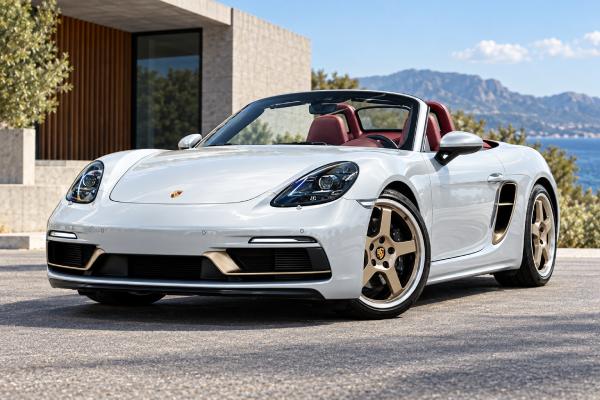
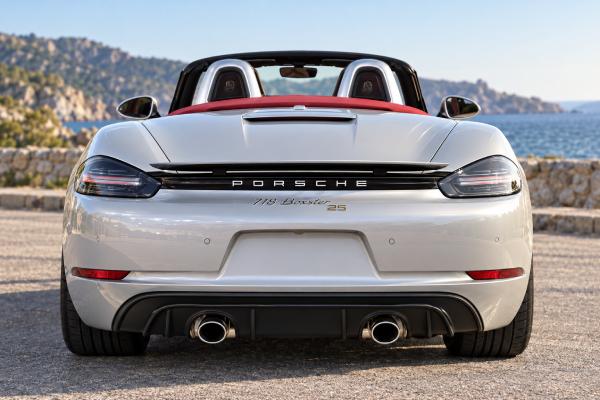
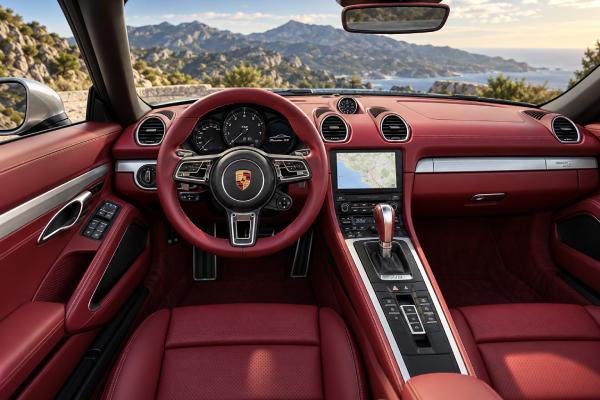
The 2021 Porsche 718 Boxster 25 Years is a commemorative model whose significance comes from both its mechanical base and its design references. Porsche limited production to 1,250 cars worldwide and built the anniversary edition from the 718 Boxster GTS 4.0, giving U.S.-market cars a 394-hp naturally aspirated 4.0-liter flat-six, a six-speed manual gearbox as standard and seven-speed PDK as an option. Its defining features are not additional engine output but a carefully specified appearance package inspired by the 1993 Boxster concept: Neodyme-colored details, a distinctive 20-inch wheel design, special badging and a Bordeaux Red interior/soft-top combination available alongside black. GT Silver Metallic, the color most closely associated with the concept-car tribute, was joined by Jet Black Metallic and Carrara White Metallic. Because the edition is visually specific and numerically limited, authentication matters more than it does on an ordinary color-and-option combination. This guide focuses solely on the 2021 Boxster 25 Years, explains where its specifications come from, and separates anniversary equipment from features inherited from the GTS 4.0 platform beneath it.
Table of Contents
- Why the Boxster 25 Years Exists
- Anniversary Design and Authentication
- Four-Liter Specifications
- Manual, PDK, and Performance
- Chassis, Roof, and Everyday Use
- Maintenance for a Low-Production Roadster
- Buying a Boxster 25 Years
Why the Boxster 25 Years Exists
Porsche announced the Boxster 25 Years in January 2021 to mark a quarter-century of the production Boxster family. The production story began in the 1990s, while the visual reference point for this edition was the Boxster concept unveiled at the 1993 Detroit Motor Show. That show car established themes that carried into the first production 986 Boxster: a compact mid-engine roadster shape, prominent side intakes, a low windscreen and a cabin/exterior color relationship that made the car look intentionally different from a 911.
The anniversary model did not attempt to replicate the 1993 concept literally. Instead, Porsche translated several of its cues into the 982-generation 718 body. Neodyme—a copper-like tone—appears on selected exterior details and the special 20-inch wheels. A Boxster 25 logo identifies the special model, and Porsche combined the package with high-level equipment from the contemporary GTS 4.0.
Production was capped at 1,250 units worldwide. That number should not be interpreted as 1,250 cars in one market, one transmission or one color. Individual regional allocations and specifications differ. If a seller makes a claim about how many examples were delivered in a particular color or country, ask for documentation rather than extrapolating from the worldwide limit.
Mechanically, the anniversary car’s foundation is the 718 Boxster GTS 4.0. That means the special edition is not a separate “25 Years” engine tune. Its U.S. output is 394 hp, while European publications describe the same model as 294 kW/400 PS because of the different power unit convention. Both figures can be correct in their respective contexts; they should not be presented as evidence that two different engines were fitted.
Anniversary Design and Authentication
The Boxster 25 Years is easiest to understand as a curated factory specification with genuine model-specific trim. The standard visual language includes Neodyme accents, a special wheel finish, high-gloss exhaust outlets and a black windscreen frame. Porsche offered three exterior colors: GT Silver Metallic, Jet Black Metallic and Carrara White Metallic. GT Silver most directly echoes the 1993 concept, but the other two are equally legitimate factory anniversary configurations.
| Anniversary feature | Factory treatment |
|---|---|
| Worldwide production limit | 1,250 units |
| Exterior colors | GT Silver Metallic, Jet Black Metallic, Carrara White Metallic |
| Accent color | Neodyme |
| Wheels | 20-inch Boxster 25 Years design with Neodyme finish |
| Interior themes | Bordeaux Red or black leather |
| Convertible top | Bordeaux Red or black, depending on configuration |
| Model identification | Boxster 25 anniversary lettering/badging and sill details |
Period U.S. equipment included 14-way electrically adjustable Sport Seats, a heated GT multifunction sport steering wheel and brushed-aluminum interior trim. The exact option list still matters because an anniversary model could have additional factory equipment beyond the core package.
Authentication should begin with the VIN and factory build data. Special-edition wheels, badges and trim can be replaced or copied; conversely, an authentic car may have had a wheel refinished or a damaged trim piece replaced. A buyer interested in originality should compare the current car with its factory option record and document any substitutions. Keep photographs of model-specific parts and retain removed originals if reversible changes are made.
The production cap also makes collision repair and cosmetic restoration worth documenting carefully. A high-quality repaint is not automatically disqualifying, but an undisclosed color change or missing Neodyme components affects what the car represents. Paint-depth readings, underside inspection and invoices for bodywork provide more useful evidence than assumptions based on shine or panel color alone.
Four-Liter Specifications
The 4.0-liter flat-six is naturally aspirated and sits behind the occupants. In U.S. specification for the Boxster GTS 4.0 and Boxster 25 Years, Porsche rates it at 394 hp. The engine uses direct injection and a high compression ratio, and its character is fundamentally different from the earlier turbocharged four-cylinder GTS.
| Engine item | 2021 Boxster 25 Years |
|---|---|
| Configuration | Naturally aspirated horizontally opposed 6-cylinder |
| Displacement | 3,995 cc |
| Maximum power, U.S. | 394 hp at 7,000 rpm |
| Maximum torque | 309 lb-ft |
| Torque range | 5,000–6,500 rpm |
| Compression ratio | 13.0:1 |
| Drive layout | Mid-engine, rear-wheel drive |
The anniversary car inherits Porsche Torque Vectoring with a mechanical rear differential lock and PASM. U.S. launch material describes the standard PASM setup as lowering the car by 0.39 inch, with a PASM Sport configuration lowered by 0.78 inch also available. Because chassis equipment can depend on market and individual configuration, inspect the build specification rather than assuming ride height from photographs.
Standard braking hardware on the GTS 4.0 platform is substantial, with larger iron discs than the earlier four-cylinder GTS. Optional ceramic brakes may be present on some cars. As with any PCCB-equipped Porsche, rotor condition and replacement cost justify specialist inspection before purchase.
| Chassis/roadster item | Specification or equipment |
|---|---|
| Adaptive suspension | PASM |
| Torque vectoring | PTV with mechanical rear differential lock |
| Standard wheel diameter | 20 in |
| Standard U.S. front brake diameter | 350 mm |
| Standard U.S. rear brake diameter | 330 mm |
| Roof | Power-operated fabric convertible top |
Manual, PDK, and Performance
Porsche offered the Boxster 25 Years with a six-speed manual or optional seven-speed PDK. This is a meaningful choice, not merely a convenience option. The manual emphasizes direct driver control and uses three pedals; PDK offers automatic operation, rapid dual-clutch shifts and launch-control performance when used with the appropriate Sport Chrono functions.
For the U.S. anniversary model, Porsche quoted a 182-mph top track speed for the manual. With PDK, the official 0–60 mph time is 3.8 seconds using launch control. Market-specific publications use different acceleration standards, so a European 0–100 km/h figure should not be converted and presented as though it were a U.S. 0–60 claim.
| Performance point | Factory-published figure |
|---|---|
| Manual transmission | 6-speed |
| Optional transmission | 7-speed PDK |
| 0–60 mph, PDK | 3.8 s with launch control |
| Top track speed, manual | 182 mph |
| European power reference | 294 kW / 400 PS |
A test drive should be judged against the installed gearbox. On a manual car, clutch take-up should be progressive, the pedal should not exhibit obvious slip under load, and the lever should select gears cleanly once the drivetrain is warm. On PDK, check engagement from rest, creeping behavior, full-throttle shifts and any stored transmission faults. A diagnostic scan is useful even when no warning light is visible.
The naturally aspirated engine should pull cleanly through the rev range without boost-related transitions because there is no turbocharger. That does not mean every mechanical noise is harmless. Investigate persistent tapping, smoke, warning messages, oil or coolant loss, or an exhaust note that suggests leaks or non-original hardware.
Chassis, Roof, and Everyday Use
Under the commemorative trim, the Boxster 25 Years remains a usable mid-engine roadster. Its front and rear luggage compartments let two occupants divide bags around the centrally located powertrain, while the powered fabric roof can be raised for weather protection without sacrificing the basic proportions that define the Boxster.
Roof condition matters more on an anniversary car if originality is part of the buying appeal. Bordeaux Red was a deliberate historical reference, and replacing a faded or damaged top with a non-original color changes the factory presentation. Inspect fabric wear, seams, rear-glass bonding, latching and the complete opening/closing cycle. Check drainage channels and carpets for signs of water entry.
The 20-inch wheels are another model-defining component. Examine them for curb rash, cracks, bends and inconsistent refinishing. A cosmetic repair that preserves correct appearance is different from a color change that hides the Neodyme treatment. Confirm tire sizes and types are appropriate for the car, and read the manufacturing date codes. Low-production cars can spend long periods stationary, making age-related tire replacement relevant even when tread depth is excellent.
PASM and the low ride height put front underbody components at risk from steep ramps and parking stops. Look beneath the nose, inspect the undertrays and check the jacking points. A scraped sacrificial surface is common on low sports cars; cracked structures, missing fasteners or distorted panels deserve closer investigation.
Cabin controls should all be tested, especially power-seat functions, heating, infotainment, climate control, steering-wheel controls and any optional equipment. On a car purchased partly for its special-edition status, small missing trim pieces can be disproportionately frustrating to replace later.
Maintenance for a Low-Production Roadster
Limited production does not reduce the need for routine mechanical maintenance. A Boxster 25 Years that has covered very few miles can still need time-based fluids, battery replacement, tires and inspections. Service records should show dates as well as mileage, and the applicable Porsche schedule should be checked for the exact VIN and market.
Engine oil and filter changes remain foundational. Verify the specified oil approval for the vehicle and document what was used. Inspect for active leakage after the engine reaches full operating temperature. Because the engine is mid-mounted, a lift inspection provides a much better view of the powertrain, cooling lines and underside than a top-side check alone.
Brake fluid is hygroscopic and therefore time-sensitive. Cars stored in climate-controlled garages are not exempt from fluid aging. Brake rotors and pads also need inspection for corrosion, glazing and heat damage. If the vehicle has ceramic brakes, use a technician familiar with PCCB condition assessment rather than treating the rotors like conventional iron discs.
Cooling inlets and heat exchangers should be kept clear of leaves and road debris. Check for damaged condenser fins, coolant residue and evidence of repeated top-ups. Air-conditioning performance is worth testing because condenser damage can occur independently of engine-cooling problems.
The convertible roof benefits from clean drainage paths and maintained seals. A battery maintainer may be sensible for infrequently driven cars, but it should not conceal a battery that no longer passes a proper condition test. Long storage also makes flat-spotted tires, sticking brakes and rodents or debris in sheltered areas possible.
Spark plugs, filters, drive-belt items and PDK-related service requirements should follow official Porsche documentation for the specific vehicle. The anniversary badge does not create a separate mechanical service schedule from the underlying platform, but its individual configuration still matters.
Buying a Boxster 25 Years
A good purchase evaluation has two parallel tracks: mechanical condition and anniversary-model authenticity. Start by confirming VIN, production data, factory color, interior, roof color, transmission and option codes. Then compare the actual car with that record. Do not assume every Neodyme-trimmed 718 is a Boxster 25 Years, and do not reject a genuine example solely because a replaceable piece has been refinished—document what is original and what is not.
For the mechanical pre-purchase inspection, prioritize a cold start, full diagnostic scan, lift inspection, brake/tire measurement and a complete road test. Listen for suspension noise at low speed and verify straight-line behavior on a level road. Check for leaks or residues after the test drive, when fluids are hot and pressures have stabilized.
Accident history deserves careful attention because unique trim can complicate restoration. Measure paint where practical, inspect panel gaps, look behind accessible seals and trim edges for overspray, and check the front underside for impacts. If bodywork has been done, quality and documentation matter more than the mere fact that paintwork exists.
Ask for both keys, manuals, service invoices and any original parts removed during modifications. An aftermarket exhaust, wheel refinish or protective-film installation may be benign, but a complete paper trail makes the car easier to understand later. If originality is important, confirm that software and exhaust emissions equipment have not been altered.
Finally, check the VIN against the applicable official recall database and confirm any campaign completion. Recall status changes over time and is specific to the individual vehicle. A seller’s statement that “all recalls are done” is useful only when supported by current records.
The Boxster 25 Years succeeds because the special-edition story is backed by a strong mechanical base: a naturally aspirated six-cylinder engine, mid-engine balance and the GTS 4.0 chassis package. For a buyer, the right example is not simply the lowest-mileage car. It is one whose special equipment can be authenticated and whose service, tires, roof, brakes and drivetrain show the consistent care expected of a low-production roadster.
References
- New limited-edition anniversary model: Boxster 25 Years 2021
- Limited-edition model: Boxster 25 years 2021
- The Boxster sports car concept: trendsetting design and clever detailed solutions 2021
- 718 Boxster GTS 4.0 – Porsche Newsroom USA 2026
- Porsche Scheduled Maintenance Plan 2026
- Check for Recalls: Vehicle, Car Seat, Tire, Equipment | NHTSA 2026 (Recall Database)
Disclaimer
This article is intended for information only and does not replace a qualified professional diagnosis, inspection or repair. Specifications, torque values, intervals and procedures can vary with VIN, market and equipment; verify them in the official Porsche service documentation for the individual vehicle before carrying out work.
If you found this anniversary-model guide useful, sharing it on Facebook, X/Twitter or another social network is a simple way to support our work.