

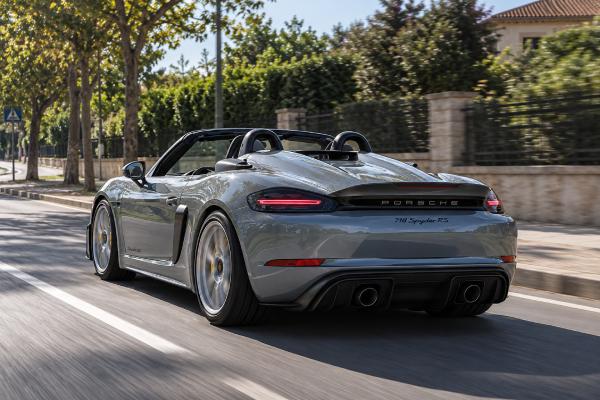
The Porsche 718 Spyder RS is the open-top endpoint of the 982-generation 718: a two-seat, mid-engined roadster built around the high-revving 4.0-liter naturally aspirated flat-six used by the Cayman GT4 RS. Porsche introduced it in 2023, with the U.S. car marketed for the 2024 model year and the model continuing into 2025. In U.S. specification it is rated at 493 hp and 331 lb-ft; European documentation lists the same basic engine at 368 kW, 500 PS, and 450 Nm. Those figures describe the same output level using different power standards, not two materially different engines. A seven-speed PDK is the only transmission.
What separates the Spyder RS from a roofless GT4 RS is not simply the absence of a fixed roof. Porsche retuned the suspension for fast road use, rebalanced the aerodynamics around a ducktail rather than a large rear wing, and created an unusually light two-piece manual top. That combination makes model-specific inspection, maintenance, and option verification especially important when buying one.
Table of Contents
- How the open-top RS concept differs
- The 4.0-liter engine, intake, and PDK
- Verified Spyder RS specifications
- Chassis, aerodynamics, and road behavior
- The two-piece roof and everyday usability
- Maintenance priorities for a high-revving RS
- Buying checks, recall status, and condition
How the open-top RS concept differs
The 718 Spyder RS occupies a narrow place in Porsche’s range. The earlier 718 Spyder already paired a naturally aspirated six-cylinder engine with the open 718 body, but the RS moves to the 9,000-rpm 4.0-liter engine and the shorter-geared PDK of the Cayman GT4 RS. Porsche’s European technical data gives a DIN unladen weight of 1,410 kg, while U.S. published specifications describe a 3,109-lb curb weight. Weight terminology and market equipment differ, so the numbers should not be treated as directly interchangeable measurements.
The model-year description also deserves care. Porsche publicly unveiled the Spyder RS in May 2023. In the United States, Porsche’s launch material called it the 2024 718 Spyder RS, and Porsche subsequently listed a 2025 model with the same 493-hp output and 191-mph top-track-speed figure. A car advertised simply as a “2023 Spyder RS” should therefore be checked by VIN, market, registration date, and build documentation rather than assumed to be a U.S.-model-year 2023 car.
The assignment identifies the engine as MDG.GA. Public Porsche press and technical sheets more often identify the engine by its 3,996-cc displacement and architecture than by that service code. For parts ordering or provenance work, use the VIN and the vehicle’s official build/service documentation to confirm the engine-code application instead of relying only on an advertisement or database label.
The RS philosophy is also different from the normal Boxster idea of easy roof operation and broad daily usability. The Spyder RS trades an electrically folding roof for a manually installed lightweight system, uses center-lock wheels, carries aggressive chassis hardware, and routes combustion air through intakes immediately behind the occupants. None of those choices makes it unsuitable for road use, but each changes what an owner needs to inspect and maintain.
The 4.0-liter engine, intake, and PDK
The engine is a 3,996-cc naturally aspirated flat-six with a 102.0 mm bore and 81.5 mm stroke. Porsche specifies a 13.3:1 compression ratio, peak power at 8,400 rpm, peak torque at 6,750 rpm, and a 9,000-rpm maximum engine speed. The architecture includes VarioCam control on the intake and exhaust sides, DLC-coated rocker arms with solid followers, six individual throttle valves, and dry-sump lubrication with a separate oil tank. These are important ownership details because this is not merely a larger-displacement version of the turbocharged four-cylinder used in the standard 718.
The intake path is one of the Spyder RS’s defining features. Combustion-air openings sit behind the headrests and feed the engine from very close to the passenger compartment. The result is a much more direct intake presence than in a conventional 718. It is also an inspection point: trim, grilles, ducting, and surrounding bodywork should be intact, clean, and free of evidence of careless modification.
Power figures depend on the standard being quoted. Porsche Cars North America publishes 493 hp and 331 lb-ft. Porsche’s European material gives 368 kW, 500 PS, and 450 Nm. Metric horsepower (PS) is slightly smaller than SAE mechanical horsepower, so 500 PS corresponds closely to 493 hp. The shared 368-kW figure is the clearest indication that these ratings represent the same basic output rather than a detuned U.S. engine.
There is no manual-transmission version. The seven-speed PDK uses short ratios, drives the rear wheels, and reaches maximum speed in seventh gear. Porsche Torque Vectoring is standard and works with a mechanical limited-slip differential. For a buyer, the practical consequence is that transmission choice is not a configuration question; instead, the focus should be on service history, fault-free operation, and whether the car remains in its factory mechanical specification.
The performance figures are equally specific. Porsche quotes 0–60 mph in 3.2 seconds for the U.S. model, 0–100 km/h in 3.4 seconds, 0–200 km/h in 10.9 seconds, and 308 km/h in European documentation. The U.S. presentation rounds that maximum to a 191-mph top track speed. Conditions, tires, surface, and test method affect real acceleration, so the factory numbers are reference specifications rather than promises for an individual used car.
Verified Spyder RS specifications
The tables below keep market-dependent figures labeled rather than merging them into a single synthetic specification. European technical data is especially detailed; U.S. power and speed figures are retained where Porsche publishes them separately.
| Item | Specification |
|---|---|
| Model | Porsche 718 Spyder RS, 982 generation |
| Body | Two-seat mid-engined roadster |
| Introduction | World premiere announced in 2023; U.S. launch as 2024 model |
| 2025 U.S. listing | Gasoline, rear-wheel drive, automatic |
| Transmission availability | Seven-speed PDK only |
| Assignment engine code | MDG.GA; verify against VIN/build documentation for service use |
| Item | Specification |
|---|---|
| Engine | Naturally aspirated six-cylinder boxer |
| Displacement | 3,996 cm³ (4.0 liters) |
| Bore × stroke | 102.0 × 81.5 mm |
| Compression ratio | 13.3:1 |
| U.S. maximum power | 493 hp |
| European maximum power | 368 kW (500 PS) at 8,400 rpm |
| Maximum torque | 450 Nm at 6,750 rpm; U.S. figure 331 lb-ft |
| Maximum engine speed | 9,000 rpm |
| Item | Specification |
|---|---|
| Drive | Rear-wheel drive |
| Gearbox | Seven-speed dual-clutch transmission (PDK) |
| Differential system | Porsche Torque Vectoring with mechanical limited-slip differential |
| 0–60 mph | 3.2 seconds |
| 0–100 km/h | 3.4 seconds |
| 0–200 km/h | 10.9 seconds |
| Top speed | 308 km/h; U.S. top-track-speed figure 191 mph |
| Item | Specification |
|---|---|
| Suspension | PASM with Spyder RS-specific sports tuning; 30 mm lower than 718 Boxster reference height |
| Adjustment | Ride height, track, camber, and anti-roll-bar settings are configurable for circuit use |
| Front brakes | Six-piston aluminum monobloc fixed calipers; 408 × 36 mm iron-composite discs |
| Rear brakes | Four-piston aluminum monobloc fixed calipers; 380 × 30 mm iron-composite discs |
| Front wheels/tires | 8.5 J × 20 ET 61; 245/35 ZR 20 95Y XL sport tires |
| Rear wheels/tires | 11.0 J × 20 ET 50; 295/30 ZR 20 101Y XL sport tires |
| Item | Specification |
|---|---|
| Length | 4,418 mm |
| Width | 1,822 mm body; 1,994 mm including mirrors |
| Height | 1,252 mm |
| Wheelbase | 2,482 mm |
| Front/rear luggage volume | 125 / 120 liters |
| DIN unladen weight | 1,410 kg |
| Permissible gross weight | 1,755 kg |
| Item | Specification |
|---|---|
| Roof type | Manual, single-layer, two-piece lightweight soft-top |
| Roof components | Sun sail plus weather deflector; pieces can be removed and stowed separately |
| Complete roof system weight | 18.3 kg including mechanical parts |
| Rear aerodynamic device | Ducktail-style tear-off edge rather than a GT4 RS fixed rear wing |
| EU drag coefficient | 0.34 |
| EU frontal area / CdA | 1.97 m² / 0.67 m² |
Porsche’s 2023 EU technical sheet lists 13.0 l/100 km and 294 g/km under the then-applicable WLTP publication, while current Porsche press-kit pages show 12.7 l/100 km and 288 g/km. Rather than silently choosing one, treat these as publication-version differences and use the documentation applicable to the car’s market, production date, and registration data when emissions or taxation matters.
Chassis, aerodynamics, and road behavior
Calling the Spyder RS an open GT4 RS is useful only up to a point. The front axle and much of the hard-core suspension concept come from Porsche’s GT program, including ball-jointed connections intended to reduce compliance. Yet Porsche deliberately reduced spring and damper rates relative to the Cayman GT4 RS. The objective was not simply a slower track setup; it was a chassis better able to work on uneven, fast country roads while retaining precise response.
Compared with the regular 718 Boxster, the body is lowered by 30 mm. Porsche also describes a wider track than the prior 718 Spyder and more rear camber, while the standard PASM system provides two manually selectable damping modes. Ride height, track, camber, and anti-roll bars can be adjusted. That adjustability is a reason to request alignment and setup records on a used car. A machine that feels unusually nervous or wears tires unevenly may not necessarily have a damaged chassis; it may simply be running an aggressive or poorly executed alignment. Conversely, “track setup” should not be accepted as an explanation for bent components, damaged underbody panels, or neglected tires.
Aerodynamically, the car is balanced around an open body and a compact rear ducktail. The front treatment is closely related to the GT4 RS, with a CFRP bonnet, an upper air outlet, NACA brake-cooling ducts, and side elements at the bumper. Because the roadster does not use the coupe’s large fixed rear wing, its front spoiler lip is shorter to preserve front-to-rear aerodynamic balance. Replacing a damaged lip with an incorrect part, altering ride height without a coherent setup, or removing aero pieces can therefore affect more than appearance.
The optional front-axle lift is especially relevant for street-driven cars. Porsche states that it raises the front by roughly 30 mm and increases clearance at the spoiler lip by about 40 mm, operating at speeds up to 60 km/h. If fitted, test it repeatedly on level ground, check for warnings, and inspect the front underside even if the system appears to work. A lift system reduces the chance of scraping; it does not make a low RS immune to contact.
Standard braking hardware is substantial, and carbon-ceramic brakes may appear on highly optioned cars depending on market and configuration. The correct buying approach is to identify what is actually installed from the build sheet and inspect that system accordingly. With iron discs, look for cracking beyond normal surface marking, pronounced lips, abnormal scoring, and mismatched replacement parts. With ceramic equipment, condition assessment is more specialized and replacement cost is materially higher, so a Porsche-experienced inspection is particularly valuable.
The two-piece roof and everyday usability
The roof is not a conventional Boxster mechanism. Porsche divides it into a sun sail and a weather deflector. The sun sail can be used alone as a Bimini-style shade, leaving much of the cabin open; adding the weather section creates the fuller weather-protection configuration. Both pieces are removable and can be stowed in the vehicle. Porsche gives the complete system, including its mechanical parts, an 18.3-kg weight.
That design creates a different ownership routine. Before buying, assemble the roof rather than merely confirming that a bag is present in the luggage compartment. Check that every panel, attachment point, tensioning element, seal, and storage component supplied with the car is included and undamaged. Verify that the fabric has not shrunk or been creased through poor storage and that water sealing is satisfactory. A missing piece may be inconvenient to source and undermines one of the car’s defining systems.
Leaving the roof at home is part of Porsche’s lightweight concept—the company says doing so can remove another eight kilograms—but it turns weather planning into the driver’s responsibility. For touring, the more meaningful number is not that weight saving but the combined packaging of roof pieces and luggage. The official EU sheet lists 125 liters in front and 120 liters at the rear, yet usable space depends on how roof components and travel gear are arranged.
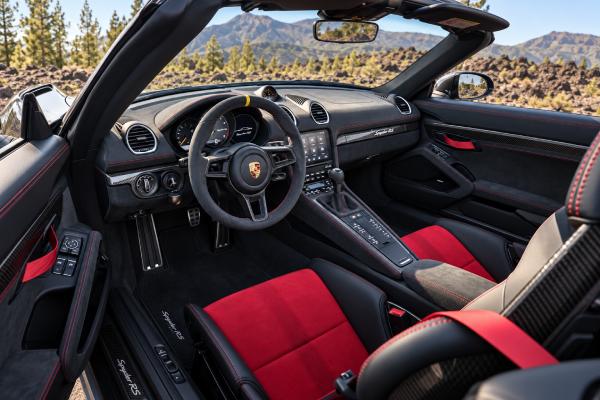
Cabin experience is similarly specialized. Standard full bucket seats use CFRP shells, the steering wheel is trimmed in Race-Tex, and the intake openings sit directly behind the occupants. Long-distance comfort depends heavily on body fit, seat position, noise tolerance, and climate. A short test drive does not answer those questions well. Anyone considering the car for frequent road trips should spend enough time in the actual seat specification to understand ingress, thigh support, back angle, and helmet clearance if track use is planned.
The Weissach Package changes the material presentation and can be paired with optional forged magnesium wheels. Those wheels are desirable to some buyers because of their lower mass and rarity, but they also deserve careful inspection for damage and correct refinishing history. The package should be verified from the build sheet; exposed carbon-look parts or aftermarket additions alone do not establish that the car was factory ordered with Weissach equipment.
Maintenance priorities for a high-revving RS
A Spyder RS should be maintained according to the service schedule for its VIN, market, and model year, not a generic 718 interval copied from another engine. Porsche’s public technical material confirms a dry-sump lubrication system with a separate tank, a 9,000-rpm maximum engine speed, solid valvetrain hardware, and model-specific PDK and chassis equipment. Those differences are enough to make service-document accuracy more important than a one-size-fits-all checklist.
For routine ownership, concentrate on records and condition rather than folklore. The engine should have the correct approved oil specification and documented oil/filter services. A high-performance engine benefits from being brought to operating temperature before sustained high-load use, and repeated track operation can justify shorter inspection cycles for fluids, filters, brakes, tires, and cooling components. The exact service actions and limits should come from Porsche documentation applicable to the car.
The intake and cooling paths deserve visual attention because the car is low, open, and designed around substantial airflow. Keep radiator and duct openings free of compacted debris, check the intake grilles and channels behind the seats, and inspect the front underbody after contact with steep ramps or curbs. Damage that seems cosmetic at the splitter can accompany broken fasteners or disturbed panels farther underneath.
Tires are part of the chassis setup, not just consumables. Confirm the correct sizes, load/speed specification, matching axle pairs, age, tread condition, and evidence of overheating or track pickup. Uneven wear should prompt an alignment and suspension inspection rather than an automatic assumption that “RS cars do that.” The car’s adjustable geometry can produce very different wear patterns depending on setup.
Center-lock wheels require disciplined service practices. Wheel removal and installation should follow Porsche’s specified procedure using appropriate, calibrated equipment and the correct current instructions for that VIN. Do not substitute a remembered torque figure from another Porsche GT model or an internet forum. Ask for evidence of competent tire and brake work, especially on a car that has changed wheels frequently for track days.
PDK behavior should be evaluated both cold and fully warm. Shifts should be consistent with the selected mode and free from warning messages. Any leakage, harshness that seems abnormal, or stored transmission fault deserves diagnosis before purchase. Likewise, inspect brake fluid history, pad/disc condition, suspension joints, dampers, and steering components based on use. A low-mileage car that has spent much of its life on circuit may require more chassis attention than a higher-mileage road car with careful service documentation.
The lightweight roof needs maintenance of a different kind: clean it with methods suitable for the material, keep attachment points free of grit, allow damp fabric to dry before long storage, and avoid forcing components that do not align. If the top suddenly becomes difficult to install, investigate alignment or damaged hardware rather than increasing tension by force.
Buying checks, recall status, and condition
A used Spyder RS warrants a pre-purchase inspection by a workshop familiar with Porsche GT and RS hardware. Mileage alone is a weak filter. Better evidence comes from a coherent build sheet, service history, diagnostic scan, tire and brake condition, body measurements where appropriate, and inspection of the underside and aerodynamic parts. The car is capable of track use from the factory, so track history should be discussed plainly rather than treated as automatic disqualification.
Start with identity. Match the VIN on the car to registration, service invoices, option records, and any warranty documentation. Confirm the market specification because U.S. and European publications use different units and may differ in equipment. Verify the 493-hp/368-kW output description, PDK transmission, factory wheel type, brake system, seats, lift system if claimed, and Weissach Package if advertised. For the MDG.GA engine-code designation in this assignment, confirm the applicable code through VIN-linked documentation before ordering code-specific parts.
Then inspect the expensive lightweight hardware. Examine the CFRP front lid and other carbon components for cracks, poor paint transitions, impact evidence, and questionable refinishing. Check the front lip and underbody for scraping. With magnesium wheels, use an appropriately qualified inspection process rather than treating a visually clean finish as proof of structural condition. Confirm that center locks and related hardware are correct and that tire-service records inspire confidence.
The roof deserves its own demonstration. Have the seller show every piece, install it, and remove it. Inspect the attachment points and seals, then verify that all storage bags or retainers supplied with the vehicle are present. Water ingress, damaged tensioning hardware, or an incomplete roof set is more meaningful on this model than a minor cosmetic defect on a conventional powered-top Boxster.
For U.S.-market 2024 cars, recall status is essential. NHTSA campaign 24V-809, Porsche campaign ARC4, covered certain 2024 718 Spyder RS vehicles along with certain 911 and Cayman GT4 RS cars because a center-lock wheel bolt could fracture and allow wheel detachment. NHTSA’s recall notice instructed owners of affected vehicles not to drive them until repaired and stated that dealers would inspect the center-lock fastening system and replace incorrectly manufactured parts as necessary. A buyer should run the VIN through the official recall system and obtain documentation showing completion when applicable; visual inspection alone cannot establish campaign status.
A diagnostic scan is useful even when no warning lights are present. Ask the inspecting shop to evaluate fault memory and available operating data in the context of Porsche’s factory diagnostic procedures. The goal is not to reject a car because it has ever been driven hard; it is to distinguish normal use from unresolved faults, overheating evidence, collision repair, or maintenance gaps.
Finally, price the car you are actually buying rather than the badge. Two Spyder RS examples can differ materially in wheels, brakes, lift system, Weissach equipment, cosmetic condition, roof completeness, protection film, and service history. Factory originality may matter strongly to some buyers, while others may accept reversible track-oriented changes. What should not be negotiable is transparency: modifications should be identified, recall work documented, wear items assessed, and any claim about model year or specification confirmed by the VIN and original paperwork.
References
- Porsche 718 Spyder RS becomes the pinnacle of the mid-engined family – Porsche Newsroom 2023
- 2024 Porsche 718 Spyder RS becomes the pinnacle of open-top, mid-engine driving – Porsche Newsroom USA 2023
- Porsche 718 Models and Configurator | Porsche USA 2025
- Chassis and suspension systems – Porsche Newsroom 2023
- TECHNICAL DATA 2023
- 1200 New Jersey Avenue SE 2024 (Recall Database)
Disclaimer
This Spyder RS article is a research aid, not a diagnostic or repair instruction. Before acting on a specification, service interval, torque value, procedure, or recall campaign, check the car’s VIN, production details, market, and equipment against current Porsche service and campaign documentation; professional inspection is especially important for safety-critical chassis and center-lock wheel work.
If these roof, RS-engine, maintenance, and campaign checks clarified the car for you, please share the guide with another Spyder RS enthusiast or prospective buyer.