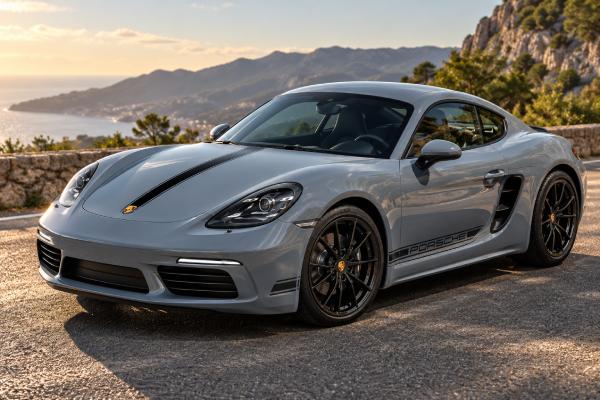
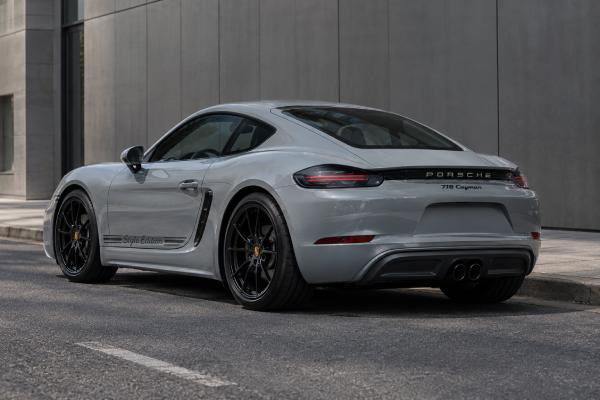
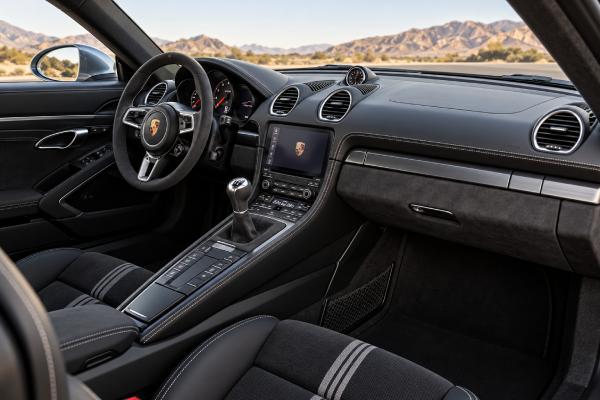
The 250-output Porsche 718 Cayman Style Edition is the fixed-roof, China-market branch of Porsche’s 982-generation Style Edition program. Porsche China launched it in November 2022 with a 1,988 cc turbocharged flat-four, 184 kW (250 PS), 310 Nm, seven-speed PDK, and rear-wheel drive. The coupe then adds the Style Edition’s high-gloss-black 20-inch Spyder wheels, contrast treatments, upgraded cabin details, and a generous local standard-equipment package without changing the basic chassis concept of the regular China-specification 718 Cayman.
Its “250 hp” assignment label needs one technical correction in the article itself: Porsche’s official Chinese rating is 250 PS, which is about 247 mechanical hp. The distinction is not academic, because global Style Edition material describes a different 300 PS/220 kW version and, in many markets, a standard manual transmission. This guide keeps the China specification separate, uses later Porsche vehicle listings where they add model-year evidence, and highlights the coupe-specific cargo and ownership details that distinguish the Cayman from the Boxster.
Table of Contents
- Why 250 PS identifies a specific market version
- Cayman body style and Style Edition content
- Technical specification for the 250 PS Cayman
- PDK, Sport Chrono, and the published performance figures
- Cargo space, wheels, and real-world usability
- Maintenance planning without borrowing the wrong schedule
- Authenticity, condition, and purchase verification
Why 250 PS identifies a specific market version
The most reliable way to understand this Cayman is to begin with its market specification rather than the Style Edition badge. Porsche China lists the Cayman Style Edition at 250 PS, automatic, and rear-wheel drive. Porsche’s China launch release is more specific: 184 kW (250 PS), 310 Nm, and seven-speed PDK as standard. Those are the numbers that define the assignment’s lower-output version.
Elsewhere, Porsche launched the Style Edition with 220 kW (300 PS) and 380 Nm, and the European/global launch material describes a six-speed manual as standard with PDK optional. That is a different homologation and sales specification even though the body, visual package, and 1,988 cc engine architecture are closely related. Combining the 300 PS torque figure or manual transmission with the Chinese 250 PS car would create a specification that Porsche did not sell in this form.
The “hp” in the assignment filename should therefore be read as a catalog shorthand, not as permission to relabel Porsche’s rating system. 250 PS is approximately 247 SAE mechanical horsepower, while 184 kW is the unambiguous official output. Whenever a parts catalog, insurance record, dyno chart, or advertisement uses a different unit, convert it explicitly rather than assuming the number alone means the same thing.
The supplied engine identifier is MA2.20. Porsche’s consumer-facing sources cited here describe a 1,988 cc turbocharged four-cylinder boxer engine and do not use that internal code on the public technical-data lines. For repair procedures or component ordering, confirm engine identification from VIN-linked Porsche workshop data; model-name shorthand is not a substitute for vehicle-specific service information.
The 2022–2025 date span also needs context. November 2022 is the announcement and China presale point. Porsche Finder documents 2025 Cayman Style Editions retaining the same 184 kW/250 PS and PDK fundamentals. Production date, model year, first registration, and press-launch year can be different dates on the same car, so all four should be kept separate when establishing provenance.
Cayman body style and Style Edition content
The Cayman Style Edition’s fixed roof changes both its appearance and its day-to-day utility relative to the Boxster. There is no convertible mechanism or roof fabric to inspect, and the rear hatch opens to a larger luggage area behind the engine. Porsche’s later China-market data lists 184 liters behind the engine in its normal configuration and up to 272 liters using the expanded rear-cargo measurement, in addition to a 150-liter front compartment.
Visually, Porsche used the same Style Edition design language across Cayman and Boxster: 20-inch 718 Spyder wheels in high-gloss black, colored Porsche crests on the wheel centers, sport tailpipes, and high-gloss-silver Porsche lettering at the rear. Buyers could also select black or white contrast packages with decorative front stripes and large side Porsche lettering. Ruby Star Neo was the headline launch color, but the model was sold in other colors, so paint choice is not an authenticity test by itself.
The coupe lacks the Boxster’s roof embossing, making the wheel, trim, graphics, interior details, and build data more useful identifiers. This is especially important because Porsche Finder examples show that exterior decals could be deleted. A Cayman Style Edition without the standard-looking side graphic can still be factory-correct if its option list records the deletion.
China’s standard equipment package went beyond the appearance items. Porsche listed bi-xenon headlights with LED daytime running lights, a two-tone leather interior, front and rear ParkAssist with reversing camera, Power Steering Plus, Apple CarPlay, cruise control, auto-dimming mirror functions, rain sensing, a heated leather multifunction steering wheel, heated seats, and two-zone automatic climate control. Cars could then add more options, so a Style Edition label does not guarantee identical specifications from one VIN to another.
| Feature area | Expected Style Edition content | Why a build sheet still matters |
|---|---|---|
| Wheels | 20-inch 718 Spyder design with high-gloss-black finish and colored crests | Wheels can be refinished or replaced |
| Rear treatment | Sport tailpipes and high-gloss-silver Porsche lettering | Badges and finishes are easy to alter after delivery |
| Contrast package | Black or white exterior graphics available | Graphics could be deleted or later removed |
| Cabin | Style-specific leather/contrast details and enriched standard equipment | Optional interior upgrades can supersede the base package |
| Body | Fixed-roof Cayman hatchback coupe | Do not import Boxster-only roof details into the Cayman description |
Technical specification for the 250 PS Cayman
The 250 PS Cayman Style Edition is a gasoline internal-combustion car with the engine mounted behind the occupants and drive sent to the rear wheels through PDK. Porsche’s 2025 China-market vehicle listings provide a useful later-year cross-check for dimensions, weight, and luggage capacity, while the 2022 launch release establishes the original local-market powertrain specification.
| Parameter | Porsche data |
|---|---|
| Engine | Turbocharged 4-cylinder boxer |
| Displacement | 1,988 cc (2.0 L) |
| Bore × stroke | 91.0 × 76.4 mm |
| Maximum power | 184 kW (250 PS) at 6,500 rpm |
| Equivalent mechanical hp | About 247 hp; conversion, not Porsche’s China-market rating label |
| Maximum torque | 310 Nm at 2,150–4,500 rpm |
| Transmission | 7-speed PDK dual-clutch automatic |
| Drive | Rear-wheel drive |
| Fuel designation on Porsche Finder | Premium unleaded |
| Assignment engine code | MA2.20; verify from the individual vehicle’s service data |
| Metric | Figure | Source context |
|---|---|---|
| 0–100 km/h | 5.6 s | China launch and later Porsche listings |
| 0–100 km/h with Sport Chrono | 5.4 s | Sport Chrono-equipped car |
| 0–160 km/h | 11.1 s | Later 2025 Porsche Finder listing |
| 80–120 km/h | 3.2 s | Later Porsche Finder listing |
| Top speed | 260 km/h | November 2022 Porsche China launch release |
| Top speed | 275 km/h | 2025 Porsche Finder listing |
Porsche’s two published top-speed numbers should remain visibly separate. The 2022 release says 260 km/h; later 2025 official vehicle listings say 275 km/h. No cited Porsche document here explains whether that reflects a later homologation value, specification change, or corrected publication data. The safest practice is to retain the number attached to the specific model-year/VIN documentation rather than inventing a reason for the difference.
| Measure | Figure |
|---|---|
| Length | 4,379 mm |
| Width without mirrors | 1,801 mm |
| Width with mirrors | 1,994 mm |
| Height | 1,295 mm |
| Wheelbase | 2,475 mm |
| Unladen weight (DIN) | 1,365 kg |
| Unladen weight (EC) | 1,440 kg |
| Permissible gross weight | 1,685 kg |
| Maximum load | 277 kg |
| Compartment | Porsche figure | Practical note |
|---|---|---|
| Front luggage compartment | 150 L | Separate compartment ahead of the cabin |
| Rear luggage compartment | 184 L | Accessible through the rear hatch |
| Expanded rear luggage measurement | 272 L | Porsche Finder lists this as the rear volume with the relevant cargo configuration |
| Seating | 2 occupants | No rear passenger seating |
| Item | Possible variation | Inspection implication |
|---|---|---|
| Sport Chrono | Optional | Required for Porsche’s quicker 5.4-second 0–100 km/h figure |
| PASM | May be optioned | Changes dampers, ride-height specification, and replacement parts |
| Rear wiper | Can be absent on dealer-stock examples | Do not assume equipment from another Cayman |
| Decorative graphics | Could be fitted or factory-deleted | Appearance alone is not definitive proof of originality |
| Audio and lighting | Multiple optional upgrades | Test the installed systems and value the actual build |
| Interior trim | Optional colors and materials | Compare with VIN-linked option data |
PDK, Sport Chrono, and the published performance figures
For this China-market Cayman, PDK is part of the core specification rather than an alternative to a manual gearbox. That removes one major variable when comparing local cars: the drivetrain should be the seven-speed dual-clutch transmission unless the vehicle has been misidentified or modified in a highly unusual way.
The engine’s 310 Nm peak extends from 2,150 to 4,500 rpm, placing the strongest torque in the middle of the road-speed rev range. PDK can shift quickly enough to keep the engine near that band during acceleration. Maximum power arrives later at 6,500 rpm, so full-throttle driving still rewards revs, but routine overtaking does not require running the engine near its upper limit.
Sport Chrono changes the official acceleration claim from 5.6 to 5.4 seconds for 0–100 km/h. The two-tenths difference is useful primarily as a configuration marker rather than as a reason to assume every Sport Chrono car is automatically in better condition or more valuable. A buyer should confirm the option and then judge maintenance, tires, brakes, suspension, and history on their own merits.
On a test drive, PDK should be assessed from cold start through normal operating temperature. Check engagement into drive and reverse, smoothness of ordinary upshifts and downshifts, response to manual commands, and the absence of warning messages. The gearbox’s low-speed behavior is inherently different from a conventional torque-converter automatic, so mild clutch-like engagement characteristics are not enough to diagnose a fault. Repeated harshness, hesitation, warnings, or stored transmission codes justify specialist testing.
The fixed roof can also change the subjective experience compared with a Boxster even when published acceleration is the same. The Cayman encloses the engine and rear cargo area within a rigid body structure, while the Boxster gives up that roof in favor of open-air driving. Porsche’s local launch figures list the same 0–100 km/h times for both Style Edition body styles; choosing between them should therefore turn on body function and ownership preference, not an assumed factory performance hierarchy.
Cargo space, wheels, and real-world usability
The Cayman earns much of its everyday usefulness from two distinct luggage zones. The 150-liter front compartment is isolated from the engine and works well for smaller bags or items that need a deep enclosed space. The hatchback rear compartment is wider and easier to load with flatter items; Porsche’s 184-liter standard rear figure is larger than the rear compartment of the roadster.
The rear hatch glass and trim should be inspected carefully on a used car. Check the struts, latch, seals, demister, interior trim, and any optional rear wiper equipment. Look for moisture traces around the hatch opening and rear carpet, and verify that the luggage-area trim has not been damaged by poorly secured cargo.
The 20-inch Spyder wheels make the Style Edition recognizable, but they also concentrate several ownership costs in one area. Examine each rim for impact damage and evidence of straightening or welding. Read tire date codes, compare brands and specifications across each axle, and look at the inside shoulders as well as the visible outer tread. A car with fresh-looking outer tread can still have alignment-related wear hidden on the inner edges.
Porsche’s launch description says the Style Edition’s powertrain and chassis are based on the regular 718 Cayman, so there is no justification for assuming a special Style-specific suspension calibration. Individual cars can nevertheless feel different because of PASM, tire choice, alignment, wheel condition, and other factory options. Establish those details before comparing ride quality between two cars.
Parking equipment is useful on a car that is low and relatively wide across the mirrors. China-standard front/rear ParkAssist and the reversing camera should all be tested. Sensor faults, lens damage, or previous bumper repair can compromise systems that may still appear on the equipment list.
The cabin’s richer standard equipment also warrants a full functional check: climate control, heated seats, steering-wheel functions, Apple CarPlay, cruise control, mirror features, and infotainment. A high-option car should be valued only after those options are demonstrated to work, not simply because an advertisement lists them.
Maintenance planning without borrowing the wrong schedule
The 982 platform spans several engines, transmissions, output levels, and markets, so the platform code by itself is not a maintenance schedule. For a 2022–2025 China-market Cayman Style Edition, the authoritative interval and procedure set is the current Porsche material matched to that VIN and model year. Earlier 982 documents can help identify component categories, but they should not supply unverified intervals, fluid specifications, or workshop procedures for this 250 PS car.
A useful service record answers four questions: what was done, when it was done, at what mileage, and according to which vehicle specification. Invoice detail is more informative than a stamped booklet with no description. Time-based work remains relevant on low-mileage cars, while mileage-based wear can arrive sooner on cars used heavily in congested traffic or hard driving.
For the turbocharged engine, verify the correct oil approval and quantity from Porsche documentation before servicing. Turbocharger lubrication and heat make oil quality important, but “more frequent is always better” is not a substitute for the manufacturer’s procedure. The same caution applies to coolant, spark plugs, brake fluid, filters, and accessory-drive components.
PDK service deserves its own documentation. Do not treat all gearbox fluids or service actions as one generic “transmission oil change.” The dual-clutch unit has specific procedures and fluid requirements that should be matched to the VIN and service information. If records use vague wording, ask the workshop what was actually changed.
Cooling-system inspection is practical on any used 718. Debris can accumulate at the front openings, so examine the accessible radiator/heat-exchanger areas and investigate any coolant smell, staining, or unexplained level loss. Cleaning the exterior surfaces carefully is different from opening a sealed system; internal service should follow Porsche procedure.
Brake condition should be measured rather than estimated from age. Inspect pad thickness, disc condition, brake-fluid history, tire grip, and any vibration under braking. Cars that spend long periods parked can develop corrosion even with low mileage, while cars driven hard can consume friction material quickly.
Battery condition is another common ownership variable on an intermittently used sports car. Low voltage can generate multiple warnings or stored faults that disappear after charging, but it can also mask a genuine issue. Test the battery and charging system first, then interpret fault memory in context with a Porsche-capable diagnostic scan.
Authenticity, condition, and purchase verification
A sensible inspection sequence for this Cayman begins with identity, moves through condition, and ends with price. First match the VIN to Porsche records and confirm 184 kW/250 PS, PDK, original body color, Style Edition package, and factory options. This prevents a visually modified standard Cayman—or a specification copied from a 300 PS overseas car—from being evaluated as the wrong vehicle.
Second, compare the physical car with that record. The Style Edition wheels, Porsche rear lettering, contrast package, interior trim, and equipment should make sense together, allowing for documented factory deletions. Fresh decals or repainted wheels are not necessarily a problem, but they should not be presented as untouched factory finishes without evidence.
Third, inspect the coupe body methodically. The low front bumper and underbody are vulnerable to scraping; 20-inch wheels are vulnerable to curb and pothole damage; the wide doors can collect edge chips. Look for repair clues such as inconsistent paint thickness, overspray, disturbed fasteners, mismatched panel gaps, or nonfactory seam work. Cosmetic paintwork can be acceptable when properly documented, while structural repairs deserve specialist assessment.
The engine and PDK should then be evaluated from a cold start through a full road test. Listen for abnormal mechanical noise, watch for warning messages or smoke, verify stable temperatures, and test moderate and stronger acceleration once the car is properly warm. Scan all control modules rather than relying only on dashboard lamps. A clean dash at one moment does not prove there are no stored or intermittent faults.
The fixed roof eliminates convertible-top mechanisms but adds its own hatch and rear-cargo checks. Inspect hatch sealing, glass, trim, struts, and moisture evidence. Because the Cayman can carry more luggage behind the engine than the Boxster, check the rear trim for damage caused by cargo and verify that removable pieces or nets included with the car are present if originally supplied.
Finally, verify service and campaign status through a Porsche Center or authoritative market-specific database. Recall applicability is VIN-specific and can differ by country. Technical service bulletins describe diagnostic or repair information and should not be turned into unsupported claims that a model is broadly unreliable.
The 250 PS Cayman Style Edition makes the most sense when bought as the specific product Porsche China offered: a 184 kW PDK coupe with distinctive factory trim and unusually strong standard equipment, not a detuned copy of a foreign-market manual car. Accurate identification, an intact option specification, and documented maintenance matter more than the cosmetic package on its own.
References
- 全新保时捷 718 Style Edition 车型 – Porsche Newsroom CHN — 2022. China launch source for 184 kW/250 PS, 310 Nm, standard PDK, local equipment, pricing, and original performance data.
- Model Overview 718 | Porsche Car Configurator (China) — Current Porsche China model overview confirming the Cayman Style Edition’s 250 PS, automatic, rear-wheel-drive configuration.
- New Porsche 718 Cayman Style Edition for sale at Porsche Centre Beijing Yizhuang — 2025 Porsche Finder example with 184 kW/250 PS, PDK, performance, dimensions, weight, and Cayman front/rear luggage data.
- The new Porsche 718 Style Edition models – Porsche Newsroom — 2022. Global 300 PS launch specification used to define what must not be mixed into the China-only 250 PS article scope.
- Porsche 718 Cayman Style Edition | Porsche International — Current global model page used to cross-check coupe architecture and the 300 PS Style Edition context without importing that output into the China-market car.
Disclaimer
Treat the specifications here as a research guide rather than a repair manual. Before servicing a China-market 250 PS Cayman, match the VIN and model year to Porsche’s official service information, since procedures, approved fluids, torque values, intervals, software, and installed equipment can vary even within the 982 family; use qualified diagnosis where faults are involved. Sharing this article with a prospective owner is appreciated if it makes a purchase or service discussion more precise.