
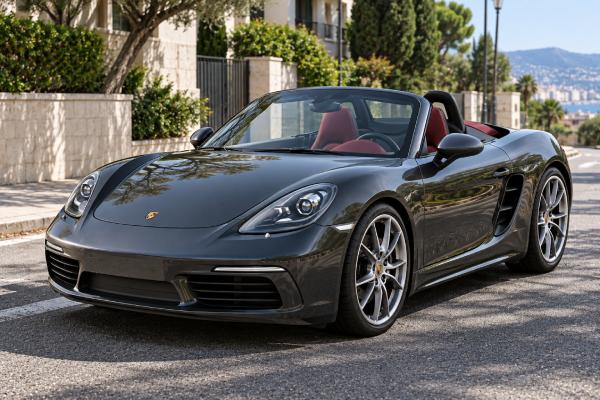
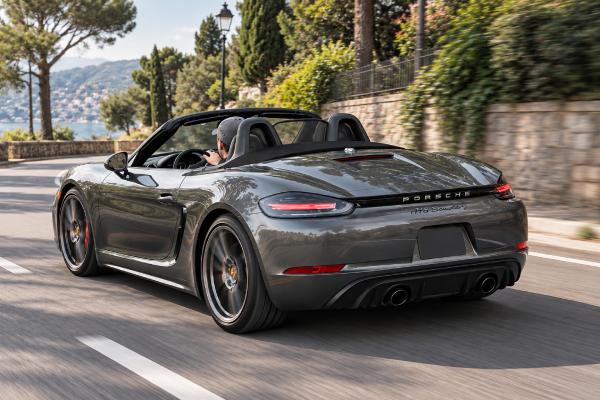
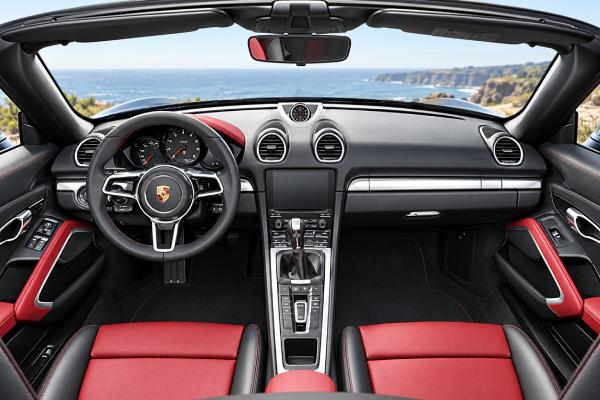
The 250 hp Porsche 718 Boxster is a market-specific version of the 982-generation roadster, not the same calibration as the better-known 300 hp base car sold in North America and much of Europe. Porsche China documents the 2.0-liter turbo flat-four at 184 kW and 250 PS, which is about 247 mechanical horsepower; the “250 hp” label commonly used in listings is therefore best understood as the Chinese-market 250 PS specification. The car retains the 718’s rear-wheel-drive, mid-engine layout and, in Porsche’s Chinese-market documentation, is paired with the seven-speed PDK dual-clutch transmission.
That distinction matters when researching parts, performance figures, software, or imported used cars. The 250 PS version has different torque and acceleration data from the 220 kW/300 hp base 718 offered elsewhere, even though both belong to the same 1,988 cc turbocharged flat-four family. This guide keeps the scope on the 184 kW Chinese-market Boxster produced across the 982 era.
Table of Contents
- The 250 PS version and its market scope
- Specifications and technical data
- How the 2.0-liter calibration changes the car
- Chassis, performance, and road behavior
- Model evolution from 2016 to 2025
- Maintenance and ownership priorities
- Used-car inspection and buying strategy
The 250 PS version and its market scope
The defining fact is simple: this is the China-market 718 Boxster with a 184 kW/250 PS tune of the 2.0-liter turbo flat-four. Porsche’s Chinese historical material identifies the 982 Boxster as launching in 2016 with this output, while Porsche’s international and U.S. documentation normally describes the base 2.0-liter car at 220 kW or 300 hp.
That regional split is easy to miss because the cars share the same 982 body, the same basic 1,988 cc engine architecture, and much of the same equipment catalog. A listing that merely says “718 Boxster 2.0” is therefore not enough to establish output. For a Chinese-market car, the build data, VIN record, original sales invoice, or Porsche Finder history should show 184 kW/250 PS. A 220 kW/300 hp specification points to the higher-output base calibration sold in other markets.
The assignment’s MA2.20 designation is commonly associated with the 2.0-liter 718 flat-four family. Porsche parts documentation also uses more granular engine-type identifiers by market, so an owner ordering internal engine components should rely on the VIN rather than treating “MA2.20” as a complete parts-ordering code. That is especially important with a long production run in which emissions hardware, software levels, accessories, and service parts can change without altering the headline displacement.
There is also a power-unit convention worth clearing up. Porsche China publishes 184 kW and 250 PS. One metric horsepower (PS) is slightly smaller than one mechanical horsepower, so 250 PS converts to roughly 247 hp. This article retains “250 hp” in the title to match the supplied vehicle designation, but the factory figure to use for technical comparisons is 184 kW/250 PS.
Specifications and technical data
The 250 PS Boxster uses the 982’s longitudinal mid-engine packaging: the turbocharged flat-four sits behind the two seats and drives the rear wheels. Chinese-market examples documented by Porsche use seven-speed PDK, and the official 2022 Style Edition release states that PDK is standard for that derivative. The figures below prioritize values Porsche has published specifically for the 184 kW car or for the shared 982 structure.
| Specification | Value | Condition or note |
|---|---|---|
| Engine | Turbocharged flat-four, gasoline | Mid-mounted |
| Displacement | 1,988 cc (2.0 L) | 91.0 mm bore × 76.4 mm stroke |
| Maximum output | 184 kW / 250 PS | Approximately 247 mechanical hp |
| Power peak | 6,500 rpm | Porsche China vehicle data |
| Maximum torque | 310 Nm (229 lb-ft) | Factory Chinese-market rating |
| Maximum engine speed | 7,500 rpm | Shown in Porsche Finder data for multiple model years |
| Fuel | Premium unleaded / Super Plus | Terminology varies by listing and market documentation |
Porsche’s archived 2016-registered example shows the 310 Nm plateau at 1,850–5,000 rpm, while later Chinese Finder records commonly show 2,150–4,500 rpm. That difference is a good example of why a single torque-band entry should not be treated as universal across the whole decade. The maximum torque itself remains consistently documented at 310 Nm.
| Specification | Value |
|---|---|
| Drive type | Rear-wheel drive |
| Transmission | 7-speed Porsche Doppelkupplung (PDK) in documented Chinese-market cars |
| Engine position | Mid-engine, behind the passenger compartment |
| Stability control | Porsche Stability Management (PSM) |
| Sport Chrono function | Includes performance-oriented drive modes; PDK cars gain Sport Response functionality on applicable configurations |
| Measure | Published figure | Condition |
|---|---|---|
| 0–100 km/h | 5.6 s | PDK |
| 0–100 km/h | 5.4 s | With Sport Chrono, as published for the Chinese Style Edition |
| 80–120 km/h | 3.2 s | Published in Porsche Finder technical data |
| Top speed | 260 km/h (162 mph) | Early Chinese-market data and the 2022 Style Edition release |
Some later Porsche Finder records display 275 km/h for 184 kW cars, which conflicts with Porsche China’s 260 km/h launch-era and Style Edition figure. Because 275 km/h is also associated with the higher-output 300 hp base 718 in other markets, the conservative approach is to treat 260 km/h as the clearly supported 250 PS figure and verify any later car against its own homologation or factory data sheet.
| Specification | Value |
|---|---|
| Body style | Two-seat roadster |
| Length | 4,379 mm (172.4 in) |
| Width, excluding mirrors | 1,801 mm (70.9 in) |
| Width, including mirrors | 1,994 mm (78.5 in) |
| Height | About 1,281 mm (50.4 in) on documented 250 PS cars |
| Wheelbase | 2,475 mm (97.4 in) |
| Turning circle | About 11.0 m (36.1 ft) |
| Drag coefficient | 0.31 Cd on documented early cars |
| Specification | Value | Note |
|---|---|---|
| Unladen weight, DIN | 1,365 kg (3,009 lb) | Typical Porsche Finder figure for PDK 250 PS cars |
| Unladen weight, EC | 1,440 kg (3,175 lb) | Different measurement convention from DIN |
| Front luggage compartment | 150 L (5.3 cu ft) | Shared 982 packaging |
| Rear luggage compartment | 122–125 L (4.3–4.4 cu ft) | Published value varies by production documentation |
| Fuel-tank capacity | 54 L (14.3 US gal) | Shown in Porsche Finder data |
| Item | Typical Porsche schedule | Owner note |
|---|---|---|
| Scheduled inspection | 30,000 km or 2 years in current German 718 schedule | Regional schedules can differ |
| Engine oil and filter | Included in scheduled maintenance | Use the oil specification required for the exact VIN and market |
| Brake fluid | Age-based service item | Commonly handled on a two-year cycle in Porsche schedules |
| Spark plugs | Age/mileage dependent | Check the market-specific maintenance booklet |
| Air-intake and cabin filters | Scheduled replacement items | Dusty environments can justify closer inspection |
How the 2.0-liter calibration changes the car
The 250 PS tune gives away peak output and torque compared with the 300 hp base 718, but it does not change the fundamental character of the 982 platform. The engine is still a turbocharged flat-four mounted low and centrally, so the car keeps the packaging, low polar moment, and quick transient response associated with the 718’s mid-engine layout.
The clearest numerical difference is torque. The 184 kW version is rated at 310 Nm, whereas the higher-output 2.0-liter car is widely documented around 380 Nm. That is a meaningful gap because turbo road cars spend much more time in the midrange than at their power peak. In practical terms, the 250 PS car needs more throttle or a lower PDK gear to produce the same overtaking urgency as a 300 hp example.
PDK helps mask that difference. Its closely spaced lower ratios and rapid shifts keep the engine nearer its useful boost range, while Sport Chrono can sharpen powertrain response on cars equipped with the package. Porsche’s Dynamic Boost strategy, introduced with the 718 generation, can also keep more charge pressure available during brief throttle lifts by controlling the throttle and fuel strategy. The result is not extra rated power; it is a reduction in the delay when the driver gets back on the accelerator.
For buyers, the calibration also changes how comparisons should be made. A dyno graph or road test for a U.S. 300 hp Boxster is not automatically representative of the 250 PS Chinese car. The same applies to ECU software claims. Before any tuning work, a shop should identify the exact engine type, software version, emissions configuration, and transmission calibration rather than assuming all MA2.20-labeled cars are electronically identical.
Chassis, performance, and road behavior
The 250 PS car uses the same basic 982 chassis concept that made the 718 a major dynamic revision over the 981. Porsche retuned the spring-strut suspension, adopted more direct electromechanical steering, strengthened the brakes, and integrated a later generation of PSM. Those chassis changes matter more to the car’s identity than the lower regional power rating might suggest.
Porsche’s U.S. technical specification for the early 982 describes lightweight MacPherson-type spring-strut suspension at the front and a lightweight strut layout at the rear, with variable-ratio electromechanical steering. Chinese-market cars can also be found with Porsche Active Suspension Management (PASM), Sport Chrono, sports exhaust, and larger wheel packages. These options should be treated as configuration-dependent, not assumed from the model name.
The roof is another practical part of the Boxster equation. Porsche specifies a power-operated soft top that can open or close in about nine seconds and can be operated at low road speed. Unlike many convertibles, the mid-engine layout leaves separate luggage spaces at both ends of the car, so opening the roof does not consume the front trunk and does not turn the rear compartment into roof storage.
With 250 PS, acceleration is brisk rather than supercar-like. The factory 5.6-second 0–100 km/h figure is enough to exploit the chassis on ordinary roads without requiring full throttle for only a moment at a time. The lower output can therefore be a rational fit for a road-focused owner who values steering, balance, roof-down driving, and usable performance more than the strongest possible straight-line acceleration.
Tire specification still matters. A 718 on older or mismatched tires can feel less precise than a mechanically healthy car on the correct Porsche-approved or equivalent high-performance fitment. When comparing two used cars, tire age, matching brand/model across an axle, correct load and speed ratings, wheel condition, and alignment history deserve at least as much attention as a cosmetic option difference.
Model evolution from 2016 to 2025
The important story across this period is continuity of the 184 kW Chinese-market powertrain combined with equipment and presentation changes. Porsche’s China history states that the current 982 Boxster arrived in January 2016 with the 2.0-liter engine rated at 184 kW/250 PS; official used-car records show 250 PS examples registered from late 2016 onward, and the same output appears in later Chinese-market listings through the end of the 982 era.
Early cars introduced the major 718-generation changes: four-cylinder turbo power, revised bodywork, updated PCM, stronger brakes, retuned suspension, and new Sport Chrono functions. For a used-car shopper, an early build should be evaluated on its actual installed options because many features that later became familiar in special editions were still separately configured.
The 2022 announcement of the 718 Style Edition is the clearest late-cycle change relevant to this engine. In China, the Boxster Style Edition retained the 184 kW/250 PS 2.0-liter engine and standard seven-speed PDK. It added a distinctive appearance package, 20-inch 718 Spyder-style wheels, richer standard equipment, and special trim details. The powertrain did not become the 300 hp specification simply because the Style Edition was sold internationally under different market configurations.
Late Porsche Finder data shows that 2024 and 2025 Chinese-market Style Edition cars continued to be listed at 184 kW/250 PS. Equipment can differ even among cars with the same badge, so options such as PASM, Sport Chrono, sports exhaust, upgraded lighting, premium audio, and particular seat types should be confirmed from the individual build rather than inferred from photographs.
There is no need to force a year-by-year mechanical narrative where Porsche did not publish one. For this version, the more useful buying distinction is early versus later production, standard Boxster versus Style Edition, and the exact option set on the car being considered.
Maintenance and ownership priorities
The 718’s maintenance needs are straightforward in concept but expensive to neglect: correct oil service, clean cooling airflow, fresh brake fluid, healthy ignition components, properly serviced PDK hardware, and good tires matter more than chasing a generic list of “common faults.” Porsche’s own service schedules provide a better baseline than forum frequency claims.
Current Porsche service material for 718 Boxster/Cayman models lists inspections at 30,000 km or two-year steps in one European schedule, with engine oil and filter replacement, cabin filtration work, checks of fluid leakage, brakes, tires, radiators and air inlets, diagnostic memory, lighting, and other operating systems. Other markets have used different mileage conventions, so an imported Chinese-market car should be serviced according to its VIN-specific documentation rather than automatically adopting a U.K., German, or U.S. interval.
Cooling-airflow inspection deserves special attention because the 718 has large front openings feeding heat exchangers. Leaves, road debris, and dirt can accumulate where they are not obvious from standing height. Porsche itself includes visual checks of radiators and air inlets in scheduled service. A buyer should look for damaged condenser fins, evidence of impacts, persistent coolant smell, or a history of overheating rather than assuming the front cooling pack is fine because the temperature gauge behaved normally on a short test drive.
Ignition and turbocharged-engine behavior should be evaluated from cold. The engine should start promptly, settle into a stable idle, and pull cleanly under load without persistent warning lights or obvious misfire. A pre-purchase diagnostic scan is valuable because a cleared dashboard does not prove there are no stored or pending faults. Ask the inspecting workshop to record fault codes before erasing anything.
PDK condition is best judged by behavior and service history. Engagement into Drive and Reverse should be prompt and controlled, low-speed maneuvering should not produce severe shudder, and full-throttle shifts should be decisive without warning messages. Fluid-service requirements vary by market schedule and production detail, so the correct interval should be taken from Porsche documentation for that VIN.
Convertible-top maintenance is equally model-specific. Test the roof several times, confirm that both latches and windows sequence correctly, inspect the fabric for abrasion or repairs, and check the drains and cabin for moisture. Water ingress can damage trim and electronics long before it becomes obvious as a puddle.
Used-car inspection and buying strategy
A good 250 PS Boxster is defined less by headline options than by evidence that it is genuinely the correct market version, has been maintained consistently, and has not been poorly repaired or modified. Because these cars are often exported, the first task is to establish identity before condition.
Use the following inspection priorities:
- Confirm the VIN, original market, and factory output. The documentation should support 184 kW/250 PS for the Chinese-market car rather than 220 kW/300 hp.
- Compare the option list with the physical car. PASM, Sport Chrono, sports exhaust, larger wheels, upgraded headlights, and seat types are not safe to assume.
- Scan all major control units before purchase. Record active, stored, and pending faults and compare mileage data where the diagnostic system provides it.
- Inspect the front cooling stack, underside, jacking points, wheel rims, suspension arms, and brake hardware for impact damage or careless repair.
- Check tires by date code as well as tread depth. A low-mileage car can still be on aged rubber.
- Operate the roof repeatedly and inspect seals, drains, carpets, seat-belt areas, and luggage compartments for moisture.
- Verify PDK service documentation and test hot and cold operation, including reversing, parking maneuvers, manual shifts, and a strong acceleration run where safe and legal.
- Look for evidence of ECU tuning or non-standard exhaust/emissions hardware. Modifications can complicate diagnostics, emissions compliance, warranty history, and future resale.
Service records deserve more weight than a low odometer reading. A 718 that has covered moderate mileage with documented oil changes, brake-fluid services, plug replacement when due, and regular inspections may be easier to evaluate than a very low-mileage car that spent years unused with little age-based maintenance.
For an imported car, also check whether the infotainment, navigation region, radio frequencies, connected services, lighting specification, emissions certification, and instrument settings suit the destination country. Those issues do not change how the car drives, but they can determine whether an apparently inexpensive import becomes inconvenient to register or use.
The strongest reason to choose this 250 PS version is not that it secretly matches the 300 hp car; it does not. Its appeal is that the underlying 982 roadster remains intact: a compact two-seat body, separate front and rear luggage spaces, quick PDK, strong chassis fundamentals, and enough turbocharged performance to use frequently. Buy it as the 184 kW Chinese-market model it is, document its exact configuration, and judge condition before options or badge prestige.
References
- Model Overview 718 | Porsche Car Configurator (China) 2026 (Official Configurator)
- 全新保时捷 718 Style Edition 车型 2022 (Manufacturer Release)
- 限量打造的保时捷 Boxster 25 周年纪念版 2021 (Manufacturer History)
- 718 Boxster: technology highlights – Porsche Newsroom 2016 (Engineering Overview)
- Technical Specifications – Porsche Newsroom USA 2026 (Technical Specification Index)
- PowerPoint-Präsentation 2024 (Porsche Service Schedule)
Disclaimer
This article is for informational purposes and is not a substitute for professional diagnosis, inspection, or repair. Specifications, torque values, service intervals, software, emissions equipment, and procedures can vary by VIN, market, production date, and installed equipment; verify all service work against the official Porsche documentation for the specific vehicle.
If this guide helped your research, please consider sharing it on Facebook, X/Twitter, or another automotive community to support our work.