
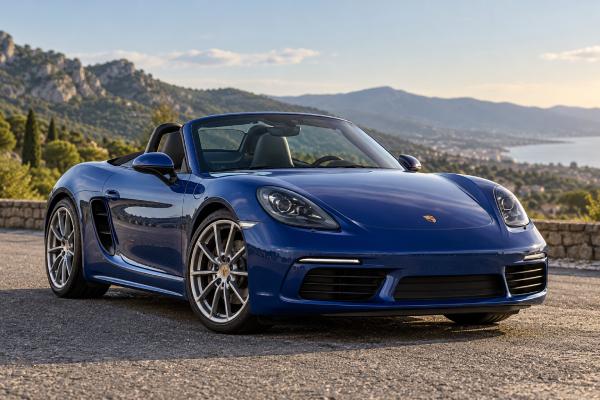
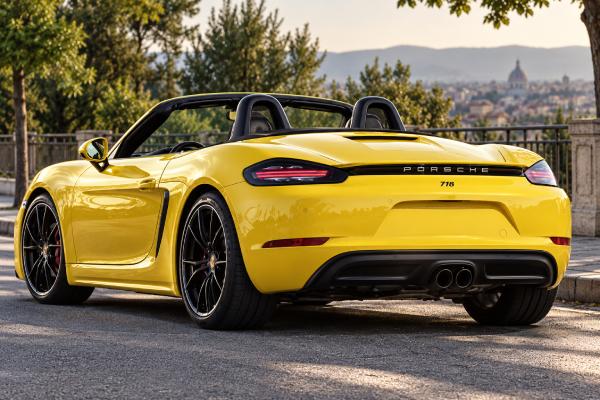
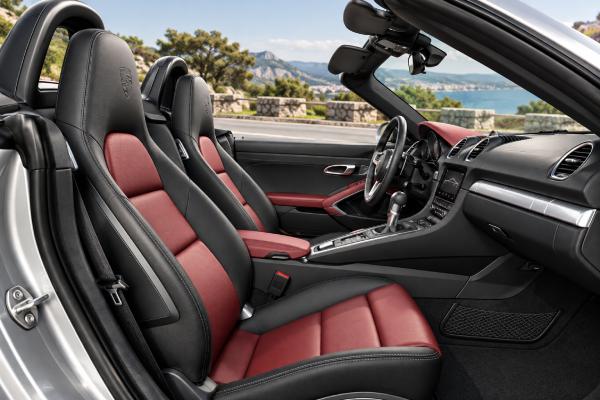
The 300 hp Porsche 718 Boxster is the core turbocharged roadster of the 982 generation: a mid-engine, rear-wheel-drive two-seater built around a 1,988 cc flat-four and offered with either a six-speed manual or seven-speed PDK. It arrived in 2016 as the successor to the naturally aspirated 981 Boxster and remained the entry point to the 718 roadster range through the 2025 model year in markets such as the United States. Its character comes from a broad 280 lb-ft torque plateau, compact dimensions, two luggage compartments, and a chassis that is substantially more capable than the “base model” label suggests.
This guide is specifically about the 2.0-liter, 300 hp Boxster—not the 250 PS China-market calibration, the 350 hp Boxster S, or the later six-cylinder GTS 4.0. Because Porsche specifications, service schedules, equipment, and model-year labels vary by country, the figures below identify their market or source context where that distinction matters.
Table of Contents
- What the 300 hp 718 Boxster actually is
- Technical data and verified specifications
- How the 2.0-liter turbo flat-four makes its performance
- Six-speed manual or seven-speed PDK
- Chassis, brakes, packaging, and everyday use
- Maintenance planning, recalls, and age-related checks
- Model-year context and used-car buying priorities
What the 300 hp 718 Boxster actually is
The 300 hp 718 Boxster is the standard-output 2.0-liter version sold in the U.S. and many other markets. Porsche introduced the 982-generation roadster in January 2016, and U.S. deliveries began in June 2016; cars sold there are generally identified as 2017 model-year vehicles even though the launch occurred during calendar year 2016.
That date distinction matters when searching registrations, parts catalogs, auction listings, and service records. The assignment span of 2016–2025 describes the generation’s launch-to-final-model-year period, but a U.S.-market buyer normally encounters 2017–2025 model years for the regular 300 hp 718 Boxster. Other markets can use different registration conventions.
Porsche’s launch specification established the formula that defined this version throughout the run: 2.0 liters, turbocharging, 300 hp at 6,500 rpm, and 280 lb-ft of torque across a wide band. The Boxster S was not simply the same engine with software; it used a 2.5-liter flat-four, 350 hp, and a variable-turbine-geometry turbocharger. Later GTS 4.0 models moved to a naturally aspirated six-cylinder engine. Keeping those variants separate prevents incompatible service parts, performance figures, and option assumptions from being mixed together.
The “982” designation is the generation identifier commonly used for the 718 Boxster and Cayman. The assignment’s MA2.20 label is useful for identifying the 2.0-liter engine family, but Porsche parts ordering should still be VIN-driven. Engine suffixes, emissions equipment, software, and replacement components can differ by production date and destination market even when headline displacement and power are the same.
Technical data and verified specifications
The early U.S. technical sheet is the most useful fixed reference because it gives engine, transmission, chassis, braking, dimensional, weight, and performance data in one document. Later cars retained the basic 300 hp/280 lb-ft mechanical specification, while equipment and published top-speed rounding changed slightly over the production run.
| Item | Specification |
|---|---|
| Engine layout | Turbocharged horizontally opposed 4-cylinder, mid-mounted |
| Displacement | 1,988 cc (2.0 L) |
| Bore × stroke | 91.0 × 76.4 mm |
| Maximum power | 300 hp at 6,500 rpm |
| Maximum torque | 280 lb-ft (380 Nm) at 1,950–4,500 rpm |
| Compression ratio | 9.5:1 |
| Maximum engine speed | 7,500 rpm |
| Boost pressure, published maximum | 20.3 psi (1.4 bar) |
| Fuel system | Direct fuel injection |
| Valve control | VarioCam Plus on intake and exhaust |
| Item | Six-speed manual | Seven-speed PDK |
|---|---|---|
| Driven wheels | Rear | Rear |
| Number of forward ratios | 6 | 7 |
| 1st gear | 3.31 | 3.91 |
| 6th gear | 0.81 | 0.88 |
| 7th gear | — | 0.62 |
| Final drive | 3.89 | 3.62 |
| Original U.S. status | Standard | Optional |
| Item | Specification |
|---|---|
| Front suspension | Lightweight MacPherson-type spring strut |
| Rear suspension | Lightweight MacPherson-type suspension |
| Steering | Electromechanical, variable ratio |
| Turning circle | 10.98 m (36.0 ft) |
| Brake calipers | Four-piston aluminum monoblock fixed calipers, front and rear |
| Front brake discs | 330 mm, vented and cross-drilled cast iron |
| Rear brake discs | 299 mm, vented and cross-drilled cast iron |
| Base front wheel/tire | 8 J × 18 ET57; 235/45 ZR18 |
| Base rear wheel/tire | 9.5 J × 18 ET49; 265/45 ZR18 |
| Item | Specification |
|---|---|
| Length | 4,379 mm (172.4 in) |
| Body width | 1,801 mm (70.9 in) |
| Width including mirrors | 1,994 mm (78.5 in) |
| Height | 1,281 mm (50.4 in) |
| Wheelbase | 2,475 mm (97.4 in) |
| Front luggage compartment | 150 L (5.3 cu ft) |
| Rear luggage compartment | 125 L (4.4 cu ft) |
| Unladen weight, manual | 2,944 lb (about 1,335 kg) |
| Unladen weight, PDK | 3,010 lb (about 1,365 kg) |
| Configuration | 0–60 mph | Top track speed |
|---|---|---|
| Six-speed manual | 4.9 s | 170 mph (274 km/h) |
| Seven-speed PDK | 4.7 s | 170 mph (274 km/h) |
| PDK with Sport Chrono / Sport Plus | 4.5 s | 170 mph (274 km/h) |
| Item | Published figure or interval | Context |
|---|---|---|
| Standard fuel tank | 54 L (14.3 U.S. gal) | 2017 U.S. technical data |
| Optional larger tank | 64 L (16.9 U.S. gal) | 2017 U.S. technical data |
| Oil maintenance | 15,000 km / 1 year | Current Porsche Centre Australian Type 982 schedule |
| Inspection | 30,000 km / 2 years | Current Porsche Centre Australian Type 982 schedule |
| Brake fluid | Every 2 years | Australian schedule |
| Spark plugs | 45,000 km / 4 years | Australian Type 982 schedule |
| Air filter | 60,000 km / 4 years | Australian Type 982 schedule |
| Drive belt | 90,000 km / 6 years | Published by several Porsche Centres in Australia |
Service intervals are deliberately labeled by market. A U.S., European, Middle Eastern, or Asian car can have a different official schedule, and severe-use requirements may differ again. The owner’s maintenance booklet and VIN-specific Porsche information take precedence over a generalized table.
How the 2.0-liter turbo flat-four makes its performance
The major change from the 981 Boxster was not merely a smaller engine. The 718’s 2.0-liter flat-four was designed around forced induction, direct injection, water-to-air charge cooling, variable cam control, and an integrated dry-sump lubrication concept with a demand-controlled oil pump. That package moves the useful torque band much lower in the rev range than the preceding naturally aspirated six-cylinder base Boxster.
The result is 280 lb-ft from 1,950 through 4,500 rpm. On the road, that means the driver does not have to wait for the top third of the tachometer to get meaningful thrust. A higher gear can still deliver strong acceleration, while a downshift puts the engine immediately into the heart of the boost plateau. Porsche’s 2016 launch release emphasized this change: torque increased by 74 lb-ft over the outgoing base engine and became available over a broader range.
The single turbocharger on the 2.0-liter engine is distinct from the variable-turbine-geometry unit used by the 2.5-liter S. Published maximum boost for the base engine was 1.4 bar. Charge-air temperature is controlled by water-to-air intercooling, while Porsche’s thermal-management system and demand-controlled water and oil pumps are intended to reduce parasitic losses and bring fluids to operating temperature efficiently.
For an owner, the engineering translates into a few practical habits. Correct oil level and specification matter in any high-output turbo engine, and repeated full-load use before the engine is properly warm is poor mechanical practice. After hard track running, a cool-down lap is preferable to arriving in the paddock immediately after maximum-load operation. None of that requires an elaborate ritual in ordinary road use; it simply reflects the greater heat density of a turbocharged 2.0-liter engine producing 300 hp.
Sound and response are the most subjective parts of the 718 debate. The turbo flat-four has a different cadence and less of the high-rpm six-cylinder character of the 981, but that does not make its objective performance ambiguous. Even the manual base car was officially quoted at 4.9 seconds to 60 mph, and the PDK/Sport Chrono combination reduced that to 4.5 seconds at launch. For buyers comparing cars rather than spec sheets, throttle response from low rpm and the way boost builds in second and third gear are more revealing than a stationary exhaust clip.
Six-speed manual or seven-speed PDK
Transmission choice changes the experience more than it changes the engine. Both versions use the same 300 hp output, but the manual prioritizes driver workload and mechanical involvement while PDK prioritizes shift speed, repeatability, and low-speed convenience.
The six-speed manual was standard when the 718 Boxster launched in the U.S. Its ratios are relatively tall, so public-road driving can involve fewer full-throttle trips through the gears than some drivers expect. The upside is a conventional clutch-and-lever interaction and a direct connection between engine speed, road speed, and the driver’s decisions. When inspecting a used manual car, clutch take-up, pedal feel, synchro behavior when cold and warm, and evidence of clutch replacement deserve attention. A difficult 1–2 or 2–3 shift should not automatically be dismissed as “they all do that”; it should be evaluated by a technician familiar with the model.
PDK uses seven forward ratios and adds a tall seventh for cruising. In Porsche’s original U.S. figures, it cut 0–60 mph from 4.9 to 4.7 seconds, or to 4.5 seconds when paired with Sport Chrono and its launch-oriented calibration. The system can shift automatically or accept manual requests from the selector and steering-wheel controls, depending on equipment.
Sport Chrono is therefore more consequential on a PDK car than a stopwatch number alone suggests. At launch, the package added Sport Plus, an Individual mode, and the Sport Response function for PDK-equipped cars. It also changes the control strategy under aggressive driving. A used-car advertisement that claims “Sport Chrono” should be checked against the physical equipment and build data rather than inferred from a steering-wheel photo or an aftermarket clock.
PDK service is also a buying consideration. Porsche service schedules distinguish between clutch-fluid and transmission-oil work, and intervals vary by market documentation. A twelve-year-old early car can be approaching time-based transmission service even with modest mileage. Receipts showing which fluid was actually changed are more useful than a generic invoice line reading “gearbox service.”
Chassis, brakes, packaging, and everyday use
The base 718 Boxster uses a serious sports-car chassis rather than a softened touring setup. Porsche retuned the suspension for the 982, made the electromechanical steering about 10 percent more direct than before, and fitted four-piston fixed aluminum calipers at all four corners. The standard early brake package used 330 mm front and 299 mm rear discs.
PASM was optional on the standard Boxster at launch and lowered the car by 10 mm while adding adaptive damping. That option can be valuable on rough roads because its purpose is not simply to make the car stiffer; it broadens the range between a road-oriented damper setting and a more controlled sporting setting. Wheel size also changes ride quality and tire cost substantially. Early base cars came on 18-inch wheels, while 19- and 20-inch combinations were available depending on year and option package.
The open roof does not eliminate practical storage. With the engine between the cabin and rear axle, the Boxster has a 150-liter front compartment and a separate rear luggage space rated at 125 liters in the early technical sheet. The shapes matter as much as the combined number: soft bags usually exploit the compartments better than rigid suitcases. The roof occupies its own packaging space rather than consuming the entire rear trunk when lowered.
Before buying, operate the convertible top through a complete opening and closing cycle. Watch the fabric tension, side-window drop and raise functions, latch operation, and synchronization of the mechanism. Check the cabin, seat-belt areas, carpet behind the seats, and luggage compartments for evidence of water entry. A roof that moves correctly once is not enough if drains are blocked or seals show damage.
Tires deserve the same seriousness as engine history. A mid-engine car can feel dramatically different on aged, mismatched, or incorrectly specified rubber. Compare date codes, tread depth across each axle, brand/model consistency, and signs of inner-edge wear. Uneven wear can reflect alignment settings, damaged components, or simply prior use, but it should trigger measurement rather than guesswork. Brake-disc lip, cracking around drilled holes, pad thickness, and fluid age are also easy pre-purchase checks with direct cost implications.
Porsche expanded the 300 hp formula rather than abandoning it. The 718 Boxster T, introduced for the 2020 U.S. model year, used the same 2.0-liter/300 hp engine but bundled more performance-focused chassis equipment. The later Style Edition also retained the 300 hp engine while concentrating on appearance and standard features. Those derivatives can be relevant comparison cars, but their option content should not be assumed to describe an ordinary base Boxster.
Maintenance planning, recalls, and age-related checks
A complete service history is more useful than low mileage by itself. The oldest 982 Boxsters are now old enough for time-based fluid, ignition, belt, battery, tire, roof, and transmission items to matter even if annual mileage has been light.
Porsche Centre schedules in Australia provide a clear Type 982 example: annual oil maintenance at 15,000 km or one year, inspection at 30,000 km or two years, brake fluid every two years, spark plugs at 45,000 km or four years, the air filter at 60,000 km or four years, and a drive belt at 90,000 km or six years. Some centres also publish long PDK clutch-fluid and transmission-oil intervals. These are not universal global instructions. For a U.S.-spec car, use the U.S. maintenance booklet or current Porsche dealer data for that VIN; for a European car, use its regional schedule.
A sensible inspection therefore starts by reconciling dates and mileage, not by asking whether the dashboard currently shows a warning. Look for documented engine-oil services with the correct approved oil, brake-fluid changes, plug replacement, air-filter service, and transmission-specific work. On a car that has spent long periods parked, check battery condition, tire age, brake corrosion, and whether the air-conditioning and roof operate consistently after more than a short demonstration.
Cooling-system condition also deserves a visual inspection because the radiators and condensers sit behind low front openings that collect debris. Leaves and dirt can trap moisture and reduce airflow. Any coolant odor, staining, unexplained reservoir-level change, or temperature anomaly calls for diagnosis rather than topping up and assuming the cause is harmless.
Recall history must be checked by VIN because campaigns typically cover defined production populations, not every 718 Boxster. Two U.S. examples show why broad “common problem” lists can be misleading. Campaign 17V-054 covered certain 2017 vehicles for fuel-collection-pipe fastening screws that could shear and permit a fuel leak. Campaign 19V-179 covered certain 2018 718 Boxster/Cayman and 911 vehicles because side-airbag impact sensors might not have been tightened correctly. Other 2017 airbag campaigns affected small subsets as well. Completion status for the actual VIN is what matters.
For a pre-purchase inspection, ask the workshop to scan all control units, not only the engine ECU. Stored or intermittent faults can reveal roof, chassis, airbag, emissions, battery-voltage, or communication issues that are invisible during a short road test. Also inspect for underbody contact, damaged lift points, non-original suspension parts, exhaust modifications, and evidence of track heat around brakes and tires. Track use is not automatically disqualifying; undocumented modifications and deferred maintenance are the larger concerns.
Model-year context and used-car buying priorities
There is no single model year that makes every other 300 hp Boxster obsolete. The core 1,988 cc output remained remarkably stable; the larger differences are age, options, infotainment details, special editions, market equipment, and the condition of the individual car.
Early cars deliver the original 718 specification and can be attractive when they have strong documentation. They are also the cars most likely to need age-based catch-up work. Confirm recall completion, inspect the roof and drains, verify the battery and tires are not simply low-mileage originals, and budget for service by elapsed time as well as odometer reading. A well-maintained early manual car and a neglected later PDK car are not equivalent risks merely because the latter is newer.
The 2020-era range introduced the Boxster T in some markets. Its significance for a shopper is not extra engine power—the T still has 300 hp—but its performance-oriented equipment bundle. If comparing a T with a base car that has PASM, Sport Chrono, PTV, and similar options, compare the actual build sheets rather than relying on badges.
For 2023 onward, the Style Edition offered another 300 hp configuration. Porsche described it as mechanically based on the regular 2.0-liter Boxster and gave it the same 280 lb-ft torque output, 4.9-second manual 0–60 mph figure, and 4.5-second PDK/Sport Chrono figure. Its value proposition is therefore equipment and styling rather than a different powertrain calibration.
By the 2025 U.S. model year, Porsche still listed the regular 718 Boxster at 300 hp with manual or PDK availability. The current configurator gives a 4.7-second 0–60 mph figure and a 171 mph top track speed with summer tires. That one-mph difference from the original 170 mph publication is best treated as a later published specification/rounding change, not evidence of a new 301-hp engine or a meaningful performance revision.
When narrowing a shortlist, prioritize evidence in this order: exact VIN/build specification, service and repair records, mechanical inspection, condition of consumables, then cosmetic preference. Option-heavy cars are not automatically better. PASM, Sport Chrono, larger wheels, upgraded lighting, premium audio, and convenience equipment all have value to different owners, but each should be verified as factory-fitted or properly retrofitted. An unmodified, correctly serviced car on fresh high-quality tires can be a more coherent purchase than a heavily optioned example with an unclear history.
A thorough test drive should include a cold start if possible, low-speed steering and braking, full warm-up, moderate boost in several gears, and both smooth and firm brake applications. For PDK, test automatic creep, low-speed changes, manual requests, and full-temperature behavior. For the manual, check clutch engagement and all synchros without forcing shifts. Listen for noises over broken pavement with the roof both up and down; an open cabin can mask or amplify different sounds.
Finally, verify the car’s specification against its market. A listing that says “2016 300 hp Boxster” may simply describe a 2016 registration date for what another database calls a 2017 model. A car advertised as 250 hp may be a genuine market-specific calibration rather than a typo. And a seller’s use of MA2.20 does not replace a VIN lookup for parts. The 718 Boxster is unusually easy to misdescribe because the body style, engine family, power calibration, registration year, and model year are separate identifiers.
References
- Powerful Purity: The new Porsche 718 Boxster and 718 Boxster S — Porsche Newsroom USA, 2016.
- 2017 718 Boxster Technical Specifications — Porsche Cars North America, 2017.
- The Porsche 718 heads into 2023 in Style — Porsche Newsroom USA, 2022.
- Porsche 718 Models and Configurator | Porsche USA — Porsche, 2025 model data accessed 2026.
- Service | Porsche Centre Sydney South — Porsche Centre Sydney South, accessed 2026.
- Porsche Safety Recall AH01 – Replacing Fastening Screws for fuel collection pipes — NHTSA/Porsche, 2017.
Disclaimer
This article is for informational purposes only. Specifications, fluids, torque values, service intervals, diagnostic procedures, parts, recall applicability, and equipment can vary by VIN, production date, market, transmission, options, and later Porsche revisions. Verify any maintenance or repair decision against the official Porsche documentation and current information for the specific vehicle. If this guide helped you understand the 300 hp 718 Boxster, consider sharing it with another owner or shopper who is comparing cars.