
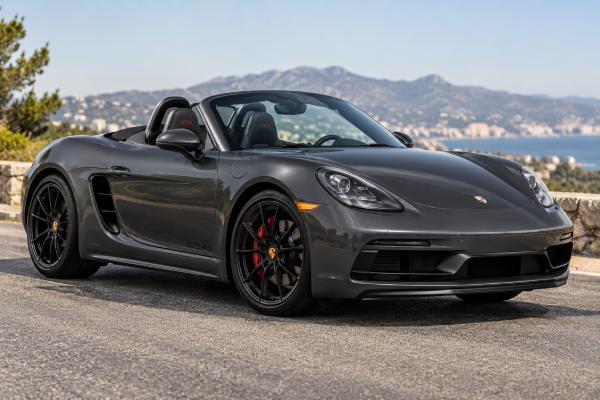
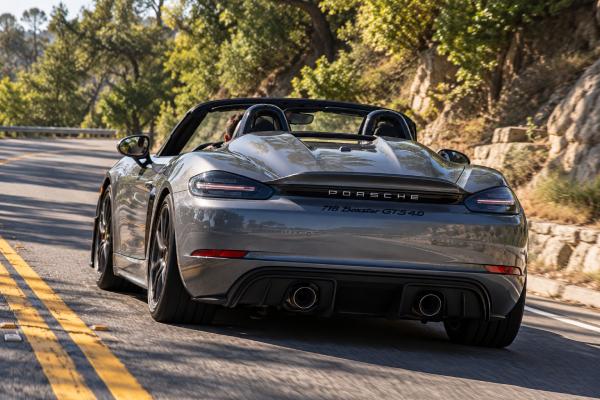
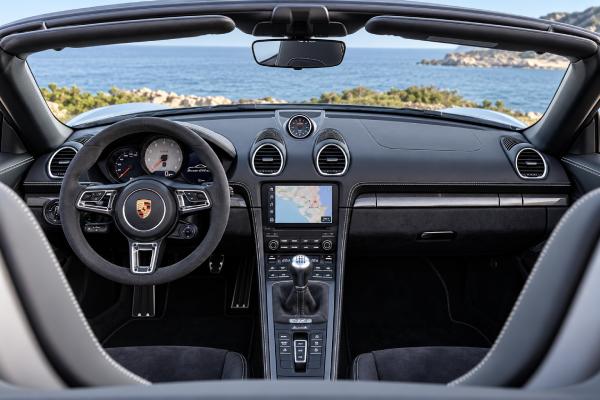
The Porsche 718 Boxster GTS 4.0 combines the 982 roadster chassis with a naturally aspirated six-cylinder engine, turning the GTS into a fundamentally different proposition from the earlier turbocharged four-cylinder 718 GTS. The 3,995 cc flat-six produces 394 hp in U.S. specification, revs to 7,800 rpm, and arrived with a six-speed manual before Porsche added an optional seven-speed PDK for the 2021 model year. Its drivetrain sits inside a factory package that already includes Sport Chrono, Porsche Active Suspension Management Sport, Porsche Torque Vectoring with a mechanical limited-slip differential, active drivetrain mounts, larger brakes, 20-inch wheels, and Sport Exhaust.
That concentration of standard hardware is why the GTS 4.0 is best understood as a complete system rather than an engine upgrade. This guide covers the 2020–2025 718 Boxster GTS 4.0, including the documented manual/PDK differences, roadster-specific packaging, service needs, the limited 2021 engine recall, and the checks that matter when evaluating a used example. Figures are kept tied to their model-year and market context instead of blending early and late brochures.
Table of Contents
- Why the Boxster GTS 4.0 Is a Distinct 718
- Factory Data: Engine, Chassis, Performance, and Dimensions
- What the Naturally Aspirated Flat-Six Changes
- The Standard GTS Chassis Package
- Roadster Packaging, Roof Use, and Everyday Practicality
- Manual to PDK: How the Drivetrain Choice Evolved
- Maintenance, Recall Verification, and Used-Car Inspection
Why the Boxster GTS 4.0 Is a Distinct 718
The GTS 4.0 arrived in 2020 as Porsche’s answer to buyers who wanted the everyday-focused GTS specification with a naturally aspirated six-cylinder engine. In U.S. documentation, Porsche rated the 4.0-liter boxer at 394 hp and 309 lb-ft (419 Nm) of torque. The engine is closely related to the 414 hp unit used by the contemporary 718 Spyder and Cayman GT4, but the GTS calibration and surrounding chassis specification were designed for a broader road-use brief.
That positioning matters because the name “718 Boxster GTS” can refer to two very different powertrains. Before the GTS 4.0, the 982 Boxster GTS used a turbocharged 2.5-liter flat-four. A listing that says only “718 GTS” is therefore not enough. The 4.0 should be confirmed from VIN/build data, engine specification, original documentation, and the actual vehicle rather than from badges alone.
Porsche launched the U.S.-market GTS 4.0 with the six-speed manual as the only transmission. Factory figures were 4.3 seconds from 0–60 mph and 182 mph top track speed. PDK became optional for the 2021 model year. Porsche then quoted 3.8 seconds to 60 mph for the PDK GTS 4.0 and increased its rated torque to 317 lb-ft. The engine remained a 394 hp naturally aspirated flat-six, but the gearbox choice became a meaningful mechanical distinction rather than simply an option-code difference.
The model’s standard chassis inventory also explains the GTS premium. PASM Sport lowers the ride height 20 mm relative to the regular 718, PTV adds a mechanical limited-slip differential, Porsche Active Drivetrain Mounts vary mount stiffness, Sport Chrono brings performance modes and timing functions, and the braking system grows to six-piston front calipers with 350 mm front discs. Porsche also fitted 20-inch staggered wheels and Sport Exhaust as standard.
For buyers, this means the key question is not how many performance options were added to create a GTS-like specification. Most of the core dynamic hardware is already built into the model. The more useful questions concern transmission, brake type, seat choice, lighting, interior package, audio/navigation, paint, and whether the car remains factory-correct or has been modified.
Factory Data: Engine, Chassis, Performance, and Dimensions
Porsche’s original U.S. technical sheet was published for the manual GTS 4.0. Later PDK and 2025 figures are identified separately so that the tables do not imply one static specification where Porsche’s own published numbers changed.
Engine and drivetrain
| Parameter | Factory figure |
|---|---|
| Engine | Naturally aspirated flat-six, mid-mounted |
| Displacement | 3,995 cc (4.0 L) |
| Bore × stroke | 102.0 × 81.5 mm |
| Valves | 4 per cylinder |
| Fuel system | Direct fuel injection with piezo injectors |
| Maximum power | 394 hp at 7,000 rpm |
| Maximum torque, manual | 309 lb-ft (approximately 419 Nm) at 5,000–6,500 rpm |
| Compression ratio | 13.0:1 |
| Maximum engine speed | 7,800 rpm |
| Lubrication | Integrated dry-sump system with demand-controlled oil pump |
| Drive | Rear-wheel drive |
| Efficiency feature | Adaptive cylinder control at low engine load |
The engine’s torque curve is deliberately different from the earlier turbo GTS. Maximum torque is published between 5,000 and 6,500 rpm for the manual car, so accessing the strongest response means using more engine speed. That is part of the model’s appeal: the engine is designed to be worked toward its 7,800 rpm limit rather than delivering its defining shove near 2,000 rpm.
Performance by documented configuration
| Configuration / period | 0–60 mph | Rated torque | Top track speed |
|---|---|---|---|
| 2020 launch, 6-speed manual | 4.3 s | 309 lb-ft | 182 mph |
| 2021-on PDK announcement | 3.8 s | Up to 317 lb-ft | Use year-specific Porsche data |
| 2025 U.S. model overview | 3.8 s with Sport Chrono | — | 179 mph |
Porsche’s current 2025 U.S. model overview lists 179 mph, while the original manual launch material lists 182 mph. Both are factory-published figures tied to different points in the model’s life. A serious specification comparison should retain that context instead of choosing one number and applying it to every 2020–2025 car.
Brakes, suspension, wheels, and tires
| Item | Factory hardware |
|---|---|
| Front suspension | Lightweight MacPherson-type spring struts |
| Rear suspension | Lightweight MacPherson-type suspension |
| Adaptive suspension | PASM Sport, 20 mm lower than standard 718; 10 mm-lower PASM was alternatively available at launch |
| Torque management | Porsche Torque Vectoring with mechanical limited-slip differential |
| Drivetrain mounts | Porsche Active Drivetrain Mounts |
| Front brakes | 350 × 34 mm iron discs; 6-piston aluminum fixed calipers |
| Rear brakes | 330 × 28 mm iron discs; 4-piston fixed calipers |
| Front wheels/tires | 8.5 J × 20 ET57; 235/35 ZR20 |
| Rear wheels/tires | 10.5 J × 20 ET47; 265/35 ZR20 |
| Optional brake system | Porsche Ceramic Composite Brake (PCCB) |
Dimensions, weight, and luggage
| Parameter | Factory figure |
|---|---|
| Length | 4,391 mm (172.4 in) |
| Body width | 1,801 mm (70.9 in) |
| Width including mirrors | 1,994 mm (78.5 in) |
| Height | 1,262 mm (49.7 in) |
| Wheelbase | 2,475 mm (97.4 in) |
| Unladen weight | 3,157 lb (approximately 1,432 kg) in the original U.S. manual data |
| Front luggage compartment | 150 L (5.3 cu ft) |
| Rear luggage compartment | 125 L (4.4 cu ft) |
| Fuel tank | 64 L (16.9 US gal) |
Service-planning intervals
| Maintenance item | Published interval |
|---|---|
| Oil maintenance | 15,000 km / 1 year |
| Inspection | 30,000 km / 2 years |
| Brake fluid | Every 2 years |
| Spark plugs, GTS 4.0 | 45,000 km / 4 years |
| Air cleaner filter | 60,000 km / 4 years on the cited Type 982 schedule |
| Drive belt | 90,000 km / 6 years on the cited schedule |
| PDK clutch fluid | 180,000 km / 12 years |
| Transmission oil | 180,000 km / 12 years on the cited Porsche Centre schedule |
These intervals are a planning reference, not a universal workshop instruction. Porsche maintenance programs differ by country, vehicle configuration, and revision date; the exact VIN and local service information govern the car in front of you.
What the Naturally Aspirated Flat-Six Changes
The GTS 4.0’s defining change is not simply two extra cylinders. It replaces boost-dependent torque delivery with a larger naturally aspirated engine whose strongest torque occurs high in the rev range. The manual car’s 309 lb-ft maximum arrives from 5,000 to 6,500 rpm, and maximum power is at 7,000 rpm. There is therefore a much greater reason to use the upper half of the tachometer than in the turbocharged 2.5-liter GTS it replaced.
Porsche engineered the engine for both response and road efficiency. Direct injection uses piezo injectors, a variable intake system manages airflow, and adaptive cylinder control can alternately deactivate one cylinder bank at low load. The system does not transform the car into an economy model; its purpose is to reduce fuel use when the full output of six cylinders is unnecessary while preserving the character of a high-revving flat-six when demanded.
The 13.0:1 compression ratio is another reminder that this is not a casual low-output engine. Fuel quality should follow Porsche’s requirements for the vehicle’s market, and any evidence of non-standard calibration deserves scrutiny. A naturally aspirated engine cannot be “boosted” by software in the same simple way as a turbo engine, but exhaust, intake, ECU, emissions, and rev-limit modifications can still affect operation and legality.
Sport Exhaust is standard, and Porsche adapted the twin-tailpipe system used on the Spyder and Cayman GT4. On a roadster, that exhaust is particularly noticeable because the roof can be lowered. A test drive should nevertheless distinguish designed exhaust character from rattles, leaks, loose heat shields, or valves that do not operate correctly. The attraction of a louder system should not make mechanical noises easier to ignore.
Oil and cooling condition remain essential even without turbochargers. The engine uses integrated dry-sump lubrication and water cooling with thermal management. A car that has seen repeated high-rpm or track use may still be an excellent example if maintenance was proportional to the use, but that history should show in fluid changes, brake and tire replacement, inspection records, and the general condition of the underbody and cooling system.
The Standard GTS Chassis Package
The GTS 4.0 is unusually easy to misunderstand if it is evaluated only by horsepower. Porsche bundled several options that would otherwise be separate decisions on lesser 718s. PASM Sport, PTV, Sport Chrono, PADM, Sport Exhaust, large iron brakes, and 20-inch wheels are not incidental; they define how the car deploys its 394 hp.
PASM Sport lowers the car by 20 mm versus a standard 718. Porsche also offered the less aggressive 10 mm-lower PASM setup as an alternative when the car launched, which matters when comparing ride height on used examples. A car that appears taller than another GTS 4.0 is not necessarily modified or incorrect. Build data should settle which suspension it left the factory with.
PTV combines selective braking intervention with a mechanical limited-slip differential. Its value appears most clearly when the car is accelerating out of a corner or when the driver is using the chassis near its limit. PADM addresses a different problem: soft drivetrain mounts improve isolation, while firmer mounts improve control of mass during dynamic driving. Active mounts vary that compromise rather than forcing one fixed setting.
The brake package reflects the step up in performance. Six-piston front calipers clamp 350 mm cross-drilled iron discs, while 330 mm discs sit at the rear. PCCB was optional. On a used car, iron brakes and PCCB require different inspection logic and budgets. Iron discs are consumables that can be measured for wear and examined for heat damage; ceramic systems have different condition criteria and potentially much higher replacement cost. Confirm which system is fitted before valuing the car.
Twenty-inch wheels leave relatively little tire sidewall, so wheel and tire condition matter. Inspect inner rims for cracks or bends, check all four tire manufacture dates, measure tread across the entire width, and note whether the car has a matching set of appropriate performance tires. Alignment-related inner-shoulder wear can be easy to miss when the car is on the ground.
Roadster Packaging, Roof Use, and Everyday Practicality
The Boxster GTS 4.0 is the roadster version of the GTS 4.0 idea, and that changes ownership in ways that do not appear on an engine chart. The powertrain sits behind the cabin, while luggage space is split between a 150-liter front compartment and a 125-liter rear compartment. Unlike the Cayman, there is no large hatch over the engine area. Packing for a trip therefore rewards smaller bags and deliberate use of both compartments.
The roof adds its own inspection category. Operate it several times with the vehicle positioned as Porsche specifies, watching for uneven motion, abnormal noises, warning messages, hesitation, or poor latching. Inspect the fabric, seams, rear-window area, drainage paths, seals, and surrounding trim. Water ingress can create problems far beyond a damp carpet, so evidence of staining, musty odor, corroded connectors, or repeated interior moisture deserves investigation.
Open-top use also changes how the driver experiences the car. The engine and exhaust are more audible, and highway comfort depends more on wind management and seat position. A buyer planning long-distance use should test the car roof-up and roof-down rather than treating the convertible mechanism as a feature to check once in the driveway.
The compact dimensions remain helpful in daily use, but the low front bodywork and 20-inch wheels demand attention around ramps, parking curbs, and broken pavement. Inspect the front lip, undertrays, wheel edges, and lower suspension areas for repeated contact. Cosmetic scraping alone is not necessarily serious; impact damage, cracked panels, bent hardware, or displaced cooling ducts is more meaningful.
Seat specification can have a large effect on the roadster’s practicality. Sport Seats Plus were part of the GTS package, while other seat choices could be available depending on market and year. Full bucket seats may suit a driver focused on support and track use but can make repeated entry and exit less convenient. Buy the seat that fits the intended use rather than the option that looks most desirable on a build sheet.
Manual to PDK: How the Drivetrain Choice Evolved
The manual is the original GTS 4.0 transmission and remains central to the model’s identity. Its six ratios require the driver to work for acceleration, which suits an engine that develops maximum torque at 5,000 rpm and power at 7,000 rpm. Porsche’s 4.3-second 0–60 mph number is not the fastest way the platform can leave the line, but speed is only one reason to choose the manual.
PDK changed the equation for the 2021 model year. Porsche quoted 3.8 seconds to 60 mph, 0.5 second quicker than the manual, and allowed the GTS 4.0 to make up to 317 lb-ft of torque instead of 309. The seven-speed gearbox also uses a shorter seventh ratio than other 718 PDK variants cited by Porsche, and Sport Chrono controls its shift strategy through Normal, Sport, Sport Plus, and Individual modes. Launch Control is integrated into Sport Plus, while Sport Response requests maximum engine and transmission performance for 20 seconds.
Neither gearbox is a fallback choice. The manual makes the engine speed and clutch work part of the experience; PDK makes the car quicker, easier to use in congestion, and more repeatable under hard acceleration. Used-car condition matters more than internet arguments about which is “correct.” A manual should be checked for clutch slip, engagement quality, shift consistency, and abnormal drivetrain noise. PDK should be tested cold and hot, in reverse and drive, at parking speed, under moderate load, and in manual mode.
Model-year details extend beyond the gearbox. Porsche replaced Alcantara with Race-Tex in the 718 range for the 2021 model year. Equipment can also differ by market, and current U.S. model data no longer reproduces every launch-era figure unchanged. When comparing two cars, use their actual build records rather than assuming a 2020-style specification applies through 2025 without revision.
Maintenance, Recall Verification, and Used-Car Inspection
A GTS 4.0 should be maintained on time even when annual mileage is low. The current Porsche Centre schedule cited above places oil maintenance at 15,000 km/one year, brake fluid at two years, GTS 4.0 spark plugs at 45,000 km/four years, and a drive belt at 90,000 km/six years. As these cars age, the calendar increasingly determines what is due.
Invoices are more useful than a generic “full service history” claim. Build a timeline showing oil services, inspections, brake fluid, plugs, filters, belts, tires, brakes, battery replacement, roof repairs, and any transmission work. For PDK cars, note that some current Porsche Centre schedules place PDK clutch fluid and transmission oil at 180,000 km or 12 years. Most 2020–2025 cars are not yet at that age, but knowing the long-term interval prevents the gearbox from being treated as maintenance-free.
The 2021 engine recall deserves precise handling because it was narrow and serious. NHTSA campaign 21V-200 covered certain 2021 Cayman GT4, Cayman GTS 4.0, 718 Spyder, and Boxster GTS 4.0 vehicles. Porsche reported that connecting rods not manufactured to specification could crack or loosen, potentially causing engine damage, a stall, or oil leakage. The campaign population listed for the U.S. was 190 vehicles across the affected models, and remedy documentation included engine replacement for affected delivered cars. This is not evidence that all 2021 GTS 4.0 engines share the defect. Check the individual VIN and obtain campaign-completion documentation.
Start a used-car inspection with that identity work. Confirm VIN, original market, model year, transmission, brake system, suspension configuration, and factory options. If the car has a replacement engine, determine why, and whether it was connected to an official campaign, warranty repair, failure, or modification history. Engine-number and campaign documentation can turn what looks like a concern into a well-supported repair record.
A cold start should be observed whenever possible. Watch the instrument cluster during its lamp check, listen for persistent abnormal noises, and note smoke or fluid odor. Do not diagnose every mechanical sound as a defect: a high-performance direct-injection engine and its control systems can be mechanically audible. The goal is to identify patterns that warrant specialist diagnosis.
The road test should include roof-up and roof-down operation, low-speed clutch or PDK behavior, higher-rpm acceleration, braking from meaningful speed, uneven pavement, and steady cruising. The engine should pull cleanly toward the upper rev range without warning messages. Steering should remain precise, the car should not wander, and the suspension should not knock. Brake vibration or repeated pulling under braking needs an explanation.
Afterward, inspect cooling openings, fluids, the lower body, tires, wheels, brakes, roof seals, luggage compartments, and interior carpets. Evidence of track use is not automatically disqualifying; it becomes important when it conflicts with the service record. A car with heat-cycled tires, heavily worn brakes, and underbody rubber debris but only ordinary annual servicing warrants a different risk assessment from a documented track-used car that received frequent fluids and consumables.
Finish with a Porsche-capable diagnostic scan and specialist pre-purchase inspection. Request current and stored faults, evaluate battery/charging condition, verify adaptive suspension and drivetrain-mount systems, operate all roof and cabin electronics, and check for modifications. On a car this complex, a pre-purchase inspection is less about finding a mythical flaw-free example and more about converting unknowns into priced, documented decisions.
The Boxster GTS 4.0 rewards that diligence because its appeal is unusually integrated: a high-revving six-cylinder engine, factory performance chassis, roadster body, and a choice between an involving manual and a faster PDK. The strongest used example is the one whose factory specification is verifiable, whose age-based maintenance is current, whose applicable campaigns are closed, and whose condition supports the way its history says it was used.
References
- Six cylinders, naturally aspirated, manual gearbox: The new 718 GTS 4.0 — Porsche Cars North America, 2020.
- Technical data: 718 Boxster GTS 4.0 — Porsche Cars North America, 2020.
- Optional Porsche dual-clutch transmission further improves performance on 718 models with six-cylinder engine — Porsche Cars North America, 2020.
- Porsche 718 Models and Configurator | Porsche USA — Porsche, 2025 model-year data.
- Boxster and Cayman Service — Porsche Centre Melbourne, accessed 2026.
- U.S. Department of Transportation — National Highway Traffic Safety Administration, Campaign 21V-200, 2021.
Disclaimer
This article is for informational purposes only. Specifications, output ratings, service intervals, fluid requirements, torque values, procedures, recall applicability, and installed equipment can vary by VIN, model year, transmission, options, and market. Verify maintenance and repair requirements using current Porsche service information, the vehicle’s owner documentation, build data, and VIN-specific recall records before ordering parts or carrying out work. If this guide is useful, please consider sharing it with another 718 Boxster GTS 4.0 owner or buyer.