


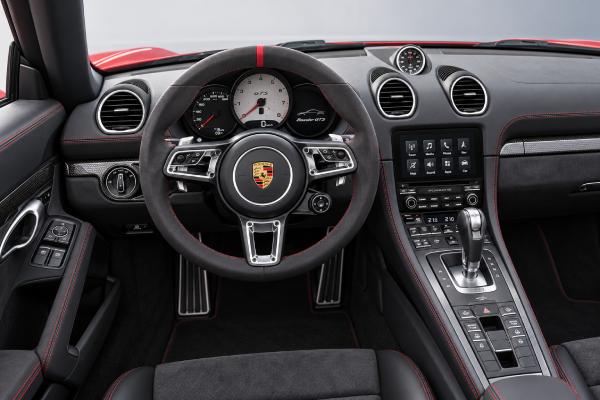
The 2.5-liter Porsche 718 Boxster GTS occupies a short but important chapter in the 982-generation roadster story. Introduced in October 2017, it sharpened the turbocharged four-cylinder 718 formula before Porsche later shifted the GTS badge to the naturally aspirated 4.0-liter six-cylinder. Its 365-hp output came from a revised intake path and optimized variable-turbine-geometry turbocharger, while Porsche bundled equipment that many buyers would otherwise have selected individually: Sport Chrono, Porsche Torque Vectoring with a mechanical rear differential lock, PASM lowered by 10 mm, 20-inch wheels and GTS-specific visual trim. A six-speed manual remained standard, and the seven-speed PDK was optional. Those transmissions matter because published torque and acceleration figures differ between them. This guide stays specifically with the 2.5-liter, 365-hp Boxster GTS covered by the 2017–2020 assignment range and does not merge data from the later 4.0-liter GTS. It also separates build/launch timing from model-year labeling where that distinction affects a used-car search.
Table of Contents
- Identifying the 2.5-Liter GTS
- Boxster GTS Technical Data
- Turbo Engine and Transmissions
- Chassis, Brakes, and Roadster Packaging
- Performance and Driving Character
- Maintenance and Wear Points
- Used-Car Inspection and Buying
Identifying the 2.5-Liter GTS
The easiest mistake with this car is assuming that every 982-generation Boxster wearing a GTS badge has the same engine. It does not. The version covered here is the turbocharged 2.5-liter flat-four rated at 365 hp in U.S. documentation. Porsche announced it in October 2017 as the 2018 718 Boxster GTS, and it preceded the 718 Boxster GTS 4.0 that arrived for the 2021 model year in the United States. A listing that says only “718 Boxster GTS” therefore needs its model year, engine and VIN checked before specifications are applied.
The 2.5-liter GTS can be recognized by more than its badge. Porsche gave it a Sport Design front fascia, darkened lighting elements, black model lettering, centrally positioned black sport-exhaust outlets and satin-black 20-inch Carrera S wheels. Inside, GTS treatment included extensive Alcantara on period cars, a GT Sport steering wheel and GTS branding. Equipment varies by market and individual order, so cosmetic cues should support—not replace—VIN and build-sheet verification.
The assignment range begins in 2017 because the model was unveiled and production-era cars can carry 2017 build dates. In the U.S., however, Porsche marketed it as a 2018 model. That distinction is useful when comparing registration dates, online listings and parts catalogs. For service or parts ordering, use the actual VIN and production data rather than inferring the model year from a first-registration date.
Boxster GTS Technical Data
Porsche’s U.S. technical material gives the 718 Boxster GTS a 2,497 cc turbocharged flat-four with gasoline direct injection, integrated dry-sump lubrication and a maximum engine speed of 7,500 rpm. The manual and PDK versions share the same 365-hp peak output but have different maximum torque ratings.
| Engine specification | 718 Boxster GTS 2.5 |
|---|---|
| Configuration | Turbocharged horizontally opposed 4-cylinder |
| Displacement | 2,497 cc |
| Bore × stroke | 102.0 × 76.4 mm |
| Maximum power | 365 hp at 6,500 rpm |
| Maximum torque, 6-speed manual | 309 lb-ft |
| Maximum torque, 7-speed PDK | 317 lb-ft |
| Compression ratio | 9.5:1 |
| Maximum engine speed | 7,500 rpm |
| Drive layout | Mid-engine, rear-wheel drive |
The standard suspension and brake package also distinguishes the GTS from a base 718. PASM lowers the car by 10 mm compared with the regular ride height, while Porsche Torque Vectoring incorporates a mechanically locking rear differential.
| Chassis item | Specification |
|---|---|
| Front suspension | Lightweight MacPherson-type strut |
| Rear suspension | Lightweight MacPherson-type |
| Adaptive damping | PASM, 10 mm lower ride height |
| Rear differential | Mechanical locking differential with PTV |
| Front brakes | 330 × 34 mm vented, cross-drilled iron rotors |
| Rear brakes | 299 × 20 mm vented, cross-drilled iron rotors |
| Front wheels/tires | 8J × 20 ET57; 235/35 ZR20 |
| Rear wheels/tires | 10J × 20 ET45; 265/35 ZR20 |
Body dimensions are compact even by modern sports-car standards, and the Boxster’s two luggage compartments make it more usable than the open roof might suggest. The rear compartment is smaller than the Cayman’s because the roadster roof mechanism occupies space behind the cabin.
| Dimension or capacity | U.S. specification |
|---|---|
| Length | 172.9 in |
| Width, mirrors folded | 70.9 in |
| Wheelbase | 97.4 in |
| Height | 50.1 in |
| Front luggage compartment | 5.3 cu ft |
| Rear luggage compartment | 4.4 cu ft |
| Total luggage capacity | 9.7 cu ft |
| Fuel tank | 16.9 U.S. gal |
Published curb weight is 3,032 lb with the manual and 3,098 lb with PDK in the U.S. technical sheet. Actual scale weight changes with options, fuel load and equipment, so those figures are best used for configuration comparison rather than as a guarantee for an individual car.
Turbo Engine and Transmissions
The 2.5-liter GTS engine is closely related to the unit in the 718 S, but Porsche raised output through a redesigned intake plenum and an optimized turbocharger operating at higher boost. The turbo uses variable turbine geometry, a technology that alters exhaust-gas flow at the turbine to improve response across a broad operating range. The result is an engine with strong midrange torque rather than the increasingly high-rpm power delivery of the later 4.0-liter GTS.
Transmission choice changes the character substantially. The six-speed manual uses a conventional clutch and gives the driver direct control over the engine’s broad torque band. Porsche’s seven-speed PDK dual-clutch gearbox adds closely managed automated shifts, launch control as part of Sport Chrono and a slightly higher published peak torque figure. Period U.S. technical data lists 309 lb-ft for the manual and 317 lb-ft for PDK, so a buyer should not treat a single torque number as universal.
| Transmission | Published torque | 0–60 mph | Quarter mile | Top track speed |
|---|---|---|---|---|
| 6-speed manual | 309 lb-ft | 4.4 s | 12.7 s | 180 mph |
| 7-speed PDK with Sport Chrono launch control | 317 lb-ft | 3.9 s | 12.3 s | 180 mph |
Those acceleration figures are factory performance claims under specified conditions, not promises for every road surface, tire or weather condition. Tire condition, ambient temperature, fuel, vehicle load and launch technique all matter. More importantly for ownership, the two gearboxes create different inspection priorities: clutch take-up and shift quality for a manual car; smooth engagement, fault history and correct servicing for a PDK car.
Because the engine is turbocharged and mid-mounted, heat management deserves attention. Cooling fans, radiators, condensers, hoses and underbody ducting should all be intact. A car that has accumulated debris in its front cooling inlets can suffer reduced heat-exchanger efficiency even if the dashboard never shows an overheating warning. Cleaning should be done carefully to avoid damaging condenser fins.
Chassis, Brakes, and Roadster Packaging
The GTS’s appeal is not simply its extra 15 hp over the period 718 S. Porsche made several dynamic systems standard, which changes both the driving experience and what a used buyer should expect to find. Sport Chrono adds selectable drive modes and, with PDK, launch control. PTV uses selective braking intervention together with a mechanical rear differential lock. PASM varies damper force while lowering the GTS 10 mm.
The standard iron brakes use four-piston aluminum monobloc fixed calipers at both axles. Porsche Ceramic Composite Brake equipment could be ordered on some cars and should be identified separately because replacement costs and inspection methods differ materially from the standard iron system. On any prospective purchase, confirm rotor type and condition rather than assuming red, yellow or repainted calipers tell the whole story.
The Boxster body adds its own ownership considerations. The powered fabric roof should move through its full cycle without hesitation, uneven motion or warning messages. Inspect the fabric for abrasion and shrinking around edges, the rear glass for secure bonding, and drains for signs of blockage. Check carpets and storage areas for moisture. Water ingress can be intermittent, so a dry cabin on one inspection does not prove the drainage system has always been clear.
Roadster-specific packaging is otherwise clever. The mid-engine layout leaves a front trunk and a separate rear trunk, so soft luggage can be split between them. The 4.4-cu-ft rear compartment remains available with the roof open, making the GTS practical for two-person touring despite its performance focus.
The factory 20-inch wheel and low-profile tire package also means curb damage and impact damage deserve a close look. Check all four wheels on both inner and outer barrels where possible, and inspect tire sidewalls for bubbles, cuts or age cracking. Uneven shoulder wear can indicate aggressive use, alignment problems or worn suspension components, although alignment settings and road camber can also influence the pattern.
Performance and Driving Character
On the road, this GTS is defined by accessible torque. The engine’s strongest shove arrives well before the 7,500-rpm maximum speed, so rapid progress does not demand constant high-rpm operation. That makes the car unusually flexible on a winding road: the manual can stay in a gear longer, while PDK can exploit the engine’s response with rapid shifts. Compared with the later naturally aspirated GTS 4.0, the 2.5’s turbocharged delivery is a different experience rather than simply a lower rung in the same formula.
The lowered PASM chassis and mechanical differential give the GTS sharper responses without turning it into the GT4’s more track-specialized package. This distinction matters to shoppers. The Boxster GTS retains the roadster’s everyday ride, storage and powered roof while providing much of the desirable dynamic equipment as standard. A used example therefore should be evaluated as a road-going performance car, not automatically judged by GT-car assumptions about alignment, brake setup or track preparation.
Steering feel, braking consistency and body control are useful test-drive diagnostics. The car should track cleanly on a level road without steering-wheel vibration, pull or knocking over low-speed bumps. Brake pedal travel should be stable across repeated stops. A slight tire roar or firm response from 20-inch performance tires is normal; clunks, grinding, pulsation or a steering wheel that never centers cleanly deserve investigation.
Open-top driving adds another variable to perceived noise. With the roof raised, listen for wind noise that changes sharply with speed, rattles around latches and rear-quarter areas, or water-stain evidence around the headliner. With the roof lowered, verify that the mechanism completes its cycle and the instrument cluster confirms the final position.
Maintenance and Wear Points
A strong maintenance record is more valuable than a generic claim that a GTS is “fully serviced.” Porsche schedules vary by market, model year, mileage and time, and the correct plan should be verified against the VIN-specific service information. In general, routine ownership centers on engine oil and filter service, periodic brake-fluid replacement, cabin/engine air filtration, spark-plug service and inspection of belts, tires, brakes and cooling components.
For a turbocharged car, oil quality and service history deserve particular scrutiny. Look for invoices that identify the oil specification and filter, not just a stamp in a booklet. Check for evidence of oil leaks around the engine and turbo plumbing, but distinguish a light film or old residue from an active leak. A pre-purchase inspection on a lift is far more informative than peering only through the rear service opening.
Spark-plug intervals can be shorter on turbocharged Porsche models than on naturally aspirated versions, and time-based requirements can apply before mileage thresholds are reached. Rather than copying a single internet interval to every car, establish the applicable schedule from official documentation for the VIN and market. The same principle applies to PDK service, accessory drive components and any option-dependent procedures.
Brake fluid absorbs moisture over time, so age matters even on a low-mileage collector-style example. Likewise, tires can age out before their tread is worn. Read the tire date codes, check that all four tires are compatible in type and performance level, and assess whether a long-stored car has flat spotting. The GTS’s performance depends heavily on tire quality; an inexpensive mismatched set can alter steering and stability more than many owners expect.
The front radiators and air-conditioning condensers sit in debris-prone airflow. During inspection, look through the intake openings for leaves, stones and damaged fins. Cooling-system repairs should be investigated if the car has a history of overheating warnings, coolant loss or repeated top-ups. A sweet smell after a drive, dried coolant residue or a dropping expansion-tank level warrants diagnosis rather than assumption.
For the roof, preventive care means keeping drains clear and seals clean, and addressing slow or asymmetric operation early. Water-management problems can damage trim and electronics if ignored. Ask whether the car has been garaged, but rely on physical evidence rather than the seller’s storage description alone.
Used-Car Inspection and Buying
The best buying process starts by proving that the car is the exact 2.5-liter GTS discussed here. Decode the VIN, compare the build data with the installed equipment and make sure a later GTS 4.0, a 718 S with cosmetic changes, or a modified car has not been described using the wrong specifications. Original options matter because seats, brakes, lighting and other equipment can materially change replacement cost and usability.
A focused pre-purchase inspection should include:
- Cold start, warm idle and a full scan of all control modules for current and stored faults.
- Engine, turbocharger plumbing, cooling system and underside inspection for leaks, impact damage or non-original repairs.
- Manual-clutch engagement and gearbox synchro behavior, or PDK engagement and shift quality, according to the installed transmission.
- Brake rotor surface, remaining pad material, hose condition and evidence of track-related heat.
- Tire age, matching specification, tread pattern and inner-edge wear.
- PASM operation, suspension joints, wheel bearings and alignment-related symptoms.
- Convertible-top operation, drain condition, interior moisture checks and rear-glass bonding.
- Front bumper, undertrays and cooling inlets for curb strikes, road debris and repairs.
Modification history deserves context rather than an automatic pass/fail judgment. Exhausts, engine calibrations, lowering components, spacers and track-oriented alignments can be appropriate when installed competently, but they change the baseline for diagnosis and may affect emissions compliance, warranty history or future resale. Ask for original parts and documentation when modifications are present.
Also check the VIN in the applicable official recall database and verify that any open campaigns have been addressed. Recall status is vehicle-specific and can change after an article is published, so a model-level statement is never a substitute for a live VIN check.
The 2.5-liter Boxster GTS makes the most sense when its identity is appreciated on its own terms: compact mid-engine roadster packaging, immediate turbo torque, a well-equipped chassis and a choice between manual involvement and PDK speed. A car with coherent records, correct tires, healthy roof drains and no unresolved drivetrain or cooling issues is a much sounder prospect than one chosen only for low mileage or cosmetic presentation.
References
- Sharper design, greater performance – the 2018 Porsche 718 GTS Models 2017
- Tailored for design and sportiness – the new Porsche 718 GTS models 2017
- Technical Specifications 2026
- Porsche Scheduled Maintenance Plan 2026
- Porsche Maintenance Schedules 2026
- Check for Recalls: Vehicle, Car Seat, Tire, Equipment | NHTSA 2026 (Recall Database)
Disclaimer
This article is for informational purposes and is not a substitute for professional diagnosis or repair. Specifications, torque values, service intervals and procedures can vary by VIN, market, production date and equipment; verify all work and maintenance requirements against the official service documentation for the specific vehicle.
If this guide helped you understand the 2.5-liter 718 Boxster GTS, please consider sharing it on Facebook, X/Twitter or another platform to support our work.