
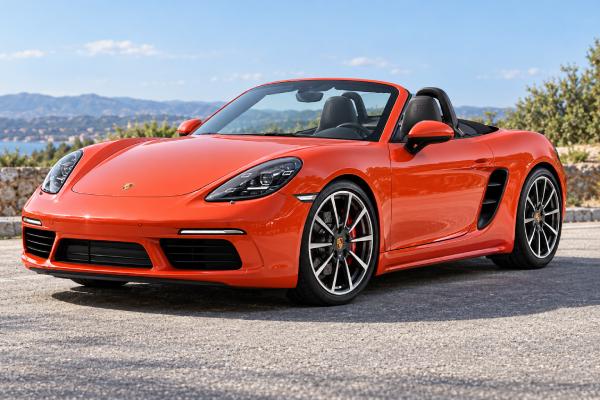

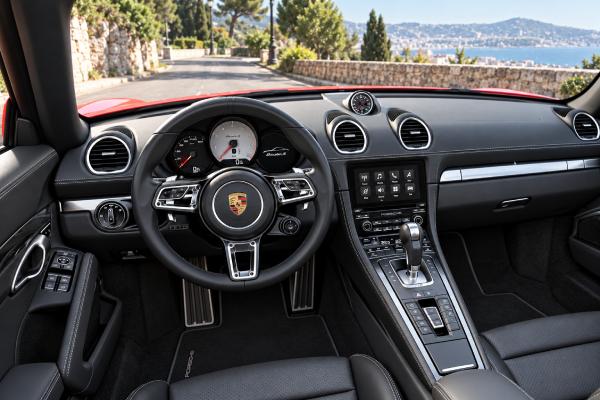
The 718 Boxster S is the version that shows why the four-cylinder 982 generation cannot be understood by displacement alone. Its 2,497 cc flat-four makes 350 hp, but the more important engineering distinction is its variable-turbine-geometry turbocharger, which helps deliver 309 lb-ft from just 1,900 rpm while retaining a 7,500 rpm engine-speed ceiling. In a compact mid-engine roadster, that produces a wide performance envelope without requiring the six-cylinder GTS 4.0 or Spyder hardware.
This article covers the 350 hp 2.5-liter Boxster S across the 2016 launch through the 2025 model-year era, with U.S. specifications used where a market reference is necessary. It does not combine the S with the 300 hp 2.0-liter Boxster, the earlier 2.5-liter GTS, or the later naturally aspirated 4.0-liter models. Equipment, maintenance intervals, emissions components, and even registration/model-year conventions vary by market, so a VIN-specific record remains the final authority for an individual car.
Table of Contents
- Why the 2.5-liter S is mechanically distinct
- Boxster S specifications and performance data
- What variable turbine geometry changes
- Brakes, wheels, suspension, and option interactions
- Service planning for a turbocharged 982 S
- What changed—and what did not—through 2025
- A disciplined pre-purchase inspection strategy
Why the 2.5-liter S is mechanically distinct
The “S” badge is not merely a power tune on the same 1,988 cc engine. Porsche enlarged bore from 91.0 mm to 102.0 mm while retaining the 76.4 mm stroke, producing 2,497 cc. The S also uses a turbocharger with variable turbine geometry (VTG), whereas the standard 2.0-liter car uses a conventional single turbocharger. Output is 350 hp at 6,500 rpm and 309 lb-ft of torque from 1,900 to 4,500 rpm.
Porsche launched the new 718 Boxster family in 2016, with the U.S. market receiving the cars as 2017 models. This is why advertisements can legitimately mention a 2016 build or registration while U.S. technical literature calls the same generation a 2017 718 Boxster S. For research and parts work, production date and VIN are more useful than an advertisement’s year label.
The S sits in an unusual point in the 718 hierarchy. The 300 hp base Boxster has less torque and uses a smaller turbo, while the later GTS 4.0 and Spyder trade turbocharged low- and mid-range thrust for naturally aspirated six-cylinder response. The S therefore appeals to buyers who want the highest-output regular turbo-four roadster rather than the character and cost structure of the six-cylinder cars.
Do not confuse the 350 hp S with the first 718 Boxster GTS. That 2018-era GTS also used the 2.5-liter turbo-four but had a higher factory output and additional standard performance equipment. Conversely, the later GTS 4.0 is a fundamentally different engine package. Engine family names can overlap in marketplace descriptions, so the VIN, displacement, factory output, and build sheet should agree before parts or software are ordered.
Boxster S specifications and performance data
Porsche’s U.S. technical sheet for the 2017 model year provides a clean baseline for the 350 hp S. Later model-year equipment changed, but the headline 2.5-liter output remained 350 hp through the 2025 U.S. offering.
| Specification | Value |
|---|---|
| Engine | Turbocharged flat-four, mid-mounted |
| Displacement | 2,497 cc |
| Bore × stroke | 102.0 × 76.4 mm |
| Power | 350 hp at 6,500 rpm |
| Torque | 309 lb-ft (about 420 Nm) at 1,900–4,500 rpm |
| Compression ratio | 9.5:1 |
| Maximum engine speed | 7,500 rpm |
| Turbo system | Single turbocharger with VTG |
| Published maximum boost | 14.5 psi (1.0 bar) |
| Charge cooling | Water-to-air intercooling |
| Fuel delivery | Direct fuel injection |
| Configuration | 0–60 mph | 0–100 mph | Quarter mile |
|---|---|---|---|
| 6-speed manual | 4.4 s | 9.7 s | 12.8 s |
| 7-speed PDK | 4.2 s | 9.5 s | 12.6 s |
| PDK with Sport Plus | 4.0 s | 9.2 s | 12.4 s |
| Item | Manual | PDK |
|---|---|---|
| Forward gears | 6 | 7 |
| 1st gear | 3.31 | 3.91 |
| 2nd gear | 1.95 | 2.29 |
| 6th gear | 0.81 | 0.88 |
| 7th gear | — | 0.62 |
| Final drive | 3.89 | 3.62 |
| Driven axle | Rear | Rear |
| Item | 2017 718 Boxster S specification |
|---|---|
| Front suspension | MacPherson-type spring strut |
| Rear suspension | MacPherson-type layout |
| Steering | Electromechanical, variable ratio |
| Front brakes | 330 × 34 mm vented, perforated cast-iron discs |
| Rear brakes | 299 × 20 mm vented, perforated cast-iron discs |
| Calipers | Four-piston aluminum monoblock fixed, front and rear |
| Standard early front wheel/tire | 8 J × 19 ET57; 235/40 ZR19 |
| Standard early rear wheel/tire | 10 J × 19 ET45; 265/40 ZR19 |
| Item | Value |
|---|---|
| Length | 4,379 mm (172.4 in) |
| Width / width with mirrors | 1,801 / 1,994 mm |
| Height | 1,280 mm (early U.S. S specification) |
| Wheelbase | 2,475 mm |
| Front luggage volume | 150 L |
| Rear luggage volume | 125 L |
| Unladen weight, manual | 2,988 lb (about 1,355 kg) |
| Unladen weight, PDK | 3,054 lb (about 1,385 kg) |
| Fuel tank | 64 L (16.9 U.S. gal) |
| Item | Figure | Scope |
|---|---|---|
| Top track speed | 177 mph (285 km/h) | Early and 2025 U.S. published data |
| Oil maintenance | 15,000 km / 1 year | Current Australian Porsche Centre Type 982 schedule |
| Inspection | 30,000 km / 2 years | Australian schedule |
| Brake fluid | Every 2 years | Australian schedule |
| Spark plugs | 45,000 km / 4 years | Australian schedule for Boxster/Cayman through S |
| Air filter | 60,000 km / 4 years | Australian schedule |
| Drive belt | 90,000 km / 6 years | Published by Porsche Centres in Australia |
The maintenance table is an example from an official Porsche retail network, not a universal schedule. Owners should use the schedule issued for their market and VIN, especially for emissions-system checks and transmission-fluid requirements.
What variable turbine geometry changes
VTG is the defining engine technology of the 2.5-liter S. Movable guide vanes alter the effective flow area and angle of exhaust gas entering the turbine. At lower exhaust flow, the geometry can accelerate gas toward the turbine to improve response; at higher flow, it can open to manage backpressure and turbine speed. Porsche had previously used this concept on high-performance 911 Turbo applications, and its use on the 718 S helps reconcile quick response with a broad operating range.
The published boost number can be misleading if viewed in isolation. The S is listed at 1.0 bar maximum boost, lower than the 2.0-liter base car’s 1.4 bar, yet it produces more power and torque. The explanation is not that boost “doesn’t matter,” but that boost pressure is only one part of air mass flow. The S has greater displacement, a different turbo system, different breathing requirements, and its calibration is designed around the full engine package. Comparing peak boost alone is therefore a poor way to judge tune level or engine stress.
The 309 lb-ft plateau begins at 1,900 rpm. This makes the S unusually flexible for a sports car: a driver can short-shift and still have substantial thrust, or use the upper rev range for a more intensive pace. The torque curve also makes traction and tire condition important. Full throttle on cold or old rear tires is not the same proposition as it is in a low-torque naturally aspirated roadster.
VTG adds sophistication that deserves correct diagnosis. A boost-control fault, wastegate-related symptom, charge-air leak, sensor fault, or ignition issue can all present as reduced power, hesitation, or a warning lamp. The right response is a fault-code and measured-value diagnosis, not immediate assumption that the turbocharger itself has failed. A pre-purchase scan can reveal stored faults even if the car drives normally during a twenty-minute test.
Heat management matters as well. Porsche uses water-to-air intercooling, two low-temperature radiators, an integrated dry-sump oil system, and demand-controlled pumps. Those systems work as a network. Evidence of coolant loss, damaged front heat exchangers, persistent high temperatures, or oil leaks should be traced to a cause rather than accepted because “turbo cars run hot.”
Brakes, wheels, suspension, and option interactions
The Boxster S received hardware that supports its additional performance rather than relying only on the engine. Early U.S. cars used 19-inch wheels as standard, and their front brake discs retained the 330 mm diameter of the base car but increased thickness from 28 to 34 mm. That extra thermal mass is relevant in repeated hard braking even though the diameter figure looks identical on a quick spec comparison.
The suspension architecture remains MacPherson-type at both ends, but Porsche retuned the 718 generation for greater precision and made the steering more direct than the 981’s. The car’s mid-engine layout keeps major mass close to the center of the wheelbase, which is one reason alignment, tire consistency, and damper condition have such a noticeable effect on its behavior.
PASM was available with a 10 mm lower ride height. At launch, the S also gained access to a PASM Sport Suspension option with a 20 mm drop, giving buyers a more focused chassis configuration without changing engine output. Because used listings often abbreviate every adaptive suspension as “PASM,” verify the actual ride-height version and option code before valuing a car.
Sport Chrono is another option that changes function more than appearance. With PDK, the original factory performance claim dropped from 4.2 to 4.0 seconds to 60 mph in Sport Plus. More important for regular driving, the package alters powertrain response modes and includes performance-oriented controls. A dash-top stopwatch alone is not enough proof of an original package if the car has been modified; check the build record and PCM menus.
Wheel upgrades require a similar reality check. Twenty-inch wheels can sharpen appearance and steering response, but they reduce tire sidewall and can increase replacement cost and impact sensitivity. On a used car, a square-looking stance does not mean the wheels are the correct widths or offsets. The 718 uses different front and rear dimensions, and aftermarket wheels should be checked for clearance, load rating, tire specification, and evidence of rubbing.
The Boxster body adds its own functional checks. The fabric top should open and close smoothly, both side windows should perform their drop/raise sequence correctly, and the weather seals should sit evenly. Inspect drains and carpet for moisture. A powerful drivetrain does not compensate for roof-mechanism neglect, and water intrusion can create electrical problems far from the original leak path.
Service planning for a turbocharged 982 S
The strongest service record is chronological and specific. A stack of invoices should show what fluid, filter, plug, belt, brake, or transmission work was actually completed—not just an annual stamp. Time matters because an early 718 Boxster S can have low mileage yet still be due for multiple age-based items.
Official Porsche Centre schedules in Australia list annual oil maintenance at 15,000 km or one year and a 30,000 km/two-year inspection for the Type 982. They list brake fluid every two years, spark plugs at 45,000 km or four years, the air filter at 60,000 km or four years, and the drive belt at 90,000 km or six years. These are valuable planning references but should not be exported unchanged to another market. The car’s regional maintenance booklet takes priority.
On manual cars, evaluate clutch operation and gearbox behavior after the oil is warm. A clutch that engages near the end of travel is not automatically worn out, but slip under high load, chatter, or hydraulic problems warrant investigation. On PDK cars, ask for proof of transmission-related service and identify exactly which fluid circuit was serviced. Different Porsche documents distinguish clutch fluid from gear oil, and marketplace descriptions often collapse both into the phrase “PDK fluid.”
Ignition quality deserves attention because high cylinder pressure under boost can expose marginal plugs or coils. Misfire counters, stored faults, and a road test under moderate-to-high load provide better evidence than idling the engine in a showroom. Any persistent stumble should be diagnosed before purchase rather than attributed casually to fuel quality.
The low front cooling openings collect leaves, stones, and road debris. Inspect the radiators and air-conditioning condensers through the grilles and, when appropriate, behind trim during a professional inspection. Bent fins are common on many low sports cars; what matters is whether airflow is restricted, corrosion is developing beneath trapped debris, or a heat exchanger is leaking.
Brake fluid, tire age, battery health, and alignment are easy to postpone because they do not create an immediate engine warning. They can nevertheless transform how the car feels and how much the first year costs. A car with four old premium tires is not “ready to drive” just because tread depth remains legal. Date codes, sidewall condition, and axle matching matter on a 177 mph-capable chassis.
Recall checking belongs in the service plan. In the U.S., certain 2017 718 Boxster S cars were included in campaigns involving fuel-collection-pipe fastening screws and airbag components. The affected populations were defined by production ranges, so a recall headline does not mean every S needs the repair. Check the individual VIN for completion status and retain proof with the vehicle file.
What changed—and what did not—through 2025
The most useful production-run fact is that Porsche did not continually chase a higher headline output for the regular Boxster S. The 2.5-liter S entered the range at 350 hp and remained listed at 350 hp in the 2025 U.S. configurator. Its published top track speed likewise stayed at 177 mph. Changes elsewhere in the 718 range can make the S look different in context without changing the S engine itself.
One notable U.S. equipment change came for the 2021 model year. Porsche added automatic two-zone climate control, heated front seats, auto-dimming mirrors with rain sensor, Apple CarPlay, and bi-xenon headlights with Porsche Dynamic Light System as standard on multiple 718 variants including the S. That means two mechanically similar cars can have different standard-equipment baselines simply because of model year.
The arrival of the GTS 4.0 also changed the choice set. Earlier shoppers could move above the S to a more powerful turbo-four GTS; later shoppers could choose the naturally aspirated six-cylinder GTS 4.0. This can affect used values and buyer priorities, but it does not turn the S into a lesser version of the same engine. The 2.5 VTG turbo has a different delivery profile and may suit drivers who prefer abundant mid-range torque.
Infotainment, colors, wheels, lighting, interior trims, and option bundling evolved across markets. Those differences are difficult to summarize reliably by calendar year because Porsche’s standard equipment can change country by country. For a real car, obtain its build data rather than inferring equipment from a U.S. brochure or a photograph of another market’s vehicle.
Late examples also need age-based inspection, just at a different stage. A 2024 or 2025 car can still have damaged wheels, overheated brakes, poor paintwork, accident repairs, or a history of short-trip use. Newer does not remove the need to inspect; it changes the likely maintenance backlog.
A disciplined pre-purchase inspection strategy
Start by confirming identity. The VIN, model designation, 2,497 cc engine, original 350 hp specification, transmission, and option list should all describe the same car. If the seller advertises a tune, downpipe, exhaust, intake, lowered suspension, or non-standard software, ask for invoices and original parts rather than treating modifications as automatic added value.
Then inspect the car cold. Cold start can reveal battery weakness, abnormal valvetrain or accessory noise, exhaust leaks, smoke, or a rough idle that disappears after warming. A brief condensation cloud is not the same as persistent oil or coolant smoke; duration, odor, conditions, and diagnostic evidence matter.
During the road test, build load progressively. Confirm boost arrives cleanly without surging or warning messages. Make several gear changes at different speeds, check steering self-centering, and brake firmly enough to expose vibration without abusing the car. A pull under braking may be tire, alignment, brake, or road-camber related; it needs measurement rather than a seller’s explanation.
After the drive, look for fresh fluid traces and recheck coolant warnings. Scan every control module. Examine tire date codes and inner shoulders, brake-disc surfaces, wheel rims, undertrays, suspension arms, dampers, and lift points. Check the convertible top again after the car is warm, because intermittent roof or window issues may not appear during the first cycle.
Service records should be reconciled with the odometer and elapsed years. If the car is due for plugs, belt, brake fluid, tires, PDK work, or a major inspection immediately after purchase, those are foreseeable ownership costs. They are not necessarily reasons to reject the car, but they belong in the price calculation.
Finally, check recalls by VIN in the country where the car is registered and check whether an imported car has open actions in its original market. Early U.S. campaigns demonstrate why the VIN matters: one recall could involve a small production window while a visually identical car built weeks later is outside the population.
The Boxster S rewards this disciplined approach because its basic specification is already strong. There is little need to rationalize an unclear history in pursuit of an extra option. The more convincing car is the one whose identity, condition, service chronology, software state, and road behavior all agree.
References
- The new Porsche 718 Boxster — Porsche Newsroom, 2016.
- 2017 – 718 Boxster and 718 Boxster S technical specifications — Porsche Cars North America, 2017.
- The 2021 Porsche 718 Boxster and Cayman models — Porsche Newsroom USA, 2020.
- Porsche 718 Models and Configurator | Porsche USA — Porsche, 2025 model data accessed 2026.
- Boxster and Cayman Service — Porsche Centre Brighton, accessed 2026.
- Porsche Safety Recall AH01 – Replacing Fastening Screws for fuel collection pipes — Porsche/NHTSA, 2017.
Disclaimer
This article is for informational purposes only. Specifications, service intervals, fluids, tightening torques, recall applicability, diagnostic procedures, and parts can vary by VIN, production date, market, transmission, equipment, and later Porsche revisions. Confirm all maintenance and repair work against current official Porsche information for the specific vehicle. If this guide is useful, please share it with another 718 Boxster S owner or buyer who may benefit from a model-specific reference.