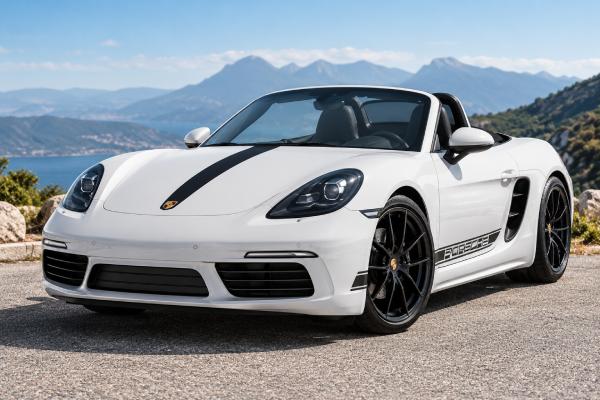
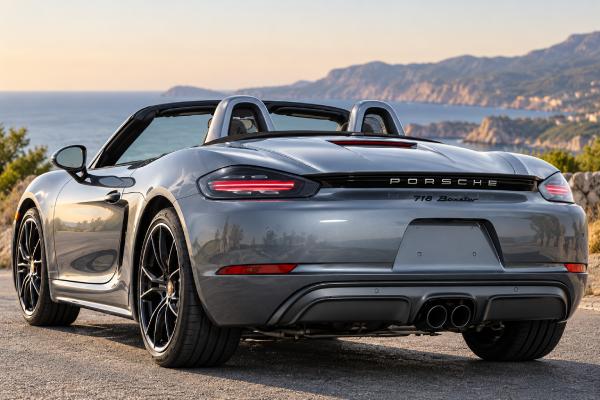
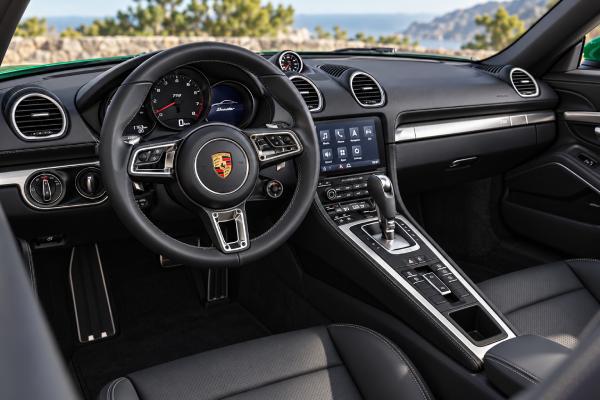
The 250-output Porsche 718 Boxster Style Edition is a China-market version of the 982-generation mid-engine roadster introduced in 2022. Its most important distinction is easy to miss in English-language material: Porsche China rates this version at 184 kW (250 PS), not 250 SAE horsepower, and pairs it with the seven-speed PDK dual-clutch transmission as standard. It keeps the 1,988 cc turbocharged flat-four and rear-wheel-drive layout of the local base 718 Boxster while adding the Style Edition’s 20-inch Spyder-design wheels, contrast graphics, richer cabin trim, and Boxster-specific roof embossing.
That market distinction matters because many global Style Edition pages describe a 300 PS model with a six-speed manual as standard. Those specifications should not be imported into the Chinese 250 PS car. This guide therefore treats the 2022–2025 250-output assignment as its own scope, explains where Porsche’s published figures changed over time, and focuses on the details that matter when identifying, servicing, inspecting, and buying this exact variant.
Table of Contents
- Identifying the 250 PS China-market Style Edition
- What the Style Edition package actually changes
- Verified technical data and specification boundaries
- How the 2.0 turbo and PDK shape performance
- Roadster packaging, options, and everyday use
- Maintenance and service priorities
- Buying checks for a used 250 PS Style Edition
Identifying the 250 PS China-market Style Edition
The 250-output Style Edition is best understood as a China-specification 718 Boxster Style Edition, not as a lower-output version of the globally advertised 300 PS car. Porsche China’s launch material specifies 184 kW (250 PS), 310 Nm, seven-speed PDK, and rear-wheel drive. The current China configurator likewise lists the Boxster Style Edition at 250 PS with an automatic transmission.
The assignment calls the car “250 hp.” For technical accuracy, the official rating should be kept in Porsche’s original units: 250 PS equals 184 kW and is approximately 247 mechanical hp. PS and SAE hp are close numerically but are not the same unit. This difference is especially important when comparing the car with North American Style Edition material, where Porsche quotes 300 hp, or European material, where the equivalent global version is listed at 300 PS/220 kW.
The assignment also identifies the engine as MA2.20. Porsche’s public China pages used for this article describe the power unit by configuration and displacement—four-cylinder turbo boxer, 1,988 cc—rather than publishing that internal engine code. For parts ordering or workshop diagnostics, the car’s VIN and the engine identification shown in Porsche service systems should therefore take precedence over a catalog label.
The date range needs similar care. Porsche announced and opened China-market presales for the Style Edition in November 2022. Cars were then sold through subsequent model years, and Porsche Finder listings document 2025 examples with the same 184 kW/250 PS core specification. A registration date, production date, model year, and announcement year can therefore differ; a buyer should use the VIN and build documentation rather than assume that “2022–2025” means every car has identical software, options, or homologation data.
What the Style Edition package actually changes
The Style Edition is primarily an equipment and appearance derivative. Porsche’s China launch statement explicitly says its powertrain and chassis are based on the regular local 718 Boxster, so the edition should not be treated as a separate high-performance mechanical model such as a GTS or Spyder.
Its recognizable exterior elements include 20-inch 718 Spyder wheels in high-gloss black, colored Porsche crests on the wheel centers, black sport tailpipes, and contrasting exterior details. The Boxster adds a detail the Cayman cannot: “Boxster” lettering embossed into the soft top above the side windows. Ruby Star Neo was promoted as a signature launch color, but a Style Edition does not have to be Ruby Star Neo. Porsche offered other exterior colors and black or white contrast packages with decorative striping and side “PORSCHE” lettering.
China-market standard equipment was also unusually important to this derivative. Porsche’s local launch list included bi-xenon headlights with LED daytime running lights, two-tone leather trim, front and rear ParkAssist with a reversing camera, Power Steering Plus, Apple CarPlay, cruise control, automatically dimming mirrors, rain sensing, a heated multifunction steering wheel, heated seats, and dual-zone automatic climate control. Individual used cars can still differ because owners could add options or delete decorative elements.
| Area | China-market Style Edition detail | Inspection point |
|---|---|---|
| Wheels | 20-inch 718 Spyder design, normally high-gloss black | Check finish, curb damage, and whether all four wheels match the build specification |
| Roof | Soft top with “Boxster” embossing | Inspect the embossing, fabric condition, sealing surfaces, and operation |
| Exhaust | Black sport tailpipes | Confirm finish and look for impact or corrosion damage |
| Graphics | Black or white contrast-package graphics could be specified | Do not assume missing graphics mean the car is not genuine; some cars were ordered with deletions |
| Interior | Style-specific leather and contrast detailing | Compare trim, stitching, sill plates, and headrests with build data |
| Driver aids | China launch equipment included ParkAssist and reversing camera | Verify each function rather than relying on the trim name |
Because Porsche Finder examples show options such as PASM, Sport Chrono, a larger fuel tank, upgraded lighting, Bose audio, and decorative-sticker deletion, the trim badge alone is not a complete equipment list. A build sheet or Porsche system printout is much more useful than an advertisement assembled from generic Style Edition features.
Verified technical data and specification boundaries
This version is a gasoline internal-combustion sports car with a longitudinally mounted mid-engine boxer layout, turbocharging, PDK, and rear-wheel drive. The core figures below come from Porsche China material for the 250 PS Style Edition and a 2025 Porsche Finder example. Where Porsche’s 2022 launch data and later vehicle listings disagree, the conflict is shown rather than blended into a single “corrected” number.
| Specification | Verified figure |
|---|---|
| Engine type | Turbocharged gasoline flat-four |
| Displacement | 1,988 cc (2.0 L) |
| Bore × stroke | 91.0 × 76.4 mm |
| Maximum power | 184 kW (250 PS) at 6,500 rpm |
| Approximate SAE mechanical horsepower | About 247 hp; not an official Porsche SAE rating for this China-market version |
| Maximum torque | 310 Nm at 2,150–4,500 rpm |
| Transmission | 7-speed Porsche Doppelkupplung (PDK) |
| Driven wheels | Rear-wheel drive |
| Fuel listed by Porsche Finder | Premium unleaded |
| Assignment engine code | MA2.20; confirm against VIN/service data for parts and repair work |
| Measure | Porsche figure | Important condition |
|---|---|---|
| 0–100 km/h | 5.6 s | Standard published figure |
| 0–100 km/h with Sport Chrono | 5.4 s | Requires the optional Sport Chrono Package |
| 80–120 km/h | 3.2 s | Listed on later Porsche Finder examples |
| Top speed at 2022 China launch | 260 km/h | Original China press release |
| Top speed in 2025 Porsche Finder listings | 275 km/h | Later vehicle-specific Porsche listing |
The top-speed discrepancy deserves attention. Porsche China’s November 2022 launch release states 260 km/h, while multiple later 2025 Porsche Finder listings for 250 PS Boxster Style Editions state 275 km/h. Without a Porsche technical bulletin explaining the change, it would be speculative to attribute it to gearing, software, homologation, or a documentation correction. For a particular car, use the model-year-specific certificate, owner’s documentation, and VIN-linked Porsche data.
| Measure | Figure |
|---|---|
| Length | 4,379 mm |
| Width without mirrors | 1,801 mm |
| Width with mirrors | 1,994 mm |
| Height | 1,281 mm |
| Wheelbase | 2,475 mm |
| Unladen weight (DIN) | 1,365 kg |
| Unladen weight (EC) | 1,440 kg |
| Permissible gross weight | 1,685 kg |
| Maximum load | 280 kg |
| Item | Figure or layout |
|---|---|
| Seats | 2 |
| Engine position | Behind the passenger compartment, ahead of the rear axle |
| Front luggage compartment | 150 L |
| Rear luggage compartment | 122 L |
| Total quoted luggage volume | 272 L across two separate compartments |
| Roof | Power-operated convertible soft top; Style Edition-specific embossing |
| Item | What to verify | Why it matters |
|---|---|---|
| Sport Chrono | Option code/build sheet and mode switch | Changes the published 0–100 km/h figure and driving functions |
| PASM | Whether fitted and which ride-height specification applies | Affects suspension hardware, alignment, ride, and replacement parts |
| Fuel tank | VIN/build configuration | Porsche Finder cars can show an optional larger tank |
| Headlights | Original lighting specification and any upgrades | Replacement cost and control-system compatibility differ |
| Exterior graphics | Build sheet versus current appearance | Graphics could be deleted or altered after delivery |
| Wheel finish | Original Style Edition finish versus refinishing | Useful for originality assessment |
How the 2.0 turbo and PDK shape performance
The China-market calibration gives this Boxster a different character from the 300 PS global Style Edition even though the basic 1,988 cc turbo-flat-four architecture is closely related. Its 310 Nm torque plateau begins at 2,150 rpm and continues through 4,500 rpm, so useful road acceleration is concentrated well below the 6,500 rpm power peak. That makes the car responsive in ordinary traffic without requiring the engine to live near the top of the rev range.
PDK is not merely an optional alternative on this specification; Porsche China launched the 250 PS Style Edition with the seven-speed dual-clutch gearbox as standard. The gearbox can keep the turbo engine within its strongest torque band under acceleration, then select a taller ratio when the driver eases off. For an owner comparing cars, this means European articles discussing the Style Edition’s standard six-speed manual do not describe the drivetrain delivered in the China-market 250 PS version.
Sport Chrono is another source of confusion. Porsche quotes 5.6 seconds from 0–100 km/h as the normal figure and 5.4 seconds when the car is equipped with Sport Chrono. A seller should not present the quicker figure as universal. The easiest checks are the build data and the relevant cabin controls, followed by confirmation through Porsche’s VIN-linked equipment information.
The mid-engine placement remains central to the Boxster’s behavior. Mass is concentrated within the wheelbase rather than far ahead of or behind the passenger cell, while drive goes only to the rear wheels. The Style Edition does not introduce a different basic chassis concept, so its dynamic differences from another equivalently equipped local 718 Boxster come mainly from wheel, tire, suspension-option, and equipment choices rather than from a bespoke Style Edition suspension tune.
The 20-inch wheels are visually defining but also deserve practical attention. Larger wheels leave less tire sidewall than smaller-diameter setups, making wheel condition, correct tire specification, pressures, and alignment more consequential on rough roads. A car that has repeatedly encountered potholes may show bent rims, cosmetic repairs, irregular tire wear, or an off-center steering wheel even when no warning light is present.
Roadster packaging, options, and everyday use
The 718 Boxster’s two luggage compartments are one of the reasons its mid-engine layout works surprisingly well for two-person travel. Porsche Finder data for the 250 PS Style Edition lists 150 liters in front and 122 liters at the rear. Those spaces are separate and shaped differently, so soft bags often work better than one large rigid case. The engine does not consume either compartment in the way a front-engine roadster’s powertrain occupies the nose.
The convertible roof adds the ownership checks absent from a Cayman. Operate it through a complete opening and closing cycle, preferably more than once. Watch both sides of the mechanism, listen for abnormal binding, and inspect the fabric at folds and tension points. Check the seals for damage and the cabin, carpets, storage areas, and luggage compartments for evidence of water entry. A clean roof exterior does not rule out a drainage or sealing problem.
The Style Edition’s richer China-market equipment can make two visually similar cars meaningfully different in daily use. The launch specification already included a reversing camera, front and rear parking assistance, heated seats, dual-zone climate control, cruise control, and Apple CarPlay. Dealer-stock examples show that buyers could add still more equipment such as Sport Chrono, PASM, upgraded headlights, Bose audio, and a larger fuel tank. The correct way to value a used car is therefore to identify the individual options, not to price every Style Edition as though the trim name guarantees identical equipment.
PASM deserves a specific check because Porsche Finder examples show it as an upgrade on some cars. Confirm that the installed dampers, ride-height specification, control functions, and alignment correspond to the option code. A modified suspension may be perfectly serviceable, but it should not be mistaken for the original configuration, and future replacement costs can differ from a passive-suspension car.
Tire age matters even on a low-mileage example. A 2022 or 2023 car can have substantial tread depth while still wearing its original tires several years later. Read the date codes, inspect for sidewall cracking or repair, compare tread wear across the axle, and confirm that all four tires are appropriate for the vehicle and wheel sizes. Matching high-quality tires are especially important on a rear-wheel-drive mid-engine car because inconsistent grip can change behavior under braking and cornering.
Maintenance and service priorities
Neither a configurator nor a launch release is a substitute for the VIN-specific maintenance schedule. The 2022–2025 China-spec Boxster Style Edition should be serviced against current Porsche documentation for its individual model year and VIN; importing interval tables from another 718 engine or another market risks the same scope error that produces incorrect performance specifications. The correct factory procedure for the actual car should control whenever an interval, fluid, torque value, or workshop method is required.
For ownership planning, the most useful approach is to separate scheduled work, condition checks, and history verification.
Scheduled work should be documented rather than inferred from mileage alone. Obtain invoices or digital service records that show dates, mileage, workshop identity, and work performed. Low annual mileage does not eliminate time-based requirements. Fluids age, filters can deteriorate, batteries discharge, and rubber components continue to age even when the odometer barely moves.
Engine-oil service is particularly important on a turbocharged engine because the oil lubricates and cools components operating under substantial thermal load. Use only the oil specification and quantity applicable to the VIN and market documentation; do not assume that an oil recommendation from another 718 engine, country, or model year is interchangeable. The same caution applies to coolant, brake fluid, PDK service procedures, spark plugs, and tightening torques.
The PDK should be judged by both service history and operation. On a proper road test, observe low-speed take-up, reverse engagement, shifts when cold and warm, behavior under moderate acceleration, and any warning messages. A dual-clutch transmission can feel different from a torque-converter automatic at parking speeds, so the presence of some mechanical immediacy is not by itself a diagnosis. Repeated faults, harsh abnormal engagement, warning lights, or stored codes require proper Porsche-capable diagnosis.
The cooling system deserves a visual inspection because the 718’s low front intakes can collect debris. Check the visible heat-exchanger area, look for damaged fins or trapped organic material, and investigate any coolant odor or unexplained loss rather than topping up repeatedly. The turbocharged engine’s thermal management makes a sound cooling system more important than cosmetic cleanliness.
Brake inspection should consider age, use pattern, and storage. A lightly driven car can develop corrosion on discs, while a hard-driven car may consume pads and tires more quickly. Measure rather than guess, and check for vibration, pulling, uneven pad wear, and fluid-service documentation. If the car has nonstandard wheels, spacers, suspension components, or brake parts, confirm compatibility before purchase.
Finally, scan the car with suitable diagnostic equipment as part of a pre-purchase inspection. Fault memory can reveal issues that are not illuminated during a short test drive. The scan should be interpreted alongside battery condition, service history, and current symptoms rather than treated as a simple pass/fail list.
Buying checks for a used 250 PS Style Edition
A good purchase starts with proving what the car actually is. Match the VIN to Porsche records, confirm the 184 kW/250 PS China-market specification, verify PDK and the original option list, and compare the Style Edition trim details with the build information. This step prevents the common mistake of using a global 300 PS listing or a generic 718 Boxster specification sheet to describe a China-market car.
Next, reconcile the chronology. A car advertised as “2022” might refer to announcement, production, model year, or registration. Record all four where available. This is also the safest way to handle Porsche’s published top-speed inconsistency: retain the model-year-specific documentation belonging to the car instead of assuming the 260 km/h launch figure or later 275 km/h Finder figure applies universally.
Body inspection should pay particular attention to the low front bumper, underside, wheel rims, rocker areas, and panel alignment. A sports car can accumulate stone impacts and curb damage without having suffered a major collision, but inconsistent paint thickness, mismatched fasteners, overspray, disturbed seam sealer, or poor panel gaps justify deeper investigation. Have repaired damage assessed on its quality and structural significance rather than rejecting every cosmetic repair automatically.
The roof needs its own inspection sequence. Check operation, fabric, rear-window area, seals, drains, and evidence of moisture. Because the roof carries Style Edition embossing, replacement with a nonmatching top can also affect originality even if it is functionally sound. Confirm that windows drop and reseal correctly during door and roof operation.
The cabin should be checked against the advertised equipment. Test climate control, heated seats, steering-wheel controls, camera, parking sensors, infotainment, Apple CarPlay, mirrors, lighting, and both keys. Electronic convenience faults are not equivalent to engine or transmission problems, but they can still be expensive or time-consuming to resolve and should be priced accordingly.
A road test should begin with the engine cold when possible. Watch for warning messages, unstable running, abnormal smoke, unexplained noises, or temperature behavior. Then evaluate PDK engagement, steering straight-ahead position, braking, suspension noise, tire vibration, and operation at normal temperature. Avoid turning one isolated noise into an internet diagnosis; Porsche-specific fault codes and physical inspection are more useful than symptom matching.
Service provenance is the final filter. Favor records that establish what was done, when, at what mileage, and with which parts or fluids. Verify open campaigns or service actions by VIN with an authorized Porsche center in the car’s market. Public recall databases from another country may not map cleanly onto a China-market VIN, and a technical service bulletin is not the same thing as a safety recall.
The 250 PS Boxster Style Edition is most defensible as a purchase when its identity is clear, its individual options are documented, its roof and PDK operate correctly, and its maintenance record follows the VIN-specific Porsche schedule. The Style trim adds desirability for buyers who value its color, wheel, roof, and interior details, but those cosmetic distinctions should never substitute for a sound mechanical inspection.
References
- 全新保时捷 718 Style Edition 车型 – Porsche Newsroom CHN — 2022. Porsche China launch specifications, China-market equipment, pricing, PDK, 250 PS output, and original performance figures.
- Model Overview 718 | Porsche Car Configurator (China) — Current model overview. Confirms 250 PS, automatic transmission, rear-wheel drive, and China-market positioning.
- 购买保时捷新车 718 Boxster Style Edition 尽在 上海外高桥保时捷中心 — 2025 Porsche Finder example with 184 kW/250 PS, PDK, performance, dimensions, luggage volumes, and individual equipment.
- The new Porsche 718 Style Edition models – Porsche Newsroom — 2022. Global Style Edition launch information used to distinguish the 300 PS specification from the China-only 250 PS scope.
- Porsche 718 Boxster Style Edition | Porsche International — Current Porsche model page used as a global 300 PS comparison point for transmission, chassis, and Style Edition context; it is not substituted for China-market 250 PS data.
Disclaimer
Use this article as vehicle research, not as workshop instructions. A China-market 250 PS Boxster must be checked against the Porsche documentation tied to its own VIN because equipment, software, fluids, torque specifications, procedures, and service intervals can differ by build and model year; diagnosis or repair should be handled with appropriate professional support. If the market-specific distinctions here helped, please share the guide with another Porsche owner or enthusiast community.