
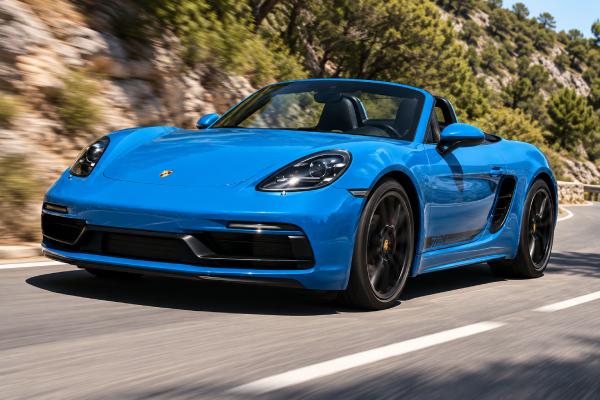
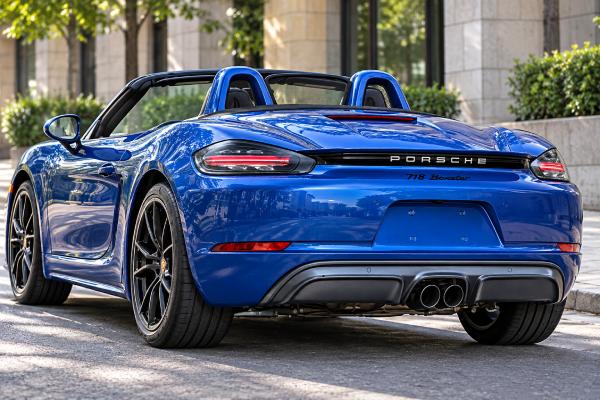
Porsche created the 718 Boxster Style Edition by taking the 982-generation 718 Boxster’s 2.0-liter turbocharged flat-four and making the specification more distinctive rather than more powerful. In U.S. form, that means 300 hp, 280 lb-ft, rear-wheel drive, and a choice of six-speed manual or seven-speed PDK, wrapped in a roadster package identified by 20-inch 718 Spyder wheels, black sport tailpipes, special contrast treatments, and “Boxster” embossing in the soft top. Porsche announced the edition in November 2022, with U.S. availability following in 2023; examples continued into the 2025 model year.
That timeline is worth stating because “2022–2025” can mix announcement year, model year, production date, and registration year. The mechanical baseline also needs to stay market-specific: U.S. documents use 300 hp and 280 lb-ft, while European material uses 300 PS/220 kW and 380 Nm. This article keeps those rating systems separate and focuses on the 300 hp configuration represented by U.S.-market Porsche documentation.
Table of Contents
- Where the 300 hp Style Edition fits in the 718 range
- Engine character and the manual-versus-PDK choice
- Verified specifications and configuration-dependent figures
- Style Edition design and equipment
- Performance, chassis, and road behavior
- Ownership, service, and recall checks
- How to evaluate a used Boxster Style Edition
Where the 300 hp Style Edition fits in the 718 range
The 300 hp Boxster Style Edition is an equipment-focused derivative of the base 718 Boxster, not an engine upgrade. Porsche’s U.S. launch material states that the Style Edition uses the same turbocharged 2.0-liter four-cylinder boxer architecture as the standard 718 Boxster, with the same quoted 300 hp and 280 lb-ft. Its purpose is to bundle recognizable visual details and additional standard equipment around that drivetrain.
That distinction separates it from the 718 Boxster S and GTS 4.0. The Style Edition does not inherit the larger engine or higher output of those variants, and its trim additions should not be interpreted as evidence of a unique engine tune. A prospective buyer should therefore value the car for its combination of base-Boxster performance, appearance specification, equipment, and condition rather than assume the Style badge denotes a separate performance tier.
The assignment identifies the engine as MA2.20. Public-facing Porsche pages for this model generally describe the engine as a 1,988 cc turbocharged boxer four and do not consistently print that internal code. For parts, diagnostics, or workshop procedures, the VIN and Porsche’s service-system engine identification should be treated as the controlling source.
There is also a regional unit difference. U.S. Porsche material quotes 300 hp / 220 kW and 280 lb-ft. European Porsche material quotes 300 PS / 220 kW and 380 Nm. The kW value makes clear that these are regional presentations of the same output class, but 300 PS and 300 SAE hp are not mathematically identical. Avoid converting one label into the other without noting the standard being used.
Engine character and the manual-versus-PDK choice
The transmission is the most consequential factory choice on the 300 hp Style Edition. Porsche launched the car with a six-speed manual as standard and a seven-speed PDK dual-clutch transmission optional in the U.S. and other 300-output markets. Both retain rear-wheel drive, but they change the car’s weight, acceleration figures, low-speed behavior, and driver interaction.
With the manual, the driver controls clutch engagement and gear selection directly. Porsche’s launch figure is 4.9 seconds from 0–60 mph. A U.S. Porsche Finder example with the manual lists a curb weight of 2,943 lb and a 170–171 mph top-track-speed figure depending on the publication. For an inspection, clutch take-up, pedal feel, shift quality, and signs of abusive launches matter more than the presence of the Style package.
PDK uses two clutches and automated gear selection. Porsche Finder data for a PDK Style Edition lists 0–60 mph in 4.7 seconds, falling to 4.5 seconds when equipped with Sport Chrono, with curb weight correspondingly higher. That acceleration advantage is consistent with faster, repeatable shifts and launch-related functions. In ordinary use, PDK also changes parking-speed feel; a dual-clutch gearbox should not be judged as if it were a conventional torque-converter automatic.
Sport Chrono needs to be verified rather than assumed. Porsche’s launch release ties the quickest 4.5-second U.S. figure to PDK plus Sport Chrono. A seller quoting 4.5 seconds for a manual car, or for a PDK car without the relevant package, is combining specifications from different configurations.
| Configuration | 0–60 mph | Typical curb-weight evidence | What to verify |
|---|---|---|---|
| 6-speed manual | 4.9 s | 2,943 lb in a U.S. Porsche Finder example | Clutch operation, shift quality, original build data |
| 7-speed PDK | 4.7 s | 3,009 lb DIN-equivalent figure shown on a Porsche Finder example | PDK operation and service history |
| 7-speed PDK + Sport Chrono | 4.5 s | Configuration-dependent | Sport Chrono equipment and mode controls |
Verified specifications and configuration-dependent figures
The Style Edition is a gasoline ICE vehicle with a turbocharged flat-four located behind the passenger compartment and driving the rear axle. The tables below use U.S. Porsche data for 300 hp cars and distinguish manual and PDK values where Porsche’s own listings differ.
| Specification | Figure |
|---|---|
| Configuration | Horizontally opposed 4-cylinder, turbocharged gasoline engine |
| Displacement | 1,988 cc (2.0 L) |
| Bore × stroke | 3.58 × 3.01 in (approximately 91.0 × 76.4 mm) |
| Maximum power | 300 hp / 220 kW at 6,500 rpm |
| Maximum torque | 280 lb-ft at 2,150–4,500 rpm |
| Maximum engine speed | 7,500 rpm on Porsche Finder examples that publish the value |
| Drivetrain | Rear-wheel drive |
| Transmission choices | 6-speed manual or 7-speed PDK |
| Assignment engine code | MA2.20; verify against VIN-linked Porsche service data |
| Measure | Published figure | Scope |
|---|---|---|
| 0–60 mph | 4.9 s | Manual launch figure |
| 0–60 mph | 4.7 s | PDK Porsche Finder/current configurator figure |
| 0–60 mph with Sport Chrono | 4.5 s | PDK + Sport Chrono |
| Top track speed | 170 mph | Original 2022 U.S. launch release |
| Top track speed | 171 mph | Later/current U.S. Porsche listings |
Porsche’s one-mph top-speed difference across publications should not be inflated into a mechanical model-year change without documentation. It can result from publication updates, rounding, tire assumptions, or certification presentation. For a particular car, the model-year technical data and owner’s documentation are more relevant than forcing all years into one number.
| Measure | Figure |
|---|---|
| Length | 172.4 in |
| Body width | 70.9 in |
| Width with mirrors | 78.5 in |
| Height | 50.4 in |
| Wheelbase | 97.4 in |
| Front luggage volume | about 5.2–5.3 cu ft, depending on the listing |
| Rear luggage volume | about 4.3–4.4 cu ft, depending on measurement presentation |
| Fuel-tank capacity shown on manual examples | 14.3 US gal |
| Item | Manual example | PDK example |
|---|---|---|
| Curb weight | 2,943 lb | 3,097 lb on one Porsche CPO listing; 3,009 lb DIN also shown |
| Gross vehicle weight rating | 3,649 lb | 3,715 lb |
| Maximum load | 613 lb | 617 lb |
The different weight conventions in Porsche listings are a useful warning against mixing figures. “Curb,” DIN, and EC weights are not automatically interchangeable, and optional equipment can also move the real scale weight. Use a single published standard when making a comparison.
| Item | Possible specification | Why it matters |
|---|---|---|
| Transmission | 6-speed manual or 7-speed PDK | Acceleration, weight, service work, and driving feel |
| Sport Chrono | Optional | Changes the quickest quoted PDK acceleration figure and driving functions |
| Power Steering Plus | Can be fitted | Changes low-speed steering assistance |
| Lighting | Base or optional upgraded systems | Replacement cost and feature set |
| Audio | Standard system or optional upgrades | Equipment value and originality |
| Style graphics | Black/white package or deletions depending on build | Visual originality cannot be judged from trim name alone |
Style Edition design and equipment
The exterior treatment is deliberate but not limited to one paint color. Ruby Star Neo received most of the launch attention because it referenced Porsche’s earlier Ruby Star color, yet Porsche explicitly offered the Style Edition in other colors. A used example in GT Silver, white, black, or another factory shade can be completely legitimate.
Standard visual identifiers include high-gloss-black 20-inch 718 Spyder wheels with colored Porsche crests, black sport tailpipes, and high-gloss-silver Porsche lettering at the rear. The Boxster adds the model name embossed into the soft top above the side windows. Two contrast packages—black or white—could add stripes on the front luggage-compartment lid, large side Porsche lettering, and coordinated wheel/model-designation finishes.
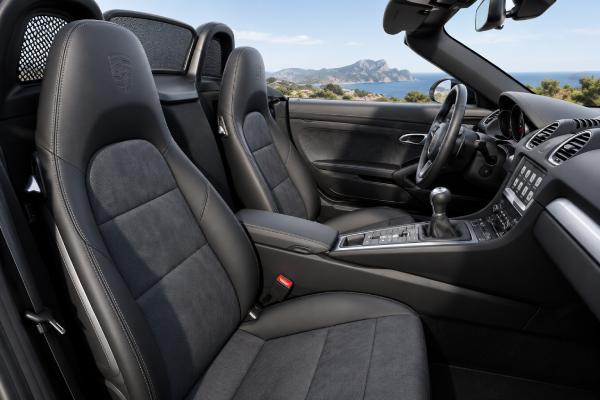
The interior package is more than a badge. Porsche specified a black leather package with Chalk contrast stitching, Porsche crests on the headrests, illuminated stainless-steel door-sill guards, a heated leather multifunction steering wheel, and matching contrast details. U.S. launch equipment also included useful daily features such as front and rear ParkAssist with a reversing camera, Apple CarPlay, heated seats, cruise control, and two-zone automatic climate control.
Options and deletions complicate originality checks. Porsche Finder examples show cars with Bose audio, upgraded headlights, Power Steering Plus, Sport Chrono, and deletion of the rear model designation. One dealer-stock car even shows a standard item crossed out because it was superseded by a selected option. The build sheet is therefore the correct reference when deciding whether a particular car is “missing” something.
The convertible top deserves special attention because it combines normal Boxster function with a Style Edition-specific visual feature. The embossing is useful for identification, but condition matters more. Inspect fabric wear, the rear-window area, stitching, seals, frame motion, and drainage. Operate the roof more than once and verify that side windows index correctly as the roof and doors move.
Performance, chassis, and road behavior
The 300 hp Style Edition’s performance is defined less by peak numbers than by the interaction of a broad torque plateau, compact mid-engine packaging, and the chosen transmission. Maximum torque arrives from 2,150 to 4,500 rpm, so the engine can deliver strong response without being held near its 6,500 rpm power peak. That is useful on public roads, where acceleration between corners or into a gap matters more often than maximum speed.
The Style package itself does not create a different core chassis tune. Porsche describes the Style Edition as based on the entry-level Boxster/Cayman mechanical package. Suspension options, wheel alignment, tire condition, and tire type can therefore make a larger difference to an individual car’s behavior than the Style badge.
The 20-inch Spyder-design wheels are part of the edition’s identity and also an inspection point. Look for rim bends, cracks, weld repairs, refinish quality, and curb damage. Check all tire date codes and tread patterns, and investigate uneven inside-edge wear rather than assuming that visible outer tread tells the whole story. If a car has aftermarket wheel spacers or non-original wheels, confirm fitment and hardware before attributing steering or vibration issues to the chassis.
On a road test, the manual and PDK should be evaluated differently. A manual car should engage cleanly from rest, shift without grinding or obstruction, and show no obvious clutch slip under load. A PDK car should select drive and reverse consistently, shift cleanly when warm, and show no drivetrain warning messages. Low-speed dual-clutch behavior can feel more direct than a conventional automatic, so diagnosis should be based on abnormal behavior, stored faults, and workshop testing rather than expectation alone.
Braking and steering checks are common to both. The car should stop straight without persistent pedal pulsation, steering shake, or pulling. An off-center steering wheel, vibration at speed, or mismatched tire wear can point to alignment, wheel, tire, or suspension issues and deserves measurement before purchase.
Ownership, service, and recall checks
A 2022–2025 Style Edition is still young enough that age-based service history can matter as much as mileage. Cars used mainly for weekends may accumulate few miles while still becoming due for brake-fluid service, filters, time-based inspections, or other scheduled work. Use the maintenance schedule for the specific VIN, model year, and market; do not transplant intervals from an older 982 document or from another country without confirmation.
Service records should show dates, mileage, and the actual work performed. For the engine, verify correct oil specification and quantity through Porsche documentation. For PDK cars, distinguish engine-oil maintenance from transmission-specific work. For manual cars, clutch condition is assessed largely through operation and history rather than a simple scheduled replacement interval.
Cooling airflow is worth checking because the 718’s low front openings can trap leaves and road debris. Look through the intakes with adequate light, inspect accessible heat-exchanger areas, and investigate coolant odor, staining, or repeated top-ups. On a turbocharged engine, ignoring cooling-system symptoms can turn a manageable maintenance issue into a much more expensive repair.
Battery health also matters on intermittently driven cars. A weak battery can create starting problems and a scatter of low-voltage fault messages that obscure diagnosis. Before treating multiple warnings as unrelated component failures, establish battery condition, charging voltage, and stored fault context.
For U.S. cars, recall status must be checked by VIN, not simply by model name. Porsche’s ARA7/NHTSA 24V-343 campaign covered only 14 model-year-2024 718 Boxster/Cayman vehicles. The issue involved a PDK shift cable that could prevent proper engagement of Park, increasing roll-away risk; Porsche’s remedy was shift-cable replacement. The campaign’s small, production-record-defined population means it is wrong to say every 2024 Style Edition is affected. It is equally wrong to assume a particular PDK car is clear without a VIN lookup or Porsche record.
Treat manufacturer communications separately from recalls. A technical bulletin may describe a repair method, updated part, approved tire, or diagnostic procedure without establishing that every vehicle has a defect. For purchase decisions, documented symptoms and VIN-specific campaigns carry more weight than a long list of unrelated bulletins found online.
How to evaluate a used Boxster Style Edition
Start by proving specification. Confirm the VIN, model year, transmission, original color, Style Edition package, major options, and engine output. The easiest expensive mistake is to compare a manual car with PDK performance numbers, or to compare a U.S. 300 hp car with the separate 250 PS China-market version because both wear the same Style Edition name.
Then inspect the body with attention to the areas most exposed on a low sports car: front bumper, splitter/lower edges, rocker panels, wheel arches, wheel rims, and underbody contact points. Stone chips are normal evidence of use; mismatched paint texture, overspray, disturbed fasteners, inconsistent panel gaps, or structural repair marks require a more careful explanation. A high-quality cosmetic repair and a poorly repaired collision are not the same thing.
Check the roof and water management before becoming distracted by paint or interior color. Look for damp carpets, staining, musty odor, blocked drains, damaged seals, and irregular roof movement. A replacement top can be functionally excellent, but a buyer paying for Style Edition originality should verify whether it retains the correct embossed detail.
Mechanical inspection should include a cold start when practical, a complete diagnostic scan, a road test to full operating temperature, and an underbody examination. Look for fluid leaks, damaged cooling components, suspension play, wheel or tire damage, abnormal exhaust modifications, and evidence of poor-quality aftermarket wiring. The engine should idle and accelerate consistently without warning lights or persistent smoke; any abnormal symptom deserves diagnosis rather than a guess based on internet anecdotes.
History is particularly valuable on a relatively recent Porsche. Request maintenance invoices, warranty repair documentation, recall completion records, and evidence for modifications or reversals to stock. A car advertised as Porsche Approved or with a “full service history” should still be checked against the documents available for that exact VIN.
Finally, price the specification you are actually buying. Manual versus PDK, Sport Chrono, lighting, audio, suspension options, color, wheel condition, tire age, roof condition, and provenance all affect desirability differently for different buyers. The Style Edition’s strongest case is not that it is mechanically rarer than a base Boxster; it is that it combines the familiar 300 hp 718 platform with a factory-coordinated appearance and equipment package. Condition and documentation determine whether an individual example still delivers that proposition.
References
- The Porsche 718 heads into 2023 in Style – Porsche Newsroom USA — 2022. U.S. launch details, 300 hp/280 lb-ft output, manual/PDK availability, Style Edition equipment, and original performance figures.
- The new Porsche 718 Style Edition models – Porsche Newsroom — 2022. Global launch data, 300 PS/220 kW and 380 Nm ratings, equipment details, and WLTP context.
- Porsche 718 Models and Configurator | Porsche USA — Current U.S. model overview. Confirms 2025 Style Edition availability, 300 hp, rear-wheel drive, transmission choice, and current performance presentation.
- New Porsche 718 Boxster Style Edition for sale at Porsche Salt Lake City — 2025 Porsche Finder example confirming the six-speed manual, 300 hp rating, 2,943-lb listed curb weight, dimensions, and roadster luggage data.
- Porsche 718 Boxster Style Edition | Porsche International — Current Porsche model page used to cross-check the 300 PS/220 kW Style Edition, manual/PDK availability, chassis options, and global performance context.
- ARA7 Recall Campaign – Replace shift cable — 2024. NHTSA-hosted Porsche recall campaign document for a narrowly defined population of 14 model-year-2024 718 Boxster/Cayman vehicles.
Disclaimer
This ownership guide cannot replace a professional inspection, diagnosis, or repair procedure. Manual and PDK cars, different markets, option sets, VINs, and model years can require different specifications, software, fluids, torque values, and maintenance steps, so every workshop operation should be confirmed in the official Porsche material for the car being serviced. Please pass this article along if it helps someone compare or inspect a Boxster Style Edition more accurately.