
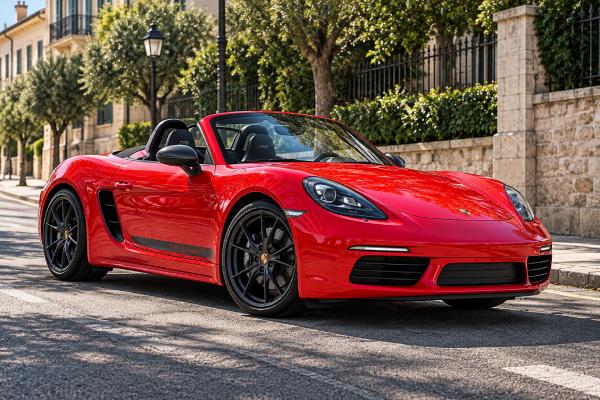
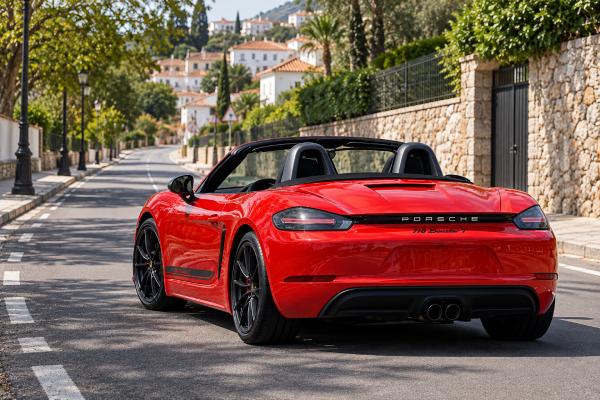
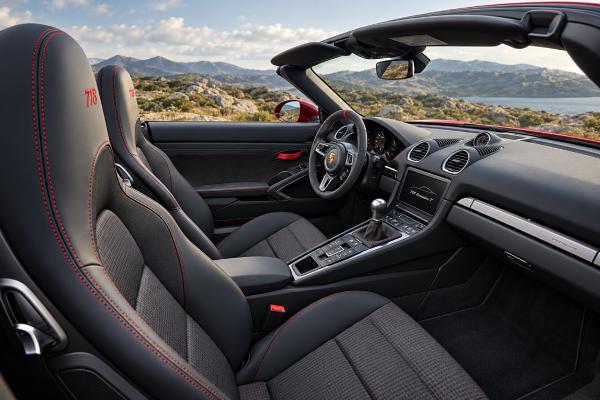
The Porsche 718 Boxster T is a chassis-led version of the 982 roadster rather than a more powerful one. Porsche kept the regular 2.0-liter turbocharged flat-four at 300 hp and concentrated the T package on equipment that changes how the car feels: PASM Sport suspension lowered by 20 mm, Sport Chrono, Porsche Torque Vectoring with a mechanical limited-slip differential, a short-throw six-speed manual shifter, dynamic drivetrain mounts and 20-inch wheels. PDK remained optional. That specification gives the T a distinct position in the 718 range: lighter in concept and more focused than a similarly powered base Boxster, but not an engine-upgrade model like the S or GTS. Porsche launched the T in Europe in December 2018 and announced the U.S. version as a 2020 model, so cars within the assignment’s 2019–2023 range need to be identified by market and actual model year rather than by first-registration date alone. This article covers the 300-hp Boxster T only, including its roadster-specific packaging, U.S. technical data, equipment differences and the maintenance and inspection points that matter most on a used example.
Table of Contents
- The T Formula in a Boxster
- Boxster T Engine and Performance Data
- Why the Chassis Is the Main Event
- Manual, PDK, and Driving Modes
- Roadster Body, Cabin, and Cargo
- Maintenance and Age-Related Needs
- How to Inspect a Used Boxster T
The T Formula in a Boxster
Porsche describes the T suffix as “Touring,” with the emphasis on driving involvement rather than added engine output. In the 718 Boxster T, that philosophy is visible in the equipment list. The 2.0-liter engine is the same 300-hp basic power unit used by the standard 718 Boxster, but hardware that was optional or unavailable in that combination elsewhere in the range was grouped together.
The key item is PASM Sport suspension with a 20 mm lower ride height. Porsche specifically highlighted that this was the first time the 2.0-liter 718 engine had been paired with that lowered PASM Sport chassis. PTV and its mechanical limited-slip differential are standard, as are Sport Chrono, Porsche Active Drivetrain Mounts and Sport Exhaust. The manual transmission receives a shorter gear lever with a red shift pattern.
Market specification changes how the “pared-back” idea appears in the cabin. Porsche’s European launch material described PCM infotainment being replaced by a storage compartment, while allowing buyers to order PCM at no extra cost. U.S. cars were presented with their own standard-equipment mix, including Sport Seats Plus with Sport-Tex centers. That is a useful reminder not to use a European press car as a universal checklist for a North American example.
Exterior details include Titanium Grey 20-inch wheels, Agate Grey mirror caps and model lettering, black sport-exhaust tips and Boxster T side graphics. U.S. cars also use Agate Grey supplemental rollover-protection bars. These details help identify a T but are not substitutes for a VIN/build-data check because trim can be replaced.
Boxster T Engine and Performance Data
The Boxster T’s engine is a 1,988 cc turbocharged flat-four with direct injection, VarioCam Plus and integrated dry-sump lubrication. U.S. output is 300 hp at 6,500 rpm with 280 lb-ft of torque from 1,950 to 4,500 rpm. Maximum engine speed is 7,500 rpm.
| Engine specification | 718 Boxster T |
|---|---|
| Configuration | Turbocharged horizontally opposed 4-cylinder |
| Displacement | 1,988 cc |
| Bore × stroke | 91.0 × 76.4 mm |
| Maximum power | 300 hp at 6,500 rpm |
| Maximum torque | 280 lb-ft at 1,950–4,500 rpm |
| Compression ratio | 9.5:1 |
| Maximum engine speed | 7,500 rpm |
| Drive layout | Mid-engine, rear-wheel drive |
Factory U.S. technical data lists a 170-mph top track speed regardless of transmission. The manual reaches 60 mph in 4.9 seconds in Porsche’s published figures; PDK with Sport Chrono launch control is quoted at 4.5 seconds. European press material uses 0–100 km/h measurements instead, so those figures should remain in their native test standard rather than be casually interchanged.
| Performance | 6-speed manual | 7-speed PDK |
|---|---|---|
| 0–60 mph | 4.9 s | 4.5 s with Sport Chrono launch control |
| Quarter mile | 13.4 s | 13.2 s |
| Top track speed | 170 mph | 170 mph |
| U.S. curb weight | 3,058 lb | 3,120 lb |
These figures explain why the T is best viewed as a handling specification rather than a straight-line-performance upgrade. The engine output is unchanged from the base 718, while the extra standard dynamic hardware targets steering response, body control, traction and drivetrain movement.
Why the Chassis Is the Main Event
The T’s most unusual factory combination is the 300-hp engine with the 20 mm-lower PASM Sport suspension. Shorter springs and retuned adaptive dampers reduce ride height by roughly 0.78 inch relative to a standard Boxster. The system still varies damping electronically, so a T should not be confused with a car that has simply been fitted with aftermarket lowering springs.
Porsche Torque Vectoring works with a mechanical limited-slip differential at the rear axle. The goal is to help the car turn in and put power down more effectively, particularly when accelerating away from tighter bends. Porsche Active Drivetrain Mounts alter mount stiffness according to driving conditions, reducing powertrain movement during rapid load changes while preserving greater isolation when appropriate.
| Chassis hardware | Boxster T factory specification |
|---|---|
| Suspension | PASM Sport, 20 mm lower ride height |
| Torque vectoring | Porsche Torque Vectoring |
| Rear differential | Mechanical limited-slip differential |
| Drivetrain mounts | Porsche Active Drivetrain Mounts |
| Front brakes | 330 × 28 mm vented/perforated iron rotors |
| Rear brakes | 299 × 20 mm vented/perforated iron rotors |
| Front wheels/tires | 8J × 20 ET57; 235/35 R20 |
| Rear wheels/tires | 10J × 20 ET45; 265/35 ZR20 |
Because the T rides lower than a base Boxster, inspect the nose, undertrays and jacking points closely. Scraping on replaceable lower surfaces is common on low sports cars, but cracked panels, bent brackets or repeated impact evidence should be understood before purchase. A lowered car also makes wheel alignment more consequential: uneven inner-edge tire wear can be hidden from an ordinary walk-around.
Standard iron brakes use four-piston aluminum monobloc fixed calipers at both ends. Optional carbon-ceramic brakes appear in Porsche’s technical data and require specialist condition assessment if fitted. Rotor replacement costs differ enough that brake type should be verified from the car itself and its build specification.
Manual, PDK, and Driving Modes
The standard six-speed manual is central to the T concept. Its shortened shift lever makes the physical action more compact, and Porsche marked the gear pattern in red. Sport Chrono adds a steering-wheel mode switch and driving programs. In manual cars, automatic rev-matching can assist downshifts in the relevant sport settings.
PDK changes the experience but does not make the car any less authentic as a T. The seven-speed dual-clutch transmission was a factory option and works with Sport Chrono to provide Sport Plus, launch control and Sport Response functions. Buyers should therefore avoid treating “manual only” as part of the model’s identity; both gearbox types are legitimate factory configurations.
For inspection, the gearboxes have different priorities. A manual car needs a clean clutch take-up, no obvious slip under load, smooth gear engagement and no persistent synchro resistance once warm. A PDK car should select Drive and Reverse promptly, creep smoothly, shift consistently in manual and automatic modes and show no transmission warnings. Diagnostic scanning can reveal stored faults that a short road test does not.
PADM faults matter on either transmission because the active mounts are part of the T package. A warning about dynamic mounts should not be dismissed as cosmetic: the system is intended to alter powertrain restraint with driving conditions. Diagnosis should identify whether the fault lies in a mount, wiring, control unit or another component before parts are ordered.
Roadster Body, Cabin, and Cargo
The Boxster T remains a practical two-seat roadster. Porsche’s U.S. technical sheet lists 5.2 cu ft of front luggage capacity and 4.4 cu ft at the rear. That rear space is smaller than in the Cayman T because the convertible roof mechanism occupies the area behind the passenger compartment.
| Body/capacity item | U.S. Boxster T data |
|---|---|
| Length | 172.4 in |
| Width, mirrors folded | 70.9 in |
| Width, mirrors extended | 78.5 in |
| Height with PASM Sport | 49.7 in |
| Wheelbase | 97.4 in |
| Front luggage capacity | 5.2 cu ft |
| Rear luggage capacity | 4.4 cu ft |
| Standard U.S. fuel tank | 14.2 U.S. gal; 16.9 U.S. gal listed as optional |
| Drag coefficient | 0.31 |
The roof should be treated as a functional system, not just upholstery. Run it through a full opening and closing cycle, check that the latch and windows coordinate correctly, inspect the fabric and rear glass, and look for dampness in carpets and storage areas. Drainage pathways should be clear. A car can appear dry during an inspection yet have a history of intermittent water entry.
The T interior adds black door-pull loops, a GT Sport steering wheel and model-specific trim. Depending on market, Sport-Tex seat centers and different infotainment configurations may be present. Equipment verification is especially useful because the European launch concept of deleting PCM did not mean every global T was delivered without infotainment.
Maintenance and Age-Related Needs
A Boxster T can now be old enough for time-based service items to matter even if its mileage is modest. The correct Porsche schedule varies by model year, market and VIN, so use official service information when deciding when plugs, filters, fluids and transmission-related operations are due.
Engine oil history should show both dates and mileage. The turbocharged four-cylinder operates under meaningful heat and load, and correct oil specification matters. During inspection, look for fresh or active seepage around the powertrain and turbo plumbing, then recheck after the car has reached full operating temperature.
Front heat exchangers deserve routine visual attention because debris accumulates in the bumper openings. Leaves and stones can obstruct airflow or damage condenser fins. A history of unexplained coolant top-ups, dried coolant residue or overheating warnings calls for pressure testing and proper diagnosis rather than continued topping up.
Brake fluid, tires and battery health are strongly time-dependent. Brake fluid can absorb moisture while the car is stored; tires can harden and crack before their tread wears out. Check all four date codes and look for uneven wear. The 20-inch low-profile tires are also susceptible to sidewall and wheel damage from impacts.
Keep the roof drains clear and seals clean. Inspect the battery compartment and interior for moisture if there are any signs of water entry. On cars driven infrequently, test the battery rather than assuming a maintainer has kept it healthy indefinitely.
For track-used cars, maintenance history should reflect the use. Frequent brake-fluid changes, tire replacements or pads are not inherently negative; they can indicate attentive ownership. What matters is whether components were inspected and replaced as needed rather than whether the car ever entered a circuit.
How to Inspect a Used Boxster T
A useful pre-purchase inspection starts with model verification. Confirm that the VIN and build information identify a genuine Boxster T and establish whether the car is manual or PDK, which brake system it has and what seats and infotainment were factory fitted. Cosmetic T components alone are easy to imitate.
Next, check whether the chassis still matches the factory concept. Aftermarket lowering springs, non-standard spacers, alignment changes and wheel substitutions are common enthusiast modifications. They are not automatically undesirable, but they can alter suspension travel, tire clearance and handling. Ask for alignment records and original parts when available.
On the road, verify steering centering, damper operation, braking stability and the absence of knocks over low-speed bumps. A T should feel firm and controlled, but mechanical clunks or a persistent pull are not part of the intended character. Test all Sport Chrono modes and watch for PASM or PADM warnings.
Inspect the front underside and cooling openings, then place the car on a lift. Look for leaking dampers, damaged arms, loose undertrays, wheel damage, oil/coolant residue and signs of previous impact repairs. Examine the inner tire shoulders where wear can be difficult to see from outside.
For the convertible system, look beyond whether the roof simply opens. Check the condition of the fabric, seals, rear glass, drainage areas and interior carpets. Operate the windows and central locking during the same visit, because water ingress and low battery voltage can create secondary electrical symptoms.
Finally, compare the service invoices with the odometer chronology and run the VIN through the relevant official recall database. Recall campaigns are VIN-specific and can be updated over time. A car with a coherent history, correct chassis hardware and evidence of methodical maintenance is a better prospect than one bought solely because it has the lowest mileage.
The Boxster T’s strongest attribute is that its specification has a clear purpose. Porsche did not chase a larger horsepower figure; it paired the 300-hp engine with a lower adaptive chassis, limited-slip differential, Sport Chrono and focused controls. Understanding that distinction makes both the test drive and the purchase inspection more meaningful.
References
- The 2020 Porsche 718 Boxster T and 718 Cayman T 2019
- The new Porsche 718 T – reduced to maximum driving pleasure 2018
- Technical Data 2020
- Technical Specifications 2026
- Porsche Scheduled Maintenance Plan 2026
- Check for Recalls: Vehicle, Car Seat, Tire, Equipment | NHTSA 2026 (Recall Database)
Disclaimer
This material is provided for informational purposes and is not a replacement for professional diagnosis or repair. Vehicle specifications, torque values, service intervals and procedures can differ by VIN, market and equipment; always verify the applicable requirements in official Porsche service documentation for the specific car.
If this Boxster T guide was useful, please share it on Facebook, X/Twitter or another social platform to help support our work.