
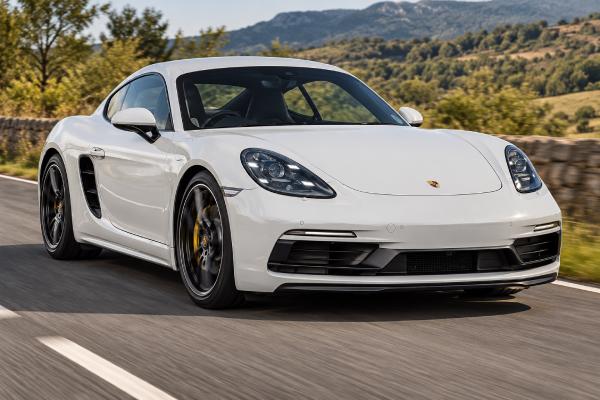
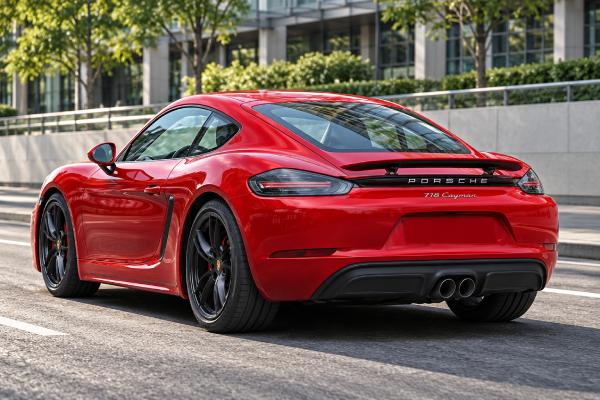
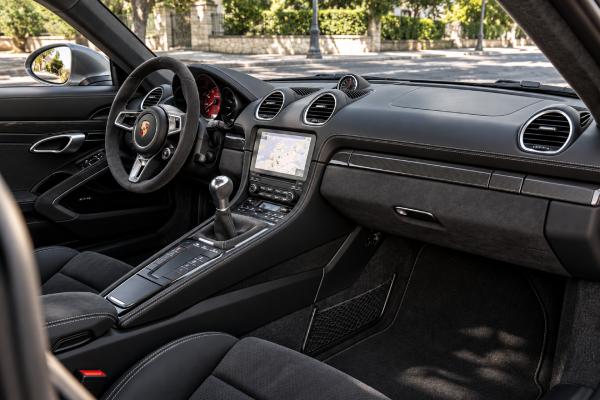
A 250 hp Porsche 718 Cayman is not a detuned figure invented by a used-car seller. It is the China-market 2.0-liter 982 calibration, officially rated at 184 kW or 250 PS and commonly described in English listings as 250 hp. That distinction is essential because the visually similar base Cayman sold in the United States and much of Europe was launched at 300 hp. Mixing the two produces incorrect acceleration, top-speed, transmission, and ownership assumptions.
The China-specification Cayman combines a 1,988 cc turbocharged flat-four with rear-wheel drive and, in the mainstream Chinese-market configuration, seven-speed PDK. Official Porsche China material gives 310 Nm of torque and later Style Edition data specifies 0–100 km/h in 5.6 seconds, 5.4 seconds with Sport Chrono, and 260 km/h maximum speed. This guide follows the 2016–2025 assignment period while separating genuine China-market data from global 300 hp figures and from inconsistent legacy fields that can appear in Porsche Finder records.
Table of Contents
- The market-specific identity behind “250 hp”
- Verified specifications for the 184 kW Cayman
- Why the Cayman body changes the ownership equation
- PDK, Sport Chrono, and interpreting performance claims
- China-specific maintenance evidence and service planning
- Reading model years, Finder records, and equipment changes
- Buying, inspecting, or exporting a 250 PS Cayman
The market-specific identity behind “250 hp”
The 184 kW version exists because Porsche configured the 718 range differently for mainland China. Porsche China material identifies the 982-generation 2.0-liter 718 at 184 kW/250 PS, while Porsche’s international 2016 Cayman launch announced 221 kW/300 hp for the regular base car in other major markets. The engine architecture is closely related, but the power calibration is not interchangeable on paper.
Power-unit notation is another source of confusion. “250 PS” is the metric-horsepower rating used in Porsche China documents. It equals roughly 247 mechanical horsepower, yet English-marketplace pages often render it as “250 hp.” The assignment’s 250 hp wording therefore points to this China-market derivative rather than to a separate 250 SAE-hp engine.
Porsche Finder records reinforce the market identity across the production run. Official Chinese inventory has shown 2017, 2018, 2019, 2020, 2021, 2022, 2023, 2024, and 2025 718 Cayman examples at 184 kW/250 PS. The later Cayman Style Edition was also offered at the same output, confirming that the lower-power calibration was not confined to the first launch year.
The exact engine code or suffix still should not be inferred from power alone. The assignment uses MA2.20 as the family identifier, but parts ordering needs the VIN because software, emissions hardware, sensors, and production revisions can be destination-specific. A 300 hp European 2.0-liter engine and a 250 PS China-market 2.0-liter engine may share basic dimensions while requiring different catalog selections or calibrations.
Verified specifications for the 184 kW Cayman
Porsche’s Chinese Finder provides unusually useful detail on real cars, including engine dimensions, brake hardware, chassis layout, weight, and standard equipment. The values below use a 2018 official Porsche Finder listing as a hardware baseline and Porsche China’s 2022 Style Edition release for the later authoritative performance figures.
| Item | Specification |
|---|---|
| Engine type | Turbocharged horizontally opposed 4-cylinder |
| Location | Mid-engine |
| Displacement | 1,988 cc |
| Bore | 91.0 mm |
| Stroke | Approximately 76.0–76.4 mm depending on published data rounding |
| Maximum power | 184 kW / 250 PS at 6,500 rpm |
| Maximum torque | 310 Nm |
| Maximum engine speed | 7,500 rpm |
| Fuel system | Direct fuel injection |
| Valve control | VarioCam Plus variable timing and lift |
| Item | Specification |
|---|---|
| Transmission | 7-speed Porsche Doppelkupplung (PDK) in regular China-market specification referenced here |
| Drive | Rear-wheel drive |
| Front suspension | Lightweight spring-strut layout |
| Rear suspension | Lightweight spring-strut layout |
| Steering | Electromechanical, variable ratio |
| Stability control | Porsche Stability Management (PSM) |
| Base front wheel/tire | 8 J × 18; 235/45 ZR18 |
| Base rear wheel/tire | 9 J × 18; 265/45 ZR18 |
| Item | Specification |
|---|---|
| Front calipers | Four-piston aluminum monoblock fixed |
| Rear calipers | Four-piston aluminum monoblock fixed |
| Front discs | 330 mm, internally vented and cross-drilled |
| Rear discs | 299 mm, internally vented and cross-drilled |
| Parking brake | Electric |
| Pad monitoring | Brake-pad wear indicator |
| Item | Published value |
|---|---|
| Length | 4,379 mm |
| Width without mirrors | 1,801 mm |
| Width with mirrors | 1,994 mm |
| Wheelbase | 2,475 mm |
| Published height in referenced listing | 1,295 mm |
| DIN unladen weight | 1,365 kg |
| EC unladen weight | 1,440 kg |
| Permissible gross weight | 1,685 kg |
| Fuel tank | 54 L on the referenced car; 64 L was available as equipment on some cars |
| Configuration | 0–100 km/h | Maximum speed |
|---|---|---|
| PDK | 5.6 s | 260 km/h |
| PDK with Sport Chrono | 5.4 s | 260 km/h |
| Item | Official China service-document indication |
|---|---|
| Oil maintenance | Dedicated Cayman (982) schedule from 2017 model year |
| Inspection | Dedicated Cayman schedule from 2017; combined 718 Boxster/Cayman inspection from 2018 |
| Oil interval in archived China document | At latest 10,000 km or 1 year |
| China-only items shown in archived schedule | Fuel additive procedure and throttle-housing cleaning; spark-plug instructions vary by schedule/model year |
| Brake fluid | Time-based replacement appears in China inspection documentation |
The service table intentionally describes what Porsche China’s maintenance library contains rather than turning an old schedule into a universal prescription. A current Porsche Centre should confirm the applicable revision for the VIN.
Why the Cayman body changes the ownership equation
The Cayman is not simply a Boxster with a roof panel added. Its fixed-roof hatchback body changes luggage access, cabin acoustics, weather sealing, and the types of age-related checks that matter most. The fundamental mid-engine platform is shared, but daily use differs enough that the coupe deserves its own buying logic.
The rear hatch gives access to a load area above and behind the engine compartment. Porsche’s Finder descriptions also identify a front luggage compartment, so the car can split luggage between two ends of the chassis. This is practical for touring, but heat exposure in the rear area means temperature-sensitive items should not be treated like cargo in an ordinary front-engine hatchback.
The fixed roof eliminates soft-top motors, fabric, drains, and latch mechanisms from the inspection list. In exchange, buyers should look carefully at hatch alignment, rear-window condition, hatch struts, weather seals, and signs of water entry around the rear opening. Rattles from the hatch area can have many causes—from loose trim to worn stops—so they should be localized rather than dismissed as normal coupe noise.
The Cayman’s structural package allows Porsche to focus the car around chassis response without accommodating an opening roof mechanism. That does not mean every 250 PS Cayman will feel identical. PASM, larger wheels, tire model, alignment, and age can change ride and turn-in significantly. The official 2018 Finder example, for instance, was optioned with PASM and 19-inch Boxster S wheels, while the listed standard specification used 18-inch Cayman wheels.
Cooling and intake paths still deserve inspection. The 2.0-liter turbo uses water cooling with thermal management, an intercooler, direct injection, and an electronically controlled oil-pump strategy. Low front openings collect road debris, and a blocked heat exchanger can gradually reduce cooling efficiency without announcing itself during a five-minute test drive.
The automatic rear spoiler is another coupe-specific visual check. Confirm that it is undamaged and operates properly. A spoiler malfunction is rarely the most expensive issue on a 718, but it can reveal prior body work, wiring problems, or neglected maintenance around the rear body structure.
PDK, Sport Chrono, and interpreting performance claims
The China-market 250 PS Cayman is closely associated with PDK. Porsche’s 2022 China release explicitly states that the Style Edition uses the seven-speed dual-clutch transmission as standard, and official Finder examples throughout the range are overwhelmingly listed as PDK. This is an important contrast with U.S. base 718s, where a six-speed manual was part of the standard specification.
PDK contributes to the car’s dual-purpose character. In traffic it behaves as an automatic, while manual commands allow the driver to select ratios for mountain roads or track sessions. The seventh gear is primarily useful for lower-rpm cruising. When inspecting a used car, test cold and fully warm operation, parking-to-drive engagement, low-speed creep, light-throttle changes, and manual requests. Any warning, repeated hesitation, or harshness should be diagnosed rather than normalized.
Sport Chrono changes the control strategy and launch behavior, but published China-market performance data need careful handling. Porsche China’s 2022 Style Edition release gives 5.6 seconds to 100 km/h in the normal configuration and 5.4 seconds with Sport Chrono. Those figures fit the 184 kW/310 Nm specification.
Some older Porsche Finder pages display 275 km/h top speed or a 4.7-second Sport Chrono acceleration figure on 184 kW cars. Those values resemble data associated with the higher-output global 718 and conflict with the later China-specific press release, which explicitly states 260 km/h and 5.4 seconds. For a 250 PS article, the safer approach is to preserve the primary China-market release figures and treat contradictory legacy Finder fields as database inconsistencies rather than evidence of a hidden factory power increase.
The same caution applies to tuning claims. A seller may state that a 250 PS car has been “restored” to 300 hp through software. Without dyno documentation, calibration provenance, and confirmation of supporting emissions/market hardware, that is simply a claim. Modified engine software can affect warranty status, emissions compliance, diagnostic behavior, and resale. Buyers who want a factory 300 hp car should identify one by its original market specification rather than assuming all 2.0-liter cars are equivalent after flashing.
China-specific maintenance evidence and service planning
Porsche China maintains a dedicated 718 Cayman maintenance-plan page, and that is more relevant to this variant than copying a European or U.S. schedule. The page lists Cayman (982) oil maintenance from the 2017 model year and inspection documentation for the 718 Boxster/Cayman from the 2018 model year onward.
An archived Porsche China oil-maintenance document indexed by Porsche specifies oil service at the latest every 10,000 km or one year for the 982. It also contains China-only operations such as mixing an approved Porsche fuel additive into the tank and cleaning the inside of the throttle housing. This is a good example of why regional service requirements should not be generalized from a forum post or a foreign dealer menu.
For a used car, the practical task is to compare the service history against both distance and elapsed time. A 2018 Cayman with only 25,000 km can still be behind on fluids, filters, tires, battery, or ignition items if years passed between visits. Conversely, a high-mileage car with consistent official or specialist care may have a clearer mechanical history.
Engine oil should be verified by approval and invoice detail rather than viscosity alone. Porsche approvals can change over time, and a current dealer can confirm the correct product for the VIN and climate. The electronic oil-level system should be checked under the specified conditions; overfilling a turbocharged flat-four is not a substitute for frequent monitoring.
The PDK deserves documentation beyond “transmission serviced.” Ask what operation was performed, which fluid was changed, and at what mileage/date. If a workshop invoice is in Chinese, translate the actual line items rather than relying on the seller’s summary. Also check for software updates or control-unit work if shifting behavior changed after a repair.
Brake fluid, coolant condition, air-conditioning operation, tire age, and battery health are equally relevant in urban Chinese use, where cars can spend long periods in congestion or storage. Repeated short trips can accumulate operating hours without much odometer distance. A diagnostic scan showing operating data and fault history helps place the mileage in context.
Reading model years, Finder records, and equipment changes
The 982 Cayman entered production in 2016, with the European market launch beginning later that year. China-market records from 2017 onward show the 184 kW calibration, and Porsche’s own used inventory documents its continuity into 2025. That evidence is stronger than assuming the China car followed the 300 hp international launch specification.
Porsche China’s 2018 published price adjustment listed both 718 Cayman and 718 Cayman S, confirming the regular Cayman as a distinct Chinese product rather than a one-off homologation special. Later Finder records continue to show 184 kW/250 PS examples registered in every major part of the run.
The Style Edition arrived as a useful late-cycle reference. Porsche China explicitly stated that its powertrain and chassis were unchanged from the regular 718 Boxster and Cayman and quoted 184 kW/250 PS, 310 Nm, standard PDK, 5.6-second 0–100 km/h acceleration, 5.4 seconds with Sport Chrono, and 260 km/h top speed. The edition added appearance and standard-equipment content rather than a new engine calibration.
Equipment should therefore be decoded by individual car, not by year alone. Finder listings show combinations such as PASM, 19-inch wheels, a 64-liter tank, LED lighting, upgraded seats, and steering options. A regular Cayman with desirable factory options can overlap heavily with a later special edition in real-world usability.
Database data also require judgment. Porsche Finder is authoritative for a vehicle’s original listing context, but older pages can contain inherited technical fields that conflict with Porsche China press material. When two official sources disagree, favor the source that explicitly discusses the China-market variant and the relevant release, and flag the discrepancy rather than silently averaging numbers.
Buying, inspecting, or exporting a 250 PS Cayman
The first buying question is not color or options; it is whether the car is genuinely a China-market 184 kW specification. Confirm the VIN, original market, 1,988 cc displacement, 184 kW rating, and PDK configuration in official records. If the car has been exported, registration documents in the destination country may convert PS to “hp” or round the power figure differently.
Next, establish whether the powertrain is still in original software condition. Request invoices for ECU or PDK programming, tuning devices, exhaust changes, intake work, and emissions-component replacement. A modified 250 PS Cayman can be enjoyable, but it should be purchased as a modified car, not valued as an untouched factory example.
A cold-start inspection should include idle quality, warning lamps, unusual smoke, coolant odor, and accessory noise. After full warm-up, use moderate and then stronger acceleration to confirm clean boost delivery. Scan all modules for stored and pending faults. A clear dashboard is not proof that no intermittent fault exists.
Inspect the front radiators and condensers for debris and impact damage, the underside for scrapes or distorted lift points, and the rear hatch area for water traces. Check all four tires for matching model, age, and even wear. The mid-engine chassis is sensitive to tire condition, and large wheel options make replacement cost significant.
Brake discs should be measured rather than judged only by visible lip. Cross-drilled discs can show superficial marks, while true heat cracking or thickness below specification requires action. Verify pad wear and brake-fluid history. If PASM is fitted, inspect dampers for leakage and confirm the system changes mode without warnings.
For PDK, drive the car in automatic and manual modes from cold to hot. For Sport Chrono-equipped cars, verify the package functions rather than relying on a dashboard clock or seller description. Confirm launch-related features only in a safe, appropriate environment; a pre-purchase inspection does not require repeated launch-control demonstrations.
Finally, verify maintenance against Porsche China’s schedule for the VIN and production date. Imported cars often lose context when records are translated, and a foreign workshop may apply its local 718 interval automatically. Retaining copies of the original Chinese service history, official Finder listing, option data, and any export paperwork makes future maintenance and resale much easier.
References
- 全新保时捷 718 Style Edition 车型 — Porsche Newsroom CHN, 2022.
- 2018 Porsche 718 Cayman (982) — Porsche Finder China, official vehicle listing.
- 保养周期 – 718 Cayman — Porsche China Service.
- The new Porsche 718 Cayman — Porsche Newsroom, 2016.
- 保时捷中国《关于降低汽车整车及零部件进口关税的公告》之价格调整声明 — Porsche Newsroom CHN, 2018.
- 保时捷车型比较 | 保时捷 (中国) — Porsche China, accessed 2026.
Disclaimer
This article is for informational purposes only. Power ratings, specifications, service intervals, fluids, torque values, software, parts, emissions equipment, and procedures can differ by VIN, model year, transmission, destination market, and later Porsche revisions. Confirm maintenance and repair decisions with current official Porsche China documentation or an authorized/suitably qualified Porsche specialist for the specific vehicle. If this market-specific guide is useful, please share it with someone evaluating a China-market 718 Cayman.