
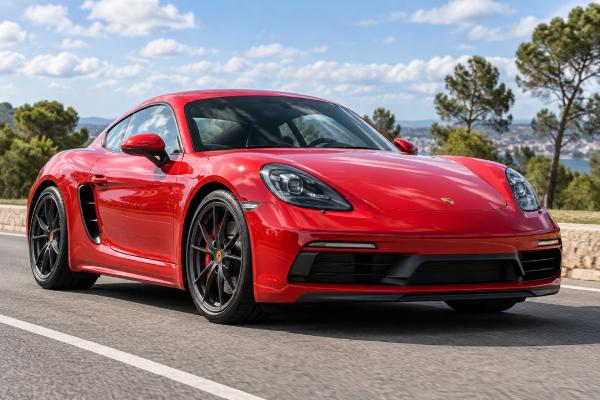
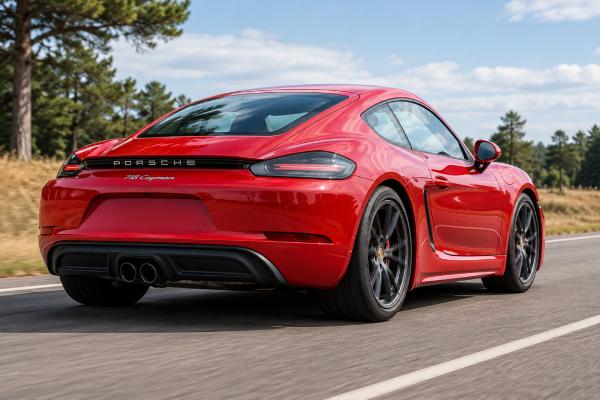
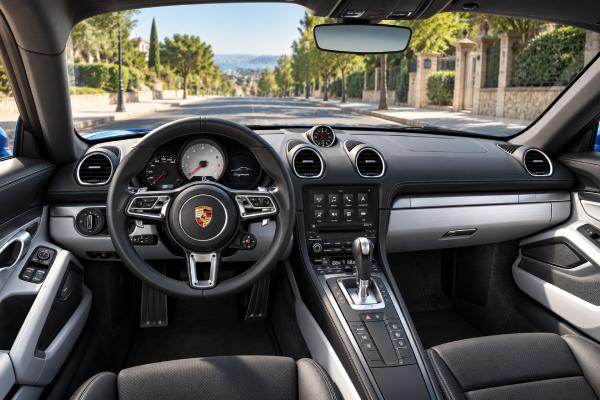
The 300 hp Porsche 718 Cayman is the core four-cylinder coupe of the 982 generation: a mid-engine, rear-wheel-drive two-seater built around a 1,988 cc turbocharged flat-four and offered with either a six-speed manual or seven-speed PDK. Introduced in 2016 for the 2017 model year in several markets, it brought far more low-rpm torque than the naturally aspirated Cayman it replaced while retaining the fixed-roof packaging that gives the Cayman both structural focus and unusually useful cargo space for a compact sports car. Porsche kept this basic 300 hp formula in production through the 2025 model year in markets such as the United States, even as six-cylinder GTS and GT derivatives expanded the range.
This guide focuses specifically on the 300 hp MA2.20 2.0-liter Cayman, not the 250 PS China-market calibration and not the 2.5-liter Cayman S. It covers factory specifications, chassis design, transmission differences, real ownership priorities, scheduled maintenance, recall checks, and the details that matter when inspecting a used example.
Table of Contents
- What Defines the 300 hp 718 Cayman
- Technical Data and Factory Specifications
- How the 2.0-Liter Turbo and Transmissions Behave
- Why the Coupe Chassis Matters
- Model-Year Evolution Without Changing the Core Formula
- Maintenance, Ageing, and Service Priorities
- How to Inspect and Choose a Used 300 hp Cayman
What Defines the 300 hp 718 Cayman
The defining specification is simple: 300 hp from a 2.0-liter turbocharged boxer four, mounted behind the seats and driving the rear wheels. Porsche announced the 718 Cayman in April 2016 with 221 kW (300 hp) and 380 Nm of torque, making the coupe and contemporary 718 Boxster equal in rated output for the first time. The engine’s torque plateau runs from 1,950 to 4,500 rpm, a major change in character from the rev-dependent naturally aspirated flat-sixes used in the preceding 981 Cayman range.
That output figure also establishes the scope of this article. Some 982 Caymans sold in China used a 184 kW/250 PS version of the 2.0-liter engine. Those cars should not be treated as 300 hp cars simply because the displacement, body code, and broad engine family look similar. Likewise, the Cayman S uses a 2.5-liter engine with variable-turbine-geometry turbocharging and 350 hp. A VIN, market specification, build sheet, or original sales documentation is therefore more reliable than a generic model-name lookup when identifying an imported car.
Porsche’s launch changes went beyond the engine. The 718 Cayman received a substantially retuned chassis, firmer springs and anti-roll bars, revised dampers, steering calibrated to be about ten percent more direct, and wider rear wheel rims. The standard Cayman also inherited the previous Cayman S brake sizing, with 330 mm front and 299 mm rear discs. Those details help explain why the base 718 can feel like a complete sports-car package rather than merely the least powerful trim.
A second important distinction is model year versus calendar year. The 982 Cayman was revealed and began appearing in 2016, while U.S.-market cars were sold as 2017 models. Registration databases can therefore describe an early car as “2016” even when factory documentation for another market calls the same generation a 2017 model. For parts, service information, recalls, and option decoding, use the VIN and actual market rather than relying on the registration year alone.
Technical Data and Factory Specifications
The following figures describe the factory 300 hp 718 Cayman configuration documented by Porsche at launch, with later-market figures called out where they changed. They should not be mixed with Cayman S, GTS, China-market 250 PS, or GT4 data.
Engine and drivetrain
| Specification | Factory figure |
|---|---|
| Engine layout | Turbocharged flat-four, mid-mounted |
| Displacement | 1,988 cc (2.0 L) |
| Bore × stroke | 91.0 × 76.4 mm |
| Valvetrain | 4 valves per cylinder; VarioCam Plus |
| Fuel system | Direct fuel injection |
| Maximum power | 300 hp at 6,500 rpm |
| Maximum torque | 380 Nm (280 lb-ft) at 1,950–4,500 rpm |
| Compression ratio | 9.5:1 |
| Maximum engine speed | 7,500 rpm |
| Induction | Single turbocharger; up to 1.3 bar / 19 psi boost in Porsche’s early U.S. technical data |
| Intercooling | Water-to-air |
| Lubrication | Integrated dry-sump system with demand-controlled oil pump |
| Drive | Rear-wheel drive |
Transmission and acceleration
| Specification | 6-speed manual | 7-speed PDK |
|---|---|---|
| 0–60 mph | 4.9 s | 4.7 s |
| 0–60 mph with Sport Plus | — | 4.5 s |
| 0–100 mph | 11.3 s | 11.1 s |
| Quarter mile | 13.4 s | 13.2 s |
| Top track speed | 170 mph (274 km/h) | 170 mph (274 km/h) |
Porsche’s European launch material quoted 0–100 km/h in 4.7 seconds for a PDK car with Sport Chrono and a 275 km/h top speed. Later U.S. configurator data for the 2025 Cayman lists 300 hp, 4.7 seconds to 60 mph, and a 171 mph top track speed with summer tires. These small differences reflect market documentation, test convention, equipment, and later homologation rather than a change to a higher-output base engine.
Chassis, brakes, wheels, and tires
| Item | Specification |
|---|---|
| Front suspension | Lightweight MacPherson-type spring struts |
| Rear suspension | Lightweight MacPherson-type suspension |
| Steering | Electromechanical variable-ratio power steering |
| Front brakes | 330 × 28 mm vented, cross-drilled iron discs; 4-piston fixed aluminum calipers |
| Rear brakes | 299 × 20 mm vented, cross-drilled iron discs; 4-piston fixed aluminum calipers |
| Front wheels/tires | 8 J × 18; 235/35 ZR18 |
| Rear wheels/tires | 9.5 J × 18; 265/45 ZR18 |
| Stability system | Porsche Stability Management (PSM) |
Option packages can materially change how a used car drives. Porsche Active Suspension Management (PASM), Porsche Torque Vectoring (PTV), Sport Chrono, larger wheels, and Sport Exhaust were available in various combinations depending on year and market. Never infer those features from exterior appearance alone: obtain the option list or decode the car’s build data.
Dimensions, mass, and cargo
| Specification | Factory figure |
|---|---|
| Length | 4,379 mm (172.4 in) |
| Body width | 1,801 mm (70.9 in) |
| Width including mirrors | 1,994 mm (78.5 in) |
| Height | 1,295 mm (51.0 in) |
| Wheelbase | 2,475 mm (97.4 in) |
| Unladen weight | 1,335 kg (2,944 lb) manual; 1,365 kg (3,010 lb) PDK in early U.S. data |
| Front luggage volume | 150 L (5.3 cu ft) |
| Rear luggage volume | 275 L (9.7 cu ft) |
The dual-cargo arrangement is one of the Cayman’s strongest practical traits. The front trunk is deep enough for compact luggage, while the hatchback area behind the engine provides a broad secondary load space. Heat from the powertrain makes the rear compartment less suitable for temperature-sensitive items after spirited driving, but for soft bags and everyday cargo it gives the Cayman genuine touring usefulness.
Fuel capacity and economy
| Specification | Factory figure |
|---|---|
| Standard fuel tank in early U.S. data | 54 L (14.3 US gal) |
| Optional larger tank in early U.S. data | 64 L (16.9 US gal) |
| European launch combined consumption | 6.9–7.4 L/100 km, depending on configuration/test cycle |
| European launch CO₂ | 158–168 g/km, depending on configuration/test cycle |
Do not compare those NEDC-era European values directly with later WLTP figures or EPA labels. Test procedures changed, and wheel, transmission, and equipment combinations can alter certified values. For a specific car, the market-specific fuel-economy label or official registration data is the correct reference.
Routine service intervals
| Service item | Published interval |
|---|---|
| Oil maintenance | 15,000 km / 1 year |
| Inspection | 30,000 km / 2 years |
| Brake fluid | Every 2 years |
| Spark plugs | 45,000 km / 4 years |
| Air filter | 60,000 km / 4 years |
| PDK clutch fluid | 180,000 km / 12 years |
| Transmission oil | 180,000 km / 12 years |
Intervals vary by market and maintenance-program revision, so this table is a planning reference, not a substitute for the schedule tied to the VIN. Cars used heavily on track, exposed to severe heat or dust, or driven mostly on short trips can justify more conservative fluid and inspection practice.
How the 2.0-Liter Turbo and Transmissions Behave
The MA2.20 changes the way a Cayman gathers speed. Peak torque arrives below 2,000 rpm and remains available through 4,500 rpm, so the car responds strongly in the middle of the rev range without requiring a downshift for every overtake. Maximum power arrives at 6,500 rpm and the engine can continue to 7,500 rpm, giving it useful rev range above the torque plateau rather than behaving like a low-speed-only turbo engine.
The single turbocharger is conventional rather than the VTG unit used on the 2.5-liter S. Porsche paired it with water-to-air charge cooling and an integrated dry-sump lubrication system, both significant engineering details in a compact mid-engine installation. The intercooling arrangement helps control intake-air temperature under sustained load, while the oil system is designed to maintain lubrication during the high lateral acceleration a sports car can generate. That does not make the car immune to heat: cooling-system condition, correct oil level, unobstructed radiators, and sound fans still matter greatly on an older or regularly tracked 718.
Transmission choice changes the experience more than the headline performance numbers suggest. The six-speed manual adds driver workload and makes the engine’s broad torque useful because a gear can be held through a wide speed range. Its factory 0–60 mph figure is slower than the PDK’s, but the attraction is interaction rather than launch performance. During a test drive, the clutch should take up cleanly, the pedal should not feel abnormally heavy or inconsistent, and the lever should select all gears without baulking once the gearbox is warm.
The seven-speed PDK emphasizes response and repeatability. It can shift rapidly under load, chooses taller gears when cruising, and allows the quickest official launch time when combined with Sport Chrono. A prospective buyer should test it both cold and fully warm. Low-speed maneuvering can feel different from a torque-converter automatic because PDK uses clutches, but persistent warning messages, pronounced shuddering, delayed engagement, or harsh behavior outside normal operating characteristics deserves diagnosis rather than being dismissed as “how PDKs are.”
Sport Chrono is more than a dashboard clock. On PDK cars it enables the launch-control/Sport Plus performance figures quoted by Porsche, and its drive-mode programming changes the urgency of powertrain responses. PTV and PASM affect another dimension of the car entirely: traction behavior and body control. That is why two nominally identical 300 hp Caymans can feel noticeably different even before tires and alignment are considered.
Why the Coupe Chassis Matters
The Cayman’s fixed roof gives the 718 a distinct role within Porsche’s mid-engine pair. It is not simply a Boxster with metal over the cabin; the coupe’s enclosed rear structure creates a useful hatch area and makes the car particularly well suited to drivers who want a compact sports car for year-round use, road trips, or occasional track days without giving up two separate luggage compartments.
Porsche’s 982 chassis revisions were deliberately broad. The company described firmer springs and stabilizers, revised dampers, greater lateral rigidity and wheel tracking, steering that was ten percent more direct, and rear wheel rims widened by half an inch. The base Cayman’s 330 mm front discs were also the size used previously by the Cayman S. In normal road driving, the practical consequence is a car whose steering, braking, and body control were engineered around substantially greater torque than its predecessor rather than having the new turbo engine inserted into an unchanged chassis.
Tire condition has an outsized influence on whether that chassis feels right. Check that all four tires are an appropriate matching set, confirm production dates, and inspect the inner shoulders rather than only the outer tread blocks. Aggressive alignment, low ride height, track use, or worn suspension joints can create inner-edge wear that is difficult to see with the car on the ground. Mixed tire models or a large age difference front-to-rear can also change wet behavior even when tread depth is legal.
Wheel size deserves similar attention. The base car launched on staggered 18-inch wheels, but many cars were ordered with larger factory wheels. Larger wheels can sharpen appearance and steering response, while adding tire cost and reducing the amount of sidewall available to absorb broken pavement. A used car on non-original wheels should be checked for correct dimensions, offsets, tire load/speed ratings, and clearance rather than judged only by whether the wheels physically bolt on.
The cabin and cargo layout are also worth evaluating in person. The rear hatch makes loading easier than the exterior dimensions suggest, yet the Cayman remains a strict two-seater. Seat type can materially change comfort: standard sport seats, Sport Seats Plus, adaptive seats, and full buckets serve different bodies and priorities. A car that looks ideal on a specification sheet can become tiring if the seat geometry does not suit its driver.
Model-Year Evolution Without Changing the Core Formula
The 300 hp base Cayman remained remarkably consistent mechanically across the 982 run, but equipment and derivative choices evolved. That makes model-year comparison less about chasing a hidden power increase and more about deciding which factory features, infotainment equipment, and option combinations matter to you.
Early cars establish the fundamental package: 300 hp, 380 Nm, manual or PDK, mid-engine layout, and the retuned 718 chassis. Their appeal can be strong because the driving hardware is already present, but they are now the oldest examples. Age-related items such as tires, batteries, coolant-system components, air-conditioning function, suspension wear, cosmetic seals, and accumulated maintenance history therefore deserve as much attention as mileage.
For the 2021 model year in the United States, Porsche expanded standard equipment across the 718 range. Automatic two-zone climate control, heated front seats, auto-dimming mirrors with a rain sensor, Apple CarPlay, and bi-xenon headlights with Porsche Dynamic Light System became standard on the regular Boxster and Cayman as well as several other 718 variants. Porsche continued to list the six-speed manual as standard and seven-speed PDK as optional. A newer car can therefore have a richer standard specification even when its engine output is unchanged.
By the 2025 model year, Porsche’s U.S. configurator still listed the regular Cayman at 300 hp with both automatic and manual availability. This continuity is useful for buyers: the essential engine choice does not require decoding a sequence of annual horsepower changes. Instead, compare the actual car’s option record. PASM, PTV, Sport Chrono, wheel choice, lighting, seat type, audio, paint, and driver-assistance equipment can affect both use and value more than the year printed on the registration document.
Market differences remain important throughout. Emissions equipment, certification figures, standard features, warranty coverage, service schedules, lighting, and even engine calibration can differ. An imported 718 deserves a build-data check before ordering parts or assuming that a local-market brochure applies. This is particularly important when distinguishing the global 300 hp car from the lower-output China-market version of the same basic displacement.
Maintenance, Ageing, and Service Priorities
A good 718 Cayman service history should show both mileage-based and time-based work. Low annual mileage does not eliminate annual oil service, biennial brake-fluid replacement, or four-year items. A ten-year-old car with 25,000 km can therefore be more overdue than a younger, higher-mileage car maintained strictly to schedule.
Start with engine oil. The turbocharger, high specific output, and mid-engine thermal environment make correct oil specification and level important. Documentation is more useful than a seller’s statement that the oil was “done recently”: look for dated invoices showing the oil and filter service and, ideally, the product specification used. On a car with uncertain history, establish a maintenance baseline rather than assuming the dashboard service indicator proves all scheduled work was performed.
Cooling-system condition is equally important because the 718 relies on multiple heat exchangers and water-to-air charge cooling. Inspect the front intake areas for leaves, road debris, and damage. Check coolant level only according to the owner’s-manual procedure and look for evidence of dried coolant residue, staining, repairs, or recurring top-ups. A stable temperature reading during a short test drive does not by itself rule out a slow leak or partially obstructed heat exchanger.
The ignition system has a defined age component. Porsche Centre guidance for the Type 982 lists spark plugs at 45,000 km or four years and the air filter at 60,000 km or four years. On cars that have spent long periods parked, verify dates rather than relying on odometer mileage. Misfire under boost, an uneven idle, or stored fault codes should be investigated before purchase rather than treated automatically as “just plugs.”
Brake maintenance is straightforward to inspect but expensive to ignore. Brake fluid is listed on a two-year cycle. Measure pad and disc condition, look for cracking beyond normal surface marking around drilled holes, inspect the inside faces of the discs, and confirm that the parking brake operates properly. Track use is not inherently disqualifying if the car was serviced accordingly, but repeated high-temperature use can consume brakes, tires, and fluids quickly.
For PDK cars, long published transmission-fluid intervals can create a false sense that the gearbox needs no attention. Porsche Centre Australia currently lists PDK clutch fluid and transmission oil at 180,000 km or 12 years for Type 982 Boxster/Cayman service planning. Because early 718s are approaching or have reached that age window, the date now matters even on modest-mileage examples. Use the schedule applicable to the car’s market and VIN before commissioning work.
Recalls should be checked by VIN rather than by model name alone. As one U.S. example, NHTSA campaign 17V-054 covered certain 2017 718 Cayman and other Porsche models for fastening screws on fuel collection pipes that could fail through stress-corrosion cracking and permit fuel leakage. That does not mean every 2017 Cayman is affected, nor that later cars share the issue. Confirm open campaigns with Porsche or the relevant national regulator and obtain proof of completion for applicable recall work.
Finally, inspect the ordinary ageing items that can be overshadowed by the engine: battery health, air-conditioning output, window operation, hatch struts and latches, lighting, infotainment, parking sensors/camera where fitted, underbody panels, and all keys. A sports car with excellent paint but unresolved electrical or comfort-system faults can still generate a disproportionate first-year bill.
How to Inspect and Choose a Used 300 hp Cayman
Buy the condition and configuration you can verify, not the story attached to the car. The 300 hp 718 Cayman’s long production span means there is no single “best year” independent of history, use, options, and price. A well-documented early manual can be a stronger purchase than a newer neglected PDK, while a later highly optioned car may justify its premium if those features are ones you actually value.
Begin identification with the VIN and build information. Confirm that the car is a 300 hp 2.0-liter Cayman for its original market, note the transmission, and list meaningful factory options. This prevents three common errors at once: confusing a 250 PS market-specific car with the 300 hp version, assuming an S or GTS feature is standard on the base Cayman, and paying for aftermarket equipment as though it were factory specification.
Then inspect the car cold. A pre-warmed engine can conceal starting behavior, exhaust smoke, accessory noises, or an initially rough idle. Watch the instrument cluster during start-up and make sure warning lamps perform their check and extinguish normally. Listen for abnormal persistent mechanical noises rather than chasing every brief sound from direct injection, pumps, or normal warm-up strategy.
During the road test, separate engine, gearbox, chassis, and brake observations. The engine should pull cleanly through the torque band without hesitation or warning messages. A manual should shift consistently and the clutch should not slip under load. PDK engagement should be predictable once conditions are understood. Steering should track cleanly on a level road, the car should not vibrate abnormally at speed, and braking should be straight and progressive without steering shake.
After the drive, look underneath and back into the front cooling openings. Fresh fluid, oil residue, damaged undertrays, bent fasteners, or evidence of repeated curb/track contact deserves explanation. Inspect wheel barrels and tire sidewalls for damage. Measure tread across the full width. If the car has adjustable or modified suspension, determine who installed it, whether alignment records exist, and whether the setup is road-legal in the jurisdiction where the car will be registered.
Service paperwork should form a coherent timeline. Match invoice dates and mileages to the maintenance schedule, then look beyond stamped-book entries for plugs, brake fluid, filters, PDK service where age requires it, tire replacement, brake work, and repairs. Gaps are not automatically fatal, but they should change the questions you ask and the amount you reserve for baseline servicing.
A pre-purchase inspection by a Porsche specialist is particularly valuable because the 718’s underside, cooling system, diagnostic history, and option coding can reveal things a driveway inspection cannot. Ask for a scan of all relevant control modules, not only a check-engine-light status. Diagnostic faults should be interpreted in context: old low-voltage records may be harmless after a battery failure, while current or repeated powertrain faults need a cause and repair plan.
The strongest 300 hp Cayman purchase is therefore one whose identity, options, maintenance, and condition all agree. The engine delivers enough low-rpm torque for daily use, the chassis is sophisticated enough to reward careful setup, and the coupe adds cargo capacity without diluting the mid-engine layout. What matters most on an individual used car is evidence: correct specification, consistent servicing, sensible wear, completed VIN-specific campaigns, and a test drive that supports the paperwork.
References
- The new Porsche 718 Cayman — Porsche AG, 2016.
- 2016 – 718 Cayman and 718 Cayman S technical specifications — Porsche Cars North America, 2016.
- The 2021 Porsche 718 Boxster and Cayman models — Porsche Cars North America, 2020.
- Porsche 718 Models and Configurator | Porsche USA — Porsche, 2025 model-year data.
- Boxster and Cayman Service — Porsche Centre Sydney South, accessed 2026.
- IMPORTANT SAFETY RECALL — National Highway Traffic Safety Administration / Porsche Cars North America, 2017.
Disclaimer
This article is for informational purposes only. Specifications, service intervals, fluids, torque values, procedures, recall applicability, and equipment can vary by VIN, model year, market, transmission, and factory options. Verify maintenance and repair requirements against current Porsche service information, the owner’s manual, the vehicle’s build data, and applicable recall databases before ordering parts or performing work. If you found this guide useful, please consider sharing it with another 718 Cayman owner or buyer.