

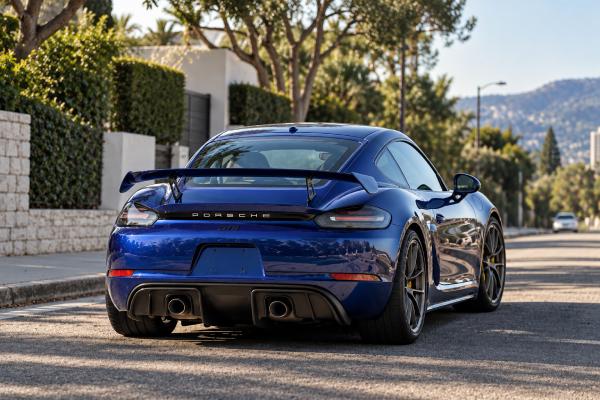
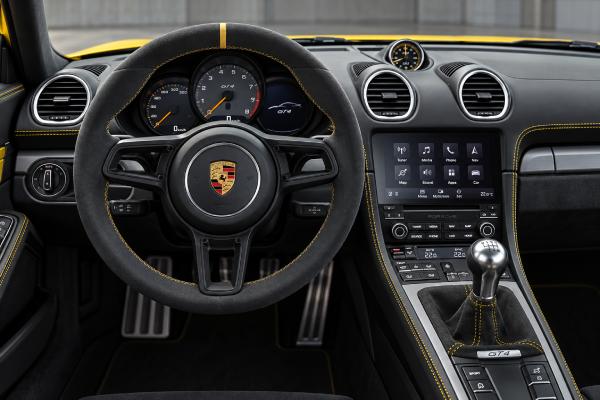
The 982-generation Porsche 718 Cayman GT4 is the point where the Cayman moved decisively into Porsche GT territory. Its 4.0-liter naturally aspirated flat-six produces 414 hp in U.S. specification, revs to 8,000 rpm and sits behind the cabin, while the chassis incorporates hardware developed with Porsche Motorsport experience. The car launched with a six-speed manual, a 30 mm-lower GT suspension, powerful fixed-caliper brakes, a mechanical rear differential lock and an aerodynamics package that Porsche said generated 50 percent more downforce than the previous GT4 without a meaningful drag penalty. The specification changed during the assignment’s 2019–2023 span: for the 2021 model year Porsche added an optional seven-speed PDK, reducing the U.S. 0–60 mph time from the manual car’s 4.2 seconds to 3.7 seconds. That transmission change is too important to bury in a footnote. This guide therefore treats the manual and PDK versions separately where necessary, while keeping the scope strictly on the 414-hp 718 Cayman GT4—not the later GT4 RS, not the GTS 4.0, and not visually modified ordinary Caymans.
Table of Contents
- GT4 Identity and Model-Year Changes
- Four-Liter Flat-Six Engine
- GT Chassis, Brakes, and Tires
- Aerodynamics That Do Real Work
- Manual Versus PDK Performance
- Track Use, Maintenance, and Consumables
- Buying and Authenticating a Used GT4
GT4 Identity and Model-Year Changes
Porsche introduced the new 718 Cayman GT4 in June 2019 alongside the 718 Spyder. Both used the same basic 4.0-liter naturally aspirated engine, but the GT4 paired it with a fixed-roof Cayman body, a large fixed rear wing and an aero package developed specifically for high-speed stability. In the United States it arrived as a 2020 model.
The first cars were manual-only. Porsche expanded the range for the 2021 model year with an optional seven-speed dual-clutch PDK. That means a specification table that simply says “2019–2023 GT4” without identifying the gearbox can be misleading, especially for acceleration, differential-lock behavior and some weight-related data.
The 414-hp figure is the U.S. SAE rating. European material describes 309 kW/420 PS. Those are different measurement conventions for the same engine family, not evidence of a separate 420-hp U.S. version. Likewise, the GT4 RS introduced later is a different model with a substantially different engine and should never be merged into this car’s specifications.
Visual identification is straightforward but still not enough for authentication. The GT4 has its own front fascia and splitter, side intakes, rear diffuser and fixed wing. A VIN/build record should confirm the car as a GT4 and document options such as ceramic brakes, seats and interior trim. Body panels and wings can be retrofitted to ordinary Caymans.
Four-Liter Flat-Six Engine
The 3,995 cc engine is a naturally aspirated horizontally opposed six-cylinder. Porsche developed it as a high-revving unit with direct fuel injection, a variable intake system and adaptive cylinder control for part-load efficiency. Peak power arrives at 7,600 rpm and the engine can turn to 8,000 rpm. Maximum torque is 309 lb-ft from 5,000 to 6,800 rpm in the original U.S. technical specification.
| Engine specification | 718 Cayman GT4 |
|---|---|
| Configuration | Naturally aspirated flat-six |
| Displacement | 3,995 cc |
| Bore × stroke | 102.0 × 81.5 mm |
| Maximum power, U.S. | 414 hp at 7,600 rpm |
| Maximum torque | 309 lb-ft at 5,000–6,800 rpm |
| Compression ratio | 13.0:1 |
| Maximum engine speed | 8,000 rpm |
| Drive layout | Mid-engine, rear-wheel drive |
The variable intake system uses resonance control to improve cylinder filling over the rev range. Piezoelectric injectors can divide injection into multiple events, and adaptive cylinder control can temporarily interrupt fuel injection to one bank during suitable low-load operation. These measures show that the engine was engineered for both high specific performance and contemporary emissions/efficiency demands.
For a prospective owner, the practical consequence of the 8,000-rpm character is that oil condition, warm-up discipline and service history matter. High engine speed is part of the design, but repeated high-load operation before oil reaches temperature is not desirable. A seller’s statement that the engine “never saw redline” is less useful than records showing correct oil, regular service and no unresolved fault history.
GT Chassis, Brakes, and Tires
The GT4 chassis is not simply a Cayman GTS suspension with stiffer springs. Porsche used many lightweight suspension components derived from GT models and set the car 30 mm lower. PASM is calibrated for the GT application, and the stability-control system can be switched off in stages for circuit use.
Standard brakes are large iron units with six-piston front and four-piston rear fixed calipers. Porsche Ceramic Composite Brakes were optional. Wheel and tire sizing is also GT-specific, with a wider rear wheel and tire than on ordinary 718 variants.
| Chassis item | Factory specification |
|---|---|
| Ride height | GT chassis, 30 mm lower |
| Adaptive damping | GT-specific PASM |
| Standard front brakes | 380 × 34 mm iron rotors; 6-piston fixed calipers |
| Standard rear brakes | 380 × 30 mm iron rotors; 4-piston fixed calipers |
| Optional PCCB front rotors | 410 × 36 mm |
| Optional PCCB rear rotors | 390 × 32 mm |
| Front wheels/tires | 8.5J × 20 ET61; 245/35 ZR20 |
| Rear wheels/tires | 11J × 20 ET50; 295/30 ZR20 |
Alignment and tire condition are critical on a car with this level of lateral capability. Look at the complete tread face, especially inner shoulders. A GT4 can wear tires unevenly after aggressive track alignment even when the outer tread looks healthy. Ask whether the car has used factory road settings or a circuit-oriented alignment, and request alignment sheets if available.
Optional ceramic brakes need expert evaluation. Surface appearance, thickness, damage history and remaining life should be assessed by someone familiar with PCCB. Replacing ceramic rotors is expensive enough that uncertainty should be resolved before purchase. On iron-brake cars, check for cracking around drillings, heavy lips, heat checking and pad taper.
Aerodynamics That Do Real Work
The fixed rear wing is not decorative. Porsche stated that the 982 GT4 generates 50 percent more downforce than its predecessor while drag remains virtually unchanged. The underbody and rear diffuser make a major contribution, enabled in part by a redesigned single-chamber rear silencer that creates space for the diffuser channel.
Porsche attributed roughly 30 percent of the GT4’s rear-axle downforce to the functional diffuser. The rear wing itself produces about 20 percent more downforce than the previous GT4, equivalent to an additional 12 kg at 200 km/h. At maximum speed, Porsche’s press-kit material cites 122 kg of rear downforce.
The front bumper uses a large spoiler lip and air-curtain features to manage front-axle lift and balance the rear aero. That means accident repair or track damage to seemingly simple plastic aero parts can have a functional consequence. During a pre-purchase inspection, check that the splitter, undertrays, ducting and diffuser are present, correctly attached and not replaced with poorly fitted aftermarket pieces.
| Aerodynamic feature | Function |
|---|---|
| Fixed rear wing | Creates rear downforce; about 20% more than previous GT4 |
| Rear diffuser | Major underbody downforce contribution |
| Front spoiler lip | Reduces front lift and balances rear aero |
| Air curtains | Manage airflow around the front wheels |
| Overall GT4 package | Up to 50% more downforce than predecessor with similar drag |
The car’s low front overhang is vulnerable on steep driveways. Scraped splitter edges are common and not automatically evidence of structural damage; broken mounts, deformed panels or damage extending into radiators and underbody components are more consequential.
Manual Versus PDK Performance
The six-speed manual was the only transmission at launch. Porsche’s U.S. technical specification quotes 0–60 mph in 4.2 seconds, a 12.4-second quarter mile and a top track speed of 188 mph. The gearing is deliberately long, so the car can reach significant road speed in the lower gears. That affects the driving experience: the engine’s high-rpm character is available, but full use of it on public roads quickly encounters legal speed limits.
For the 2021 model year, seven-speed PDK became optional. Porsche quoted 0–60 mph in 3.7 seconds for the PDK GT4, a half-second improvement over the original manual factory figure. The PDK also brought revised mechanical differential locking values and launch-control functionality.
| Transmission distinction | 6-speed manual | 7-speed PDK |
|---|---|---|
| Availability | From launch | Added for 2021 model year |
| U.S. 0–60 mph | 4.2 s | 3.7 s |
| Launch control | No | Yes |
| Mechanical differential lock | Launch specification 22% traction / 27% overrun | 30% traction / 37% overrun |
The choice is therefore about more than acceleration. The manual gives direct clutch and gear selection; PDK offers faster shifts and allows the engine to stay closer to its strongest operating range during hard acceleration. Both were factory-engineered GT4 configurations and neither should be treated as a conversion of the other.
On inspection, manual cars should be tested for clutch slip, take-up behavior and clean synchro operation. PDK cars should be scanned for faults and driven through low-speed, part-throttle and full-load conditions. Any evidence of gearbox overheating, repeated warnings or non-standard software should be investigated.
Track Use, Maintenance, and Consumables
A GT4 is designed to tolerate demanding driving, but “track capable” does not mean “maintenance free after track use.” Consumables can age quickly under repeated heat cycles. Brake fluid, pads, rotors, tires and wheel bearings deserve closer attention on cars that have seen circuits, autocross or frequent mountain driving.
Service intervals must be taken from official documentation for the VIN and market. Regular engine oil and filter changes are fundamental, and time-based maintenance still matters when annual mileage is low. Documented fluid changes can be more valuable than a vague “dealer maintained” description.
Inspect front radiators and condensers for debris, stone damage and bent fins. GT4 aero sends substantial airflow through the car, and the low nose makes road debris unavoidable. Cooling systems should hold pressure correctly with no unexplained coolant loss. The underside should be examined for damaged ducts, loose panels and track-curbing impacts.
Tires on a GT4 can look acceptable by tread depth but be compromised by age, heat cycles or inner-edge wear. Read date codes and inspect for rubber pickup, chunking, flat spotting and sidewall damage. If the car has been stored on track tires through cold conditions, assess whether those tires remain appropriate for road use.
The brake system needs a condition-based evaluation. With iron rotors, check surface cracking, thickness and pad deposits. With PCCB, use an experienced specialist. A fresh set of pads does not prove the rotors are healthy, and recently refinished calipers do not establish the history of the system.
Interior wear can also reveal use. Bucket-seat bolsters, harness pass-through areas and door sills may show repeated track access. A roll-bar or harness installation warrants checking how it was mounted and whether original trim is included. Modifications should be understood as engineering changes, not merely as accessories.
Buying and Authenticating a Used GT4
Start with the VIN and factory equipment record. Confirm model identity, transmission, brake system, seat type and original color. The GT4’s appearance is widely copied, so wings, bumpers and badges alone do not authenticate the model.
A proper pre-purchase inspection should include a cold start, a full diagnostic scan, paint/body assessment, lift inspection and a road test after full warm-up. Look for over-rev or operating data where the available diagnostic system and market documentation support it, but have a Porsche specialist interpret the information; isolated counters can be misunderstood without context.
Examine the front splitter, radiators, undertrays and rear diffuser for impacts. Check the rear wing mounts and deck area for cracks or evidence of non-standard mounting. Inspect tires and brakes with track use in mind, and verify wheel condition on the inner barrels as well as the visible faces.
Modifications such as exhausts, suspension links, ride-height changes, alignment hardware or engine software can be appropriate for enthusiast use, but they change the original baseline. Ask who performed the work, whether calibration is emissions-compliant for the jurisdiction, and whether factory parts are available. A car returned to stock for sale should be checked just as carefully as one still modified.
Review service invoices chronologically. Gaps matter more than the logo at the top of the page. A frequently used GT4 with regular fluids, tires and brake work can be a better mechanical prospect than a lower-mileage car that sat for years with old consumables.
Before purchase, run the VIN through the applicable official recall database and verify campaign completion. Recalls are VIN-specific and can be updated after this article. The strongest candidate is the car whose identity, configuration, use history and maintenance tell the same story.
The 718 Cayman GT4 combines an unusually high-revving naturally aspirated engine with a chassis and aero package engineered around serious performance use. Its mid-cycle addition of PDK broadens the choice but also makes model-year accuracy essential. Buyers who distinguish the gearbox versions, inspect consumables in the context of possible track use and authenticate factory equipment are much less likely to be surprised after purchase.
References
- Pure fun: The 2020 Porsche 718 Cayman GT4 and 718 Spyder 2019
- Emotive powerhouse 2019
- Ideal for the racetrack 2019
- Efficient downforce 2019
- Porsche dual-clutch transmission now also for flagship 718 models 2020
- Check for Recalls: Vehicle, Car Seat, Tire, Equipment | NHTSA 2026 (Recall Database)
Disclaimer
This article is for informational use and is not a substitute for professional vehicle diagnosis, inspection or repair. Specifications, torque values, service intervals and procedures can vary by VIN, market, production date and equipment; consult the official Porsche service documentation applicable to the individual car before performing work.
If this GT4 guide was useful, please consider sharing it on Facebook, X/Twitter or another social platform to support our work.