


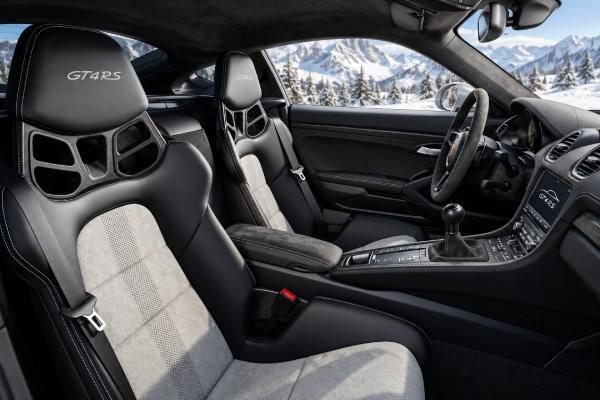
The Porsche 718 Cayman GT4 RS is the most track-focused road-going Cayman of the 982 generation. Revealed in November 2021 and sold through the final years of the combustion-engine 718, it replaces the regular GT4’s 4.0-litre engine with the high-revving, GT3-derived unit used in Porsche’s GT program. In U.S. specification Porsche rates it at 493 hp; European documents quote 368 kW (500 PS). The engine sits ahead of the rear axle, drives only the rear wheels, and is paired exclusively with a short-ratio seven-speed PDK dual-clutch transmission.
The GT4 RS is not simply a Cayman with more power. Its intake system, aero package, suspension joints, brakes, weight-saving measures and cabin all reflect a different brief: repeatable speed and response on a circuit while remaining road legal. That focus also changes the ownership equation. Tire condition, brake wear, alignment, underbody damage, recall completion and evidence of track use matter more than they do on an ordinary 718.
Table of Contents
- What makes the GT4 RS different
- Specifications and technical data
- Engine, PDK, chassis, and aerodynamics
- Performance and road-versus-track character
- Maintenance and consumable costs
- Recalls and documented service concerns
- Used-car inspection and buying priorities
What makes the GT4 RS different
The GT4 RS is the RS derivative of the 982-generation 718 Cayman, not a trim package for the standard Cayman GT4. Its defining hardware is the 3,996 cc naturally aspirated flat-six, seven-speed PDK, RS-specific chassis, extensive aerodynamic work and weight reduction.
Porsche unveiled the model in November 2021, while customer cars followed for the 2022 model year in many markets. That distinction matters when an assignment or database lists “2021–2025”: 2021 is the launch and technical-data publication year, while registration and model-year availability can begin later depending on country. Buyers should therefore use a VIN and market-specific build record rather than assuming that every calendar year maps neatly to a model year.
The assignment identifies the engine as MDG.GA. Porsche’s public launch and technical-data material usually describes the engine by architecture and output rather than relying on that code as the primary identifier, so a buyer who needs an engine-code match for parts or authenticity should confirm it against the vehicle’s VIN-linked documentation.
The mechanical distinction from the regular 718 Cayman GT4 is substantial. Porsche increased maximum engine speed to 9,000 rpm, raised output by roughly 80 PS over the contemporary GT4, shortened the gearing, replaced compliant suspension bushings with ball joints in key locations, and developed an aero package centered on a swan-neck rear wing. The body also receives carbon-fibre-reinforced plastic for major panels, thinner or reduced sound insulation in selected areas, lightweight glazing and RS-specific cabin details.
The result is a car that trades some quietness, ride isolation and everyday subtlety for sharper responses. That trade is intentional. A used example that has lived on track is not automatically undesirable, but it should be evaluated as a high-performance machine whose tires, brakes, alignment settings and bodywork may have been subjected to loads well beyond normal road use.
Specifications and technical data
The GT4 RS uses a mid-mounted, naturally aspirated 4.0-litre flat-six and rear-wheel drive. It is PDK-only, with Porsche Torque Vectoring and a mechanical limited-slip differential, and its suspension is adjustable for circuit setup. Figures below distinguish Porsche’s U.S. technical data from European metric figures where that avoids mixing power conventions.
| Specification | Value |
|---|---|
| Engine layout | Naturally aspirated six-cylinder boxer, mid-mounted |
| Displacement | 3,996 cc (4.0 L) |
| Bore × stroke | 102.0 × 81.5 mm |
| Valves | 4 per cylinder |
| Maximum power | 493 hp at 8,400 rpm (U.S.); 368 kW / 500 PS in European documentation |
| Maximum torque | 331 lb-ft in U.S. data; 450 Nm in European data |
| Compression ratio | 13.3:1 |
| Maximum engine speed | 9,000 rpm |
| Induction | Variable intake manifold with six individual throttle valves |
| Lubrication | Dry-sump system with separate oil tank and multi-stage scavenging |
| Specification | Value |
|---|---|
| Transmission | 7-speed Porsche Doppelkupplung (PDK) dual-clutch |
| Drive | Rear-wheel drive |
| Rear differential | Mechanical limited-slip differential with Porsche Torque Vectoring |
| Final-drive ratio | 4.17:1 |
| 1st / 2nd / 3rd gear | 3.75 / 2.38 / 1.72 |
| 4th / 5th / 6th / 7th gear | 1.34 / 1.11 / 0.96 / 0.84 |
| Specification | Value |
|---|---|
| 0–60 mph | 3.2 seconds |
| 0–100 km/h | 3.4 seconds |
| 0–160 km/h | 7.1 seconds |
| 0–200 km/h | 10.9 seconds |
| Top speed | 315 km/h (196 mph) |
| WLTP combined fuel use | 13.0 L/100 km |
| WLTP combined CO₂ | 295 g/km in Porsche launch-era European data |
| Specification | Value |
|---|---|
| Suspension | RS-specific steel springs with PASM adaptive damping; ride height 30 mm lower than a regular 718 |
| Front brakes | Six-piston fixed calipers, 408 × 36 mm iron composite discs |
| Rear brakes | Four-piston fixed calipers, 380 × 30 mm iron composite discs |
| Front wheels / tires | 8.5 J × 20 ET61; 245/35 ZR20 |
| Rear wheels / tires | 11.0 J × 20 ET50; 295/30 ZR20 |
| Stability control | PSM with two-stage deactivation strategy; ABS remains active |
| Specification | Value |
|---|---|
| Length | 4,455 mm (175.4 in) |
| Width without mirrors | 1,821 mm (71.7 in) |
| Width with mirrors | 1,994 mm (78.5 in) |
| Height | 1,267 mm (49.9 in) |
| Wheelbase | 2,484 mm (97.8 in) |
| U.S. curb weight | 1,464 kg (3,227 lb) |
| DIN kerb weight quoted by Porsche in Europe | 1,415 kg |
| Front luggage volume | 125 L (4.4 cu ft) |
| Rear luggage volume | 136 L (4.8 cu ft) |
| Specification | Value |
|---|---|
| Drag coefficient | 0.33 in Porsche U.S. technical data |
| Frontal area | 2.033 m² |
| Drag area | 0.671 m² |
| Rear wing | Fixed swan-neck design with adjustable positions |
| Track-use aero setting | Porsche states up to 60% more downforce than the 718 Cayman GT4 in the performance position |
The two quoted weight figures are not contradictory: Porsche’s U.S. curb-weight convention and European DIN kerb-weight convention are different. The same caution applies to 493 hp versus 500 PS. They describe the same basic output using different power units, not two engine tunes.
Engine, PDK, chassis, and aerodynamics
The GT4 RS engineering package is built around keeping the engine in its high-rpm operating range and keeping the chassis stable as cornering speed rises. The power figure alone does not explain why it feels so different from a standard 718 or even a regular GT4.
The flat-six uses six individual throttle valves, a variable intake manifold and a rigid, high-speed valvetrain. Porsche’s technical material also specifies dry-sump lubrication with a separate tank and multiple scavenging stages. Those systems matter during sustained lateral and longitudinal acceleration because oil control becomes more demanding on a circuit than in ordinary road use.
The air path is one of the car’s most visible departures from a normal Cayman. Process-air intakes replace the small rear side windows, putting the intake openings close to the occupants. The side intakes ahead of the rear wheels are then used primarily for engine cooling. This arrangement helps the engine breathe and deliberately brings induction noise into the cabin. It also means the GT4 RS can be much more tiring at highway speed than its performance figures suggest; reduced insulation and aggressive tires add to that effect.
PDK is mandatory. That may disappoint buyers who associate a Cayman with a manual gearbox, but the short ratios and rapid shifts are integral to the RS performance target. Seventh gear is still used for the quoted maximum speed, and the gearing is closer than in a conventional road-biased 718. For a buyer, the important point is not simply that the car is “automatic”: it is a dual-clutch transmission with a specific calibration and gearing package developed around circuit use.
The suspension uses ball joints at locations where ordinary road cars would commonly use rubber bushings. That reduces compliance and makes wheel control more precise, but it also transmits more impact and vibration. Porsche Active Suspension Management (PASM) adaptive dampers are standard, and camber, toe and anti-roll-bar settings can be adjusted for track work. A car that has been altered from factory alignment should not be judged purely by a short road test; uneven tire wear can be the result of aggressive alignment, damaged suspension parts or both.
Aerodynamics are equally functional. The swan-neck rear wing leaves the underside of the wing cleaner, while front aero elements, wheel-arch venting and underbody work balance the rear load. Porsche’s performance setting is intended for circuit use and increases downforce relative to the regular GT4. An owner who changes wing position or ride-height/alignment settings should treat the whole car as a system: altering one end without understanding the balance can change high-speed behavior.
The optional Weissach Package changes materials and appearance rather than turning the car into a different model. Depending on market and configuration it adds visible carbon-weave components and can be paired with forged magnesium wheels. Those wheels reduce unsprung and rotating mass, but they are expensive parts that deserve careful inspection for damage and correct refinishing history.
Performance and road-versus-track character
The factory numbers are supercar-fast—3.4 seconds to 100 km/h and 315 km/h at the top end—but the GT4 RS is defined more by how it reaches those numbers than by the numbers themselves. Its 9,000-rpm engine, short gearing and high-aero chassis concentrate the experience toward speed, response and repeated hard use.
Porsche used the Nürburgring Nordschleife as an important development and validation reference. A production-specification GT4 RS recorded 7:09.300 on the 20.832 km configuration during final testing, substantially quicker than the preceding 718 Cayman GT4. The result illustrates the effect of the complete package: more power, better aero, lower mass, more tire and a more rigidly controlled chassis.
For normal road driving, some of those same decisions become compromises. The car is low, the front aero is vulnerable to steep ramps, the spring and bushing strategy is firm, and the cabin intentionally admits mechanical and intake noise. Optional front-axle lift is therefore a practical feature rather than a vanity option for cars used in cities or underground garages.
Braking specification also needs context. The standard iron system is already large, with 408 mm front discs and six-piston front calipers. Porsche Ceramic Composite Brake (PCCB) was available in many markets. Ceramic brakes reduce unsprung mass and resist repeated high-temperature use, but replacement costs are far higher, so a buyer should inspect disc condition carefully rather than assuming ceramic brakes are automatically preferable.
Tires are another major part of the car’s behavior. Factory fitment is staggered at 245/35 ZR20 front and 295/30 ZR20 rear, and the GT4 RS was developed around very high-grip performance tires. Age, heat cycles, track use, storage conditions and alignment can matter as much as remaining tread depth. A tire with ample tread can still be unsuitable for hard use if the rubber has aged or been repeatedly overheated.
Porsche later offered a Manthey Kit for owners seeking additional track performance. It adds major aerodynamic and chassis changes and, in Porsche testing, cut the Nürburgring time further. A Manthey-equipped car should be valued and inspected as a distinct configuration: verify that all parts are genuine, correctly installed and documented, and do not compare its setup directly with an unmodified GT4 RS.
Maintenance and consumable costs
A GT4 RS does not require exotic maintenance simply because it wears an RS badge, but its use pattern can make consumables and inspections much more important. Service intervals must be checked for the car’s market and VIN, while tires, brakes and alignment should be assessed according to actual use rather than calendar alone.
Porsche’s 718 maintenance material shows that service schedules differ by market. Published 982-generation plans use different mileage intervals for different regions, and Porsche also applies time-based requirements for items such as brake fluid. The correct schedule for a specific GT4 RS should therefore come from its official service information, not a generic internet list.
For ownership planning, separate routine service from track-related wear:
- Engine oil and filter: follow the market-specific interval, but cars used on circuit warrant closer monitoring of oil level, condition and service history. The dry-sump system is sophisticated, and correct filling procedures matter.
- Brake fluid: age and heat exposure matter. Repeated high-temperature track use can justify more frequent replacement than a normal road schedule, but the fluid specification and procedure should come from Porsche service documentation.
- Pads and discs: inspect friction material, disc cracking or heat distress, and wear limits. PCCB discs need specialist assessment because damage is not evaluated the same way as iron discs.
- Tires: check manufacturing date, inner-shoulder wear, heat-cycle history when known and evidence of pickup or abrasion from circuit use.
- Alignment and ride height: the chassis is adjustable. Ask for setup sheets if the car has been corner-weighted or aligned for track work.
- PDK and differential: fluid service requirements are time/mileage dependent and market specific. Evidence of correct Porsche-spec fluid and documented servicing is more valuable than claims that the gearbox is “maintenance free.”
- Cooling and underbody: inspect radiators, ducts, undertrays and front aero for debris or impact damage. A low car used on track can collect rubber, gravel and grass in cooling paths.
Track use also shortens the useful life of components that are not normally thought of as scheduled-service items. Wheel bearings, ball-jointed suspension parts, engine mounts, driveshaft boots and fasteners deserve closer inspection when a car has spent significant time on curbs and slick surfaces.
A complete service history is especially valuable because the GT4 RS was expensive enough that deferred maintenance makes little sense. Gaps, undocumented fluid changes or repeated tire replacements without alignment records are reasons to investigate further, not necessarily reasons to reject the car.
Recalls and documented service concerns
The most important documented safety item for U.S.-market GT4 RS buyers is NHTSA recall 24V-809, which covers certain 2024 718 Cayman GT4 RS vehicles equipped with affected center-lock wheel hardware. Porsche reported that a center-lock wheel bolt could fracture and allow a wheel to detach; the remedy involves inspection and replacement of incorrectly manufactured parts as necessary.
That recall should be treated as a VIN-specific safety matter, not as evidence that every GT4 RS has a wheel problem. Before purchase, verify completion in the applicable national recall database and in Porsche service records. If a car is still subject to an unrepaired stop-drive instruction or other open safety campaign, follow the official remedy guidance rather than relying on an independent shop’s visual opinion.
Technical service information also exists for narrower configurations. For example, Porsche issued service material concerning exhaust-flap control-line routing on certain GT4 RS cars with specific equipment. A technical bulletin is not the same thing as a safety recall, and it does not establish a universal defect rate. Its value to a buyer is as a prompt to review VIN-specific campaign history and ensure prior work was completed by the correct procedure.
There is not strong evidence to justify labeling the GT4 RS engine or PDK as inherently failure-prone. The high-revving engine is complex and expensive, but complexity alone is not a reliability diagnosis. More useful inspection priorities are objective: cold-start behavior, fluid leaks, fault memory, oil-consumption history if documented, evidence of over-revs or track data where accessible, cooling-system condition and a pre-purchase diagnostic scan by a Porsche specialist.
Body and aero damage can be financially significant even when the car drives normally. Carbon-fibre-reinforced panels, front splitters, underbody pieces and rear-wing components are costly. Inspect panel fit, mounting points and underside fasteners rather than focusing only on paint finish from standing height.
Used-car inspection and buying priorities
A good GT4 RS purchase is less about finding a car that has never been driven hard and more about finding one whose condition, configuration and history are transparent. These cars were built for high-load use, so evidence of competent maintenance is more meaningful than an unusually low odometer reading by itself.
Start with the identity and paperwork. Confirm the VIN, build sheet, model year, market specification and option list. Check whether the car has the Weissach Package, PCCB, magnesium wheels, front-axle lift or a Manthey Kit, because each materially changes replacement cost or inspection needs. Match major carbon components and wheel types to the build record rather than assuming every visible upgrade is factory original.
Then inspect the car from the ground up:
- Recall status: verify all VIN-specific safety recalls and campaigns, especially the 2024 center-lock recall where applicable.
- Wheels and tires: inspect center-lock hardware, wheel condition, date codes, inner shoulders and signs of repeated track heat.
- Brakes: measure wear and look for heat damage. Ceramic systems deserve a specialist who knows Porsche PCCB inspection criteria.
- Front aero and underbody: check splitters, ducts, undertrays, jacking points and fasteners for curb or off-track damage.
- Suspension and alignment: look for bent components, play in ball joints, abnormal ride height and uneven tire wear. Ask for alignment records if the setup is nonstandard.
- Powertrain: perform a cold start, scan fault memory, inspect for leaks and verify PDK operation in both low-speed maneuvering and full-temperature driving.
- Cooling system: examine radiator openings and ducts for impact damage or debris, and verify stable operating temperature.
- History: compare service invoices with mileage, tire replacements and brake work. Frequent consumable replacement is understandable on a tracked car if the work is documented.
For road-biased ownership, front-axle lift and standard iron brakes can be attractive because they simplify daily use and future costs. For frequent circuit work, the appeal of PCCB, Weissach, magnesium wheels or Manthey hardware depends on budget and intended use; none should be treated as universally necessary.
The GT4 RS is also a poor candidate for buying solely on cosmetic specification. Paint-to-sample colors, carbon trim and rare options can dominate listings, but mechanical condition is more consequential. A plain-color car with fresh tires, known alignment, documented brake life and complete Porsche history can be a more intelligible purchase than a highly optioned car with uncertain track history.
Finally, arrange a pre-purchase inspection with a workshop experienced in Porsche GT products. The inspection should include an underside view, diagnostic scan, brake and tire assessment, evidence of accident repair, cooling-system checks and confirmation of recall completion. The GT4 RS is engineered to tolerate serious use; the buyer’s task is to establish how that use was managed.
References
- The new Porsche 718 Cayman GT4 RS – Porsche Newsroom 2021
- 718 Cayman GT4 RS – Porsche Newsroom USA 2021–2025 (Model Resource)
- TECHNICAL DATA 2021 (Technical Data)
- New Powerhouse | Porsche Christophorus 2021
- Manthey Kit Announced for Porsche 718 Cayman GT4 RS – Porsche Newsroom USA 2023
- 1200 New Jersey Avenue SE 2024 (Recall 24V-809)
Disclaimer
Use this GT4 RS guide for research and inspection planning, not as a workshop method. Track-oriented hardware, options, model-year changes, market specification, and the individual VIN can affect procedures, torque settings, consumables, and service intervals; qualified diagnosis and the official Porsche service information for the specific car take precedence before any repair or maintenance work.
If the distinction between road-car data, track consumables, and used-car checks was valuable, please share the article with another GT4 RS owner or buyer.