
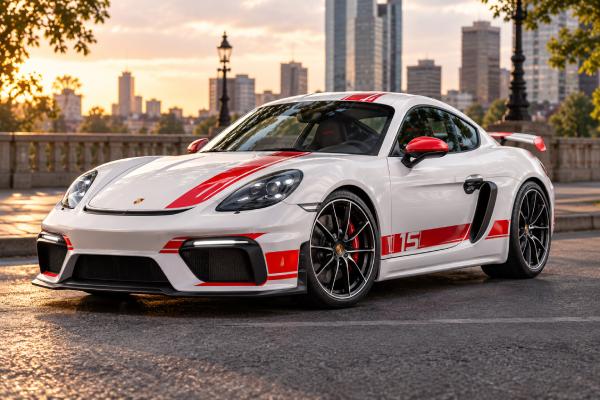
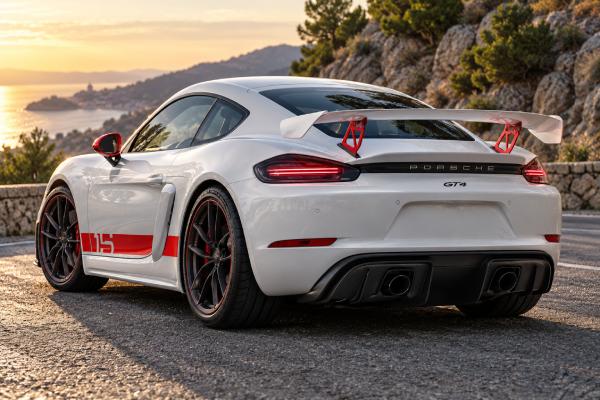
The 2019 Porsche 718 Cayman GT4 Sports Cup Edition is not a separate high-output GT4 derivative; it is a German-market special edition built on the then-new 982-generation 718 Cayman GT4. Porsche created it for the 15th anniversary of the Porsche Sports Cup Germany and sold it for a limited period through the 88 German Porsche Centres beginning in October 2019. Mechanically, its defining hardware is therefore the GT4 package: a mid-mounted, naturally aspirated 4.0-liter flat-six, rear-wheel drive, a six-speed manual gearbox, a 30 mm-lowered GT chassis, large fixed rear wing, diffuser and track-oriented brakes. The edition’s real distinction lies in Porsche Exclusive Manufaktur detailing—Black or White paint, Guards Red graphics, anniversary number 15, special interior trim and edition inscriptions. That makes provenance unusually important when buying one: the visual package is part of the car’s identity, while the underlying service and inspection priorities are those of a 2019 manual 718 Cayman GT4.
Table of Contents
- What makes the Sports Cup Edition different
- GT4 technical data beneath the edition
- Engine, GT chassis, brakes, and aerodynamics
- Edition-specific exterior and interior details
- Performance and road-use trade-offs
- Maintenance and ownership priorities
- How to authenticate and inspect one
What makes the Sports Cup Edition different
The Sports Cup Edition is best understood as a factory-personalized 718 Cayman GT4 rather than a mechanically re-engineered GT4. Porsche explicitly described the standard 309 kW (420 PS) GT4 as the basis and concentrated the edition work on color, graphics, trim and presentation.
Its launch was tied to two events at Hockenheimring in October 2019: the 15th anniversary of Porsche Sports Cup Germany and the opening of the Porsche Experience Centre Hockenheimring. Porsche Deutschland developed the model with Style Porsche and Porsche Exclusive Manufaktur, and availability was restricted to the German dealer network for a limited ordering period. That market restriction matters today because a car offered elsewhere may have been exported after first registration rather than originally supplied by a local dealer.
Unlike a numbered collector series such as the later Boxster 25 Years, Porsche’s announcement did not state a fixed global production total for the Sports Cup Edition. A seller’s claim that a particular car is one of a specific numbered quantity therefore deserves documentary proof rather than assumption. The strongest evidence is the original German invoice, build specification, service history and edition-specific factory equipment that all agree with the vehicle identification number.
The edition was offered in only Black or White. Guards Red provides the visual theme: a red double stripe with Porsche lettering runs over the driver’s side, a red side stripe incorporates a racing-style “15,” the fixed rear wing carries red Porsche script and its supports are Guards Red. Satin-gloss black 20-inch wheels use a Guards Red rim flange, while the brake calipers and rear model lettering are black. Porsche also supplied an exclusive indoor cover in black with the red double-stripe motif.
GT4 technical data beneath the edition
Under the special graphics and trim is the 2019 manual 718 Cayman GT4 mechanical package. The key identifiers are the 3,995 cc naturally aspirated flat-six, six-speed manual transmission, rear-wheel drive, GT-specific suspension and 20-inch staggered ultra-high-performance tires.
| Specification | Value |
|---|---|
| Engine | Naturally aspirated six-cylinder boxer |
| Displacement | 3,995 cc (4.0 L) |
| Bore | 102.0 mm |
| Stroke | 81.5 mm |
| Maximum power | 309 kW (420 PS; 414 hp) at 7,600 rpm |
| Maximum torque | 420 Nm (309 lb-ft) at 5,000–6,800 rpm |
| Compression ratio | 13.0:1 |
| Maximum engine speed | 8,000 rpm |
| Valve control | VarioCam with adaptive cylinder control |
| Lubrication | Integrated dry-sump system with demand-controlled oil pump |
| Specification | Value |
|---|---|
| Drive | Rear-wheel drive |
| Transmission | Six-speed manual with dual-mass flywheel |
| Rear differential | Porsche Torque Vectoring with mechanical locking differential |
| 1st / 2nd / 3rd gears | 3.31 / 1.95 / 1.41 |
| 4th / 5th / 6th gears | 1.13 / 0.95 / 0.81 |
| Final drive | 3.89 |
| Specification | Value |
|---|---|
| Suspension | Adjustable GT sports suspension with PASM, 30 mm lower ride height |
| Front brakes | Six-piston fixed calipers, 380 mm iron composite discs |
| Rear brakes | Four-piston fixed calipers, 380 mm iron composite discs |
| Optional PCCB front discs | 410 mm carbon-ceramic composite |
| Optional PCCB rear discs | 390 mm carbon-ceramic composite |
| Front wheels/tires | 8.5 J × 20 ET 61; 245/35 ZR 20 |
| Rear wheels/tires | 11 J × 20 ET 50; 295/30 ZR 20 |
| Stability control | PSM with staged ESC/traction-control deactivation |
| Specification | Value |
|---|---|
| Length | 4,458 mm (175.5 in) |
| Width, mirrors folded | 1,801 mm (71.0 in) |
| Width, mirrors extended | 1,996 mm (78.6 in) |
| Height | 1,270 mm (50.0 in) |
| Wheelbase | 2,484 mm (97.8 in) |
| U.S.-spec curb weight | 1,451 kg (3,199 lb) |
| Front luggage volume | 147 L (5.2 cu ft) |
| Rear luggage volume | 269 L (9.5 cu ft) |
| Specification | Value |
|---|---|
| 0–100 km/h | 4.4 s |
| 0–60 mph | 4.2 s |
| Quarter mile | 12.4 s |
| Top speed | 304 km/h (188 mph) |
| Fuel tank | 64 L (16.9 US gal) |
| Drag coefficient | 0.34 |
The U.S. technical sheet is useful for mechanical dimensions and SAE-oriented performance, while the 2019 European launch material quotes 420 PS and 304 km/h. Those are not contradictory power claims: 420 PS converts to roughly 414 mechanical horsepower.
Engine, GT chassis, brakes, and aerodynamics
The Sports Cup Edition’s significance is mostly cosmetic, but the GT4 underneath it is technically far from a normal 718 Cayman. Its 4.0-liter flat-six is naturally aspirated and revs to 8,000 rpm, with peak power near the top of the range rather than the low-rpm torque plateau of the turbocharged four-cylinder 718s.
The engine belongs to the same broad engine family used by contemporary 911 Carrera models but is configured here without turbocharging. Porsche added a variable intake system, direct injection with piezo injectors, adaptive cylinder control for light-load operation and an integrated dry-sump lubrication arrangement suited to sustained high lateral acceleration. For an owner, the practical point is that the car rewards revs and also needs to be treated as a high-performance GT engine: correct oil, warm-up discipline, clean cooling airflow and accurate service records matter more than chasing generic “4.0 Porsche” advice that may apply to a different engine.
The chassis is another clear separation from ordinary 718 models. Porsche used a 30 mm-lowered, adjustable GT suspension with ball-jointed locations in parts of the axle system, PASM dampers and geometry intended to support circuit use. Toe, camber and anti-roll bars can be adjusted. That adjustability is valuable but creates a buying question: a car that has been heavily track-aligned may wear the inner shoulders of expensive tires quickly or feel nervous on rough roads. Ask for alignment printouts if the seller claims a track setup.
The steel brakes are already substantial at 380 mm on both axles, with six-piston front and four-piston rear fixed calipers. Porsche Ceramic Composite Brakes were optional. PCCB reduces unsprung mass and resists repeated heat well, but replacement components are costly; inspect ceramic discs for damage and establish remaining serviceability rather than treating yellow calipers as an automatic value bonus.
Aerodynamically, the GT4 uses a large front spoiler lip, air curtains, a functional rear diffuser and fixed rear wing. Porsche stated that the 982 GT4 generated substantially more downforce than its predecessor without increasing drag. The edition’s red wing supports and graphics change the appearance, not the aerodynamic concept.
Edition-specific exterior and interior details
Authentic edition trim is central to the car’s identity. A mechanically perfect GT4 with aftermarket graphics can look similar from a distance, but it is not equivalent to a factory Sports Cup Edition.
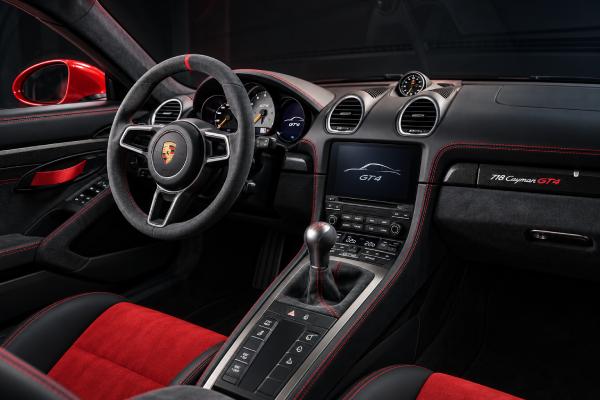
Inside, Porsche used a black leather/Alcantara base with Guards Red accents. Red decorative stitching appears on the dashboard and door panels, with red seat belts and red door-pull loops. The driver’s seat is deliberately asymmetric: it has a red Alcantara center panel that distinguishes it from the passenger seat. The Alcantara steering wheel carries a red 12-o’clock marker, while the black gear lever has a red shift pattern.
The door, dashboard and center-console trim is black brushed aluminum. Edition lettering appears on the passenger-side decorative trim and carbon door-entry guard. The center armrest is Alcantara with an embossed “Porsche 15 Jahre Sports Cup Deutschland” logo. Edition-specific floor mats use a black leather border and Guards Red stitching, and the steering-column trim is Alcantara.
Because many of these pieces can be removed or damaged, originality is more than a paint-and-decal question. Photograph the door sills, armrest embossing, seat centers, steering wheel, trim strips, wheels and cover before purchase. If any piece has been replaced, establish whether the original accompanies the car and whether an authentic replacement is still obtainable.
Performance and road-use trade-offs
In straight-line terms the Sports Cup Edition performs like the manual GT4 on which it is based: strong rather than launch-control brutal. Its appeal is the combination of high engine speed, a manual gearbox and a chassis that can accept meaningful track use without turning the car into a competition vehicle.
The manual’s long gearing is part of the experience. First and second gears cover substantial road speed, so a driver will not always be able to work through several gears without reaching speeds inappropriate for public roads. On the other hand, the naturally aspirated throttle response and broad upper-rpm performance make precise gear choice rewarding on a circuit or unrestricted road.
Daily use is more practical than the rear wing suggests. The Cayman body retains separate front and rear luggage areas, together providing considerably more storage than many two-seat sports cars. Visibility is acceptable for the category, climate control and infotainment remain road-car equipment, and the fixed roof avoids the weather sealing concerns of the Spyder. The compromises are lower ground clearance, firm low-speed ride, wide performance tires, considerable road noise and expensive wear items.
The front splitter is vulnerable to ramps and parking structures. The 295-section rear tires and low-profile fronts are susceptible to damage from potholes, while the GT alignment can make tire wear look uneven even when nothing is mechanically wrong. A buyer should distinguish expected performance-car wear from neglect or poor geometry.
Maintenance and ownership priorities
Ownership should follow the maintenance schedule for the exact VIN and market, not a generic internet interval. Porsche schedules vary by country and model year, and a Sports Cup Edition imported from Germany may now be serviced under a different local maintenance regime.
For a lightly used collector example, time matters as much as mileage. Engine oil, brake fluid, tires, the 12-volt battery and air-conditioning operation all age while a car sits. A low odometer reading is therefore not evidence that maintenance can be skipped. The date codes on the tires are particularly important: old ultra-high-performance tires can have deep tread while no longer delivering the grip expected from a GT4.
For a car used on track, shorten the inspection mindset even if the official road schedule has not yet called for replacement. Look at pad thickness, disc condition, tire shoulders, wheel damage, underbody contact, suspension joints and fluid condition. Track work is not inherently abusive when the car is prepared and maintained correctly, but it changes the relevance of consumables and alignment records.
The 4.0-liter engine uses an integrated dry-sump lubrication system and is designed for high lateral loads. Check for oil leaks, unexplained consumption notes, warning messages and evidence of incorrect oil level procedures. Listen from cold and warm, but do not diagnose a high-value engine from sound alone; a pre-purchase inspection with Porsche-capable diagnostics is appropriate if anything is questionable.
A manual GT4 also deserves a clutch and gearbox assessment. Confirm smooth engagement from cold and warm, no crunching during deliberate upshifts or downshifts, and no driveline noises that change abruptly with load. The mechanical limited-slip differential and rear drivetrain should be dry and quiet. If the car has spent time on circuit, ask whether clutch, flywheel, gearbox oil or differential work has been performed and why.
How to authenticate and inspect one
Buy the Sports Cup Edition on documentation and condition, not graphics alone. Its rarity comes from a specific German-market factory configuration, so authentication should precede negotiation.
A sensible inspection sequence is:
- Match the VIN across the car, registration, service records and original sales invoice.
- Obtain the factory build specification from a Porsche source and confirm the Sports Cup Edition equipment rather than relying on a seller-created option list.
- Check the Black or White exterior, Guards Red graphics, number 15 motif, wing details, satin-black wheels with red rim flange and black calipers against factory imagery.
- Verify the red driver’s seat center, red belts and pulls, edition sills and dashboard trim, embossed anniversary armrest and other cabin details.
- Inspect the fixed rear wing, front splitter, diffuser and underbody for collision repair or repeated grounding.
- Measure tire age and condition, inspect brake hardware and request alignment records on cars described as track-used.
- Review the service chronology by date as well as mileage, including brake fluid and age-sensitive items.
- Check the VIN for open safety recalls in the market where the car is now registered.
Paintwork deserves special attention because the exterior graphics make refinishing more complicated. Use a paint-depth gauge where appropriate and look for masking edges, inconsistent panel texture, non-factory decal placement and damaged clear coat. A repaired car can still be a good purchase if the work is documented and structurally sound, but originality should not be assumed merely because the livery looks convincing.
The most useful comparison car is a normal 2019 718 Cayman GT4 of similar specification and condition. Mechanically, that shows whether a fault or wear pattern is edition-specific—it usually will not be. From there, the Sports Cup Edition’s additional value rests on provenance, completeness, original trim and how much the buyer cares about its direct connection to Porsche Sports Cup Germany rather than on extra horsepower or unique chassis tuning.
References
- Exclusive special-edition model in motor sports design 2019
- 718 Cayman GT4 & 718 Spyder 2019 (Press Kit)
- Emotive powerhouse 2019
- Ideal for the racetrack 2019
- Technical Specifications 2026
- Check for Recalls: Vehicle, Car Seat, Tire, Equipment | NHTSA 2026 (Recall Database)
Disclaimer
This article is for informational purposes and is not a substitute for professional diagnosis, inspection, or repair. Specifications, torque values, service intervals, parts, and procedures can differ by VIN, market, production date, and equipment; verify all work against the official Porsche service documentation for the specific vehicle.
If this guide helped your research, please consider sharing it on Facebook, X/Twitter, or your preferred enthusiast community to support our work.