
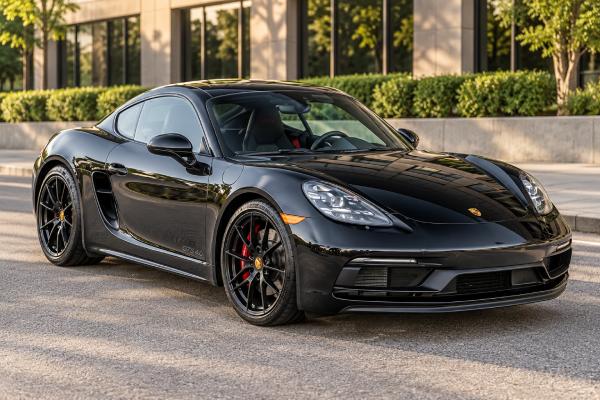
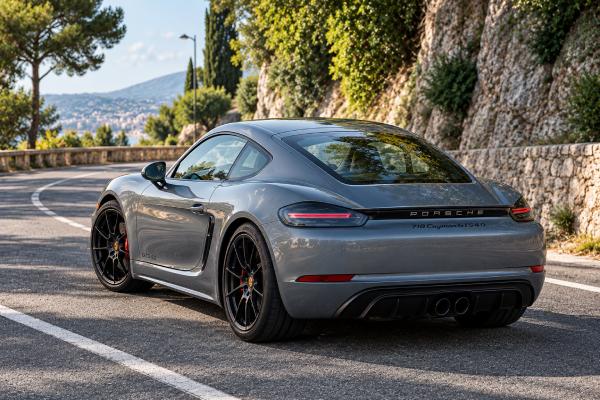
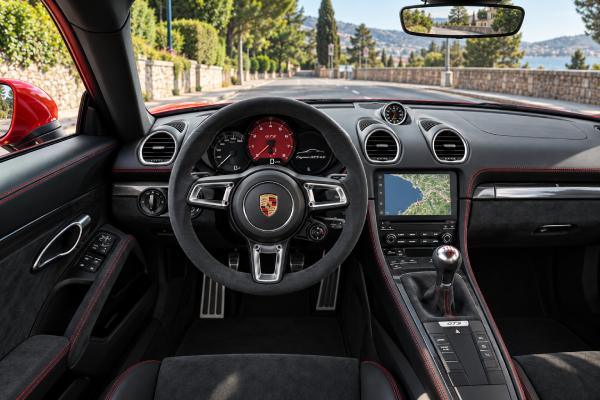
The Porsche 718 Cayman GTS 4.0 occupies a deliberately narrow space in the 982 range. It combines the fixed-roof Cayman body with a naturally aspirated 4.0-liter flat-six, but stops short of the more track-centered Cayman GT4 formula. The result is a coupe with 394 hp in U.S. specification, a 7,800-rpm engine-speed ceiling, a standard six-speed manual at launch, and the option of seven-speed PDK from the 2021 model year. Its specification is unusually complete: PASM Sport suspension, Porsche Torque Vectoring with a mechanical limited-slip differential, Sport Chrono, active drivetrain mounts, larger brakes, and 20-inch wheels were all part of the GTS package rather than an options-list reconstruction. Introduced in 2020 and offered in the U.S. as a 2021 model, it remained fundamentally consistent through 2025. This guide separates launch-era manual data from later PDK figures, explains what the coupe body contributes, and focuses on the service and inspection details that matter when evaluating a used example.
Table of Contents
- The Coupe Brief: Where the GTS 4.0 Fits
- Numbers That Define the Cayman GTS 4.0
- Rev Range, Gearing, and Transmission Choice
- Why the Fixed-Roof Packaging Matters
- Chassis Hardware Behind the GTS Badge
- Model-Year Changes and Configuration Decisions
- Maintenance and a Diagnostic Buying Baseline
The Coupe Brief: Where the GTS 4.0 Fits
The central fact about the Cayman GTS 4.0 is not simply that it has two more cylinders than the turbocharged Cayman and Cayman S. Porsche reworked the character of the car around an engine that rewards engine speed rather than boost. The 3,995 cc boxer six is closely related to the unit used in the contemporary 718 Cayman GT4, but Porsche rated the U.S.-market GTS at 394 hp rather than the GT4’s 414 hp. Peak power arrives at 7,000 rpm, maximum engine speed is 7,800 rpm, and the original manual specification delivers 309 lb-ft between 5,000 and 6,500 rpm. That places the strongest part of the torque curve much higher than in the turbocharged four-cylinder 718s.
That distinction changes how the car is used. A turbocharged Cayman S can produce strong acceleration without approaching its redline; the GTS 4.0 makes repeated trips through the upper half of the tachometer a central part of the experience. Porsche still designed it as a road-oriented GTS rather than a homologation-style special. The suspension is lower and more focused than a standard Cayman, yet adaptive damping remains. The cabin retains normal infotainment and comfort equipment, and the coupe keeps substantial luggage space at both ends of the car.
The launch chronology can be confusing because “2020” and “2021” both appear in legitimate descriptions. Porsche unveiled the 718 Cayman GTS 4.0 in January 2020 and said U.S. ordering would begin that summer. In June, Porsche identified it as a 2021-model-year car for the U.S., with dealer arrivals expected late in 2020. For an international 2020–2025 assignment, 2020 is therefore the introduction year; for U.S. VIN and equipment research, 2021 is the first model year to use as the baseline.
Another point worth keeping separate is horsepower convention. Porsche’s U.S. material consistently quotes 394 hp for the GTS 4.0 in this period. Some other markets publish 294 kW or 400 PS, which describe essentially the same output under different unit conventions. A used-car advertisement showing “400 hp” may therefore be reflecting metric horsepower rather than a different engine tune. Verify the destination market and original specification instead of treating the number alone as proof of a modification.
Numbers That Define the Cayman GTS 4.0
Factory data is most useful when transmission and market context stay attached to the numbers. The first technical sheet documented the six-speed-manual car; Porsche later published separate PDK figures. The tables below use U.S. factory data unless otherwise noted.
| Engine specification | Factory figure |
|---|---|
| Layout | Mid-mounted, naturally aspirated flat-six |
| Displacement | 3,995 cc (4.0 liters) |
| Bore × stroke | 102.0 × 81.5 mm |
| Compression ratio | 13.0:1 |
| Maximum power | 394 hp at 7,000 rpm |
| Maximum torque, 6-speed manual | 309 lb-ft at 5,000–6,500 rpm |
| Maximum torque, 7-speed PDK | 317 lb-ft; Porsche lists the peak at 5,500 rpm in later technical material |
| Maximum engine speed | 7,800 rpm |
| Fuel and lubrication | Direct fuel injection; integrated dry-sump lubrication with demand-controlled oil pump |
| Performance / transmission | 6-speed manual | 7-speed PDK |
|---|---|---|
| 0–60 mph | 4.3 seconds | 3.8 seconds with Launch Control / Sport Chrono |
| Top track speed | 182 mph | 179 mph in later U.S. published data |
| Drive | Rear-wheel drive | Rear-wheel drive |
| Quarter mile, launch technical sheet | 12.5 seconds | Not listed on the launch manual sheet |
| Maximum torque | 309 lb-ft | 317 lb-ft |
| Availability | Standard from launch | Optional from the 2021 model year |
The PDK car’s lower published top speed is not a contradiction with its quicker acceleration. The two transmissions use different gearing and the PDK was calibrated around rapid shifts and launch performance. Porsche’s 2025 U.S. configurator still listed the Cayman GTS 4.0 at 394 hp, with manual or automatic transmission availability, a 3.8-second 0–60 mph figure with Sport Chrono, and a 179 mph top track speed. That online headline is effectively the quicker PDK performance headline; it should not overwrite the 182 mph manual figure from the original technical sheet.
| Chassis and brake hardware | Specification |
|---|---|
| Front suspension | Lightweight MacPherson-type spring-strut |
| Rear suspension | Lightweight MacPherson |
| Standard adaptive suspension | PASM Sport, 20 mm lower than standard 718 Cayman |
| Torque management | Porsche Torque Vectoring with mechanical limited-slip differential |
| Front brakes | 350 × 34 mm vented, cross-drilled cast-iron discs; six-piston aluminum monobloc fixed calipers |
| Rear brakes | 330 × 28 mm vented, cross-drilled cast-iron discs; four-piston fixed calipers |
| Standard wheels / tires | 20-inch; 235/35 ZR20 front and 265/35 ZR20 rear |
| Optional braking system | Porsche Ceramic Composite Brake (PCCB) |
| Coupe dimensions | Launch technical data |
|---|---|
| Length | 173.4 in (4,405 mm) |
| Body width / width with mirrors | 70.9 / 78.5 in (1,801 / 1,994 mm) |
| Height | 50.2 in (1,276 mm) |
| Wheelbase | 97.4 in (2,475 mm) |
| Front / rear track | 60.1 / 60.4 in (1,527 / 1,535 mm) |
| Turning circle | 36 ft (10.98 m) |
| Weight, storage, and aero | Manual Cayman GTS 4.0 |
|---|---|
| Unladen weight | 3,166 lb |
| Front luggage capacity | 5.3 cu ft (150 L) |
| Rear luggage capacity | 9.7 cu ft (270 L) |
| Fuel tank refilling volume | 16.9 US gal (64 L) |
| Drag coefficient | 0.31 |
| Published power-to-weight ratio | 8.0 lb/hp |
These figures also show why the Cayman body deserves attention independently of the mechanically similar Boxster GTS 4.0. The coupe’s 270-liter rear luggage area is more than double the roadster’s launch-sheet rear capacity, while retaining the 150-liter front compartment. For owners who use the car for long road trips or carry track-day equipment, that packaging difference is practical rather than cosmetic.
Rev Range, Gearing, and Transmission Choice
The 4.0-liter engine’s defining feature is the shape of its delivery. With peak torque beginning at 5,000 rpm and power peaking at 7,000 rpm, short-shifting at ordinary road speeds leaves much of the engine’s intended character unused. There is enough displacement for clean low-speed response, but the reward comes from holding a gear and letting the engine move through the midrange toward its 7,800-rpm ceiling. The standard Sport Exhaust gives that process an audible role without changing the basic performance figures.
Porsche incorporated several efficiency measures that are easy to overlook in an engine chosen mainly for sound and response. Under light load, adaptive cylinder control can deactivate one cylinder bank, effectively allowing the engine to operate on three cylinders for periods of low demand. Direct injection uses piezo injectors, and a variable intake system helps manage airflow. The integrated dry-sump lubrication arrangement is more relevant to sustained cornering than a conventional wet sump would be, although it does not eliminate the need to maintain the correct oil level and temperature before demanding use.
The six-speed manual was the only transmission at the GTS 4.0’s announcement. Its appeal is not measured by the quickest acceleration number. The clutch, lever, and fixed ratios require the driver to decide when the engine enters its high-rpm zone, and the relatively tall road gearing means full use of that zone can produce substantial speed. A test drive should therefore include both low-speed maneuvering and warm, moderate-load shifts through several gears. A clutch that engages inconsistently, a gear lever that resists a particular gate, or driveline noise that appears only on overrun deserves diagnosis rather than being dismissed as sports-car character.
PDK changed the performance envelope without changing the engine’s basic identity. Porsche announced the seven-speed dual-clutch option for six-cylinder 718 models for the 2021 model year. In the GTS 4.0, PDK raised maximum quoted torque from 309 to 317 lb-ft and reduced the official 0–60 mph time by half a second, to 3.8 seconds. The transmission works with the standard Sport Chrono modes, adds Launch Control in Sport Plus, and provides a Sport Response function for a temporary maximum-response setting. Porsche also used a shorter seventh-gear ratio in these six-cylinder 718 applications than in other 718 PDK models of the period.
There is no universal “better” gearbox for this car. A manual suits an owner who values the process of choosing gears and accessing the engine’s upper range deliberately. PDK suits repeated acceleration, dense traffic, or track work where consistency and uninterrupted shifts matter more. For a used purchase, condition and history should outrank ideology: a well-maintained example in the less-preferred transmission is a sounder starting point than a neglected car with the preferred one.
Why the Fixed-Roof Packaging Matters
A mid-engine Cayman divides its storage around the powertrain. The GTS 4.0 keeps a 150-liter compartment in the nose and adds 270 liters under the rear hatch. That rear volume changes how the car works on a trip. Soft bags can be distributed rather than stacked into one deep trunk, and the hatch makes the engine-cover area useful for broader, flatter items. Heat from the powertrain still matters when deciding what to place at the rear, particularly after sustained high-load driving, so temperature-sensitive luggage belongs in the front compartment when practical.
The fixed roof also changes the cabin and body environment. Porsche’s launch material specified Alcantara on the Cayman’s A-pillars and headliner in addition to the usual GTS touch points such as the steering wheel, center console, gear lever, and Sport Seats Plus center sections. Later production moved toward Race-Tex terminology and material updates, so interior descriptions should be checked against the actual model year rather than assumed from a launch press release.
For inspection, the hatch and roof introduce coupe-specific checks. Confirm that the hatch opens, closes, and latches cleanly and that its struts support it properly. Water staining around the luggage area, headliner, rear lights, or hatch seals deserves investigation. Listen for trim noises on uneven pavement, but separate harmless cabin squeaks from mechanical noises that follow engine speed, wheel speed, or load. A fixed-roof shell can make powertrain sounds more apparent than an open-top car, and that makes a calm baseline test drive useful before hard acceleration.
Visibility and seating position are also part of the Cayman formula. The low cowl and compact overall dimensions make the car easy to place once the driver is accustomed to the rear haunches, while the 78.5-inch width including mirrors matters in older garages. Cars with front-end paint-protection film, replacement windshields, or repainted bumpers are common in enthusiast use; those items are not inherently negative, but the workmanship and documentation matter. Uneven panel gaps, overspray, missing fasteners underneath, or mismatched tire dates can reveal more about prior use than a glossy exterior.
The coupe’s practicality does not turn it into a grand tourer with soft suspension and generous ground clearance. PASM Sport lowers the body by 20 mm relative to a standard 718, so steep driveways, curbs, underbody aero pieces, and front bumper surfaces deserve inspection. Cars used frequently in cities may show cosmetic underside damage even when the suspension is healthy. Conversely, a spotless body does not prove gentle use; service records, tire wear, brake condition, and diagnostic history provide better evidence.
Chassis Hardware Behind the GTS Badge
The GTS 4.0 specification is unusually integrated. Rather than starting with a base Cayman and selecting a few cosmetic options, Porsche bundled the hardware that determines how the car responds when the road becomes demanding. PASM Sport provides electronically controlled dampers and a 20 mm ride-height reduction. Sport Chrono changes the powertrain and stability-control context. Porsche Active Drivetrain Mounts alter mount stiffness according to conditions, while PTV combines selective braking intervention with a mechanical limited-slip differential.
The mechanical limited-slip differential matters most where the inside rear tire can unload under power. It cannot create grip that the tires do not have, but it helps distribute torque in a way an open differential cannot. PTV adds braking-based yaw assistance, so the car’s cornering behavior is the result of several systems working together rather than a single “LSD effect.” A warning light for PSM, PASM, or drivetrain mounts therefore should not be treated as an isolated convenience fault; these systems are part of the intended chassis specification.
Porsche enlarged the GTS 4.0’s standard iron brakes relative to lower 718 variants. The front uses 350 mm discs and six-piston fixed calipers, while the rear uses 330 mm discs. Surface cracks around drilled holes, lip formation, heat checking, pad thickness, and rotor measurement all matter on a car that may have seen track use. Cross-drilled iron discs can show cosmetic marks that are not automatically a failure, but cracks extending significantly from holes or to disc edges require professional assessment. The optional PCCB system changes both replacement cost and inspection technique, so identify the fitted brake system before estimating ownership costs.
Tires are equally central. Porsche specified 235/35 ZR20 front and 265/35 ZR20 rear tires on the standard satin-black 20-inch wheels. Matching model, correct load and speed rating, tread depth, age, and even wear across each axle are more informative than brand prestige alone. Inner-shoulder wear can be difficult to see with the car on the ground and may indicate alignment, ride-height, or usage issues. An alignment sheet after suspension work is useful documentation.
The standard PASM Sport setup is not the only factory possibility. At launch, Porsche said the regular PASM suspension with a 10 mm reduction, rather than 20 mm, could be ordered as an alternative. This is a good example of why a build sheet matters. A car sitting slightly higher than another GTS 4.0 is not automatically modified, and an owner should not purchase replacement springs or dampers based only on comparison photographs.
Track use itself is not evidence of abuse. The Cayman GTS 4.0 was designed with hardware that invites performance driving, and Porsche included its Track Precision App capability with Sport Chrono. What matters is whether use was followed by appropriate fluid, tire, brake, and inspection work. A car with documented track events and prompt consumable replacement can be easier to evaluate than one whose history is vague but whose seller insists it was “never driven hard.”
Model-Year Changes and Configuration Decisions
The powertrain headline changed less than the equipment story. Porsche introduced the GTS 4.0 in early 2020 with the manual transmission, then made PDK available for the U.S. 2021 model year. The 2021 range also received broader standard-equipment changes: automatic two-zone climate control, heated front seats, auto-dimming mirrors with rain sensor, Apple CarPlay, and bi-xenon headlights with Porsche Dynamic Light System were listed as standard on U.S. GTS 4.0 cars. These changes mean two visually similar cars can have different factory content depending on destination market and production timing.
The PDK option is the major mechanical fork within the 2020–2025 assignment. It does not represent a later, higher-output engine in the usual sense: Porsche retained the 394 hp U.S. rating, while the transmission application allowed 317 lb-ft instead of the manual’s 309. The headline 3.8-second 0–60 mph figure that appears in later U.S. configurator material is therefore a transmission-specific performance result, not evidence that late cars gained extra horsepower.
Interior terminology also evolved. Early Porsche material used Alcantara for the GTS-specific suede-like trim. Porsche later transitioned to Race-Tex branding across much of its range. Buyers comparing cars should focus on the actual seat type, trim coverage, stitching package, and condition rather than treating terminology in an advertisement as a definitive model-year identifier.
Options can materially affect ownership cost. PCCB ceramic brakes are the clearest example: they reduce unsprung mass and resist repeated high-temperature use well, but damaged ceramic rotors are expensive. Adaptive lighting, premium audio, navigation/connectivity options, carbon trim, full leather, and seat choices influence desirability for an individual buyer without changing the 4.0-liter engine. A build sheet or original window sticker is therefore valuable both for valuation and for confirming whether missing features were never fitted or have been removed.
By 2025, Porsche’s U.S. configurator still showed the 718 Cayman GTS 4.0 with 394 hp and a choice of manual or automatic transmission. The long run means condition can differ more than nominal specification. A lightly used early car with complete history may be a stronger candidate than a newer car with deferred age-based maintenance. Rubber components, fluids, batteries, tires, and brake fluid age even when mileage stays low.
When comparing advertisements across countries, resist mixing U.S. and European headline data. A 400 PS European-market listing and a 394 hp U.S. listing can refer to the same underlying engine output expressed under different standards. Emissions equipment, lighting, software, option bundles, service schedules, and warranty context may also differ. The VIN, destination market, and factory option record should anchor the comparison.
Maintenance and a Diagnostic Buying Baseline
A GTS 4.0 can accumulate little mileage while still becoming due for several services by age. That makes invoice dates as important as odometer readings. As one documented official-market example, Porsche Centre Brighton’s Australian Type 982 schedule lists annual oil maintenance at 15,000 km or one year and an inspection at 30,000 km or two years. It lists brake fluid every two years and GTS 4.0 spark plugs every 45,000 km or four years. These are useful reference points, not universal instructions: a U.S., European, or other-market car should be serviced to the schedule assigned to its VIN and operating conditions.
| Maintenance item | Documented Type 982 interval example | Used-car check |
|---|---|---|
| Engine oil maintenance | 15,000 km / 1 year | Confirm dated invoices, correct oil specification, and no unexplained long gaps |
| Inspection | 30,000 km / 2 years | Look for completed inspection records rather than oil-change receipts alone |
| Brake fluid | Every 2 years | Check date and fluid service documentation |
| Spark plugs, GTS 4.0 | 45,000 km / 4 years | Age can trigger the interval before mileage does |
| Air-cleaner filter | 60,000 km / 4 years in the cited schedule | Verify market/VIN applicability |
| Drive belt | 90,000 km / 6 years | Inspect age and replacement record |
| PDK clutch fluid | 180,000 km / 12 years | PDK cars only; verify current VIN schedule |
| Transmission oil | 180,000 km / 12 years | Confirm transmission-specific procedure |
Before purchase, begin with a cold start when possible. A seller-prewarmed engine removes useful information about cold idle, startup warning messages, exhaust behavior, and noises during the first temperature rise. Observe oil pressure and temperature displays, confirm the cooling system reaches and maintains normal operating behavior, and look underneath after the drive for fresh fluid traces. Because the engine is largely concealed beneath trim and the rear luggage area, a lift inspection is far more useful than a quick look from above.
The diagnostic scan should cover more than a check-engine light. Read faults in the powertrain, PSM, PASM, active drivetrain mounts, airbag, climate, and other relevant control modules. On manual cars, a specialist can interpret over-rev data in context; the presence of recorded events is not by itself a complete diagnosis, because range, count, operating hours, recency, and mechanical condition all matter. On PDK cars, check shift quality both cold and fully warm and investigate faults or leaks rather than assuming software explains every irregularity.
There is one especially important VIN-specific campaign in this model’s early U.S. history. NHTSA campaign 21V-200, Porsche campaign AMA4, covered certain 2021 Cayman GTS 4.0, Cayman GT4, 718 Spyder, and Boxster GTS 4.0 vehicles because connecting rods may not have been manufactured to specification. NHTSA’s report lists Cayman GTS 4.0 production dates from January 26 through March 4, 2021, and states that affected vehicles were identified through production records. The 190 potentially involved vehicles were the total across the four listed models, not 190 Cayman GTS 4.0s. The remedy documentation included engine replacement for delivered affected vehicles. This is not evidence that every GTS 4.0 has a connecting-rod problem; it is a reason to run the specific VIN through official recall records and confirm completion if applicable.
Brake and tire condition can reveal how the car has been used. Measure the inner and outer pad/rotor condition, inspect tire date codes, and look at the inside shoulders. Check wheels for bends and repairs. Examine radiators and front air openings for debris or impact damage, the underside for contact from lowered ride height, and suspension joints for play or leakage. A car wearing new tires immediately before sale is not automatically suspect, but alignment data and the reason for replacement help establish context.
Service history should also show sensible responses to age. A six-year-old low-mileage example may need drive-belt attention even if it has never approached 90,000 km. A four-year-old garage queen may be due for plugs and filters depending on its market schedule. Battery replacement and charging history matter because low voltage can generate faults across multiple modules. Ask what battery is fitted, when it was installed, and whether the car spends long periods on an appropriate maintainer.
Finally, verify the car rather than the advertisement. Decode the VIN, obtain the factory option record, check recall completion, match service invoices to mileage and dates, and have a Porsche-experienced technician inspect the underside and run diagnostics. Confirm whether the suspension is the standard 20 mm PASM Sport setup or the alternative factory configuration, identify iron versus ceramic brakes, and establish whether exhaust, wheels, software, or suspension components are original. The Cayman GTS 4.0’s appeal comes from how coherently its engine, chassis, and coupe packaging work together; preserving that coherence is a more useful buying goal than chasing the lowest mileage number.
References
- Porsche Newsroom USA — “Six cylinders, naturally aspirated, manual gearbox: The new 718 GTS 4.0” (2020)
- Porsche — “Technical Data: 718 Boxster GTS 4.0 / 718 Cayman GTS 4.0” (2020)
- Porsche Newsroom USA — “Optional Porsche dual-clutch transmission further improves performance on 718 models with six-cylinder engine” (2020)
- Porsche USA — “718 Models and Configurator” (2025 model listings)
- Porsche Centre Brighton — “Boxster and Cayman Service” (Type 982 service schedule)
- NHTSA — “Safety Recall 21V-200: Cracked Connecting Rod May Damage Engine” (2021)
Disclaimer
This article is for informational purposes only. Specifications, performance figures, maintenance intervals, torque settings, procedures, campaign applicability, and equipment can vary by VIN, destination market, model year, transmission, options, and later factory updates. Before servicing, modifying, or purchasing a vehicle, verify the applicable information in current Porsche workshop literature, the owner’s documentation, official recall databases, and VIN-specific records, or consult a qualified Porsche technician. If this guide helped clarify the Cayman GTS 4.0, please consider sharing it with another 718 owner or shopper who may find it useful.