
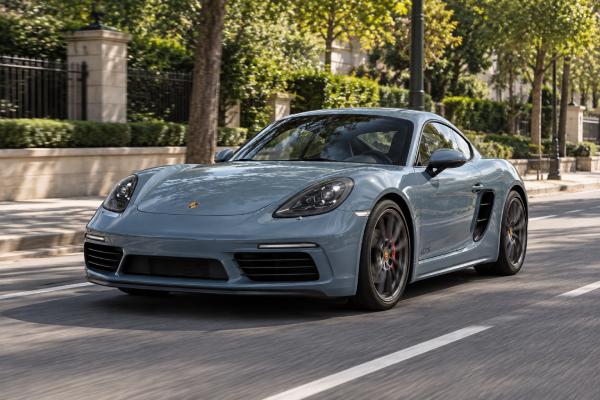
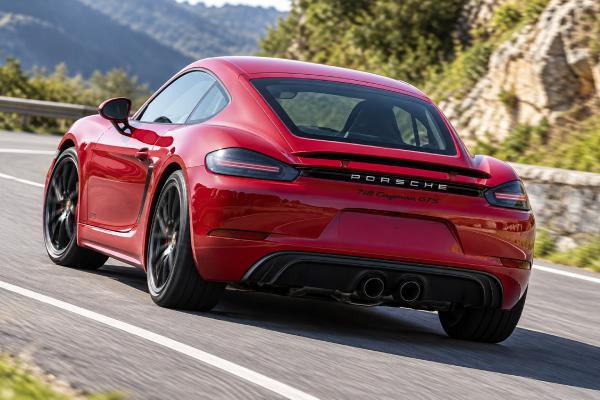
The 365-hp Porsche 718 Cayman GTS is the most highly developed factory version of the turbocharged 2.5-liter four-cylinder Cayman before the GTS name moved to a 4.0-liter naturally aspirated six. That timing makes precision important: the car announced in 2017 and sold as a 2018 model in the United States is mechanically distinct from the later GTS 4.0 even though both carry nearly identical badges. The 2.5 GTS combines stronger boost and a revised intake with a package of chassis hardware that was unusually complete from the factory—PASM, Sport Chrono, Porsche Torque Vectoring with a mechanical differential lock, 20-inch wheels and the Sport Exhaust System. It could be ordered with a six-speed manual or seven-speed PDK, and Porsche published different peak-torque figures for the two transmissions. The Cayman body also gives this version a practical advantage over its Boxster sibling: a large rear luggage area beneath the hatch in addition to the front compartment. This article keeps the scope on the 2.5-liter, 365-hp 982 Cayman GTS and treats year, transmission and market-specific figures explicitly rather than blending them with adjacent 718 variants.
Table of Contents
- Where the Turbo GTS Fits
- Powertrain Numbers and Gearbox Effects
- Coupe Chassis and Braking Hardware
- Dimensions, Storage, and Efficiency
- What to Expect on the Road
- Service Priorities for the 2.5 GTS
- Inspection Strategy for a Used Cayman GTS
Where the Turbo GTS Fits
Porsche revealed the 718 Cayman GTS with the 718 Boxster GTS in October 2017. In U.S. documentation it was a 2018 model, so the assignment’s 2017–2020 span should be understood as the launch/production-era range rather than proof that every market labeled a 2017-built car a 2017 model year. For parts, service and valuation, the VIN and official build information take precedence over a registration date.
The central identifying feature is the 2.5-liter turbocharged flat-four. Porsche raised output to 365 hp, 15 hp above the contemporary Cayman S, using a redesigned intake plenum and an optimized turbocharger with greater boost pressure. The GTS package then added equipment that made the car more than an engine tune: Sport Chrono, PASM with a 10 mm lower ride height, PTV with a mechanical rear differential lock, Sport Exhaust and 20-inch Carrera S wheels in satin black.
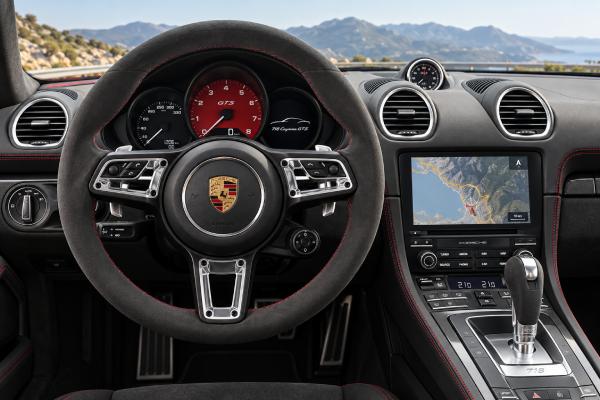
Exterior details include a Sport Design front fascia, darkened front and rear lighting, black model lettering and centrally mounted black exhaust outlets. Period interiors used Alcantara extensively on the steering wheel, center sections and other touch surfaces, together with GTS logos. Because individual cars could be ordered with different seats, trim and options, a factory build sheet is a better authentication tool than a visual checklist alone.
A later 718 Cayman GTS 4.0 can resemble the 2.5 from a distance but should never be used as a source for engine output, service requirements or performance data. The successor has a naturally aspirated 4.0-liter flat-six and a different technical character. Likewise, GT4 specifications do not transfer to the GTS simply because both sit within the 982 Cayman family.
Powertrain Numbers and Gearbox Effects
The GTS engine displaces 2,497 cc and uses a single turbocharger with variable turbine geometry. VarioCam Plus valve control, direct fuel injection and integrated dry-sump lubrication are part of the package. Peak power arrives at 6,500 rpm, while the engine can continue to 7,500 rpm.
| Powertrain specification | 718 Cayman GTS 2.5 |
|---|---|
| Engine layout | Mid-mounted turbocharged flat-four |
| Displacement | 2,497 cc |
| Bore × stroke | 102.0 × 76.4 mm |
| Power | 365 hp at 6,500 rpm |
| Torque, 6-speed manual | 309 lb-ft |
| Torque, 7-speed PDK | 317 lb-ft |
| Compression ratio | 9.5:1 |
| Maximum engine speed | 7,500 rpm |
| Driven wheels | Rear |
The transmission choice is not a minor footnote. Porsche’s six-speed manual and optional seven-speed PDK have different factory torque ratings, and PDK enables launch control through the standard Sport Chrono package. U.S. factory figures put the manual at 4.4 seconds from 0–60 mph and PDK with launch control at 3.9 seconds. Both are rated for a 180-mph top track speed.
| Factory performance | 6-speed manual | 7-speed PDK |
|---|---|---|
| Maximum torque | 309 lb-ft | 317 lb-ft |
| 0–60 mph | 4.4 s | 3.9 s with Sport Chrono launch control |
| Quarter mile | 12.7 s | 12.3 s |
| Top track speed | 180 mph | 180 mph |
The numbers describe controlled factory testing, not guaranteed real-world results. Tire temperature, surface, fuel, weather, vehicle load and driver technique all change acceleration. For a used buyer, the more useful distinction is mechanical: a manual car should be checked for clutch condition, clean engagement and synchro behavior; a PDK car should be assessed for fault history, consistent low-speed engagement and correct maintenance.
The variable-turbine-geometry system helps deliver substantial midrange torque, giving the 2.5 GTS a different response pattern from the high-revving naturally aspirated six-cylinder GTS 4.0. It is not necessary to frame one as inherently “better.” The turbo GTS rewards early and midrange throttle use, while the later six puts more emphasis on revs and sound.
Coupe Chassis and Braking Hardware
The 2.5 GTS uses the core 718 suspension architecture with MacPherson-type struts at both ends, but its standard PASM calibration lowers the ride height by 10 mm. Porsche Torque Vectoring combines selective braking intervention with a mechanically locking rear differential. Sport Chrono adds selectable driving modes and dynamic drivetrain behavior, while the standard Sport Exhaust changes the exhaust path and sound character.
| Chassis component | Factory configuration |
|---|---|
| Adaptive suspension | PASM, 10 mm lower than standard 718 ride height |
| Torque-vectoring system | PTV |
| Rear differential | Mechanical locking differential |
| Standard front brakes | 330 × 34 mm vented and cross-drilled iron discs |
| Standard rear brakes | 299 × 20 mm vented and cross-drilled iron discs |
| Front tires | 235/35 ZR20 |
| Rear tires | 265/35 ZR20 |
The standard brake package uses four-piston aluminum monobloc fixed calipers front and rear. Cars equipped with optional ceramic brakes need a different inspection approach: carbon-ceramic rotors can be expensive, and visual surface condition is only part of the assessment. Verify the installed brake system from factory equipment data and have a specialist evaluate questionable rotors rather than relying on caliper color.
Twenty-inch wheels and low-profile tires increase steering precision but leave less sidewall between the rim and road. Inspect for bent inner barrels, hairline cracking, repaired wheels and sidewall damage. Tire wear across the inner shoulders is particularly important because it may not be obvious when the car is sitting on the ground.
Track use does not automatically disqualify a GTS; these cars are capable of it. What matters is whether use was matched by maintenance. Heat-checked rotors, discolored calipers, heavily worn tire shoulders, damaged undertrays or repeated brake-fluid changes can provide useful context. Ask for invoices and inspect the actual condition rather than accepting either “never tracked” or “only one track day” without evidence.
Dimensions, Storage, and Efficiency
The fixed-roof Cayman body adds a rear hatch and a larger rear luggage compartment than the Boxster. Porsche’s U.S. data lists 5.3 cu ft in front and 9.7 cu ft at the rear, for 15.0 cu ft in total. That makes the Cayman GTS unusually practical for a two-seat sports car and changes how it works as a touring car.
| Body and capacity | 718 Cayman GTS 2.5 |
|---|---|
| Length | 172.9 in |
| Width, mirrors folded | 70.9 in |
| Height | 50.6 in |
| Wheelbase | 97.4 in |
| Front luggage capacity | 5.3 cu ft |
| Rear luggage capacity | 9.7 cu ft |
| Total luggage capacity | 15.0 cu ft |
| Drag coefficient | 0.32 |
| Fuel tank | 16.9 U.S. gal |
Published U.S. curb weight is 3,032 lb for the manual and 3,098 lb for the PDK version. Those values are configuration references; options and operating fluids change actual measured weight.
Period EPA figures in Porsche’s technical sheet are 19 mpg city, 25 highway and 21 combined for the manual, versus 20 city, 26 highway and 22 combined for PDK. These ratings belong to the tested U.S. configurations and should not be substituted for WLTP or other-market data. Real consumption varies heavily with traffic, temperature and throttle use.
| U.S. EPA rating | Manual | PDK |
|---|---|---|
| City | 19 mpg | 20 mpg |
| Highway | 25 mpg | 26 mpg |
| Combined | 21 mpg | 22 mpg |
What to Expect on the Road
The Cayman GTS places the engine immediately behind the occupants and carries relatively little mass beyond either axle. The result is quick response to steering input and a sense that the chassis rotates around the cabin. PASM keeps the platform controlled, while the mechanical differential can improve traction when accelerating from tighter corners.
A healthy example should feel cohesive rather than merely stiff. It should not wander on a smooth level road, knock over small bumps or shake the steering wheel at motorway speed. Strong tire tramlining can occur with wide performance tires and road grooves, but persistent pull or an off-center steering wheel warrants an alignment and suspension check.
Turbo response should be progressive and consistent. Hesitation, repeated boost-related warnings, smoke, unusual whistling or a sudden reduction in power should be investigated. The sport exhaust changes volume and tone with operating mode, so verify its valves work normally and that aftermarket exhaust work has not introduced rattles or leaks.
The coupe also offers useful acoustic clues. With no convertible mechanism to add wind and roof noises, rattles from the hatch area, rear trim or suspension can be easier to isolate. A loose cargo cover or items in the rear compartment can mimic mechanical noises, so empty the storage areas before drawing conclusions during a test drive.
Service Priorities for the 2.5 GTS
Maintenance planning should be based on the specific VIN, market and model year, not a generic “718 service schedule” copied from a forum. Porsche service requirements include both mileage- and time-based operations, and turbocharged engines can have different spark-plug intervals from naturally aspirated variants. Confirm the applicable schedule in official documentation before budgeting.
Oil and filter history is central. A low annual mileage does not make old oil desirable, and an incomplete invoice that says only “service” gives little evidence of what was actually used. A good record identifies dates, mileage and the work performed. On inspection, look underneath for active leaks and examine the engine area after a full warm drive. Freshly cleaned components can hide evidence, so documentation still matters.
Cooling efficiency deserves attention because front-mounted heat exchangers collect leaves and road debris. Inspect the bumper openings and condensers, check coolant level only according to correct safety procedures, and investigate repeated coolant top-ups. Underbody panels and ducts should be present and correctly fastened; damage from ramps or road strikes can affect airflow and indicate other impacts.
Brake fluid, tires and battery condition are age-sensitive. A lightly used car may have plenty of brake pad material yet overdue fluid, old tires and a battery that has spent years on intermittent charge. Tire manufacturing dates and condition matter more than tread depth alone on a powerful mid-engine car.
PDK servicing, clutch wear, spark plugs and accessory-drive items should be verified against the vehicle’s official schedule. Do not assume the same interval applies across all years and markets. For cars used regularly on circuit, fluid and wear-item replacement may need to be more frequent than the normal road schedule.
Inspection Strategy for a Used Cayman GTS
Begin a purchase inspection with identity. Confirm the VIN, engine specification, transmission and factory options. The 365-hp 2.5 GTS should not be confused with a Cayman S fitted with GTS-style trim or the later 4.0 GTS. If originality matters to the purchase, compare wheels, seats, exhaust, suspension and software status with the build sheet.
Then inspect the car in layers. First look for accident and impact evidence: inconsistent paint texture, altered panel gaps, overspray, cracked undertrays, scraped front splitters and distorted jacking points. Next assess consumables—tires, brakes and battery—because these can turn an apparently inexpensive car into an immediate high-cost service visit. Finally, use a Porsche-capable diagnostic scan and a lift inspection for drivetrain and suspension issues.
Manual cars deserve a controlled test of clutch take-up, full-throttle load without clutch slip and clean selection across all gears once warm. PDK cars should engage Drive and Reverse promptly and shift without warnings or abnormal judder. Any concern should be diagnosed rather than explained away as a “GTS characteristic.”
Check cabin electronics, air conditioning, infotainment and every seat function installed on the car. Inspect the front and rear luggage areas for moisture or collision repair. On a Cayman, the hatch should latch cleanly and seals should sit evenly. Condensation after washing can be benign in some circumstances, but standing water, staining or persistent musty odor calls for investigation.
Before completing a purchase, run the VIN through the relevant official recall database and confirm campaign status with an authorized Porsche source. Recall applicability is VIN-specific and can be updated after publication. A documented pre-purchase inspection, complete service history and consistent mechanical condition are stronger buying signals than low odometer mileage on its own.
The turbocharged Cayman GTS is best understood as a distinct 718 configuration, not a placeholder for the six-cylinder car that followed. Its combination of strong midrange torque, compact coupe packaging, standard performance hardware and two very different transmission choices gives it an identity of its own. Buying the right example means matching the published specification to the actual car, then judging maintenance and condition with the same care as performance.
References
- Sharper design, greater performance – the 2018 Porsche 718 GTS Models 2017
- Tailored for design and sportiness – the new Porsche 718 GTS models 2017
- Technical Specifications 2026
- Porsche Scheduled Maintenance Plan 2026
- Porsche Maintenance Schedules 2026
- Check for Recalls: Vehicle, Car Seat, Tire, Equipment | NHTSA 2026 (Recall Database)
Disclaimer
This guide is informational and does not replace professional diagnosis, inspection or repair. Specifications, torque values, maintenance intervals and procedures may differ by VIN, market, build date and equipment, so the official service documentation for the individual car should be used before servicing or ordering parts.
Please share this article on Facebook, X/Twitter or your preferred social platform if it was useful and you would like to support our work.