
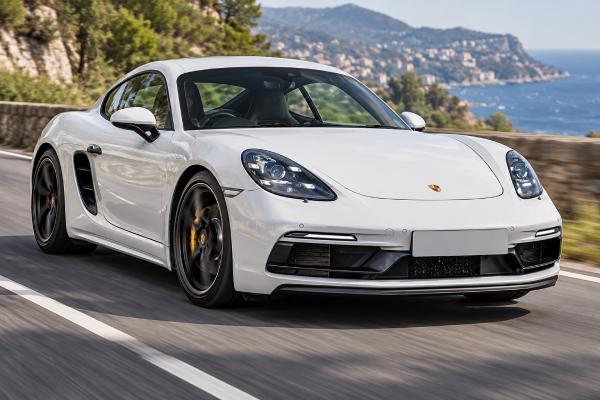

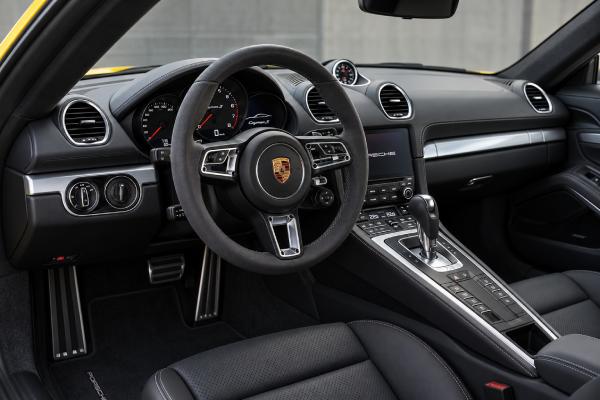
The 718 Cayman S is the version of Porsche’s 982 coupe in which the four-cylinder concept becomes a distinct engineering package rather than simply a higher-output tune. Its MA2.22 engine grows to 2,497 cc, produces 350 hp and 420 Nm, and uses variable turbine geometry (VTG) to broaden turbo response. Porsche paired that engine with larger standard wheels and thicker front brake discs than the base Cayman, while retaining the same mid-engine, rear-wheel-drive layout and the choice of six-speed manual or seven-speed PDK. In period factory testing, a PDK car with Sport Chrono reached 60 mph in 4.0 seconds and the Cayman S carried a 177 mph top-track-speed rating.
This article covers the 350 hp 2.5-liter Cayman S across the 982 production run associated with 2016–2025, with market and model-year differences identified where they matter. It does not treat the 300 hp 2.0-liter Cayman, the later six-cylinder GTS 4.0, or the GT4 as interchangeable substitutes. The goal is to explain what the S hardware changes, how to maintain it, and what evidence matters when buying one used.
Table of Contents
- What the S Badge Changes
- Cayman S Specifications and Measured Factory Targets
- VTG Turbocharging and Thermal Management
- Chassis, Brakes, Tires, and the Options That Matter
- Manual Versus PDK: Two Different Ways to Use 420 Nm
- Service Life, Age-Based Work, and Recall Checks
- A Used-Cayman-S Inspection Strategy
What the S Badge Changes
The Cayman S is not a 2.0-liter Cayman with software added. Porsche enlarged displacement from 1,988 to 2,497 cc by increasing bore to 102.0 mm while retaining a 76.4 mm stroke, raised output from 300 to 350 hp, and increased maximum torque from 380 to 420 Nm. The S engine also uses a variable-turbine-geometry turbocharger rather than the conventional turbo fitted to the 2.0-liter base model. Porsche’s 2016 launch information emphasized that VTG had previously been associated with the 911 Turbo and that the Cayman S installation also incorporated a wastegate.
VTG is central to the S model’s character. Adjustable guide vanes ahead of the turbine alter the effective flow area presented to exhaust gas. At lower engine speed, the geometry can increase gas velocity at the turbine to improve response; at higher flow rates, the vanes can open to avoid excessive backpressure and support power. Porsche specified the Cayman S torque plateau at 1,900–4,500 rpm, so its additional 40 Nm arrives across a broad everyday operating range rather than appearing only near redline.
The chassis hardware also moved upward. Early factory technical data lists 19-inch wheels as standard on the Cayman S rather than the base car’s 18s. Both models use four-piston fixed aluminum calipers, but the S front discs are 330 mm in diameter and 34 mm thick, compared with 28 mm thickness on the standard Cayman’s front discs. At the rear, both use 299 × 20 mm discs in the cited launch-era specification. These differences matter when budgeting wear items: an S buyer should price the correct S-specific front discs and the 19-inch tire sizes rather than using base-Cayman costs.
Porsche also opened a wider chassis-option path. At launch, PASM with a 10 mm reduction in ride height was available, while the S could additionally be ordered with PASM Sport Suspension at a 20 mm reduction. Porsche Torque Vectoring (PTV) and Sport Chrono were separate performance-oriented options in many markets. Because a used Cayman S can combine these features in numerous ways, “S” tells you the engine and core brake/wheel specification, not the complete dynamic configuration.
That distinction is especially important after many years of ownership. A car may have replacement springs, aftermarket dampers, non-standard wheels, added exhaust hardware, or software changes that visually obscure its original build. Verify the factory equipment list before deciding what the car is supposed to have.
Cayman S Specifications and Measured Factory Targets
The tables below use Porsche’s early 982 Cayman S technical data as the primary baseline and note later factory information where appropriate. They describe the 350 hp 2.5-liter S, not the GTS or six-cylinder variants.
MA2.22 engine
| Parameter | Factory specification |
|---|---|
| Configuration | Turbocharged flat-four, mid-engine |
| Displacement | 2,497 cc (2.5 L) |
| Bore × stroke | 102.0 × 76.4 mm |
| Valves | 4 per cylinder |
| Valve control | Camshaft adjustment and VarioCam Plus valve-lift control |
| Fuel system | Gasoline direct injection |
| Maximum power | 350 hp at 6,500 rpm |
| Maximum torque | 420 Nm (309 lb-ft) at 1,900–4,500 rpm |
| Compression ratio | 9.5:1 |
| Maximum engine speed | 7,500 rpm |
| Turbocharger | Single VTG turbo; early U.S. data lists 1.15 bar / 16.7 psi maximum boost |
| Intercooling | Water-to-air |
| Lubrication | Integrated dry-sump system with demand-controlled oil pump |
Transmission and performance
| Measure | 6-speed manual | 7-speed PDK |
|---|---|---|
| 0–60 mph | 4.4 s | 4.2 s |
| 0–60 mph with Sport Plus | — | 4.0 s |
| 0–100 mph | 9.7 s | 9.5 s |
| 0–100 mph with Sport Plus | — | 9.2 s |
| Quarter mile | 12.8 s | 12.6 s |
| Top track speed | 177 mph (285 km/h) | 177 mph (285 km/h) |
Porsche’s 2025 U.S. model overview continued to list the Cayman S at 350 hp and 177 mph, with a 4.2-second 0–60 mph figure on the model card. That continuity is useful when shopping: later model years did not quietly turn the ordinary Cayman S into a different-output engine. Equipment and market specification evolved, but the defining 350 hp rating remained.
Brakes, wheels, and chassis
| Item | Specification |
|---|---|
| Front suspension | Lightweight MacPherson-type spring struts |
| Rear suspension | Lightweight MacPherson-type suspension |
| Steering | Electromechanical variable-ratio steering |
| Front brakes | 330 × 34 mm vented/perforated iron discs; 4-piston fixed aluminum calipers |
| Rear brakes | 299 × 20 mm vented/perforated iron discs; 4-piston fixed aluminum calipers |
| Front wheels/tires | 8 J × 19 ET57; 235/40 ZR19 |
| Rear wheels/tires | 10 J × 19 ET45; 265/40 ZR19 |
| Stability control | Porsche Stability Management (PSM) |
Dimensions, weight, and utility
| Parameter | Factory figure |
|---|---|
| Length | 4,379 mm (172.4 in) |
| Body width | 1,801 mm (70.9 in) |
| Width including mirrors | 1,994 mm (78.5 in) |
| Height | 1,295 mm (51.0 in) |
| Wheelbase | 2,475 mm (97.4 in) |
| Unladen weight | 1,355 kg (2,988 lb) manual; 1,385 kg (3,054 lb) PDK in early U.S. data |
| Front luggage compartment | 150 L (5.3 cu ft) |
| Rear luggage compartment | 275 L (9.7 cu ft) |
| Fuel tank | 64 L (16.9 US gal) |
Early official fuel-economy data
| Cycle | Manual | PDK |
|---|---|---|
| City | 20 mpg US | 21 mpg US |
| Highway | 26 mpg US | 28 mpg US |
| Combined | 22 mpg US | 24 mpg US |
European launch documentation quoted NEDC combined consumption across the Cayman S range of 7.3–8.1 L/100 km with CO₂ figures of 167–184 g/km. Those numbers belong to an older test cycle. They should not be used as direct substitutes for later WLTP or market-specific ratings.
Current Type 982 service planning reference
| Item | Published interval |
|---|---|
| Oil maintenance | 15,000 km / 1 year |
| Inspection | 30,000 km / 2 years |
| Brake fluid | Every 2 years |
| Spark plugs, up to S | 45,000 km / 4 years |
| Air filter | 60,000 km / 4 years |
| Drive belt, up to S | 90,000 km / 6 years |
| PDK clutch fluid | 180,000 km / 12 years |
| Transmission oil | 180,000 km / 12 years on the cited Porsche Centre schedule |
Service programs differ among markets and can be revised. Use these figures to understand the scale of age-based work, then confirm the schedule for the exact VIN and region.
VTG Turbocharging and Thermal Management
The 2.5-liter engine’s most technically distinctive component is its VTG turbocharger. A fixed-geometry turbo is designed around compromises in turbine size and flow: a small turbine can respond quickly but becomes restrictive at high exhaust flow, while a larger turbine can support power but may respond less quickly at low speed. VTG adds movable guide vanes that change how exhaust gas is directed into the turbine, effectively widening the useful operating window.
For an owner, the result is more important than the mechanism. The Cayman S reaches its 420 Nm maximum at 1,900 rpm and holds it to 4,500 rpm. It can accelerate hard without living near the 7,500 rpm maximum engine speed, yet it still delivers its 350 hp peak at 6,500 rpm. The broad torque band suits both gearboxes: a manual driver can leave the car in a chosen gear through a sequence of bends, while PDK can exploit the power curve with rapid shifts.
Turbocharging also concentrates heat. Porsche’s system uses water-to-air intercooling with low-temperature radiators and a water intercooler, plus a cooling system with thermal management and an on-demand water pump. The car’s mid-engine layout places much of the powertrain out of easy view, so ownership discipline matters. Front heat exchangers should be kept free of accumulated debris, cooling-system leaks should not be ignored, and any repeated coolant-level loss needs a cause rather than repeated topping up.
A pre-purchase drive should include enough time to reach full operating temperature. Watch for warning messages, unstable temperatures, reduced-power behavior, or a cooling fan that seems to be responding abnormally. After the drive, inspect for dried coolant residue and fluid odors. A clean diagnostic scan is useful because intermittent thermal-management faults can be stored even when the dashboard is currently clear.
Oil condition and level also matter under sustained load. Porsche’s integrated dry-sump design is intended for sports-car use, but it still depends on the correct oil, correct fill, and sound pumps and control systems. Track-driven cars are not automatically poor purchases; what matters is whether maintenance frequency, fluid condition, and inspection history are consistent with that use.
Modifications deserve special scrutiny on a turbocharged engine. Software can raise boost or torque, and exhaust/intake changes can alter the environment in which the engine management operates. If a car has been tuned, ask who supplied the calibration, what hardware it expects, whether the car can be returned to stock, and whether diagnostic readiness and emissions compliance are intact. A seller’s claim that a tune is “conservative” is not a substitute for documentation.
Chassis, Brakes, Tires, and the Options That Matter
The Cayman S chassis is best evaluated as a system. Its extra engine torque, 19-inch staggered wheels, thicker front discs, steering calibration, suspension geometry, tires, and available active-damper or torque-vectoring options all influence how the car feels. Focusing on one headline option while ignoring tire quality or alignment can lead to the wrong conclusion about a particular example.
Start with the brakes. The S front discs are 330 mm in diameter and 34 mm thick in Porsche’s early specification, with four-piston fixed calipers. Their increased thickness over the base Cayman’s discs provides greater thermal mass. On a used car, inspect the inner and outer disc faces, pad thickness, caliper condition, and the areas around drilled holes. Fine surface marks and wear are different from significant cracking, deep lips, vibration, or heat damage. If carbon-ceramic brakes are fitted, inspection and replacement economics differ substantially and should be assessed separately.
Then look at tires as evidence, not merely consumables. Porsche specified 235/40 ZR19 front and 265/40 ZR19 rear tires on the launch-era S. Uneven inner-shoulder wear can point to alignment settings, worn components, or hard use. Four premium tires with similar age and tread condition are preferable to a mixture chosen one axle at a time. A car on 20-inch wheels may be factory-correct, but verify wheel part numbers and dimensions if originality matters.
PASM and PASM Sport Suspension need to be identified accurately. The S could be configured lower than the standard car, and aftermarket springs can create a similar visual stance. A build sheet, damper part numbers, and diagnostic equipment can help distinguish factory adaptive suspension from later modifications. If adaptive dampers are present, cycle the modes and look for warning messages; replacing multiple worn adaptive dampers can materially change ownership cost.
PTV is another option that is easy to oversimplify. It combines a mechanical rear differential lock with selective braking strategy to influence agility and traction. A buyer interested in track work or tight-road driving may value it, but a non-PTV Cayman S remains the same 350 hp S engine and core chassis. The correct question is whether the option suits intended use, not whether a car without it is somehow an incomplete S.
Manual Versus PDK: Two Different Ways to Use 420 Nm
The six-speed manual and seven-speed PDK serve different priorities, and factory acceleration figures make the distinction clear. The early manual Cayman S was rated at 4.4 seconds to 60 mph, while PDK reduced that to 4.2 seconds and Sport Plus launch control to 4.0 seconds. Top speed remained 177 mph either way. PDK is therefore the objectively quicker launch system in Porsche’s own data, but that fact does not decide which transmission makes a better used car for a particular owner.
The manual emphasizes continuity and driver choice. Because 420 Nm is available from 1,900 rpm, the car does not demand constant high-rpm shifting. A driver can use third or fourth gear across a wide speed range and still access strong response. During inspection, test clutch engagement from rest, moderate-load upshifts, high-load acceleration in a taller gear, and warm gearbox behavior. Slipping, notchiness that persists when warm, abnormal bearing noise, or inconsistent pedal behavior should be diagnosed.
PDK prioritizes speed and consistency. In automatic mode it can keep the engine in the efficient part of its torque curve; in manual mode it changes gear with less interruption to acceleration than a conventional manual. Low-speed clutch behavior can feel different from a torque-converter automatic, but a healthy gearbox should still engage predictably. Test reverse as well as drive, repeated low-speed maneuvers, moderate acceleration, full-temperature shifts, and manual commands.
On older cars, transmission history becomes more important than brochure acceleration. Early 982s are approaching the 12-year intervals shown in some current Porsche Centre maintenance schedules for PDK clutch fluid and transmission oil. That makes service dates relevant even when mileage is low. If records are incomplete, price the car assuming the missing work may need to be established rather than assuming “lifetime” fluid.
Service Life, Age-Based Work, and Recall Checks
Age is now a primary maintenance variable for the earliest Cayman S examples. A car can have low mileage and still be due for plugs, air filter, drive belt, brake fluid, transmission fluids, battery replacement, tires, or other time-sensitive work. The service history should therefore be read chronologically rather than judged by the number of stamps in a book.
Annual oil maintenance and two-year inspections in the cited Porsche Centre schedule create the basic rhythm. Every two years, brake fluid appears as an additional maintenance item. Spark plugs are listed at 45,000 km or four years, the air filter at 60,000 km or four years, and the drive belt at 90,000 km or six years for cars up to the S. These intervals show why a seldom-driven eight-year-old car can still need a substantial catch-up service.
Consumables should be considered in groups. A brake job may coincide with old tires; an air-filter service may reveal debris in intake areas; a belt replacement is an opportunity for a broader visual check. Bundling inspection logically can reduce surprises even if it does not reduce the price of the parts themselves.
Records should identify what was actually done. “Major service” is less useful than an invoice showing oil, filter, plugs, brake fluid, air filter, belt, diagnostic work, and any repair findings. Where independent specialists maintained the car, quality can be excellent, but the documentation should still be specific enough to establish parts and intervals.
Recall status is separate from routine maintenance. In the United States, certain 2017 718 Cayman S and other Porsche models were included in campaign 17V-054/AH01 concerning fastening screws for fuel collection pipes that could fail and permit fuel leakage. Another narrow 2017 campaign covered seat-mounted side-airbag inflator initiators on a small group of vehicles. These campaigns do not apply automatically to every car of the same year. Check the VIN with Porsche and the relevant national recall database and retain evidence that applicable work was completed.
A Used-Cayman-S Inspection Strategy
A useful Cayman S inspection proceeds from identity to history to condition, in that order. First prove that the vehicle is the specification being sold. Confirm VIN, original market, model year, MA2.22 2.5-liter S configuration, transmission, and factory option list. This matters for imported cars, modified cars, and examples whose badges or wheels have been changed.
Next build a timeline from invoices. Mark annual oil services, two-year brake-fluid work, four-year plug and filter events, six-year belt work, and age-dependent transmission service. Add tires, brakes, batteries, coolant repairs, air-conditioning work, suspension parts, and recalls. A gap becomes a concrete question rather than a vague concern once the timeline is visible.
Inspect the car from cold. Verify that warning lamps illuminate for their self-check, then extinguish normally. Listen for persistent mechanical noises, observe idle quality, and note exhaust smoke or odor. Direct-injection engines, pumps, and normal warm-up control can make sounds that are not faults, so the point is not to diagnose by ear alone; it is to identify anything that deserves specialist investigation.
The road test should deliberately cover low rpm, the torque plateau, higher engine speed, rough pavement, steady highway speed, and repeated braking. The engine should deliver boost progressively without hesitation or warning lights. Steering should be centered and stable. The suspension should not knock. Brake vibration, a pulling sensation, or steering shimmy should be investigated rather than explained away as “sporty.”
After the drive, inspect the front cooling openings, underbody, wheel barrels, tires, brakes, and visible fluid areas. Look for impact damage, missing undertray fasteners, leaks, dried coolant traces, and tire wear that disagrees with the seller’s description. If the car sits unusually low, determine whether that is factory PASM Sport Suspension or aftermarket hardware.
Finish with a Porsche-capable diagnostic scan and a pre-purchase inspection by a specialist familiar with 982 cars. Ask for current and stored faults, operating data that can be interpreted reliably, suspension/brake condition, cooling-system inspection, and evidence of previous repairs or track-oriented modifications. Diagnostic data should be interpreted rather than sensationalized: a historical low-voltage code after a failed battery is not equivalent to a persistent boost-control or transmission fault.
The Cayman S makes a compelling long-term ownership proposition when its specification and maintenance are transparent. Its 2.5-liter VTG engine is meaningfully different from the base 2.0, its brake and wheel hardware supports the extra performance, and its fixed-roof body preserves the Cayman’s two-compartment practicality. The best example is not automatically the newest or lowest-mileage one; it is the car whose configuration, service record, wear pattern, recall status, and mechanical behavior all tell the same coherent story.
References
- The new Porsche 718 Cayman — Porsche AG, 2016.
- 2016 – 718 Cayman and 718 Cayman S technical specifications — Porsche Cars North America, 2016.
- The 2021 Porsche 718 Boxster and Cayman models — Porsche Cars North America, 2020.
- Porsche 718 Models and Configurator | Porsche USA — Porsche, 2025 model-year data.
- Boxster and Cayman Service — Porsche Centre Willoughby, accessed 2026.
- IMPORTANT SAFETY RECALL — National Highway Traffic Safety Administration / Porsche Cars North America, 2017.
Disclaimer
This article is for informational purposes only. Specifications, service intervals, fluid requirements, torque values, repair procedures, recall applicability, and equipment can differ by VIN, model year, transmission, options, and market. Confirm all maintenance and repair work against current Porsche service information, the vehicle’s owner documentation, and VIN-specific campaign data before ordering parts or beginning work. If this guide helps another Cayman S owner or shopper, please consider sharing it.