

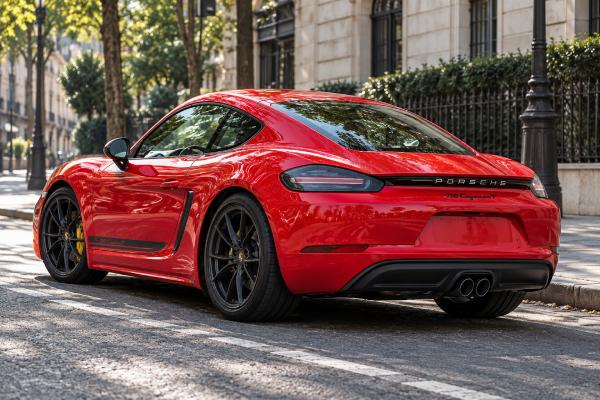
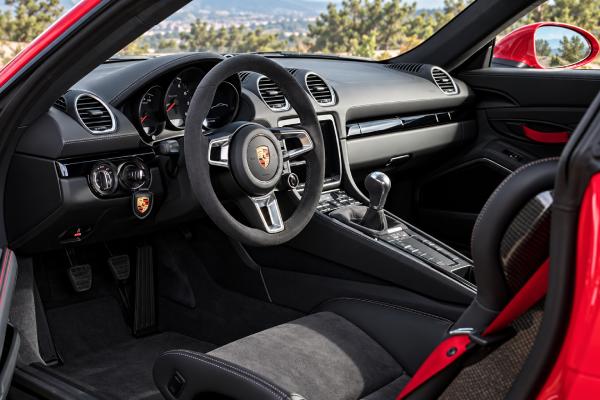
The Porsche 718 Cayman T answers a specific question: what if the entry-level 300-hp 718 engine were paired with the chassis and driver-focused equipment normally selected farther up the option list? Porsche’s answer was not to increase output. Instead, the T received PASM Sport suspension with a 20 mm reduction in ride height, Porsche Torque Vectoring and a mechanical limited-slip differential, Sport Chrono, active drivetrain mounts, 20-inch wheels and a short-throw manual shifter. A seven-speed PDK remained available for buyers who wanted dual-clutch operation and launch control. In fixed-roof Cayman form, that package also preserves one of the 718’s strongest practical advantages: useful storage under the rear hatch plus a separate front trunk. The model was announced in Europe in late 2018, while Porsche introduced it to the U.S. as a 2020 model, so “2019–2023” can describe the production-era scope without implying identical model-year labeling in every country. The right way to understand the Cayman T is therefore as a factory handling specification built around the 2.0-liter turbo engine, not as a detuned S or a cosmetic GTS substitute.
Table of Contents
- A Cayman Built Around Balance
- Technical Specifications at a Glance
- T-Specific Hardware and Controls
- Coupe Packaging and Daily Usability
- Performance With Two Transmission Choices
- Service, Wear, and Long-Term Care
- Used Cayman T Checklist
A Cayman Built Around Balance
The “T” concept is best understood through equipment rather than horsepower. Porsche kept the 1,988 cc turbocharged flat-four at 300 hp and 280 lb-ft in U.S. specification. What changed was the environment around that engine. PASM Sport, unavailable with the base engine in this combination before the T, lowers the car by 20 mm and uses adaptive damping. PTV adds selective braking intervention and a mechanically locking rear differential. Sport Chrono and active drivetrain mounts sharpen response to driver inputs.
This configuration makes the Cayman T different from a standard Cayman fitted only with appearance parts. It also separates the T from the 2.5-liter Cayman S and GTS: those models achieve greater output through a larger turbocharged engine, whereas the T’s purpose is to extract more involvement from the base power unit.
Porsche supported that theme with details such as black door-opening loops, a GT Sport steering wheel, a red shift-pattern marking on manual cars, 718 logos on the headrests and dark exterior trim. Titanium Grey 20-inch wheels and Agate Grey accents are characteristic. Individual cars still vary by market and options, so these cues should be verified against factory build information.
European launch cars could be specified without PCM infotainment, replaced by a storage compartment, with PCM available at no extra charge. U.S. specification was not identical. This is a useful example of why photographs from press launches should not be treated as a mandatory global equipment list.
Technical Specifications at a Glance
The Cayman T uses a water-cooled, turbocharged flat-four with gasoline direct injection, VarioCam Plus valve control and integrated dry-sump lubrication. The turbocharger’s maximum boost is listed at 19 psi in Porsche’s U.S. technical data.
| Engine data | 718 Cayman T |
|---|---|
| Engine | Turbocharged flat-four |
| Displacement | 1,988 cc |
| Bore × stroke | 91.0 × 76.4 mm |
| Power | 300 hp at 6,500 rpm |
| Torque | 280 lb-ft at 1,950–4,500 rpm |
| Compression ratio | 9.5:1 |
| Maximum engine speed | 7,500 rpm |
| Fuel management | Gasoline direct injection |
| Drive layout | Mid-engine, rear-wheel drive |
The standard brake system uses four-piston aluminum monobloc fixed calipers at both axles. Porsche’s U.S. sheet lists 330 mm front and 299 mm rear iron rotors. Optional ceramic brakes were also documented, so a used car’s actual braking system should be identified before replacement costs are estimated.
| Running gear | Specification |
|---|---|
| Suspension | PASM Sport, 20 mm lower |
| Rear differential | Mechanical limited-slip with PTV |
| Front brakes | 330 × 28 mm vented/perforated iron rotors |
| Rear brakes | 299 × 20 mm vented/perforated iron rotors |
| Front wheel/tire | 8J × 20 ET57; 235/35 ZR20 |
| Rear wheel/tire | 10J × 20 ET45; 265/35 ZR20 |
| Steering | Electromechanical, variable ratio |
T-Specific Hardware and Controls
PASM Sport is the center of the Cayman T package. Compared with the ordinary ride height, its 20 mm reduction lowers the body and center of gravity while adaptive dampers continue to vary their force. The result is more purposeful body control without converting the car to a passive fixed-rate setup.
PTV and the mechanical limited-slip differential work at the driven rear axle. Under cornering and acceleration they help the car use available traction more effectively, while Porsche Active Drivetrain Mounts vary the restraint of the engine/transmission assembly. Softer mount behavior can isolate vibration in normal use; firmer behavior under dynamic load reduces powertrain movement.
Sport Chrono brings a mode switch to the steering wheel and changes the response of several systems. On manual cars, sport modes support automatic rev-matching for downshifts. With PDK, Sport Plus enables launch control and more aggressive transmission logic. These systems should all be tested on a prospective purchase because a fault in PASM or PADM can compromise the very equipment that defines the T.
The lowered chassis also creates practical inspection points. The front lower surfaces, undertrays and jacking areas sit closer to obstacles. Minor scuffing on sacrificial plastic is common, but broken mounting tabs, cracked underbody panels, bent suspension parts or poorly repaired impacts need attention. Wheel alignment is equally important: a T can look straight while wearing the inner edges of its tires rapidly.
Coupe Packaging and Daily Usability
The Cayman T’s fixed roof provides considerably more rear luggage room than the Boxster T. Porsche’s U.S. technical data lists 5.2 cu ft in the front trunk and 9.7 cu ft beneath the rear hatch. The two compartments together make the Cayman unusually useful for touring, especially when luggage is packed in soft bags shaped around the available space.
| Body and capacity | U.S. Cayman T data |
|---|---|
| Length | 172.4 in |
| Width, mirrors folded | 70.9 in |
| Width, mirrors extended | 78.5 in |
| Height with PASM Sport | 50.2 in |
| Wheelbase | 97.4 in |
| Front luggage compartment | 5.2 cu ft |
| Rear luggage compartment | 9.7 cu ft |
| Drag coefficient | 0.30 |
The hatch area should be checked for rattles, water traces and damage from unsecured cargo. Heat from the mid-mounted engine makes the rear compartment warmer than an ordinary front-engine hatchback’s luggage bay, so heat-sensitive items should be packed accordingly.
Cabin ergonomics are deliberately simple. The GT Sport steering wheel, supportive seats and compact dimensions put primary controls close to the driver. Optional seat types vary widely in comfort and adjustability, so a buyer should spend time in the exact seats fitted rather than assuming all T interiors feel alike.
Road noise from broad low-profile tires is part of the package, but booming, grinding or speed-dependent vibration should not be written off as normal sports-car behavior. Empty both luggage compartments before a diagnostic road test so loose objects and cargo covers do not imitate chassis noises.
Performance With Two Transmission Choices
Porsche offered a six-speed manual as standard and seven-speed PDK as an option. Both use the same 300-hp engine and carry the same 170-mph factory top-track-speed figure in U.S. data, but acceleration differs.
| Factory performance | Manual | PDK |
|---|---|---|
| 0–60 mph | 4.9 s | 4.5 s with Sport Chrono launch control |
| Quarter mile | 13.4 s | 13.2 s |
| Top track speed | 170 mph | 170 mph |
| Published U.S. curb weight | 3,065 lb | 3,127 lb |
The manual is mechanically conventional and places clutch control with the driver. The shortened lever changes the tactile experience without changing the car into a close-ratio homologation special. PDK shifts faster and can keep the turbocharged engine in its strong torque band with little interruption.
During a test drive, a manual should engage cleanly from rest and select every gear without grinding or persistent resistance. Clutch slip under load is a warning sign. On a PDK car, verify smooth low-speed engagement, consistent shifts in automatic and manual modes, and the absence of gearbox warnings. A Porsche-capable scan should supplement, not replace, the road test.
Factory acceleration figures are controlled test results. Tire age, pavement, temperature, vehicle load and launch technique can alter measured performance substantially. A healthy used Cayman T is better judged by consistent power delivery and system operation than by attempting to reproduce a brochure time on a public road.
Service, Wear, and Long-Term Care
The Cayman T needs the same disciplined maintenance approach as any modern turbocharged Porsche, with added attention to the dynamic hardware that makes the T special. Exact intervals depend on market, VIN and production date, so owners should use official service documentation rather than a single universal schedule.
Oil and filter changes need documented dates and mileage. Correct oil approval matters, particularly for a turbocharged engine that can spend sustained time at high load. During service, inspect for leaks around the engine, turbo plumbing and cooling connections. Rechecking after a fully warmed drive can reveal seepage that is not visible when cold.
The front bumper openings expose radiators and air-conditioning condensers to leaves and stones. Debris should be removed carefully, and bent fins or coolant residue investigated. Repeated coolant top-ups are not maintenance; they are a symptom that needs diagnosis.
Tires deserve more scrutiny than tread depth. Read date codes, inspect the inner shoulders and look for sidewall damage or flat spotting. Twenty-inch wheels can bend on potholes without dramatic external marks, so a vibration that increases with road speed should be traced rather than balanced away repeatedly.
Brake fluid ages with time, and performance driving accelerates pad and rotor wear. If the car has ceramic brakes, obtain a specialist condition assessment. On iron-brake cars, inspect drilling areas, rotor thickness and pad condition. Track use can be perfectly compatible with good ownership when records show appropriate fluid and consumable replacement.
The active mounts and adaptive dampers should remain free of warnings. A fault in these systems may not stop the car from moving, but it reduces the function of the T package. Diagnose electronic warnings before purchasing parts; sensor, wiring and control issues can mimic component failure.
Used Cayman T Checklist
Verification comes first. Confirm through the VIN and factory data that the car is a Cayman T, then establish its original transmission, brakes, seats, wheels and infotainment configuration. Because many T cues can be added to a standard Cayman, badges and door loops are not proof of model identity.
Inspect the paint and body for accident repair, paying particular attention to the front bumper, lower sill areas and rear quarter panels. Look underneath for damaged trays, incorrect fasteners and evidence that the car has contacted curbing or ramps. Check jacking points for deformation from improper lifting.
Review modifications with the same care. Springs, spacers, alignment links, engine software and exhaust systems can materially alter the car. Ask for receipts, calibration details and original parts. A modified car can be excellent, but the buyer needs to know whether it still matches factory geometry and emissions requirements.
Service paperwork should form a believable timeline. Long gaps, repeated unexplained battery replacements, persistent warning-light entries or multiple cooling repairs deserve follow-up. Compare mileage shown on invoices, inspection reports and the current odometer.
A pre-purchase inspection should include a cold start, module scan, warm road test and lift inspection. Test PASM, Sport Chrono, PADM-related functions, climate control, infotainment and all installed seat equipment. Check the front and rear luggage areas for water entry and the hatch seal for damage.
Use the applicable official database to check the VIN for outstanding recalls or campaigns. Status is vehicle-specific and can change after publication. Once identity and maintenance are verified, the Cayman T’s appeal is easy to define: it combines the base engine’s accessible performance with a factory chassis specification designed to make speed, response and driver involvement more engaging without sacrificing the coupe’s everyday usefulness.
References
- The new Porsche 718 T – reduced to maximum driving pleasure 2018
- The 2020 Porsche 718 Boxster T and 718 Cayman T 2019
- Technical Data 2020
- Technical Specifications 2026
- Porsche Scheduled Maintenance Plan 2026
- Check for Recalls: Vehicle, Car Seat, Tire, Equipment | NHTSA 2026 (Recall Database)
Disclaimer
This guide is informational only and cannot replace professional diagnosis, repair or a vehicle-specific inspection. Specifications, torque values, maintenance intervals and procedures may vary by VIN, market and installed equipment; confirm them with the official Porsche service documentation for the individual car.
Please consider sharing this Cayman T guide on Facebook, X/Twitter or another social channel if it helped you and you would like to support our work.