
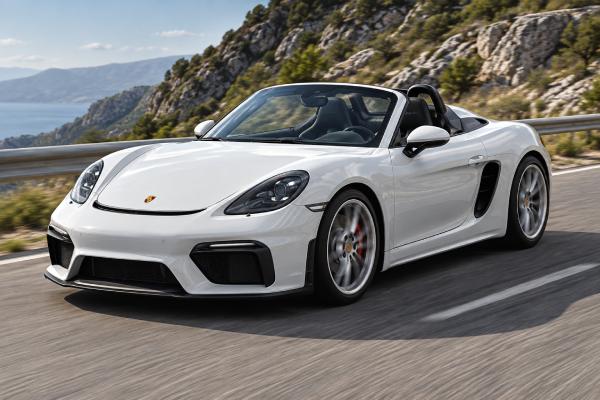
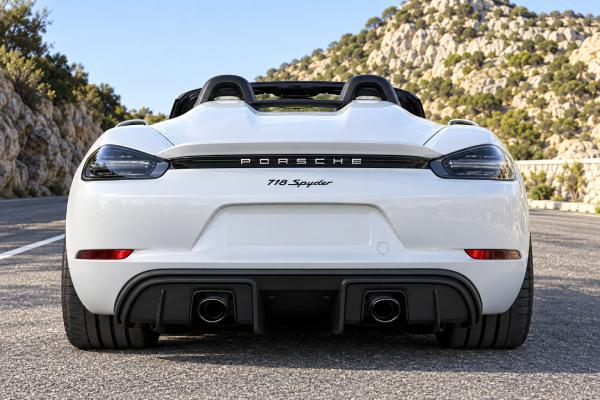
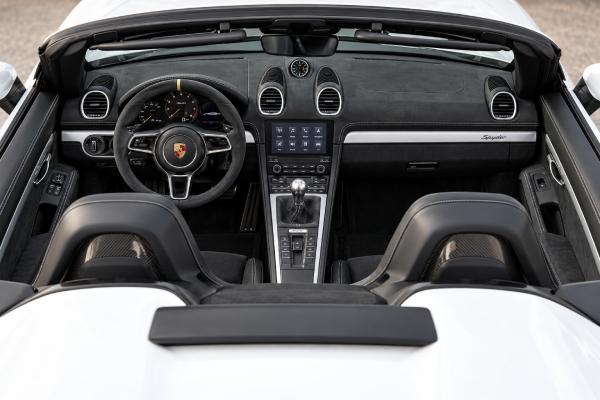
The 982-generation Porsche 718 Spyder is not merely a Boxster with a larger engine. Porsche Motorsport gave it the same 414-hp naturally aspirated 4.0-liter flat-six and much of the GT chassis hardware used by the contemporary 718 Cayman GT4, then wrapped that engineering in a roadster body with a lightweight manually handled roof, twin rear streamliners and an automatically deploying rear spoiler. At launch the Spyder came only with a six-speed manual; for the 2021 model year Porsche added an optional seven-speed PDK, raising U.S. peak torque from 309 to 317 lb-ft and cutting the factory 0–60 mph time from 4.2 to 3.7 seconds. That model-year change is essential when comparing used cars across the 2019–2023 assignment range. The Spyder also differs fundamentally from the later 718 Spyder RS, so RS figures should not be backfilled into this model. This guide focuses on the 414-hp 718 Spyder, including its GT-derived suspension and brakes, distinctive aero and roof systems, transmission split, maintenance priorities and the practical checks that determine whether a used example is as complete and healthy as its appearance suggests.
Table of Contents
- What Makes the 718 Spyder Distinct
- Engine, Transmission, and Performance
- GT-Derived Chassis and Brakes
- Roof, Aerodynamics, and Roadster Design
- Dimensions, Tires, and Practicality
- Maintenance for Road and Track Use
- Pre-Purchase Inspection for a Spyder
What Makes the 718 Spyder Distinct
Porsche launched the 718 Spyder with the 718 Cayman GT4 in June 2019. The two share a 3,995 cc naturally aspirated six-cylinder engine and a closely related GT chassis, but their bodies and aerodynamic strategies are different. The Cayman uses a fixed roof and large rear wing; the Spyder uses a lightweight roof, two sculpted rear streamliners and a rear spoiler that rises automatically at speed.
The Spyder also marked a significant technical step from earlier Boxster-based Spyder models. Porsche described it as the first Boxster-family model to use a chassis developed with Porsche Motorsport input at this level, including suspension components related to the 911 GT3 and Cup-car engineering. It therefore should not be evaluated as a standard Boxster with a cosmetic package.
Model-year accuracy matters. Original cars use a six-speed manual. For 2021, Porsche added seven-speed PDK and revised several equipment details, including the change from Alcantara to Race-Tex, an Aurum wheel-color option and an available conventional summer-tire choice in addition to the original ultra-high-performance tire fitment. Those changes mean two genuine 718 Spyders from different years can have legitimate factory differences.
The later Spyder RS is outside this article’s scope. It uses a different powertrain and a much more extreme aero/induction concept. A used-car listing that calls an ordinary 414-hp Spyder an “RS-style” car may describe appearance modifications, not factory specification.
Engine, Transmission, and Performance
The Spyder’s engine is a naturally aspirated flat-six displacing 3,995 cc. U.S. output is 414 hp at 7,600 rpm, with an 8,000-rpm maximum engine speed. Launch-specification manual cars produce 309 lb-ft from 5,000 to 6,800 rpm. The engine uses direct injection, a variable intake system and adaptive cylinder control during suitable light-load operation.
| Engine specification | 718 Spyder |
|---|---|
| Configuration | Naturally aspirated horizontally opposed 6-cylinder |
| Displacement | 3,995 cc |
| Bore × stroke | 102.0 × 81.5 mm |
| Maximum power, U.S. | 414 hp at 7,600 rpm |
| Manual maximum torque | 309 lb-ft at 5,000–6,800 rpm |
| Compression ratio | 13.0:1 |
| Maximum engine speed | 8,000 rpm |
| Drive layout | Mid-engine, rear-wheel drive |
The original six-speed manual version carries U.S. factory figures of 4.2 seconds from 0–60 mph, 12.4 seconds for the quarter mile and a 187-mph top track speed. PDK became optional for the 2021 model year. Porsche increased the quoted PDK torque to 317 lb-ft and published a 3.7-second 0–60 mph time.
| Transmission comparison | 6-speed manual | 7-speed PDK |
|---|---|---|
| Availability | From launch | From 2021 model year |
| Peak torque, U.S. | 309 lb-ft | Up to 317 lb-ft |
| 0–60 mph | 4.2 s | 3.7 s |
| Launch control | No | Yes |
| Rear differential locking values | 22% traction / 27% overrun | 30% traction / 37% overrun |
The manual and PDK cars should be inspected according to their hardware. Manual clutch take-up, slip and synchro behavior are priorities on three-pedal cars. PDK cars need smooth low-speed engagement, consistent shifts and a diagnostic scan for stored transmission faults. Non-standard software should be documented because it changes the factory baseline.
GT-Derived Chassis and Brakes
The Spyder uses a 30 mm-lower GT chassis with adaptive damping and lightweight suspension components. Porsche Stability Management can be relaxed or switched off in stages, reflecting the car’s circuit capability. A mechanical rear differential lock works with the rear-drive layout, and its locking values differ between manual and PDK versions.
Standard brakes are serious even before options. Six-piston aluminum monobloc fixed calipers clamp 380 mm front iron rotors, while four-piston rear calipers use 380 mm rotors. Porsche Ceramic Composite Brakes were optional, increasing rotor diameters and reducing unsprung mass.
| Chassis/brake item | Factory data |
|---|---|
| Ride-height reduction | 30 mm |
| Adaptive damping | GT-calibrated PASM |
| Standard front brakes | 380 × 34 mm iron rotors; 6-piston fixed calipers |
| Standard rear brakes | 380 × 30 mm iron rotors; 4-piston fixed calipers |
| Optional PCCB front | 410 × 36 mm |
| Optional PCCB rear | 390 × 32 mm |
| Stability management | PSM with GT-specific calibration |
A car used hard on road or circuit can consume tires and brakes quickly without being abused mechanically. Inspection should therefore look for evidence of appropriate maintenance rather than trying to prove the car was never driven as intended. Fresh brake fluid, measured rotor condition, quality tires and documented alignments are positive evidence when they correspond with use.
PCCB-equipped cars need specialist brake inspection. Ceramic rotors cannot be evaluated solely by the same visual rules used for iron discs, and replacement cost is high. On standard brakes, check for heat checking, cracks around perforations, heavy lips and uneven pad deposits.
Roof, Aerodynamics, and Roadster Design
The lightweight roof is one of the Spyder’s defining systems. It is not fully automatic. Porsche uses electric release functions, but the driver completes a short manual sequence to fold and stow the roof beneath the rear deck. Porsche described the process as five steps after unlocking. The roof uses reduced insulation and a flexible rear window as part of the weight-saving concept.
That simplicity brings inspection responsibilities. Check the fabric for chafing and tension, confirm the side fins engage their mounts correctly, inspect the rear window and seams, and operate the roof through a complete cycle. Missing clips, stretched fabric or improvised repairs can make an otherwise excellent car frustrating to use. Porsche stated that the roof is suitable for motorway speeds and car washes when correctly installed, so persistent flapping or water leakage should not simply be accepted as normal.
The Spyder’s aero is subtler than the GT4’s fixed wing but still functional. The rear spoiler extends automatically at 120 km/h (about 75 mph), and the functional diffuser contributes a large portion of rear-axle downforce. Porsche stated that the Spyder is the first Boxster model to generate rear-axle downforce.
| Spyder aero/body feature | Purpose |
|---|---|
| Rear spoiler | Deploys automatically at 120 km/h |
| Rear diffuser | Generates about 50% of rear-axle downforce |
| Front GT section | Reduces front-axle lift and maintains aero balance |
| Twin streamliners | Roadster design feature with aerodynamic shaping |
| Lightweight roof | Manual stowage after electric release; weight-focused design |
Damage to the diffuser, undertrays or front aero can therefore be more than cosmetic. A low front end is vulnerable to steep ramps, while the underside can contact track curbing. Inspect mounting points and ducts as well as visible surfaces.
Dimensions, Tires, and Practicality
Despite its GT hardware, the Spyder remains compact. U.S. launch technical data lists a 174.5-inch length, 97.8-inch wheelbase and 49.6-inch height. The standard 20-inch wheel package uses 245/35 ZR20 front and 295/30 ZR20 rear tires.
| Dimension/capacity | U.S. launch specification |
|---|---|
| Length | 174.5 in |
| Width, mirrors folded | 71.0 in |
| Width, mirrors extended | 78.6 in |
| Height | 49.6 in |
| Wheelbase | 97.8 in |
| Front luggage capacity | 5.2 cu ft |
| Rear luggage capacity | 4.2 cu ft |
| Manual curb weight | 3,206 lb |
| Fuel tank | 16.9 U.S. gal |
| Drag coefficient | 0.34 |
Practicality depends on accepting the roof routine. With experience, the procedure is straightforward, but it is less convenient than the power roof of an ordinary Boxster. A buyer who expects to raise or lower the top repeatedly in stop-start urban use should perform the process personally before deciding that the Spyder fits daily life.
Tire choice matters as well. The original ultra-high-performance fitment prioritizes dry-weather capability. From the 2021 model year Porsche offered a conventional summer-tire option in some markets. Check what is currently fitted, its age and whether all four tires are a compatible set. Do not assume a high-grip tire is suitable for cold temperatures or standing water merely because it is factory-sized.
Maintenance for Road and Track Use
The maintenance schedule should be taken from official documentation for the exact VIN, market and production date. A GT-derived 718 still needs ordinary time-based care—engine oil and filter, brake fluid, filters, spark plugs and inspections—while hard use can shorten the practical life of consumables.
Warm-up habits are important with a high-revving naturally aspirated engine. The 8,000-rpm ceiling is an engineered capability, but full load is best reserved for properly warmed fluids. Service invoices that document correct oil and regular changes are more meaningful than claims that the car was “babied.”
Cooling inlets, condensers and radiators are exposed to road debris. Inspect the front openings and clean accumulated leaves carefully. Check for dried coolant residue, bent fins and signs of repeated top-ups. An unexplained loss of coolant should be pressure-tested and diagnosed.
The roof needs its own routine care. Keep seals and attachment points clean, verify drains and stowage areas are free of debris, and repair small fabric damage before it grows. Moisture in the cabin or luggage spaces deserves investigation because water can travel away from the original entry point.
Track-driven cars require closer review of brake fluid, pads, rotors, tires, alignment and underbody condition. Look for rubber pickup and heat cycling on tires, worn inner shoulders, cracked aero panels and damaged wheel barrels. A well-maintained track-used Spyder can be a sound car; the key is whether maintenance intensity matched use intensity.
Battery condition also matters on cars stored seasonally. A maintainer helps, but it does not restore a battery that has lost capacity. Low system voltage can create misleading fault messages, so test battery health when diagnosing intermittent electronics.
Pre-Purchase Inspection for a Spyder
Confirm identity before condition. Use the VIN and factory build data to establish that the car is a genuine 718 Spyder, determine manual or PDK specification, identify brake type, seat type and original options, and note model-year equipment changes. Spyder badges, wheels and rear body pieces can be imitated.
Operate the roof yourself. Watch the electric releases, inspect the side fins and latches, and confirm the fabric sits correctly when tensioned. Check the stowage area and both luggage compartments for moisture. Because the roof is model-specific, missing or damaged small components deserve attention before the purchase is completed.
On a lift, inspect the front underside, suspension arms, dampers, brake lines, engine area and rear diffuser. Look for track-curbing marks or impact damage and distinguish harmless surface scraping from cracked mounts or structural deformation. Examine wheel barrels and all four tire inner shoulders.
During the road test, allow the car to warm fully. Check steering centering, brake pedal consistency, suspension noise and drivetrain response. Manual cars need a clutch and synchro assessment; PDK cars need smooth engagement and shifting. Run a full diagnostic scan and investigate any history of PASM, PSM, transmission or active-system warnings.
Ask for invoices rather than relying on a stamped service book alone. Tire replacements, alignment sheets, brake-fluid service and rotor/pad work can reveal how the car was used and cared for. If modifications are present, document software, exhaust, suspension and aero changes and determine whether factory parts are included.
Finally, run the VIN through the appropriate official recall database and confirm completion of applicable campaigns. The combination of roof condition, GT chassis health and coherent maintenance history matters more than odometer mileage in isolation.
The 718 Spyder is unusual because its defining traits pull in two directions at once: it has serious GT-derived engineering, yet its manually managed roof and classic roadster form make the experience deliberately tactile. Buying one successfully means respecting both halves of that identity—verifying the performance hardware with the same care as the roof, trim and weather-management systems.
References
- Pure fun: The 2020 Porsche 718 Cayman GT4 and 718 Spyder 2019
- Emotive powerhouse 2019
- Efficient downforce 2019
- Minimised for maximum driving pleasure 2019
- Optional Porsche dual-clutch transmission further improves performance on 718 models with six-cylinder engine 2020
- Check for Recalls: Vehicle, Car Seat, Tire, Equipment | NHTSA 2026 (Recall Database)
Disclaimer
This article is informational and is not a substitute for professional diagnosis, inspection or repair. Specifications, torque values, service intervals and procedures may vary by VIN, market, model year and equipment; verify them against the official Porsche service documentation for the individual vehicle.
If this 718 Spyder guide was helpful, please share it on Facebook, X/Twitter or another social platform to support our work.