
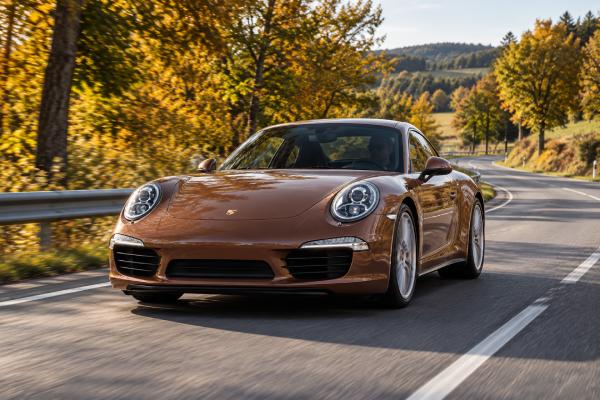
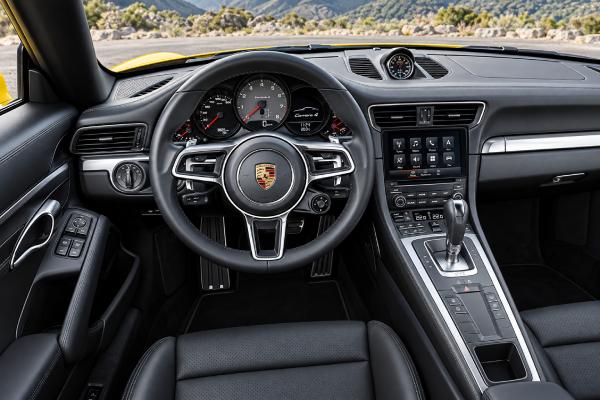
The 991.1 Porsche 911 Carrera 4 is the early-generation 911 that pairs the 350 hp, 3.4-liter naturally aspirated flat-six with Porsche Traction Management (PTM) all-wheel drive. It is not an S model with less power and it is not the later 991.2 Carrera 4 with a turbocharged 3.0-liter engine. In period U.S. specification, the MA1.04 engine produces 287 lb-ft (390 Nm) at 5,600 rpm, revs to 7,800 rpm, and can be matched to either the seven-speed manual or seven-speed PDK.
What makes the Carrera 4 especially relevant as a used car is the way the extra driven axle changes the package. It uses the wider Carrera 4 body, an 18 US gallon fuel tank, and active torque transfer to the front axle, while retaining the smaller 3.4-liter engine and 19-inch standard wheels. That combination can be a useful all-weather alternative to a rear-drive Carrera, but only if its tires, alignment, front driveline, brakes, and service history have been treated as a system rather than as unrelated maintenance items.
Table of Contents
- The Carrera 4 Brief: 3.4 Liters, AWD, Wide Body
- Factory Data for the Coupe
- How PTM Changes the Driving Hardware
- Performance Without the S Engine
- Ownership Priorities for an AWD 991
- A Used-Car Check in the Right Order
The Carrera 4 Brief: 3.4 Liters, AWD, Wide Body
The simplest way to identify this car is 350 hp plus active all-wheel drive in the pre-facelift 991 body. The Carrera 4 shares the 3.4-liter engine output of the rear-drive Carrera, but its PTM hardware and broader rear body distinguish it mechanically and visually.
The 3.4-liter engine belongs to the MA1.04 family listed in the assignment. It is direct injected, naturally aspirated, and uses the same 77.5 mm stroke as the 3.8-liter S engine but a smaller 97 mm bore. That gives 3,436 cc of displacement. The result is an engine that rewards rpm: maximum power comes at 7,400 rpm and maximum torque at 5,600 rpm. Buyers coming from a modern turbocharged car should expect less low-rpm shove and more reason to use the upper half of the tachometer.
The “4” is not a permanently locked 50:50 driveline. Porsche’s active PTM system sends the engine’s primary drive to the rear and can engage the front axle through an electronically controlled multi-plate clutch. The control strategy responds to wheel speeds, steering angle, acceleration, and other vehicle-state information. In practical terms, the car can add front-axle drive before or during a traction demand without giving up the rear-engine, rear-biased architecture that defines the 911.
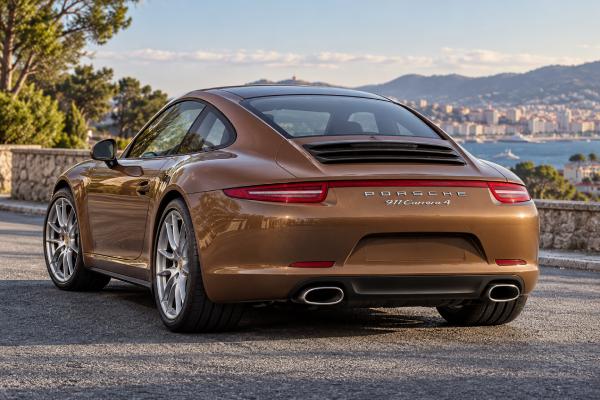
The body is also important. The Carrera 4 uses the wider rear shell associated with the all-wheel-drive 991 models and carries the full-width rear light treatment that makes it easy to distinguish from the narrow-body rear-drive Carrera. Do not use appearance alone to verify identity, though: bumper conversions, aftermarket lamps, wheels, and badges are common enough that the VIN and factory build data should remain the authority.
Factory Data for the Coupe
Porsche’s 2013 U.S. technical sheet gives a clear baseline for the Carrera 4 coupe. These are model-specific numbers for the 3.4-liter all-wheel-drive car; Cabriolet values and Carrera 4S values are intentionally excluded unless a row explicitly states otherwise.
| Specification | Value |
|---|---|
| Configuration | Rear-mounted, water-cooled horizontally opposed six-cylinder |
| Displacement | 3,436 cc (3.4 L) |
| Bore × stroke | 97.0 × 77.5 mm |
| Induction | Naturally aspirated |
| Fuel system | Direct fuel injection |
| Valvetrain | Four overhead camshafts, four valves per cylinder, VarioCam Plus on intake side |
| Compression ratio | 12.5:1 |
| Maximum power | 350 hp at 7,400 rpm |
| Maximum torque | 390 Nm (287 lb-ft) at 5,600 rpm |
| Redline | 7,800 rpm |
| Fuel | Premium unleaded |
| Specification | Value |
|---|---|
| Drive type | Active all-wheel drive |
| AWD coupling | Electronically controlled multi-plate clutch |
| Manual gearbox | 7-speed manual |
| Optional gearbox | 7-speed PDK dual-clutch transmission |
| Rear final-drive ratio | 3.44:1 |
| Manual 7th gear | 0.71:1 |
| PDK 7th gear | 0.62:1 |
| Specification | Value |
|---|---|
| Front brakes | 4-piston fixed aluminum calipers; 330 × 28 mm discs |
| Rear brakes | 4-piston fixed aluminum calipers; 330 × 28 mm discs |
| Front wheels | 8.5J × 19 |
| Rear wheels | 11J × 19 |
| Front tires | 235/40 ZR19 |
| Rear tires | 295/35 ZR19 |
| Steering | Electromechanical power steering, variable ratio |
| Turning circle | 11.1 m (36.4 ft) |
| Specification | Manual | PDK |
|---|---|---|
| Wheelbase | 2,450 mm (96.5 in) | |
| Length | 4,491 mm (176.81 in) | |
| Width excluding mirrors | 1,852 mm (72.91 in) | |
| Height | 1,304 mm (51.34 in) | |
| Curb weight | 1,430 kg (3,153 lb) | 1,450 kg (3,197 lb) |
| Front luggage compartment | 125 L (4.41 cu ft) | |
| Fuel tank | 68 L (18 US gal) | |
| Measure | Manual | PDK |
|---|---|---|
| 0–60 mph | 4.7 sec | 4.5 sec |
| Top track speed | 177 mph | 175 mph |
| City economy | 19 mpg | 20 mpg |
| Highway economy | 27 mpg | 28 mpg |
| Combined economy | 22 mpg | 23 mpg |
The published performance numbers are baseline figures. Sport Chrono, launch conditions, tire temperature, road surface, and test procedure can produce different acceleration results, so a quicker number in a period road test should not be merged with Porsche’s standard configuration and presented as universal.
How PTM Changes the Driving Hardware
PTM gives the Carrera 4 extra traction, but it also adds components that a rear-drive Carrera does not have. That makes tire matching, front driveline condition, and fault-free AWD operation central to a pre-purchase inspection.
The system’s multi-plate clutch can vary how much drive reaches the front axle. Under steady conditions, the car retains the rear-driven character of its layout; when traction demand changes, front-axle drive is added. Porsche’s own engineering description emphasizes that the control system considers wheel speed, longitudinal and lateral acceleration, and steering angle rather than waiting only for obvious wheelspin.
That sophistication does not make tires less important—it makes consistency more important. An AWD 911 should be evaluated on four correctly sized tires with compatible specifications and sensible tread-depth differences. Large circumference differences caused by mismatched models or very uneven wear can create unnecessary work for the driveline and can also distort the way the car feels under braking or turn-in.
During a road test, pay attention to low-speed full-lock maneuvers, tight parking ramps, highway-speed vibration, and acceleration over uneven surfaces. Binding, clunks, repeated driveline warnings, or vibration should be investigated rather than attributed automatically to “normal AWD feel.” Also inspect the front axle area and underbody for impact damage because the additional shafts and drive unit make underside condition more consequential than on a rear-drive car.
PTM is not a substitute for winter tires. All-wheel drive can help the car accelerate, but braking and lateral grip still depend on the tire-road contact. A Carrera 4 on inappropriate summer tires in freezing conditions is not made safe simply because four wheels can receive engine torque.
Performance Without the S Engine
The 350 hp Carrera 4 is slower on paper than the contemporary 400 hp Carrera 4S, yet its character is not defined by being a detuned S. It uses a different 3.4-liter displacement, smaller standard wheels and brakes, and a different balance of performance, ride, consumable cost, and engine response.
The engine’s 287 lb-ft peak torque appears at the same 5,600 rpm region where a naturally aspirated flat-six is already working hard. That means passing performance depends on gear selection more than it does in a later 991.2 Carrera 4, whose turbocharged 3.0-liter engine produces a much broader low-rpm torque plateau. With the manual, using fifth or sixth rather than leaning on seventh is normal when quick acceleration is required. PDK does that ratio selection automatically and, in Sport modes, more aggressively.
Porsche quoted 4.7 seconds to 60 mph for the manual and 4.5 seconds for PDK in the period U.S. technical data. More important for a used-car evaluation is repeatability: the engine should pull cleanly toward redline, the transmission should behave consistently when hot, and the car should not require steering correction under full acceleration or hard braking.
The standard 19-inch setup is one of this model’s practical strengths. Compared with a 20-inch S configuration, it leaves more tire sidewall and can reduce replacement cost. That does not mean every 19-inch car will ride softly; old tires, high pressures, worn dampers, bent wheels, or aggressive aftermarket alignment can make a well-designed chassis feel harsh or nervous.
Fuel capacity is 18 US gallons in the U.S. technical sheet, larger than the 16.9-gallon figure published for the rear-drive Carrera. Combined with the period 22–23 mpg ratings, that gives the Carrera 4 useful touring range without turning it into an economy car. Actual consumption depends heavily on speed and use of the upper rev range.
Ownership Priorities for an AWD 991
For this Carrera 4, preventive ownership is less about a single famous failure and more about keeping age-sensitive service, cooling airflow, tires, brakes, and the added AWD hardware in a coherent state. Isolated anecdotes should not be promoted into a “common problem” list without stronger evidence.
For interval decisions, use the maintenance booklet and current Porsche information tied to the car’s VIN and market rather than a generic internet schedule. The service file should let you trace oil changes and inspections as well as age- or mileage-dependent work on brake fluid, spark plugs, air filtration, the drive belt, and transmission fluids. The AWD configuration also makes tire history unusually important: four correctly sized, compatible tires with sensible age and tread-depth relationships are part of drivetrain care, not merely a cosmetic detail.
Age changes the meaning of mileage. A 25,000-mile car that still has decade-old tires and long-overdue brake fluid is not better maintained than a 60,000-mile car with consistent invoices. Likewise, a low-use car should have evidence that the battery was maintained rather than repeatedly run flat.
The front bumper openings feed radiators and air-conditioning condensers that can collect leaves, grit, and road debris. During inspection, use a light to assess the visible condition of the heat exchangers. A little debris is not a diagnosis; densely packed organic material, impact damage, corrosion, or staining deserves cleaning or further investigation.
Brake condition should be read together with wheel and tire history. The standard 330 mm discs are conventional steel components, so replacement economics are manageable compared with PCCB, but neglected pads can still damage discs. If ceramic brakes are fitted as an option, obtain a specialist assessment because replacement cost and damage criteria differ substantially.
Manual and PDK cars have different ownership questions. For the manual, clutch condition, shift quality, and engine over-rev data are relevant. For PDK, look for smooth engagement, consistent low-speed behavior, clean manual commands, and fault-free operation at temperature. In both cases, the maintenance record should identify what fluid work was actually done rather than relying on generic workshop stamps.
A Used-Car Check in the Right Order
A good inspection sequence prevents cosmetic presentation from distracting from expensive mechanical evidence. Start with identity and records, move to a true cold start and diagnostic scan, then examine the body and underside, and finish with a fully warm road test.
First, confirm that the VIN belongs to a Carrera 4 coupe and obtain the factory option list. Check the transmission, suspension options, Sport Chrono, brake type, seat specification, lighting, and wheel package. If the car has been modified, ask for the removed original parts and invoices. A reversible, well-documented modification is very different from unexplained wiring, unknown software, or a suspension setup that cannot be aligned to sensible values.
Second, inspect the car before it is started. Check coolant and oil residue where visible, tire date codes and tread depth, brake surfaces, front heat exchangers, the underside of bumpers, and the condition of the front luggage area. Signs of water intrusion, poorly repaired crash structure, or disturbed seam sealer deserve a body specialist’s opinion.
Third, start it cold and leave the warning history intact. The engine should settle after the normal elevated cold idle. Persistent misfire, smoke after warm-up, active warning lamps, or coolant-temperature instability are not things to explain away because the car is a 911. Scan all major control modules with Porsche-capable equipment before faults are cleared.
Fourth, drive the car through conditions that exercise the entire package. Use tight turns at low speed to listen for driveline noises, a straight road to check tracking, progressively firmer braking to assess stability, and enough engine speed to confirm that the naturally aspirated flat-six pulls cleanly. A highway segment is useful for wheel balance and bearing noise; a rougher road reveals damper knocks that smooth pavement can hide.
Finally, verify recall status by VIN. In the United States, NHTSA’s VIN lookup reports open safety recalls. Other markets have their own official systems. A model-year recall list cannot prove that a specific vehicle is affected or that a remedy has been completed.
The Carrera 4 makes most sense for a buyer who values the 991.1’s naturally aspirated response but wants active front-axle traction and the wide-body presentation. Its best examples are not necessarily the lowest-mileage cars; they are the ones where tires, driveline, brakes, records, diagnostics, and body condition all tell the same credible story.
References
- Technical Specifications – Porsche Newsroom USA 2026
- The 991: the 911 passes the one million mark – Porsche Newsroom 2018
- Porsche Traction Management for greater agility, stability and traction – Porsche Newsroom 2018
- From the Lohner-Porsche to the 911 Turbo – Porsche Newsroom 2018
- Service | Porsche Centre Melbourne 2026
- Check for Recalls: Vehicle, Car Seat, Tire, Equipment | NHTSA 2026 (Recall Database)
Disclaimer
This article is for informational purposes only and does not replace professional diagnosis, inspection, or repair. Specifications, fluids, torque values, service intervals, campaigns, and procedures can vary by VIN, market, production date, transmission, and equipment. Confirm the individual vehicle against current official Porsche service information and the relevant government recall database. If the guide helped your research, please share it on Facebook, X/Twitter, or a suitable Porsche community to support our work.