
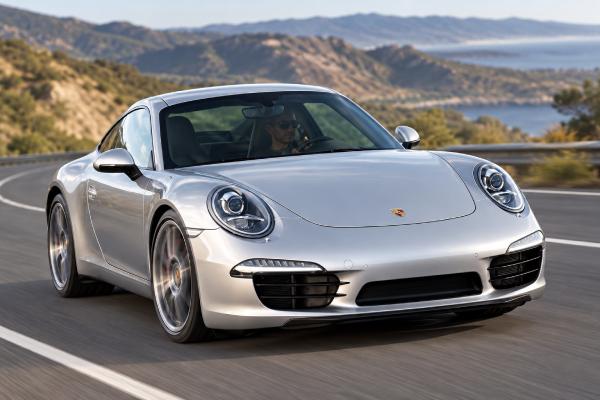
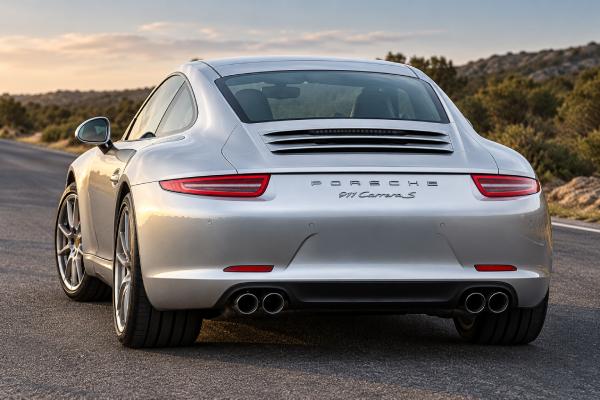
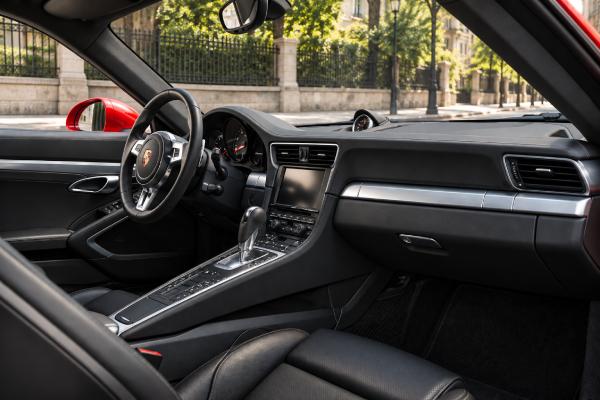
The 991.1 Porsche 911 Carrera S is the rear-wheel-drive, naturally aspirated 3.8-liter S model from the first phase of the 991 generation. In U.S.-specification factory data, the flat-six produces 400 hp at 7,400 rpm and 325 lb-ft (440 Nm) at 5,600 rpm, with a 7,800 rpm redline. A seven-speed manual was standard and seven-speed PDK was optional. That combination makes this car fundamentally different from the facelifted 991.2 Carrera S, which moved to a 3.0-liter twin-turbo engine.
For a used buyer, the headline numbers are only part of the story. The 991.1 Carrera S could be configured with important chassis options such as Porsche Active Suspension Management (PASM), Sport Chrono, Porsche Dynamic Chassis Control (PDCC), Porsche Torque Vectoring, and ceramic brakes. Those options change both capability and future service cost. A strong example is therefore one whose VIN, option record, maintenance history, tires, brakes, cooling system, transmission behavior, and accident history all support the condition claimed by the seller.
Table of Contents
- Identity and Scope of the 991.1 Carrera S
- Technical Reference for the 3.8-Liter Carrera S
- Engine Character and Gearbox Choice
- Chassis Options That Change the Car
- Performance, Efficiency, and Real Use
- Maintenance by Age, Not Just Mileage
- Pre-Purchase Evidence and Inspection Priorities
Identity and Scope of the 991.1 Carrera S
The car covered here is the 991.1 Carrera S coupe with rear-wheel drive and the 3.8-liter naturally aspirated engine, not the Carrera 4S, GTS, Cabriolet, or later turbocharged 991.2 Carrera S. That distinction matters because closely related 991 models can share body dimensions or transmissions while differing in engine output, driven wheels, brakes, standard wheel size, curb weight, and factory acceleration figures.
Porsche introduced the 991 generation with a longer wheelbase, extensive aluminum-steel construction, electromechanical power steering, and a seven-speed manual transmission. The Carrera S received the larger 3.8-liter flat-six and 20-inch wheels, while the base Carrera used a 3.4-liter engine and 19-inch wheels. The S also opened the door to chassis hardware such as PDCC that was not central to the base-car proposition.
The assignment’s MA1.03 designation is consistent with the 3.8-liter 400 hp engine used in the 991.1 Carrera S. The engine is direct injected, uses VarioCam Plus on the intake side, and employs integrated dry-sump lubrication. It should not be confused with the 430 hp Powerkit calibration used in the later 991.1 Carrera GTS or with the DCH-family 3.0-liter turbo engine used in the 991.2 Carrera S.
One model-year caution is useful: production dates, market model years, registration years, and advertised “year” can differ. A car first registered in 2016 may still be a pre-facelift 991.1, while some markets transitioned to the 991.2 on a different calendar. The physical engine, VIN, build data, exterior details, and factory equipment list should settle the identity.
Technical Reference for the 3.8-Liter Carrera S
Factory U.S. technical data describes a compact two-plus-two coupe with a rear-mounted naturally aspirated flat-six, rear-wheel drive, and either a seven-speed manual or seven-speed PDK. The specifications below are intentionally limited to values clearly attributable to the Carrera S coupe rather than borrowing data from the Carrera 4S or Cabriolet.
| Specification | Value |
|---|---|
| Engine | Rear-mounted, water-cooled horizontally opposed six-cylinder |
| Engine family/code | MA1.03 |
| Displacement | 3,800 cc (3.8 L) |
| Bore × stroke | 102.0 × 77.5 mm |
| Induction | Naturally aspirated |
| Fuel system | Direct fuel injection |
| Valvetrain | Four overhead camshafts, four valves per cylinder, VarioCam Plus on intake side |
| Compression ratio | 12.5:1 |
| Maximum power | 400 hp at 7,400 rpm |
| Maximum torque | 440 Nm (325 lb-ft) at 5,600 rpm |
| Engine redline | 7,800 rpm |
| Fuel | Premium unleaded |
| Specification | Value |
|---|---|
| Driven wheels | Rear-wheel drive |
| Manual transmission | 7-speed manual |
| Optional automatic | 7-speed Porsche Doppelkupplung (PDK) dual-clutch transmission |
| Final-drive ratio | 3.44:1 |
| Manual 7th gear | 0.71:1 |
| PDK 7th gear | 0.62:1 |
| Specification | Value |
|---|---|
| Front brakes | 6-piston aluminum fixed calipers; 340 mm internally vented, cross-drilled discs |
| Rear brakes | 4-piston aluminum fixed calipers; 330 mm internally vented, cross-drilled discs |
| Front wheels | 8.5J × 20 |
| Rear wheels | 11J × 20 |
| Front tires | 245/35 ZR20 |
| Rear tires | 295/30 ZR20 |
| Steering | Electromechanical power steering, variable ratio |
| Specification | Value |
|---|---|
| Wheelbase | 2,450 mm (96.46 in) |
| Length | 4,491 mm (176.81 in) |
| Width excluding mirrors | 1,808 mm (71.18 in) |
| Height | 1,295 mm (50.98 in) |
| Front luggage capacity | 135 L (4.76 cu ft) |
| Fuel tank capacity | 64 L (16.9 US gal) |
| Specification | Manual | PDK |
|---|---|---|
| Curb weight | 1,395 kg (3,075 lb) | 1,415 kg (3,120 lb) |
| 0–60 mph | 4.3 sec | 4.1 sec |
| Top track speed | 188 mph | 187 mph |
| Measure | Manual | PDK |
|---|---|---|
| City | 19 mpg | 20 mpg |
| Highway | 27 mpg | 27 mpg |
| Combined | 22 mpg | 22 mpg |
The acceleration table reflects Porsche’s period technical specification for the coupe. Sport Chrono can change launch behavior and quoted acceleration, so listings that cite a quicker time should be checked for transmission and package context rather than treated as contradictory data.
Engine Character and Gearbox Choice
The 3.8-liter engine makes its case at higher engine speed: peak torque arrives at 5,600 rpm, peak power at 7,400 rpm, and the redline is 7,800 rpm. That shape is the core difference between this car and the later 991.2 S, whose turbocharged engine delivers much more torque from low rpm. A healthy 991.1 S therefore feels progressive rather than dramatically boosted in the midrange.
The high compression ratio and direct injection make correct fuel quality important. Porsche specifies premium unleaded in its U.S. technical data. A pre-purchase drive should be performed only after the engine is warm enough for meaningful evaluation. The driver should look for clean response through the rev range, stable temperatures, no persistent warning messages, and no abnormal smoke or misfire behavior under load.
The seven-speed manual is unusual because it adds a tall seventh gear to a layout intended to preserve performance in the lower ratios. Its attraction is direct driver control, but condition matters more than romanticizing the specification. The clutch should take up progressively, full-load acceleration should not produce engine-speed flare without matching vehicle acceleration, and all gates should engage cleanly. A vague or obstructive shift is a reason to diagnose, not something to dismiss as “normal for a seven-speed.”
PDK is the faster and easier transmission in dense traffic. It also gives the lower cruising ratio in seventh. On a used car, test both cold and fully warm behavior: selection of Drive and Reverse, low-speed creep, smoothness leaving a stop, manual paddle commands, and harder upshifts after the fluids reach temperature. Warning messages, repeated harsh engagement, or obvious judder deserve specialist investigation.
Neither gearbox should be chosen on the assumption that it eliminates maintenance. Porsche’s service documentation and market-specific schedules should determine fluid and inspection work. A complete invoice history is more useful than a seller’s statement that a transmission is “sealed for life.”
Chassis Options That Change the Car
The same 991.1 Carrera S can feel and cost very different depending on its option list. PASM, Sport Chrono, PDCC, Porsche Torque Vectoring, sport exhaust, seat type, and brake system are not interchangeable cosmetic details; some materially change the car’s dynamic behavior or the price of future wear items.
PASM uses electronically controlled dampers and, where fitted in this generation, lowers the chassis relative to the standard setup. It broadens the usable range between road comfort and body control. On inspection, confirm that the system changes modes without faults, all dampers are dry, ride height is consistent, and there are no noises that appear only over small sharp inputs.
PDCC was a notable option on the Carrera S. The hydraulic anti-roll system reduces body roll by actively counteracting lateral movement. It can make the car flatter in fast corners, but it also adds hydraulic components that should be inspected for leaks, damage, or warning messages. A car without PDCC is not incomplete; it is simply a mechanically simpler configuration.
Sport Chrono affects the driver interface and the way PDK cars access their most aggressive launch and shift strategies. It should therefore be confirmed from factory equipment data rather than inferred from an aftermarket steering wheel or dashboard clock alone.
The standard S brakes are already substantial. Porsche Ceramic Composite Brakes (PCCB) were optional on many 991 configurations. PCCB-equipped cars require a different buying mindset because carbon-ceramic discs can be very expensive to replace. Do not judge them only by remaining pad thickness: inspect disc surfaces for damage and obtain a specialist assessment if there is any doubt about wear or prior track use.
Tires are equally consequential. Four premium tires of the correct size, similar age, and comparable tread depth tell a better story than a mix of brands installed at different times. Date codes matter on low-mileage cars because a tire can age out before it wears out. The 20-inch S wheels are also vulnerable to pothole damage; vibration at speed or repeated balancing weights can justify closer wheel inspection.
Performance, Efficiency, and Real Use
The Carrera S was quick by contemporary standards without depending on forced induction: Porsche listed 0–60 mph in 4.3 seconds for the manual and 4.1 seconds for PDK in the period U.S. technical sheet. With the appropriate Sport Chrono configuration, Porsche also publicized quicker launch figures. The practical point is that acceleration data should always be tied to gearbox and equipment.
Top speed is similarly configuration-specific. Porsche listed 188 mph for the manual coupe and 187 mph for PDK. Those figures are useful for identifying the performance envelope, not for suggesting that a road car should be evaluated at such speeds. Far more relevant in normal ownership is how the engine responds above 4,000 rpm, whether the brakes remain straight and consistent, and whether the car tracks cleanly without tramlining caused by worn tires or poor alignment.
Period U.S. economy figures of 22 mpg combined for both manual and PDK show that the 991’s efficiency work was not limited to engine downsizing. Auto start/stop, electrical recuperation, thermal management, electromechanical steering, and—in PDK cars—coasting strategies were part of the generation’s engineering approach.
Real fuel use can move substantially with traffic, temperature, tire choice, speed, and driving style. A buyer should not treat a single dashboard average as proof of engine health. More meaningful signals are smooth cold starting, stable fuel trims in a diagnostic scan, absence of misfire counts that point to an active problem, and a service history showing appropriate ignition and air-filter maintenance.
Practicality is better than the classic 911 silhouette suggests. The front luggage compartment is useful for soft bags, and the rear seats can carry small passengers or be folded for additional luggage. The compromise is packaging: wide rear tires, low ride height, and 20-inch wheels make neglected roads and steep driveways more demanding than in a conventional coupe.
Maintenance by Age, Not Just Mileage
A 991.1 Carrera S is now old enough that calendar-based service is as important as odometer mileage. A low-mileage car can still have aged brake fluid, old tires, tired batteries, hardened seals, stale air filters, and service items that were postponed because the car was driven only occasionally.
Treat the maintenance booklet for the car’s VIN and market as the controlling schedule. On a 991.1 Carrera S, the history should show that both elapsed time and mileage were considered for oil service, brake fluid, spark plugs, intake filters, the auxiliary drive belt, and the appropriate transmission fluids. A car that has spent years covering very little distance can still be overdue for age-based work, so invoices with dates and odometer readings are more informative than a service stamp alone.
Useful records should show more than stamps. Ask for invoices documenting:
- engine-oil and filter services, including dates and mileage;
- spark plugs and ignition-related work;
- brake-fluid changes and any caliper, pad, or disc work;
- air-filter and drive-belt replacement;
- PDK or manual-transmission fluid service where due;
- battery replacements and charging-system work;
- cooling-system repairs, including the reason for replacement rather than only the part name;
- tires with installation dates, alignment work, and any wheel repairs.
Front radiators and air-conditioning condensers sit behind openings that can collect leaves and road debris. Inspection should therefore include the front cooling area rather than stopping at the visible bodywork. Debris does not prove overheating, but blocked airflow, damaged fins, wet staining, or obvious impact damage should be addressed.
The underside deserves equal attention. Look for damaged aerodynamic panels, fluid residue, bent jacking points, scraped exhaust components, and signs that the car has been lifted incorrectly. A clean underside is especially valuable on cars that have been driven through salted winters or used on track days.
For cars driven infrequently, battery condition matters because low system voltage can produce misleading warnings and unhappy module behavior. A maintained battery and evidence of correct storage are more reassuring than a car that starts only after a jump pack despite showing very low mileage.
Pre-Purchase Evidence and Inspection Priorities
The safest way to buy a 991.1 Carrera S is to treat documentation, diagnostics, and physical condition as one evidence set. No single feature—low mileage, a clean paint finish, a dealer stamp, or a desirable option—should override contradictions elsewhere.
Begin with identity. Decode the VIN, obtain the factory option list or build data, and make sure the car is genuinely a Carrera S with the expected engine and body configuration. Confirm major options physically. Aftermarket wheels, retrofitted steering wheels, exhaust systems, software, and suspension parts are not automatically bad, but they should be declared and supported by invoices.
A cold-start inspection is valuable because it reveals behavior that a pre-warmed seller demonstration can hide. Listen after the initial fast-idle phase, check the instrument cluster before clearing any messages, and inspect the ground beneath the car. Once fully warm, drive through low load, steady cruise, and progressively higher load. Use the upper rev range briefly if conditions are safe; a 3.8-liter Carrera S that is never taken beyond midrange cannot be evaluated properly.
A Porsche-capable diagnostic scan should be part of a serious inspection. On a manual car, review over-rev data in context with an experienced specialist rather than treating every logged event as catastrophic. On PDK cars, inspect transmission fault memory and behavior. Across both, check current and stored engine, chassis, ABS/PSM, PASM, airbag, and body-control faults.
Body condition should be verified with panel gaps, paint-depth readings where appropriate, glass and lamp dates, underbody inspection, and records of any repair. A professionally repaired cosmetic incident is not the same as structural damage, but undisclosed repairs reduce confidence because they make the rest of the seller’s history harder to trust.
Finally, check open recalls and campaigns by VIN in the country where the car is registered. Recall applicability can depend on production date and equipment; a generic list for “2012–2016 Porsche 911” is not precise enough. In the United States, the NHTSA VIN tool is the official starting point.
The 991.1 Carrera S is most compelling when its original high-revving engine, transmission choice, chassis specification, and maintenance history all make sense together. For ownership, the best evidence is not a claim that the model is universally reliable or troublesome; it is a well-documented individual car whose condition supports the records.
References
- Technical Specifications – Porsche Newsroom USA 2026
- The new Porsche 911 Carrera: Tradition meets modernity – Porsche Newsroom 2011
- The 991: the 911 passes the one million mark – Porsche Newsroom 2018
- 60 Years of Porsche 911 – Porsche Newsroom 2023
- Service | Porsche Centre Melbourne 2026
- Check for Recalls: Vehicle, Car Seat, Tire, Equipment | NHTSA 2026 (Recall Database)
Disclaimer
This article is for informational purposes and is not a substitute for professional diagnosis, repair, or inspection. Specifications, torque values, service intervals, fluids, campaigns, and procedures can vary by VIN, market, production date, transmission, and equipment. Verify the individual car against current official Porsche service documentation and the applicable recall database before maintenance or purchase. If this guide was useful, please consider sharing it on Facebook, X/Twitter, or another enthusiast community to support our work.