
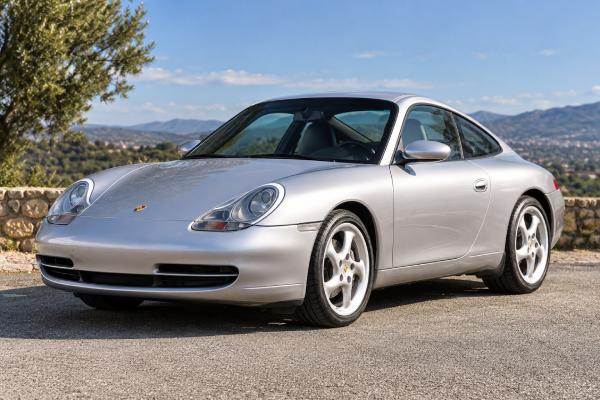
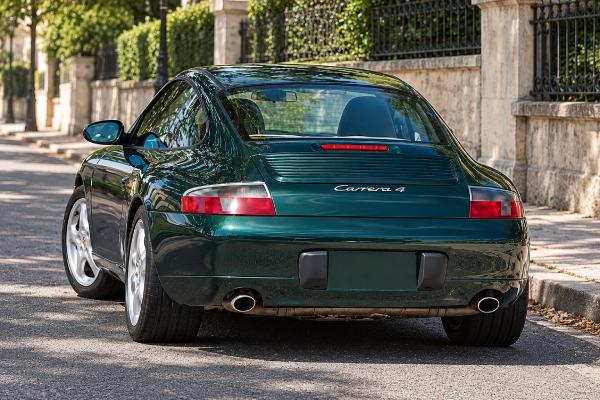
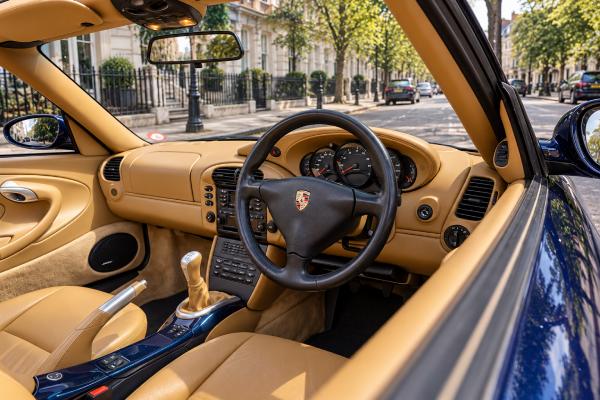
The 2000–2001 Porsche 911 Carrera 4 adds a specific layer of engineering to the early 996 formula: a compact, rear-engined 911 with the 3.4-liter M96.04 flat-six and a passive all-wheel-drive system. It is not a wide-body 4S and it is not mechanically equivalent to the later 3.6-liter 996.2 Carrera 4. For these two model years, the regular Carrera 4 keeps the narrow Carrera body while adding a front differential, propeller shaft, and viscous center coupling that can feed torque to the front axle when rear slip develops.
Porsche rated the engine at 221 kW and 300 PS; 300 PS equals about 296 mechanical hp, although North American period specifications often list 300 hp. This article uses the manual Coupé as the principal specification reference and notes where Tiptronic S, Cabriolet bodywork, market equipment, or option packages alter the figures.
Table of Contents
- Why the early Carrera 4 is different
- All-wheel-drive system explained
- Carrera 4 specifications
- Performance and chassis trade-offs
- Service needs unique to the C4
- M96.04 engine health
- How to inspect and buy one
Why the early Carrera 4 is different
The 2000–2001 Carrera 4 combines the original 996.1 styling and 3.4-liter engine with all-wheel drive, but it still uses the same narrow body shell as the contemporary rear-wheel-drive Carrera. That is the easiest way to separate it conceptually from the later Carrera 4S, whose Turbo-derived wide body, brakes, and styling create a very different package.
Porsche introduced the 996-generation Carrera 4 after the rear-wheel-drive Carrera and designed the 996 platform from the outset with space in the transmission tunnel for an all-wheel-drive system. The drivetrain adds hardware at the front of the car but does not turn the Carrera 4 into a front-heavy grand tourer. The engine remains behind the rear axle, and the all-wheel-drive system is strongly rear-biased in normal operation.
This matters for both driving and ownership. Compared with the equivalent Carrera, the Carrera 4 carries more mass and more rotating components. In return, it can send torque to the front axle when rear-wheel speed differs enough to engage the viscous coupling. On wet, cold, loose, or uneven surfaces, that extra traction is the defining advantage of the variant.
The Carrera 4 was sold as a Coupé and Cabriolet. Both could be ordered with a six-speed manual or five-speed Tiptronic S. The Coupé is the lighter and simpler reference configuration, while the Cabriolet adds roof mechanisms and body reinforcement. Buyers should therefore treat a quoted curb weight or acceleration time as body- and transmission-specific rather than universal.
All-wheel-drive system explained
The 996.1 Carrera 4 uses a passive viscous-coupling system rather than a modern electronically controlled Porsche Traction Management setup. In normal conditions it behaves as a rear-biased 911, with only a small amount of torque reaching the front axle; when slip increases, the viscous coupling progressively transfers more torque forward.
Specialist technical summaries commonly describe the system as sending roughly 5 percent of available torque to the front axle in normal driving and up to about 40 percent when slip demands it. The exact split is not a driver-selectable map. It depends on the speed difference across the coupling and the physical behavior of the silicone fluid inside it.
| Component | Arrangement | Practical significance |
|---|---|---|
| Engine | Rear-mounted M96.04 flat-six | Retains classic rear-engine 911 weight bias |
| Transmission | 6-speed manual or 5-speed Tiptronic S | AWD-specific transaxle hardware |
| Center coupling | Passive viscous coupling | Transfers more torque forward as slip increases |
| Front drive | Propeller shaft and front differential | Adds traction and additional service points |
| Nominal torque bias | Strongly rear-biased | Preserves rear-drive character in ordinary use |
| Stability control | Porsche Stability Management fitted on Carrera 4 | Works alongside mechanical AWD rather than replacing it |
The system is simple compared with later electronically managed AWD. There is no separate driver mode for front-axle engagement and no clutched transfer case varying torque according to a software map. That simplicity is one reason the early Carrera 4 remains attractive to owners who want extra traction without a dramatic change in 911 character.
Porsche’s own historical record gives the system unusual credibility. In 1999, Porsche Cars Australia used a standard-production 996 Carrera 4 as the basis for a crossing of the Simpson Desert. The car received practical changes for ground clearance and desert preparation, but the AWD hardware itself was standard. That does not make the Carrera 4 an off-road vehicle; it does show that the passive system was designed with meaningful traction reserve rather than serving as a cosmetic model distinction.
Carrera 4 specifications
The 2000–2001 Carrera 4 keeps the same 3,387 cc engine output as the rear-wheel-drive Carrera but gains approximately 55 kg in DIN curb weight for the manual Coupé. Most of that difference comes from the front-drive hardware and related structure.
| Specification | Value |
|---|---|
| Engine code | M96.04 |
| Type | Naturally aspirated, water-cooled flat-six |
| Displacement | 3,387 cc (3.4 L) |
| Bore × stroke | 96 × 78 mm |
| Valvetrain | DOHC, 24 valves with VarioCam |
| Compression ratio | 11.3:1 |
| Maximum power | 221 kW at 6,800 rpm |
| Power convention | 300 PS; approximately 296 mechanical hp |
| Maximum torque | 350 Nm (258 lb-ft) at 4,600 rpm |
| Specification | Manual Coupé | Tiptronic S Coupé |
|---|---|---|
| Transmission | 6-speed manual | 5-speed torque-converter automatic |
| Drive | All-wheel drive | All-wheel drive |
| 0–100 km/h | About 5.2 s | About 6.0 s |
| Top speed | 280 km/h (174 mph) | Approximately 275 km/h (171 mph) |
| DIN curb weight | 1,375 kg (3,031 lb) | Higher than manual configuration |
| Specification | Value |
|---|---|
| Body style | 2-door 2+2 Coupé or Cabriolet |
| Length | 4,430 mm (174.4 in) |
| Width, excluding mirrors | 1,765 mm (69.5 in) |
| Height | 1,305 mm (51.4 in), Coupé reference |
| Wheelbase | 2,350 mm (92.5 in) |
| Fuel tank | 64 L (16.9 US gal) |
| Front luggage space | About 130 L, depending on measurement convention |
| Specification | Value |
|---|---|
| Front suspension | MacPherson strut |
| Rear suspension | Independent multi-link |
| Steering | Hydraulic power-assisted rack and pinion |
| Standard front tire | 205/50 ZR17 |
| Standard rear tire | 255/40 ZR17 |
| Optional wheel package | 18-inch staggered wheels were available |
| Brakes | Ventilated discs with fixed four-piston calipers |
North American specification databases sometimes list 300 hp rather than the European 300 PS figure. Because the assignment itself uses 300 hp, both descriptions are likely to be encountered in advertisements and owner records. The safest technical convention is to keep the factory 221 kW figure visible and state the power unit being used.
Performance and chassis trade-offs
The Carrera 4 does not gain engine power over the rear-wheel-drive Carrera; its advantage is traction. In dry straight-line acceleration, the extra drivetrain mass largely offsets the launch benefit, so factory performance is very close to the Carrera rather than dramatically quicker.
That creates a different ownership proposition from a higher-output model. The Carrera 4 is not the performance upgrade in the way a Carrera S or Turbo is. It is the traction-focused choice within the early 996 Carrera family. On poor surfaces the front axle can help deploy the same 350 Nm more cleanly, while the rear-biased default keeps steering and throttle behavior recognizably 911-like.
The front driveline adds some inertia and weight over the nose. Drivers comparing otherwise healthy Carrera and Carrera 4 examples may notice the C4 feels slightly less delicate in steering response, but condition has a larger effect than the badge after twenty-five years. Worn front control arms, aging dampers, old tires, or poor alignment can make a Carrera 4 feel far duller than Porsche intended.
Tire matching is particularly important on the AWD car. The front and rear tires are different sizes by design, but their rolling circumferences still need to stay within the expected relationship. Mixing unrelated tire models, very different tread depths, or incorrect sizes can create unnecessary speed differences across the driveline. For that reason, a C4 buyer should inspect all four date codes, sizes, brands, and tread depths rather than evaluating the rear tires alone.
Porsche Stability Management also changes the safety envelope. On the Carrera 4, PSM can brake individual wheels and reduce engine torque when the car deviates from the intended path. It works in addition to the passive mechanical AWD system. A warning light, disabled system, or diagnostic fault should therefore be treated as a real repair item, not merely an inconvenience.
Service needs unique to the C4
A Carrera 4 needs the same engine, cooling, brake, and suspension attention as a rear-wheel-drive 996, plus inspection and fluid service for the front driveline. The added hardware is generally durable, but neglect is harder to justify now that these cars are old enough for several generations of deferred maintenance.
| Area | What to check | Why it matters |
|---|---|---|
| Front differential | Oil condition, seals, bearing noise | Unique AWD service point |
| Propeller shaft | Joints, support, vibration, damage | Connects rear transaxle to front axle |
| Viscous coupling | Abnormal binding or ineffective torque transfer | Core of the passive AWD system |
| Front driveshafts | CV boots, joints, grease leakage | Age can crack rubber boots and contaminate joints |
| Tires | Correct staggered size and comparable rolling diameter | Protects driveline behavior and traction balance |
| PSM/ABS | Warning lights and diagnostic faults | Wheel-speed data is central to stability functions |
A specialist maintenance schedule for an aging 996 typically shortens the practical oil-service interval from the long original factory mileage schedule and emphasizes annual inspection. Brake fluid, engine air and cabin filters, spark plugs, accessory belt, coolant-system condition, gearbox oil, and differential oil should be judged by age and documentation as well as mileage.
The front differential is easy to overlook because the car may continue to drive normally with old fluid or slight seal seepage. A complete service history should therefore show more than engine oil changes. On a manual car, transmission oil and front-differential oil are separate items. On a Tiptronic car, the automatic transmission adds its own fluid and filter requirements.
Cooling-system condition remains a priority. The Carrera 4 shares the 996’s front-mounted radiators and condensers, which can trap leaves and debris in the bumper ducts. Inspect for corrosion, dried coolant residue, fan operation, expansion-tank cracking, water-pump history, and hose condition.
M96.04 engine health
The M96.04 should be evaluated by evidence rather than internet reputation. The major point specific to the 2000–2001 period is that the intermediate-shaft bearing can be either a dual-row or single-row serviceable design, so year alone is not enough to identify what is fitted.
LN Engineering’s technical material identifies these two years as the crossover period. A replacement engine can further complicate identification because a factory replacement may use the bearing design current when that replacement engine was produced. Before ordering parts or assuming a previous retrofit is compatible, the actual engine and bearing configuration should be confirmed.
An IMS failure can release metal debris and disturb camshaft timing, potentially causing extensive engine damage. Preventive bearing work therefore only makes sense on an engine that is otherwise healthy. A pre-qualification inspection should consider oil-filter debris, oil leaks, running quality, abnormal noises, diagnostic faults, and the engine’s broader mechanical condition.
Other M96 concerns deserve the same measured approach. Persistent oil smoke, high oil use, rhythmic knocking, or unequal soot between exhaust outlets can justify borescope, compression, or leak-down testing. Those symptoms can also have less severe causes, including a faulty air-oil separator, so proper diagnosis matters.
Rear main seal leakage is another familiar inspection item. The presence of oil near the bellhousing should be traced rather than automatically blamed on one seal. On a manual car, clutch replacement provides an opportunity to address rear-of-engine service items efficiently, which makes detailed invoices useful when assessing a car that has already had transmission-out work.
How to inspect and buy one
A good 2000–2001 Carrera 4 should prove three things before purchase: that it is the correct early 3.4-liter C4, that the engine is healthy, and that the all-wheel-drive hardware has not been ignored. A generic used-car inspection is not enough for a model whose distinguishing feature is a second driven axle.
Confirm the VIN, model year, engine identity, transmission, and original body style first. Cars registered in late 2001 can overlap with the 2002-model 996.2 changeover, so the 3.4-liter M96.04 and original 996.1 exterior details should match the assignment scope. If the engine number indicates a remanufactured or replacement engine, determine when it was installed and what documentation exists.
Then road-test the AWD system indirectly. There should be no driveline vibration, clunking, front-differential whine, or tight-corner binding. Steering should self-center cleanly, the car should track straight, and PSM/ABS warning lamps should complete their normal self-check and remain off. Abnormal behavior should be scanned rather than dismissed.
On a lift, inspect the front differential and driveshafts, propeller shaft, undertrays, coolant lines, engine and transmission for leaks, suspension joints, brake hoses, exhaust, and evidence of impact damage. The 996’s low nose makes front underbody damage possible, while poor accident repairs can disturb suspension geometry or driveline alignment.
Service records should show a pattern of proactive care rather than a burst of work immediately before sale. Useful evidence includes regular oil services, cooling-system repairs, suspension renewal, brake fluid changes, clutch or Tiptronic work, differential/gearbox fluids, IMS documentation if applicable, and replacement of age-sensitive rubber parts.
Finally, inspect the tires as a system. Four matching, correctly sized performance tires with similar age and sensible tread-depth relationships are a reassuring sign on a Carrera 4. A mixture of brands, incorrect sizes, or one axle with dramatically newer tires can indicate cost-cutting and should prompt a broader look at maintenance standards.
The 996.1 Carrera 4 makes the most sense for a buyer who specifically values the early 3.4-liter character and wants additional traction without the weight, width, and visual changes of the later 4S. Its appeal is not that it is faster than the Carrera. It is that Porsche added a compact, passive AWD system while retaining the narrow-body early 996 package.
References
- Trailblazer for the future of the 911: 25 years of the 996-generation Porsche 911 – Porsche Newsroom AUS 2022
- 70 Years Porsche in Australia: Sandmeister – Porsche Newsroom AUS 2021
- How to buy a Porsche 996 2022
- Used 2001 Porsche 911 Carrera 4 Specs & Features | Edmunds 2026
- Porsche 996 911 Buyer’s Guide | FCP Euro 2021
- What intermediate shaft bearing does my 2000 or 2001 Porsche Boxster or 911 have? – LN Engineering 2026
Disclaimer
This article is for informational purposes and does not replace professional diagnosis, inspection, or repair. Specifications, torque values, intervals, fluid requirements, and procedures can vary by VIN, market, body style, transmission, production date, and equipment, so confirm them against the official service documentation for the individual car.
If this guide helped, please share it on Facebook, X/Twitter, or another Porsche community to support our work.