
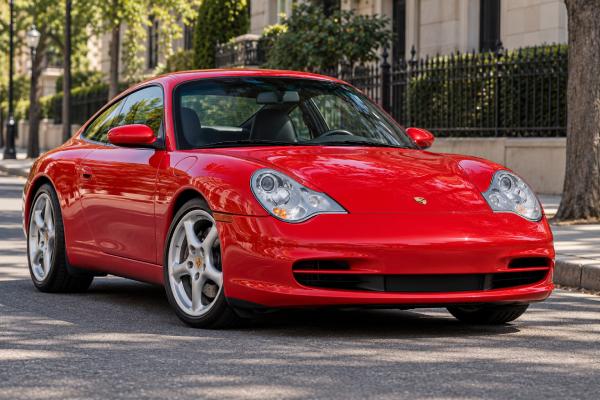
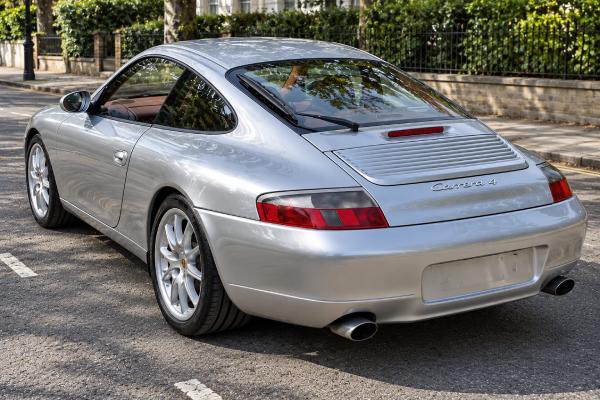
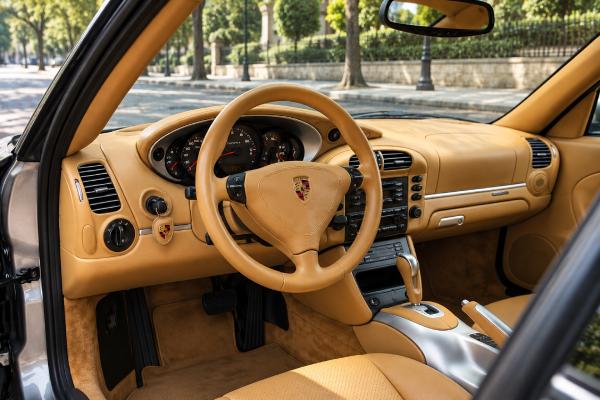
The 2002–2004 Porsche 911 Carrera 4 is the narrow-body, all-wheel-drive version of the facelifted 996.2 Carrera. It combines the 3.6-liter M96.03 flat-six and its VarioCam Plus valvetrain with a passive viscous-coupling driveline that normally remains strongly rear-biased but can transfer additional torque to the front axle when front-to-rear speed differences develop. That makes it mechanically distinct from both the simpler rear-wheel-drive Carrera and the visually broader Carrera 4S.
Porsche rated the facelift engine at 235 kW and 320 PS in European material. That metric figure corresponds to roughly 316 mechanical horsepower; North American data commonly lists 315 hp. The “320 hp” label in this article’s vehicle identification follows common model shorthand, not an assertion that PS and hp are identical units.
The discussion below covers the standard Carrera 4 Coupe architecture for model years 2002 through 2004, with transmission and market differences called out where relevant. Cabriolet data, Carrera 4S dimensions, Turbo hardware, and later 997 all-wheel-drive systems should not be substituted for this car.
Table of Contents
- What the “4” Adds to the Facelift Carrera
- How the Viscous All-Wheel-Drive System Works
- Carrera 4 Technical Data
- Grip, Stability, and Chassis Response
- Maintaining the Front Driveline and the Rest of the Car
- M96.03 Condition Checks That Matter
- Buying a Narrow-Body 996.2 Carrera 4
What the “4” Adds to the Facelift Carrera
The Carrera 4 adds a front differential, propeller shaft, front half-shafts, and a viscous multi-plate coupling to the basic 996.2 Carrera package. It does not add the wide Turbo-style body of the Carrera 4S: Porsche’s Classic description specifically notes that the standard Carrera 4 body is visually identical to the rear-wheel-drive Carrera.
That narrow-body point prevents a common classification error. A 2002–2004 Carrera 4 and a Carrera 4S share the naturally aspirated 3.6-liter output and all-wheel drive, but they are not the same trim with different badges. The 4S uses the broad body associated with the Turbo, different wheel and brake specifications, and its own chassis presentation. The ordinary Carrera 4 keeps the Carrera’s approximately 1,770 mm width and standard 17-inch wheel concept.
The 2002 facelift simultaneously brought the larger M96.03 engine. Displacement is 3,596 cc, output is 235 kW/320 PS in Porsche’s European specification, and torque is 370 Nm. VarioCam Plus varies both inlet cam timing and valve lift. A six-speed manual was standard in the usual enthusiast configuration, while five-speed Tiptronic S was optional.
All-wheel drive also increases mass. A representative 2004 U.S. Carrera 4 specification lists 3,267 lb (1,482 kg) curb weight, considerably more than the corresponding rear-drive listing. Market definitions of curb weight and installed equipment differ, so a single number should not be treated as universal, but the direction of the change is intrinsic: the front driveline adds hardware.
| Attribute | Specification |
|---|---|
| Body concept | Narrow-body 996.2 Carrera Coupe |
| Drive | Permanent/passive all-wheel drive with viscous coupling |
| Engine | M96.03 naturally aspirated flat-six |
| Displacement | 3,596 cc |
| European output | 235 kW (320 PS) at 6,800 rpm |
| North American output convention | 315 hp at 6,800 rpm |
| Torque | 370 Nm (273 lb-ft) at 4,250 rpm |
| Manual transmission | 6-speed |
| Optional automatic | 5-speed Tiptronic S |
How the Viscous All-Wheel-Drive System Works
The 996 Carrera 4 does not use the electronically controlled Porsche Traction Management system found on later 911 generations. Its front-axle torque transfer is passive: a sealed viscous multi-plate coupling responds to a rotational-speed difference between the axles, increasing torque transfer without a command from an electronic clutch controller.
Specialist technical descriptions of the 996 system place the normal front contribution at about five percent, with as much as roughly 40 percent available to the front axle when the coupling reacts to slip. The car therefore remains rear-biased in normal running. It is better to think of the front axle as an automatically available traction supplement than as half of a fixed 50:50 system.
The path starts at the rear-mounted engine and transaxle. A propeller shaft carries drive forward to the front axle unit. Within that assembly, the viscous coupling contains alternating plates connected to the two sides of the torque path and a silicone fluid. When front- and rear-axle speeds diverge, shearing of the fluid produces resistance between the plates and transfers more torque.
This arrangement has two important ownership consequences. First, there is physical hardware ahead of the cabin that a rear-drive Carrera does not have: propeller shaft, front differential/coupling assembly, seals, bearings, half-shafts, and CV joints. Second, tire circumference matters across all four corners. Tires of the correct specified sizes can still develop materially different rolling circumferences if they are mismatched by brand, model, wear, or pressure.
A small tread-depth difference is not automatically evidence of damage, but a Carrera 4 should not be treated like a two-wheel-drive car where replacing only one axle with any nominally matching tire is inconsequential. When tires are replaced, compare actual dimensions and remaining tread, use the correct staggered sizes, keep axle pairs matched, and follow Porsche guidance for the specific wheel package.
| Component or behavior | Function |
|---|---|
| Rear transaxle | Primary transmission/final-drive unit behind the engine |
| Propeller shaft | Carries drive forward from the rear transaxle |
| Front axle drive unit | Contains front differential and viscous-coupling hardware |
| Normal torque bias | Strongly rear-biased; about 5% to the front in cited specialist descriptions |
| Additional front transfer | Up to about 40% when axle-speed difference activates the coupling |
| Control principle | Passive viscous response rather than an electronically commanded center clutch |
Carrera 4 Technical Data
The manual 996.2 Carrera 4 uses the same core M96.03 dimensions as the rear-drive Carrera but carries the extra AWD mass. Period European data gives a 285 km/h top speed and about 5.0 seconds from 0–100 km/h for a six-speed Coupe; the five-speed Tiptronic S is slower, with period factory listings around 5.5 seconds and 280 km/h.
| Item | Manual specification |
|---|---|
| Engine configuration | Water-cooled DOHC 24-valve flat-six |
| Bore × stroke | 96.0 × 82.8 mm |
| Compression ratio | 11.3:1 |
| Valve control | VarioCam Plus |
| 0–100 km/h | About 5.0 seconds |
| Top speed | About 285 km/h (177 mph) |
The narrow Carrera body is approximately 4,430 mm long and 1,770 mm wide, with a 2,350 mm wheelbase. Height is around 1,305 mm. The tank holds 64 liters. These dimensions are useful identifiers because the 4S grows to roughly 1,830 mm wide, so a specification sheet showing the wider figure is not describing a normal Carrera 4.
| Measure | 996.2 Carrera 4 Coupe |
|---|---|
| Length | Approximately 4,430 mm (174.4 in.) |
| Width without mirrors | Approximately 1,770 mm (69.7 in.) |
| Height | Approximately 1,305 mm (51.4 in.) |
| Wheelbase | 2,350 mm (92.5 in.) |
| Representative 2004 U.S. curb weight | 3,267 lb (about 1,482 kg) |
| Fuel tank | 64 L (16.9 U.S. gal) |
Standard 17-inch fitment is commonly 205/50 ZR17 front and 255/40 ZR17 rear. Eighteen-inch wheels were optional. Wheel width, offset, approved tire size, load rating, and tire circumference should be checked together, particularly on modified cars.
| Axle | Tire size |
|---|---|
| Front | 205/50 ZR17 |
| Rear | 255/40 ZR17 |
Historical U.S. fuel-economy data for a 2004 Carrera 4 manual lists 15 mpg city, 22 mpg highway, and 18 mpg combined. Those values describe a period test cycle and should not be projected directly onto modern real-world use.
Grip, Stability, and Chassis Response
The Carrera 4’s front driveline changes how the chassis deploys traction without erasing the 911’s rear-engine character. In ordinary driving most torque remains at the rear, so steering is not continuously loaded as it would be in a fixed high-front-torque system; when rear slip creates an axle-speed difference, the viscous coupling increases front participation.
Porsche Stability Management is an important partner to the mechanical system. PSM can use braking and engine intervention to address instability, whereas the viscous coupling’s role is torque transfer. A warning lamp, wheel-speed sensor fault, mismatched tire, or low-voltage electrical problem can affect the behavior of stability and ABS systems even though the center coupling itself is passive.
Compared with the rear-drive Carrera, the C4 carries more mass and hardware toward the front. That can make the car feel less delicate in initial response while giving the driver additional traction security on wet or loose surfaces. Alignment and tire quality remain decisive. All-wheel drive cannot compensate for old rubber, weak dampers, or worn suspension joints.
The front suspension remains strut-based and the rear uses a multi-link arrangement. Age can soften control-arm bushes, wear ball joints and links, and degrade top mounts and dampers. A Carrera 4 that feels vague, tramlines badly, knocks, or pulls under braking should be inspected mechanically before an alignment is used as a cure-all.
Brakes are ventilated discs at all four wheels. Brake-fluid age, caliper piston movement, flexible hoses, rotor condition, and pad wear matter more to stopping quality than a glossy caliper finish. Cars that sit can develop rotor corrosion and sticky parking-brake components even if their mileage is low.
Maintaining the Front Driveline and the Rest of the Car
A Carrera 4 service plan must include front-driveline items that do not exist on a Carrera 2. The front differential oil, shaft seals, propeller shaft, CV boots and joints, front axle bearings, and evidence of leakage or abnormal noise all deserve inspection alongside normal 996 engine and chassis maintenance.
A Porsche-derived historical maintenance document covers periodic oil service, fault-memory checks, underbody inspection, coolant hoses, radiators and air inlets, brakes, drive-shaft boots, tires, and road testing. Modern specialist schedules add age-based interpretation because these cars are now decades old. Pcarwise, for example, specifically includes front differential oil among the later-interval items for four-wheel-drive 996 Carreras.
| System | Useful checks |
|---|---|
| Front differential/coupling unit | Oil condition where serviceable, leakage, seal condition, bearing noise |
| Propeller shaft | Mounting, joints/couplings, vibration, interference or damage |
| Front half-shafts | CV boots, grease leakage, clicking or play |
| Tires | Correct staggered sizes, matching construction, pressure, age, tread-depth balance |
| PSM/ABS | Fault scan, wheel-speed data, warning-lamp function |
| Cooling package | Radiators, condensers, debris pockets, fans, coolant tank, pump, hoses |
Listen for driveline symptoms at different operating conditions. A whine that varies with road speed, a vibration under load, a click during tight turns, or oil around the front axle unit should be investigated before parts are ordered. Tire-related vibration, wheel-bearing noise, propeller-shaft problems, and differential noise can overlap subjectively.
The engine side of the service plan remains substantial. Establish oil and filter history, spark-plug and coil age, accessory-belt condition, coolant history, water-pump condition, air-oil separator health, and any recurring fault codes. Clean debris from the front cooling-air cavities and verify both radiator-fan stages as appropriate.
Brake fluid and tires age even when mileage is low. Battery condition matters too because low system voltage can create misleading electronic symptoms. A maintained Carrera 4 should have records showing attention across systems rather than a thick folder devoted only to cosmetic upgrades.
M96.03 Condition Checks That Matter
The 2002–2004 M96.03 should be assessed for its actual mechanical condition, with the IMS bearing treated as one important item rather than the entire diagnosis. Specialist IMS documentation identifies 2002–2005 996 engines as the period in which the smaller serviceable single-row bearing was fitted, although a replacement engine can carry a configuration associated with its own production date.
For a car still using its original 2002–2004 engine, documentary proof of any IMS work is valuable. An invoice should identify the installed solution, date, mileage, and ideally related clutch or rear-main-seal work. A sticker or seller statement saying “IMS done” does not establish what bearing is installed or whether it has a service interval of its own.
Cylinder condition also deserves attention. Oil consumption, unevenly sooted exhaust outlets, unusual mechanical noise, contaminated spark plugs, or debris in the oil/filter can justify deeper investigation. A borescope examination by a technician experienced with M96 cylinders can provide direct information; compression or leak-down testing may add context when symptoms warrant it.
Crankcase ventilation through the air-oil separator affects idle, oil control, and smoke behavior. A failed or deteriorated separator can create strong crankcase vacuum and oil ingestion. Rear main seal seepage, cam-cover leaks, and other oil leaks must be traced to source because oil appearing at the bottom of the engine can migrate.
The cooling system deserves equal seriousness. An expansion tank, cap, pump, thermostat, hose, or radiator fault can become expensive if overheating follows. Evidence of chronic coolant loss, mixed coolant types, residue around the tank, or an unstable temperature indication should be resolved before purchase.
VarioCam Plus, ignition coils, plugs, mass-airflow sensing, and vacuum leaks can all influence running quality. Read diagnostic fault memory and, where appropriate, live data and camshaft deviations rather than diagnosing from a single idle symptom.
Buying a Narrow-Body 996.2 Carrera 4
A pre-purchase inspection of a 996.2 Carrera 4 should prove three things separately: that the car is the variant represented, that its M96.03 is healthy, and that the additional AWD hardware is functioning without expensive deferred work. Mileage alone cannot answer any of those questions.
Start with the VIN and option data. Confirm body style, model year, transmission, engine identity, and original equipment. Because 996 Carreras are frequently modified with later wheels, bumpers, lights, suspension parts, or badges, appearance is not enough to determine specification. The standard C4 should retain the narrow body even if it wears 18-inch wheels.
Inspect tires as a set of four. Record brand, model, size, load/speed rating, production date, tread depth, and pressure. Large discrepancies between front and rear rolling circumference deserve correction and may justify asking how long the car was operated that way.
With the car on a lift, inspect the front axle drive unit for leaks, the propeller-shaft path and mounts, front CV boots, wheel bearings, undertrays, brake lines, suspension joints, and signs of impact. Examine the cooling system from the front bumper rearward. A clean top surface does not prove the radiator and condenser cavities are free of trapped debris.
Start the engine from cold when possible. Note oil-pressure response, idle, smoke, unusual mechanical sounds, coolant warnings, and all dashboard self-check lamps. A scan should include engine, PSM/ABS, airbag, and transmission-related modules where applicable. Historic or intermittent faults matter when they align with road-test symptoms.
During the road test, use tight low-speed turns as well as straight acceleration and steady cruising. Listen for clicking, groaning, speed-related whine, vibration, wheel-bearing roar, and suspension knocks. Test braking on a safe straight surface and confirm that ABS/PSM warning lamps remain off. Manual cars should shift consistently when hot; Tiptronic cars should engage and change gears cleanly without flare or harsh delay.
Finally, reconcile the invoices with the physical car. Look for evidence of front differential service, four-tire replacement practices, cooling-system work, suspension renewal, clutch and IMS history, oil service, plugs/coils, brake fluid, and recurring repairs. A Carrera 4 can be an exceptionally usable 996, but its extra traction hardware makes “maintained like a normal Carrera” an incomplete standard. The best example is one whose engine, front driveline, tires, stability systems, and age-sensitive chassis parts have all been treated as parts of the same car.
References
- Modelo Porsche 911 Carrera 4 (tipo 996) | Porsche España 2026
- Fifth generation – Engines – Porsche Newsroom 2023
- Used 2004 Porsche 911 Carrera 4 Specs & Features | Edmunds 2026
- Porsche 996 911 Buyer’s Guide | FCP Euro 2021
- Recommended Maintenance Schedule Porsche 911 Carrera 996 2026
- IMS Bearing Problem Years in Porsche Boxster and 911 – LN Engineering 2026
Disclaimer
This guide provides general technical and ownership information; it is not a substitute for professional inspection, diagnosis, or repair. Vehicle specifications, fluids, torque values, service intervals, parts, and procedures can differ by VIN, market, production date, transmission, body style, and equipment. Confirm service work against the official documentation for the individual car.
Please share this guide with another 996 Carrera 4 owner or Porsche community if it would help someone maintain or inspect one more carefully.