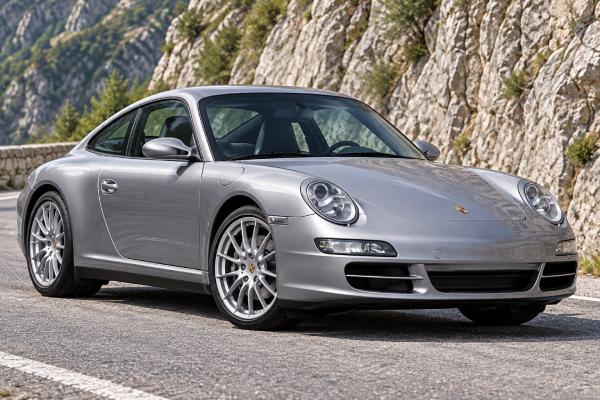
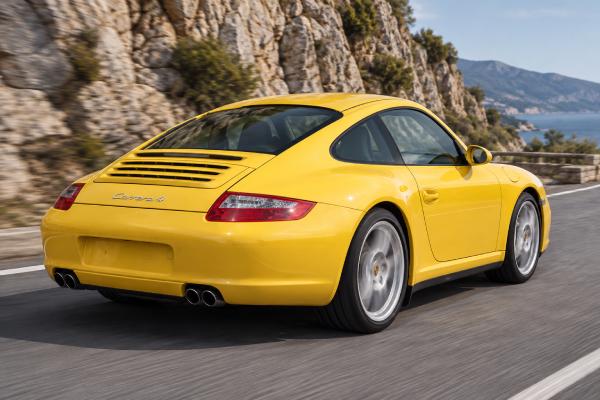
Adding the numeral “4” changes more than traction on the 2006–2008 Porsche 911 Carrera 4. This 997.1 combines the 3.6-liter M96.05 flat-six with permanent all-wheel drive, a 44 mm wider body than the contemporary rear-drive Carrera, a 67-liter fuel tank, and wider rear wheels and tires. It is still the non-S model: output is 239 kW/325 PS in Porsche’s European material, the brakes are the smaller Carrera specification, and PASM was optional rather than standard. North American period sources commonly label the engine 325 hp, while 325 PS converts to roughly 321 mechanical horsepower.
The scope here is specifically the 2006–2008 Carrera 4 Coupe-era specification with the pre-facelift M96.05. It excludes the 3.8-liter Carrera 4S, Targa 4, Turbo, and the 2009-on 997.2, whose direct-injected engine and revised all-wheel-drive technology make it a different technical proposition.
Table of Contents
- The Wide-Body 3.6-Liter Carrera 4
- How the 997.1 Carrera 4 AWD System Works
- 3.6 Carrera 4 Specifications and Technical Data
- Tires, Brakes, and AWD Road Behavior
- Maintaining the Extra Driveline Hardware
- M96.05 Engine Risks in 2006–2008 Cars
- Buying by Condition, Evidence, and Configuration
The Wide-Body 3.6-Liter Carrera 4
The 997.1 Carrera 4 is the all-wheel-drive counterpart to the base 3.6-liter Carrera, but Porsche gave the four-wheel-drive cars a body 44 mm wider than the rear-drive versions. It therefore has the visual stance many buyers associate with the 4S while retaining the 325-output M96.05, black brake calipers, 18-inch standard wheel package, and optional rather than standard PASM.
That combination is useful to understand because used-car descriptions often collapse “Carrera 4” and “Carrera 4S” into one wide-body category. The sheet metal may be similarly broad, but the mechanical specification is not. The Carrera 4S has the 3.8-liter M97.01, 355-output rating, larger 330 mm brakes, and S-model chassis equipment. The 3.6 Carrera 4 discussed here uses 318 mm front and 299 mm rear iron brake discs and a different standard wheel/tire package.
The wider rear body accommodates an 11-inch rear wheel and 295/35 ZR18 tire in the standard 18-inch configuration. Up front, the typical factory specification is an 8-inch wheel with a 235/40 ZR18 tire. The rear-wheel-drive base Carrera uses a narrower rear package, so a seller’s claim that a C4 has ordinary “Carrera wheels” should be checked against actual widths, offsets, tire sizes, and part numbers rather than appearance alone.
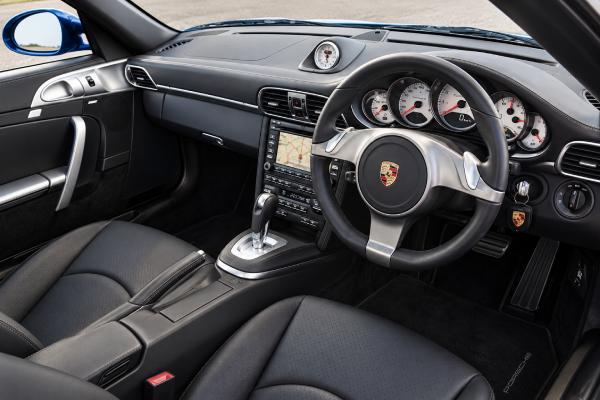
Porsche Active Suspension Management was available as an option on the Carrera 4. A car without PASM is therefore not missing standard equipment, while a car advertised as having PASM should have the corresponding controls and correct adaptive dampers. The same principle applies to Sport Chrono, PCCB, navigation, seat types, and other options: distinguish factory specification from later additions.
The 2006–2008 date range is also technically convenient for one engine issue. Unlike the 2005 rear-drive Carrera, which straddles two IMS-bearing designs, a 2006–2008 M96.05 is expected to use the later, larger bearing that is not externally replaceable with the engine assembled. That does not eliminate the need for engine due diligence, but it changes what a sensible inspection should focus on.
How the 997.1 Carrera 4 AWD System Works
The pre-facelift Carrera 4 uses a permanent all-wheel-drive system centered on a viscous multi-plate coupling, not the electronically controlled Porsche Traction Management hardware introduced on the contemporary 997 Turbo. In normal operation the front axle receives a small share of drive, with the viscous coupling able to increase front torque transfer as rear-to-front speed difference rises.
Period technical descriptions put the front-axle share between about 5 and 40 percent. The layout sends drive forward through a propshaft to a front final drive, while the viscous coupling changes how strongly the front axle is engaged according to relative rotational speed. It is fundamentally a mechanical, self-reacting system rather than a clutch commanded continuously by a modern chassis computer.
That matters in three practical ways. First, the car remains rear-biased in feel; it was not engineered to drive like a front-heavy all-wheel-drive sedan. Second, the system depends on suitable rolling circumference at all four corners. Third, the additional shaft, front final drive, seals, bearings, joints, and mounts create inspection and service points that simply do not exist on a rear-drive Carrera.
The viscous unit itself is generally described as maintenance-free, but “maintenance-free coupling” does not mean “maintenance-free all-wheel-drive car.” Porsche’s period maintenance material specifies a front differential oil change for four-wheel-drive 997 models at the long 120,000-mile/180,000-km or 12-year interval. Every car in this article’s model-year range is now beyond the time side of that original interval unless it has already been serviced.
Do not confuse this system with 997.2 Carrera 4 hardware. The facelift brought major drivetrain changes, just as it brought direct fuel injection and PDK. Parts listings, fluid advice, and diagnostic procedures for a later PTM-equipped car should not be transferred casually to a 2006–2008 viscous-coupling Carrera 4.
Tire matching is especially important because an all-wheel-drive system reacts to rotational differences. Porsche-approved tire specifications, correct sizes, closely matched wear, and appropriate pressures help keep effective rolling circumference where the drivetrain expects it. A car with one new tire and three heavily worn tires, mismatched axle sizes, or an improvised wheel package deserves correction and a closer driveline check.
3.6 Carrera 4 Specifications and Technical Data
The 997.1 Carrera 4 uses the same basic 3,596 cc M96.05 engine specification as the rear-drive Carrera but pairs it with the wider all-wheel-drive chassis. The tables below use representative manual Coupe values; Tiptronic S and Cabriolet configurations carry different weights and acceleration figures.
| Item | Specification |
|---|---|
| Engine code | M96.05 |
| Configuration | Rear-mounted, naturally aspirated flat-six |
| Displacement | 3,596 cc (3.6 L) |
| Bore × stroke | 96.0 × 82.8 mm |
| Compression ratio | 11.3:1 |
| Valvetrain | DOHC, 24 valves, VarioCam Plus |
| Fuel delivery | Sequential port fuel injection |
| Maximum output | 239 kW; 325 PS in European Porsche data at 6,800 rpm |
| North American period rating | 325 hp at 6,800 rpm |
| Maximum torque | 370 Nm (273 lb-ft) at 4,250 rpm |
| Engine-speed cutoff | Approximately 7,300 rpm |
| Item | Specification |
|---|---|
| Drivetrain | Permanent all-wheel drive, rear-biased |
| Center coupling | Viscous multi-plate coupling |
| Front torque share | Approximately 5–40% depending on coupling action |
| Standard gearbox | 6-speed manual |
| Optional gearbox | 5-speed Tiptronic S |
| 0–100 km/h | About 5.1 seconds, manual Coupe |
| 0–60 mph | About 4.9 seconds in period U.S. manual-Coupe data |
| Top speed | 280 km/h (174 mph), manual Coupe |
The output convention deserves a brief note. Porsche’s European 325 PS equals 239 kW and approximately 321 mechanical horsepower, while U.S. period specifications commonly list 325 hp. Both describe the same standard model in different market conventions; neither justifies substituting the 355-output 3.8-liter S engine.
| Item | Specification |
|---|---|
| Front suspension | MacPherson-strut layout with anti-roll bar |
| Rear suspension | LSA multi-link layout with anti-roll bar |
| Steering | Hydraulically assisted rack-and-pinion |
| PASM | Optional on Carrera 4 |
| Front brakes | 318 × 28 mm ventilated, cross-drilled iron discs; four-piston fixed calipers |
| Rear brakes | 299 × 24 mm ventilated, cross-drilled iron discs; four-piston fixed calipers |
| Standard front wheels/tires | 8J × 18; 235/40 ZR18 |
| Standard rear wheels/tires | 11J × 18; 295/35 ZR18 |
| Item | Specification |
|---|---|
| Length | 4,427 mm |
| Width | 1,852 mm excluding mirrors |
| Height | 1,310 mm |
| Wheelbase | 2,350 mm |
| Representative curb weight | About 1,450 kg (3,197 lb) in European manual-Coupe data |
| Fuel tank | 67 L (17.7 US gal) |
| Cycle | Rating |
|---|---|
| City | 17 mpg US |
| Highway | 25 mpg US |
| Combined | 20 mpg US |
Fuel economy is highly usage-dependent on an aging sports car. Those figures are period ratings, not expected consumption for every present-day example, especially one used mainly for short cold trips or fitted with non-standard tires.
Tires, Brakes, and AWD Road Behavior
The Carrera 4’s road behavior comes from the combination of rear-biased all-wheel drive and the wider 295-section rear tire, not from a large increase in engine output. Compared with the rear-drive 3.6 Carrera, it trades some mass and a little straight-line speed for greater traction reserve and a different sense of stability when conditions are poor.
The extra drivetrain mass is roughly on the order of 50 kg in period descriptions. That helps explain why the manual Carrera 4’s factory-style 0–100 km/h figure is about 5.1 seconds and top speed about 280 km/h, slightly behind the lighter rear-drive Carrera. The gain is not a faster engine; it is the ability to send some torque forward when rear-wheel speed difference causes the viscous coupling to engage more strongly.
On dry roads the system should remain unobtrusive. Binding, hopping, shuddering, or repeated driveline vibration on ordinary low-speed turns is not a desirable “AWD characteristic.” Those symptoms warrant investigation of tire circumference, wheels, CV joints, propshaft components, mounts, final-drive condition, or other driveline causes.
The standard brake hardware is another point where the non-S identity matters. The 318/299 mm iron discs are capable for road use, but they are not the 330 mm all-around S brakes. Replacement parts should be ordered by VIN and measured where necessary, especially on cars that have been modified over the years. Black calipers are normal for the Carrera 4; red calipers alone do not prove that a complete S brake conversion has been performed correctly.
Inspect all four tires as one system. Check brand/model pairing, Porsche approval markings where relevant, production dates, tread depth at multiple points, inner shoulders, previous puncture repairs, and pressure. The rear tires can wear far faster than the fronts, but large circumference disparities are a poor way to economize on a permanent-AWD 911.
Alignment is equally revealing. A car that follows cambers excessively, wears one rear shoulder rapidly, or has a steering wheel off-center may simply need geometry correction, but it may also have bent wheels, worn control arms, damaged suspension points, or prior collision work. The wider rear arches make the car look planted even when its underlying geometry is not.
Maintaining the Extra Driveline Hardware
The Carrera 4’s ownership plan must include the front final drive and the hardware connecting it to the rear-mounted powertrain. Porsche’s period schedule gives the front differential a very long service interval, so many low-mileage cars have reached the time limit even though they are nowhere near the mileage limit.
For 2005–2007-era 997 Carrera 4/4S models, Porsche Cars North America maintenance material specifies front differential oil at 120,000 miles (180,000 km) or 12 years. The same schedule also calls for manual transmission oil at that interval; Tiptronic cars have their own transmission and final-drive service requirements. Brake fluid is listed every two years, while spark plugs on naturally aspirated Carreras are listed at 60,000 miles (90,000 km) or four years in that period schedule.
| Service item | Period schedule reference |
|---|---|
| Brake fluid | Every 2 years |
| Spark plugs, naturally aspirated Carrera | 60,000 miles (90,000 km) or 4 years |
| Drive belt replacement | 60,000 miles (90,000 km) or 6 years |
| Front differential oil | 120,000 miles (180,000 km) or 12 years |
| Manual transmission oil | 120,000 miles (180,000 km) or 12 years |
| Tiptronic transmission oil/filter and final-drive oil | 120,000 miles (180,000 km) or 12 years in the applicable schedule |
Those are period factory references, not a claim that a nearly two-decade-old car should simply wait for the original interval if fluid condition or history is unknown. A competent specialist can build a catch-up plan around documented history, age, contamination, leaks, usage, and current condition.
The all-wheel-drive inspection should include the front final-drive housing for leakage, the propshaft and its supports/joints, front axle shafts and boots, fasteners, and any abnormal noise under load or coast. A vibration that changes with road speed should not automatically be blamed on the engine. Wheel balance, bent rims, tires, wheel bearings, prop hardware, and axle components can all produce speed-related symptoms.
Cooling and braking systems remain ordinary age-related priorities. Debris accumulates around the front cooling package; radiators and condensers can corrode or leak, coolant hoses and joints age, and brake hoses, calipers, discs, and parking-brake hardware should be checked rather than assumed healthy because mileage is low.
Service records are particularly valuable on a C4 because they can distinguish a genuinely maintained driveline from a car that has received only engine oil and cosmetic attention. Look for differential-fluid documentation, transmission service as applicable, brake-fluid dates, plugs, belt work, tires fitted in sets or sensible axle pairs, and invoices explaining any driveline noise repairs.
M96.05 Engine Risks in 2006–2008 Cars
The 2006–2008 M96.05 should not be evaluated with the same IMS advice used for an early 996 or an early-2005 997. These model years use the larger 6305 intermediate-shaft bearing, which is trapped behind an opening too small for normal external replacement and therefore is not a routine “clutch-out IMS retrofit” item with the engine assembled.
That is an important correction to a common buying-guide shortcut. Specialist guidance identifies the larger non-serviceable bearing on M96.05 engines after the 2005 transition point and specifically lists the 2006–2008 Carrera 4 among the applications. If an advertisement for a 2007 Carrera 4 claims a conventional externally replaced IMS bearing, documentation should explain exactly what was done and whether the engine was apart.
The larger bearing is generally regarded as less failure-prone than the earlier single-row design, but “less common” is not “impossible.” Avoid invented failure percentages unless the methodology behind them is clear. More useful evidence includes oil-filter inspection, absence of suspicious metallic debris, coherent oil-service history, diagnosis of abnormal noises, and records from any engine work.
Cylinder bore scoring is a separate concern. Specialist engine-repair sources identify the 3.6-liter M96.05 among engines that can experience bore scoring. A purchase inspection should therefore consider oil consumption, soot asymmetry, cold and warm mechanical noise, misfires, spark-plug condition, and—when risk, symptoms, or purchase value justify it—a borescope performed by someone familiar with where scoring appears in these engines.
The borescope result is more valuable when documented with images and cylinder identification than when summarized as “looks good.” A compression or leak-down test can add information but does not replace visual inspection of the cylinder walls. Likewise, a quiet engine can still deserve inspection, while a brief start-up noise may have causes other than scored bores.
Other M96.05 ownership issues include oil leaks, aging ignition coils, air-oil-separator faults, coolant-pump and expansion-tank problems, mounts, belt-drive components, and vacuum or intake faults. These range from routine age-related repairs to symptoms that can overlap with more serious problems. Diagnosis should lead the repair plan; a list of internet failure terms should not.
Buying by Condition, Evidence, and Configuration
A 997.1 Carrera 4 is worth inspecting as an integrated four-wheel-drive car, not as a rear-drive Carrera with two extra driven wheels. The best pre-purchase inspection proves the engine, AWD system, chassis geometry, brakes, electronics, body condition, and service history are internally consistent.
Begin with identity. Verify VIN, model year, engine number, transmission type, and factory option data. Confirm that the engine is an M96.05 and that any replacement-engine history is documented. Check that the wide rear body is factory-correct and that wheels and tires match the expected C4 sizes or a clearly documented compatible option.
Then inspect the all-wheel-drive system dynamically. On a road test, listen during steady cruise, gentle acceleration, lift-off, and low-speed turns. Note vibration frequency and whether it follows engine rpm or road speed. Check for front-final-drive leaks on the lift and examine the prop and axle hardware. A silent, dry system with correct tires and service records carries more weight than a seller’s statement that AWD “has never needed anything.”
The engine should be seen cold and then fully warm. Watch the exhaust on start-up, listen for persistent tapping or knocking, verify stable idle, scan all relevant control modules, and inspect for leaks above as well as below the engine. If a borescope is part of the PPI, ask for the images. If the seller reports meaningful oil consumption, quantify it rather than accepting “they all use oil.”
Body and wheel inspection can reveal expensive history. The 1,852 mm rear body should be symmetrical, panel gaps coherent, and paint-depth readings explainable. Check the inner faces of the 18-inch wheels for bends or cracks and inspect tire age and wear. Underbody damage around lift points, suspension mounting areas, or front-driveline components deserves more attention than superficial bumper stone chips.
Options should be judged by condition and desirability, not simply quantity. PASM adds adaptive damping but also adds specialized dampers to the future repair budget. PCCB can be appealing but demands careful rotor inspection and expensive replacement planning. Tiptronic S may suit some owners well, but it is a five-speed torque-converter automatic, not PDK; correct servicing and smooth operation matter more than later terminology applied in an advertisement.
Finally, total the near-term work before comparing asking prices. Four tires, brake discs and pads, front differential service, transmission service, suspension renewal, cooling repairs, and engine diagnostics can turn an apparently inexpensive Carrera 4 into the more costly car. A well-documented example with evidence of matched tires, serviced driveline fluids, healthy cylinders, and resolved age-related maintenance is usually easier to understand—and to budget for—than a low-mileage car whose maintenance history stops at oil changes.
References
- Modelo 911 con tracción total (tipo 997) | Porsche España 2026
- Sixth generation – Engines 2023
- Porsche 911 Carrera 4 Coupe (997) (2006 – 2008) 2015
- Major Maintenance Checklist – 911 Carrera/Turbo (997) & Boxster/Cayman (987) (2005-07) 2007
- IMS Bearing in MY06-08 987 Boxster Cayman and 997 911- LN Engineering 2026
- What is Porsche Cylinder Bore Scoring – LN Engineering 2026
Disclaimer
This article is for informational purposes only and does not replace professional diagnosis, inspection, maintenance, or repair. Specifications, torque values, service intervals, procedures, fluids, and equipment can vary by VIN, market, production date, and factory options; confirm the applicable information in official Porsche service documentation before performing work.
Please share this article on Facebook, X/Twitter, or a Porsche community if it was useful and you would like to support our work.