
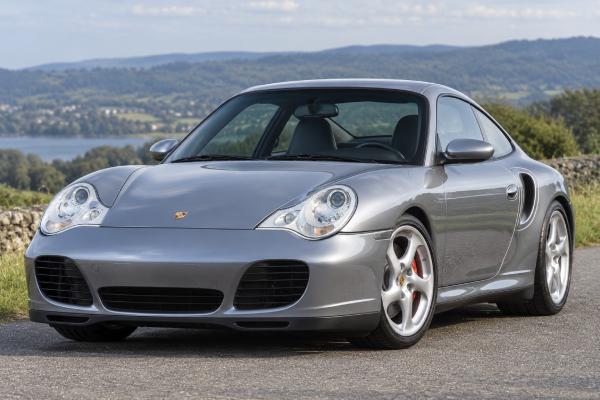
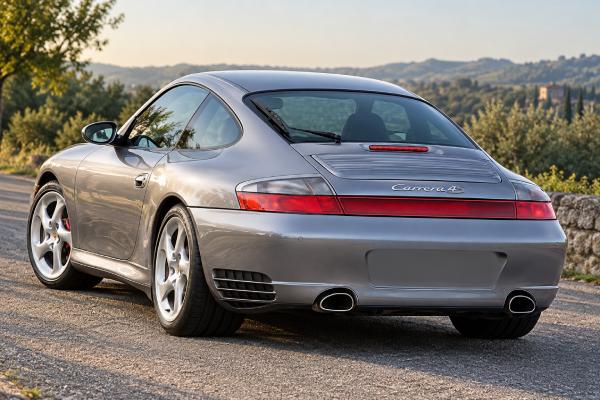
The Porsche 911 Carrera 4S of the 996.2 generation is not simply a Carrera 4 with an “S” badge. Sold as a Coupe from 2002 through 2005, it combines the naturally aspirated 3.6-liter M96.03 engine with permanent all-wheel drive, the broad Turbo-style body, 18-inch wheels, a full-width rear reflector, and a more substantial chassis presentation. Porsche’s own Classic material identifies the 4S by its wider rear wings, Turbo-like body width, redesigned front section, red brake calipers, and 320 PS engine.
That engine output requires a unit note. European Porsche sources quote 235 kW and 320 PS; 320 PS is about 316 mechanical horsepower, while U.S. period specifications generally state 315 hp. “320 hp” remains common shorthand for this model, but PS and hp should not be treated as numerically identical.
This article covers the 996-generation Carrera 4S Coupe across the assignment’s 2002–2005 range. It does not substitute Cabriolet weights for Coupe data, nor does it borrow the 3.8-liter specifications of the later 997 Carrera 4S that began appearing as the generations overlapped.
Table of Contents
- Why the 996 Carrera 4S Stands Apart
- Wide Body, Chassis, Wheels, and Brakes
- M96.03 Power and the Viscous AWD System
- Specifications and Performance
- Service Demands Hidden in the “S” Package
- Engine Risks, Including the 2005 IMS Nuance
- Authenticity and Pre-Purchase Inspection
Why the 996 Carrera 4S Stands Apart
The 996 Carrera 4S is defined by a combination of naturally aspirated Carrera power and Turbo-influenced body and chassis hardware. Its 1,830 mm-wide body is roughly 60 mm broader than a normal 996.2 Carrera, and its stance is reinforced by wider rear track, 18-inch wheels, a distinctive rear reflector panel, and all-wheel drive.
Porsche Classic describes the Coupe as a 2002–2005 model and the Cabriolet as a 2003–2005 addition. That date split matters when reading advertisements: a genuine early 2002 4S is a Coupe, while a claimed 2002 Carrera 4S Cabriolet deserves particularly careful identity checking.
The 4S is still powered by the Carrera-family M96.03 rather than the Turbo’s Mezger-derived twin-turbo engine. It therefore produces the same nominal 320 PS as the contemporary Carrera and narrow-body Carrera 4. The “S” value proposition was principally body, running gear, equipment, and appearance rather than a higher-output standard engine.
The rear bodywork is one of the easiest identifiers. The broad rear quarters flow into a full-width reflector between the taillights, while the Turbo-style shell omits the Turbo’s side intake openings because the naturally aspirated engine does not need the same intercooler airflow arrangement. The extending rear spoiler is also model-specific in execution.
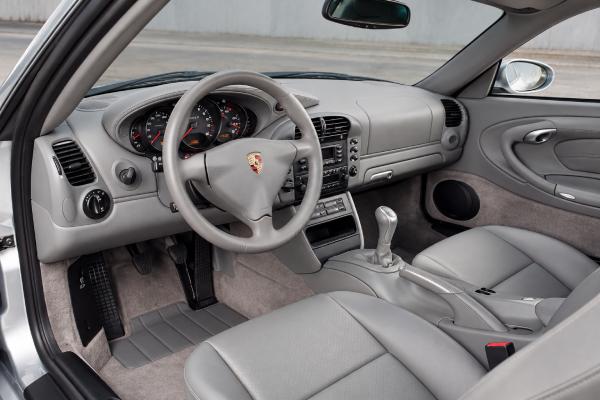
Interior specification was generally richer than that of a basic Carrera, but individual cars vary because Porsche offered extensive options. Seats, audio, navigation, trim, sport exhaust, xenon lighting, and other details should be decoded from the build information rather than assumed to be standard simply because the car is a 4S.
| Area | Defining feature |
|---|---|
| Model years in this guide | 2002–2005 |
| Engine | M96.03, 3.6-liter naturally aspirated flat-six |
| Drive | All-wheel drive with viscous coupling |
| Body | Wide Turbo-style shell, approximately 1,830 mm wide |
| Rear styling | Wide quarters and full-width reflector panel |
| Standard wheel concept | 18-inch staggered fitment |
| Transmission choices | 6-speed manual or optional 5-speed Tiptronic S |
Wide Body, Chassis, Wheels, and Brakes
The most tangible differences between a Carrera 4S and a normal Carrera 4 sit outside the engine bay. The 4S uses the wide body, a broader track, 18-inch wheels with 295-section rear tires, and larger-performance-oriented chassis hardware that gives it a heavier, more planted physical character.
Standard wheel dimensions are 8 J × 18 at the front and 11 J × 18 at the rear, typically carrying 225/40 ZR18 and 295/30 ZR18 tires. Those sizes are not decorative trivia: rear tires are expensive, tire choice affects the passive AWD system, and incorrect offsets can produce rubbing or geometry problems.
| Position | Wheel | Tire |
|---|---|---|
| Front | 8 J × 18 | 225/40 ZR18 |
| Rear | 11 J × 18 | 295/30 ZR18 |
The body measures about 4,430–4,435 mm long, 1,830 mm wide, and roughly 1,295 mm high, depending on the specification source and measuring convention. Wheelbase remains 2,350 mm. A European manual Coupe reference weight is about 1,495 kg, while a U.S. 2004 listing gives 3,240 lb (1,470 kg); differing curb-weight definitions and equipment explain why one number should not be applied universally.
The suspension retains the 996 architecture: a Porsche-developed strut layout at the front and multi-link rear suspension. The wider stance and larger tires increase grip potential, but they also make alignment, tire condition, wheel straightness, and bushing health more visible in how the car drives. A 4S on worn control arms and old mismatched tires can feel worse than a simpler Carrera on fresh components.
Brake descriptions vary by market and option package, so the individual car should be checked rather than relying only on a generic online table. Period specialist material identifies 330 mm-class front and rear discs with four-piston aluminum calipers on the 4S, and Porsche Classic highlights the model’s red calipers. Porsche Ceramic Composite Brake equipment existed in the 996 era and can appear on optioned cars, but it should not be assumed from wheel style or caliper color alone.
For any 4S, inspect rotor condition, pad thickness, caliper boots, piston movement, flexible hoses, and brake-fluid age. Large wheels can hide inner-rotor wear from a casual exterior view. If ceramic brakes are fitted, replacement costs and correct inspection procedures make accurate identification especially important.
M96.03 Power and the Viscous AWD System
The Carrera 4S uses the 3,596 cc M96.03 flat-six with 96.0 mm bore, 82.8 mm stroke, an 11.3:1 compression ratio, and VarioCam Plus. Porsche’s European rating is 235 kW (320 PS) at 6,800 rpm, with 370 Nm (273 lb-ft) of torque around 4,250 rpm.
VarioCam Plus combines variable inlet-cam phasing with variable valve lift. In practical terms, the system broadens the engine’s operating range instead of relying only on a high-rpm peak. The 4S feels stronger through the middle of the rev range than the earlier 3.4-liter 996.1, but the wide body and AWD hardware mean it also carries more mass than a rear-drive Carrera.
| Item | Specification |
|---|---|
| Configuration | Water-cooled naturally aspirated flat-six |
| Displacement | 3,596 cc |
| Bore × stroke | 96.0 × 82.8 mm |
| Compression ratio | 11.3:1 |
| Valvetrain | DOHC, 24 valves, VarioCam Plus |
| European power | 235 kW (320 PS) at 6,800 rpm |
| U.S. quoted power | 315 hp at 6,800 rpm |
| Torque | 370 Nm (273 lb-ft) at 4,250 rpm |
The AWD arrangement is the passive viscous-coupling system used by other all-wheel-drive 996 models. In normal conditions it is strongly rear-biased. When axle-speed differences develop, the viscous multi-plate coupling can increase torque transfer to the front axle. Specialist descriptions commonly cite about five percent front torque under normal conditions and up to roughly 40 percent when needed.
Because the coupling is passive, it should not be described as an early version of the electronically controlled Porsche Traction Management clutch used in later generations. PSM is a separate stability system that can intervene through braking and engine management.
The hardware adds a front axle drive unit, propeller shaft, front half-shafts, joints, and seals. Those parts create service and inspection points that do not exist on a Carrera 2. They also make correct tire matching across the car more consequential.
Specifications and Performance
A six-speed manual Carrera 4S Coupe is a roughly 1.5-tonne, 320 PS all-wheel-drive 911 with a period factory 0–100 km/h time of about 5.1 seconds and a top speed of 280 km/h. Tiptronic S versions are slower, with period specialist data around 5.6 seconds to 100 km/h and about 275 km/h maximum speed.
| Measure | Specification |
|---|---|
| Drive layout | Rear engine, all-wheel drive |
| Transmission | 6-speed manual |
| 0–100 km/h | Approximately 5.1 seconds |
| Top speed | 280 km/h (174 mph) |
| Measure | Specification |
|---|---|
| Length | Approximately 4,430–4,435 mm (174.4–174.6 in.) |
| Width without mirrors | 1,830 mm (72.0 in.) |
| Height | Approximately 1,295 mm (51.0 in.) |
| Wheelbase | 2,350 mm (92.5 in.) |
| Representative European curb weight | About 1,495 kg (3,296 lb) |
| Fuel tank | 64 L (16.9 U.S. gal) |
A 2004 U.S. specification lists 15 mpg city, 22 mpg highway, and 18 mpg combined. Those are historical test-cycle figures and are most useful for comparison with period cars; present consumption depends heavily on traffic, temperature, transmission, tires, driving style, and mechanical condition.
The 4S is not faster in a straight line than every narrow Carrera simply because it wears an S badge. Its standard engine output is the same, while the extra body and driveline hardware add mass. The model’s technical identity is better understood through traction, body, brakes, track width, and equipment than through a horsepower hierarchy.
Service Demands Hidden in the “S” Package
A Carrera 4S carries several recurring-cost items that a basic Carrera either does not have or uses in smaller form. Wide 18-inch tires, the front driveline, larger brake hardware, more body-specific trim, and the usual M96 cooling and ignition systems all need to be included in an ownership budget.
Tires are the most visible example. The 295/30 ZR18 rears are not only expensive; the all-wheel-drive system rewards consistent rolling circumference. Inspect all four tires for matching model, correct sizes, date codes, tread-depth balance, repairs, cracking, and pressure. A seller fitting two new rear tires while leaving much older fronts may have solved tread depth but not overall tire compatibility.
| Area | Why it matters |
|---|---|
| Wide 18-inch tires | Cost, age, circumference matching, alignment sensitivity |
| Front differential and AWD hardware | Fluid history, leaks, bearings, CV joints, propeller-shaft condition |
| Brakes | Larger components; identify iron versus optional ceramic hardware correctly |
| Cooling openings | Debris can collect around front radiators and A/C condensers |
| Suspension | Wide tires expose worn arms, links, dampers, mounts, and poor geometry |
| Body-specific parts | Wide rear quarters, bumper pieces, reflector, wheels, and trim affect repair cost |
The historical Porsche service schedule remains useful for the categories that should be inspected: fault memories, oil leaks, coolant hoses, radiators and air inlets, brakes, drive-shaft boots, tires, steering, and transmission operation. But elapsed time now matters as much as mileage. A low-mileage 4S can still have two-decade-old brake fluid history, brittle plastic cooling parts, old tires, hardened seals, or tired dampers.
Clean the front cooling cavities rather than judging them only through the bumper openings. Leaves and road debris can trap moisture between radiators and condensers. Check fan operation, coolant tank condition, cap, hoses, water pump, thermostat history, and any unexplained coolant loss.
Front differential fluid is an AWD-specific maintenance item. Inspect for leakage at seals and for road-speed-dependent whine. CV boots can split and lose grease; propeller-shaft or joint problems can create vibration that is easily blamed on wheels. Diagnosis should isolate the source before components are replaced.
The 4S also rewards careful alignment. A broad rear tire can hide substantial inner-edge wear. Ask for alignment records after major suspension work, and inspect the entire tread face on a lift.
Engine Risks, Including the 2005 IMS Nuance
The M96.03’s condition cannot be summarized by whether an advertisement says “IMS done.” IMS configuration, cylinder health, air-oil separation, cooling integrity, ignition, valve-control operation, and oil leakage are separate questions, and the 2005 end of the 996 production run introduces an additional identification wrinkle.
Specialist IMS documentation groups most 2002–2005 996 engines with the smaller serviceable single-row factory bearing. It also notes that some late-production 2005 engines may use the larger non-serviceable bearing associated with the later design. Therefore a 2005 Carrera 4S should not have its bearing type declared from model year alone.
Engine replacement further complicates the picture. A replacement engine carries the design used when that engine was manufactured, not necessarily the design implied by the chassis model year. On any 2005 4S—and on a car with replacement-engine history—verify engine serial information and existing hardware before planning an IMS retrofit.
For cars with the serviceable single-row bearing, documentation should identify what was installed, when, and at what mileage. Some aftermarket replacements have their own inspection or replacement requirements. A decades-old invoice proves prior work occurred; it does not automatically establish unlimited future life.
Cylinder-wall condition deserves independent investigation. Warning signs can include increased oil use, uneven sooting, piston-slap-like noise, damaged spark plugs, or abnormal debris, but direct borescope evidence is far more useful than rumor. When a specialist sees concerning symptoms, compression, leak-down, oil-filter inspection, and bore examination can help build a coherent diagnosis.
The air-oil separator influences crankcase vacuum and oil ingestion. A failing separator can cause smoke and poor running that mimic more serious problems. Likewise, oil at the bellhousing area can come from more than one source, so rear main seal diagnosis should be visual and specific.
Cooling failures can threaten any M96 engine. A worn water-pump bearing or impeller, cracked expansion tank, weak cap, blocked radiator, failed fan, or old hose can create heat problems independent of IMS or bore condition. Review the cooling history as carefully as the famous engine issues.
VarioCam Plus and ignition systems also age. Scan for cam timing faults and misfires, inspect coils and plugs, and compare live data when symptoms exist. Parts substitution without diagnosis is especially wasteful on a car whose maintenance costs are already elevated by 4S-specific chassis hardware.
Authenticity and Pre-Purchase Inspection
A 996 Carrera 4S pre-purchase inspection should confirm authenticity as carefully as mechanical health because Turbo-style conversions, changed wheels, replacement engines, and retrofitted options can blur what a casual inspection suggests. Start with the VIN, model designation, option codes, engine number, and service documentation.
Check the wide rear quarters and body seams for previous collision repair. Measure paint if possible, inspect weld and seam-sealer consistency, look underneath the sill and jack areas, and examine bumper alignment. The 4S-specific reflector panel and broad rear body can make accident repairs more costly than the same damage on a narrow Carrera.
Wheels deserve identification, not just a glance. Confirm 18-inch dimensions and offsets, inspect inner barrels for bends or cracks, and look for evidence of spacer use. Read every tire date code and measure tread across the width. Very different tread depths or tire constructions on an AWD car should be corrected.
On a lift, inspect the front differential/coupling unit, propeller-shaft route, CV joints and boots, wheel bearings, brake components, cooling pipes and hoses, suspension joints, dampers, undertrays, and engine/transmission mounts. Oil or coolant staining should be traced upward to its origin.
A cold start provides information a prewarmed engine cannot. Watch for smoke duration, listen for mechanical noise, verify warning-lamp self-tests, and let the car reach full operating temperature. Scan the engine, PSM/ABS, airbag, and transmission modules as applicable. Check camshaft deviation data and misfire history where the diagnostic platform supports it.
Manual cars should be tested for clutch slip, judder, release-bearing noise, flywheel symptoms, and consistent shift quality. Tiptronic cars need smooth cold and hot engagement and a documented fluid/service history. In both cases, road-test for AWD-related vibration, road-speed whine, CV noise on tight turns, wheel-bearing roar, and stability-system warnings.
A 2005 car needs one extra documentation step: establish the exact engine and IMS configuration before assigning value to an “IMS solution” claim or budgeting future work. A replacement engine should likewise be identified by its own production evidence.
Finally, price the deferred work as a system rather than a list of isolated minor jobs. Four quality tires, suspension arms and alignment, brake renewal, cooling repairs, an AWD leak, and engine preventive work can accumulate quickly. A well-documented 4S earns its desirability by having its distinctive hardware maintained, not merely by having the wide body and rear reflector intact.
References
- Model Porsche 911 Carrera 4 (type 996) | Porsche Australia 2026
- How to buy a Porsche 996 2022
- Used 2004 Porsche 911 Carrera 4S Specs & Features | Edmunds 2026
- Porsche 996 Carrera 3.6 Buyer’s Guide – elferspot.com – Magazine 2023
- Recommended Maintenance Schedule Porsche 911 Carrera 996 2026
- IMS Bearing Problem Years in Porsche Boxster and 911 – LN Engineering 2026
Disclaimer
This article is intended as general information for owners and buyers, not as professional diagnosis, inspection, or repair advice. Specifications, parts, service intervals, torque settings, fluids, and procedures can change with VIN, production date, market, transmission, body style, options, and replacement-engine history. Verify the exact car against official Porsche documentation before carrying out service.
If you know another enthusiast researching a 996 Carrera 4S, please share this article with them or with a Porsche community where the technical distinctions may be useful.