
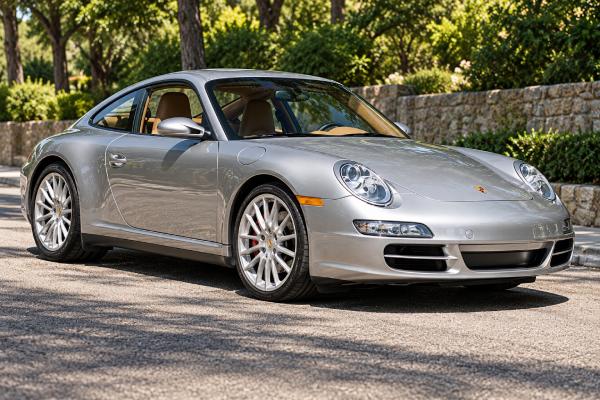
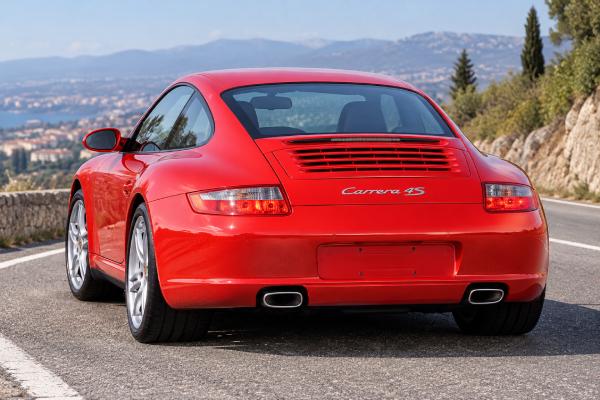
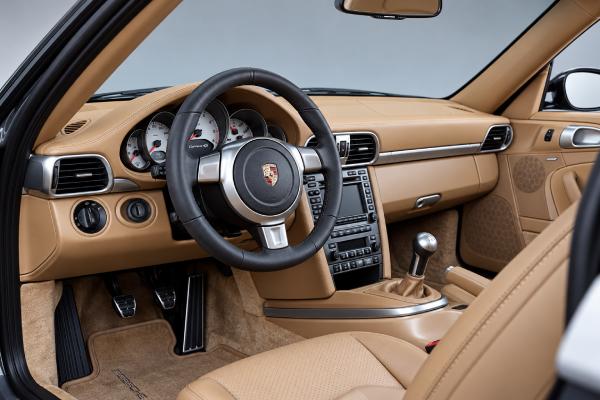
The 2006–2008 Porsche 911 Carrera 4S (997.1) combines three pieces of first-generation 997 hardware that are easy to blur together when shopping: the 3.8-liter M97.01 engine from the Carrera S, the wider body and permanent all-wheel drive of the Carrera 4, and S-model chassis equipment that includes Porsche Active Suspension Management (PASM) and larger brakes. It is not a Turbo without turbochargers, and it is not a later 997.2 Carrera 4S with Porsche Traction Management and direct injection.
That distinction matters because the maintenance and inspection priorities follow the exact mechanical package. The 997.1 Carrera 4S uses a passive viscous multi-plate coupling to feed part of the engine’s torque forward, a six-speed manual or five-speed Tiptronic S, port fuel injection, and the M97-generation intermediate-shaft arrangement. At this age, condition matters more than mileage alone: tire matching, bore condition, cooling-system health, drivetrain leaks, suspension wear, and documentation can separate a strong car from an expensive project.
Table of Contents
- Why the 4S Is Not Just an S With AWD
- M97.01 Engine and the X51 Line
- Viscous AWD, PASM, and 19-Inch Hardware
- Factory Data for the Coupe
- Service Priorities on a Now-Classic C4S
- Bore Scoring, IMS, and Diagnostic Evidence
- A C4S-Specific Pre-Purchase Sequence
Why the 4S Is Not Just an S With AWD
The 997.1 Carrera 4S is best understood as a coordinated drivetrain-and-chassis specification, not simply a Carrera S with two extra driven wheels. Porsche widened the all-wheel-drive 997 body by 44 mm relative to the rear-drive Carrera body, and the 4S paired that shell with the 3.8-liter S engine, permanent all-wheel drive, standard PASM, red brake calipers, 330 mm drilled and internally ventilated brake discs, four round exhaust outlets, and a wider rear tire than the rear-drive Carrera S.
Those details are useful identification checks. A normal 2006–2008 Carrera 4 uses the same wide AWD body but has the 3.6-liter engine, black brake calipers in standard form, and PASM as an option. A rear-drive Carrera S has the 3.8-liter engine and standard PASM but uses the narrower rear-drive body and a 295-section rear tire rather than the 305-section size associated with the Carrera 4S factory 19-inch fitment.
The Turbo is a different engineering branch again. Although it also has a wide body and all-wheel drive, it uses a turbocharged Mezger-family engine and Porsche Traction Management rather than the Carrera 4S’s naturally aspirated M97.01 and passive viscous coupling. That difference is especially important when reading used-car listings or repair discussions: advice about Turbo drivetrain hardware does not automatically apply to a Carrera 4S.
The covered model years are also deliberately limited to the pre-facelift car. The 2009 model-year 997.2 Carrera 4S introduced a direct-injected 3.8-liter engine, PDK in place of Tiptronic S, and a different electronically controlled all-wheel-drive strategy. Those later components should not be imported into a 2006–2008 service or buying plan.
| Model | Key hardware | Why it differs from the 2006–2008 Carrera 4S |
|---|---|---|
| Carrera S | 3.8L, rear-wheel drive, PASM standard | Narrower rear-drive body and no front driveline |
| Carrera 4 | 3.6L, permanent AWD, wide body | Smaller engine; PASM was optional |
| Carrera 4S | 3.8L, permanent AWD, wide body, PASM standard | Exact variant covered here |
| 997.1 Turbo | Turbocharged engine, electronically managed AWD | Different engine and torque-management system |
| 997.2 Carrera 4S | Direct injection, PDK available, later AWD system | Facelift drivetrain; outside the 2006–2008 scope |
M97.01 Engine and the X51 Line
The M97.01 is the defining mechanical upgrade over the base Carrera 4. Its 3,824 cc displacement comes from a 99.0 mm bore and 82.8 mm stroke, with an 11.8:1 compression ratio. It is a naturally aspirated, water-cooled flat-six with four valves per cylinder, port fuel injection, and VarioCam Plus variable intake valve timing and lift.
Porsche’s European heritage material rates the standard 3.8-liter 997.1 S engine at 355 PS (261 kW) at 6,600 rpm and 400 Nm (295 lb-ft) at 4,600 rpm. Converting 355 metric horsepower gives about 350 mechanical hp; period North American literature and databases commonly identify the model as 355 hp. Those are different rating conventions, so “355 PS” and “355 hp” should not be treated as mathematically identical. This article retains the assignment’s 355-hp identifier while stating Porsche’s PS/kW figure where the unit distinction matters.
The standard M97.01 should also be separated from the factory X51 power kit. Porsche offered an S-model power increase from the 2006 model year, raising output to 381 PS. A car advertised as an X51 should therefore have evidence that the power kit is genuinely present—ideally the correct option documentation and matching engine hardware—rather than relying on exhaust tips, an intake part, or seller description alone. Standard Carrera 4S specifications should not be overwritten with X51 figures.
The engine uses an integrated dry-sump lubrication concept rather than the separate external oil tank of older air-cooled 911s or the GT/Turbo Mezger architecture. Multiple oil pumps manage scavenging and pressure under acceleration, braking, and cornering. That layout is well suited to a rear-engined sports car, but it does not make oil level, temperature, leakage, or service history irrelevant. On a car approaching two decades old, the quality and consistency of maintenance records are more informative than slogans about “dry sump” construction.
| Specification | Value | Notes |
|---|---|---|
| Engine code | M97.01 | Standard 3.8L Carrera S / Carrera 4S application |
| Configuration | Naturally aspirated flat-six | Water-cooled, rear-mounted |
| Displacement | 3,824 cc (3.8L) | Port fuel injection |
| Bore × stroke | 99.0 × 82.8 mm | 3.90 × 3.26 in |
| Compression ratio | 11.8:1 | Standard engine |
| European rated output | 261 kW / 355 PS at 6,600 rpm | About 350 mechanical hp by unit conversion |
| Peak torque | 400 Nm (295 lb-ft) at 4,600 rpm | Standard engine |
| Valve control | VarioCam Plus | Variable intake timing and lift |
| Fuel system | Sequential port injection | Not 997.2 direct injection |
Viscous AWD, PASM, and 19-Inch Hardware
The 997.1 Carrera 4S sends power through a permanent all-wheel-drive system built around a viscous multi-plate coupling. Period technical material describes the front wheels as receiving about 5 percent of drive in normal conditions and as much as roughly 40 percent when the coupling reacts to a speed difference. There is no driver-selectable torque split and no 997.2-style electronically commanded center clutch.
That passive behavior is one reason tire condition deserves unusual attention. The coupling responds to rotational-speed differences, so all four tires should be the correct compatible sizes, similar in effective rolling circumference, and sensibly matched for model and wear. A new pair at one axle combined with heavily worn or incorrect-diameter tires at the other is not merely a cosmetic inconsistency on this car; it can alter how much slip the driveline sees in ordinary use.
PASM is standard on the 4S. The adaptive dampers provide Normal and Sport settings while the S chassis sits lower than a non-PASM base Carrera. PASM does not eliminate normal age-related suspension wear. Dampers can leak or lose effectiveness, top mounts and control-arm joints can deteriorate, and alignment can drift as components age. A warning-free dashboard also does not prove that every damper is healthy.
The standard 19-inch package is another C4S-specific clue. Porsche-approved tire information lists 8J × 19 front wheels with 235/35 ZR19 tires and 11J × 19 rear wheels with 305/30 ZR19 tires for the 997 Carrera 4S. That rear size is wider than the 295-section tire commonly associated with the rear-drive Carrera S. Original-style fitment matters not because a car must retain one exact tire brand forever, but because the four-wheel-drive system, ABS, Porsche Stability Management (PSM), gearing, and chassis calibration all assume a coherent front-to-rear rolling relationship.
The 330 mm brakes are substantial, but age and use still determine condition. Inspect disc thickness and cracking around drilled holes, pad wear across the full friction surface, caliper condition, flexible hoses, and brake-fluid history. Porsche Ceramic Composite Brakes were optional; a car equipped with PCCB requires a different cost calculation because damaged ceramic discs are far more expensive than the standard iron components.
| System | Standard specification | Owner relevance |
|---|---|---|
| Drive layout | Rear engine, permanent all-wheel drive | Includes front differential, propeller shaft, and front drive shafts |
| Center coupling | Viscous multi-plate type | Passive torque transfer; not later PTM hardware |
| Front torque contribution | About 5–40% depending on slip | Period description; not a fixed 40% split |
| Suspension control | PASM standard | Adaptive damping with Normal/Sport modes |
| Front wheels/tires | 8J × 19; 235/35 ZR19 | Factory 19-inch C4S fitment |
| Rear wheels/tires | 11J × 19; 305/30 ZR19 | Wider than the rear-drive Carrera S fitment |
| Brake discs | 330 mm front and rear | Drilled, internally ventilated iron discs in standard form |
| Calipers | Red fixed calipers | Four-piston fixed calipers front and rear |
Factory Data for the Coupe
For a representative manual-transmission Carrera 4S Coupe, the commonly published curb weight is about 1,475 kg (3,252 lb), roughly 55 kg more than a comparable rear-drive Carrera S Coupe. Equipment changes the actual vehicle weight, and the five-speed Tiptronic S adds further mass. Porsche owner documentation lists a range of empty weights because options and market equipment affect the final number.
The six-speed manual was standard; five-speed Tiptronic S was optional. Period specifications put the manual Coupe at about 4.6–4.8 seconds from rest to 60 mph/100 km/h depending on the quoted test or factory convention, with a maximum speed around 288 km/h (179 mph). Tiptronic S is slower in the standard published figures and has a slightly lower maximum speed. Independent tests can be quicker than manufacturer figures, so a single acceleration number should not be presented as universal.
The 67-liter (17.7-U.S.-gallon) fuel tank, four-seat cabin, and front luggage compartment make the car usable beyond short drives, but the 997’s rear seats remain small. The AWD hardware occupies space and adds mass low in the chassis, yet does not turn the 911 into a high-clearance all-weather vehicle. Tire choice and condition remain decisive on snow, standing water, and cold pavement.
| Specification | Value | Configuration or qualification |
|---|---|---|
| Body | 2-door, 2+2 Coupe | Cabriolet also existed; figures here focus on Coupe |
| Drivetrain | Permanent AWD | Viscous multi-plate coupling |
| Manual transmission | 6-speed | Standard |
| Automatic transmission | 5-speed Tiptronic S | Optional; no PDK on 2006–2008 997.1 |
| Wheelbase | 2,350 mm (92.5 in) | 997 platform |
| Overall width | 1,852 mm (72.9 in) | 44 mm wider than rear-drive 997 Carrera body |
| PASM ride height | About 1,300 mm (51.2 in) | Owner-manual dimension for PASM-equipped cars |
| Manual curb weight | About 1,475 kg (3,252 lb) | Representative Coupe value; equipment can increase weight |
| Fuel capacity | 67 L (17.7 U.S. gal) | Premium unleaded required by period specifications |
| 0–60 mph | About 4.6 s | Published manual-Coupe figure; tests vary |
| 0–100 km/h | About 4.8 s | Published manual-Coupe figure |
| Maximum speed | 288 km/h (179 mph) | Manual Coupe |
Service Priorities on a Now-Classic C4S
A factory maintenance schedule is the starting point, but every 2006–2008 Carrera 4S is now old enough that elapsed time can matter more than the original mileage trigger. Porsche Cars North America’s period checklist called for regular maintenance inspections, brake-fluid replacement every two years, and additional long-interval drivetrain work. It also identifies front-differential oil as a 120,000-mile (180,000-km) or 12-year item for Carrera 4/4S models.
That 12-year point has already passed for every car in scope. A low-mileage example with no evidence of front-differential service therefore should not be treated as “not due yet” simply because its odometer is far below 120,000 miles. The same principle applies to old brake fluid, accessory-drive components, coolant hoses, seals, and tires: calendar age is real even when mileage accumulation is slow.
Service records should be read for content rather than stamp count. An invoice showing the exact oil grade/specification, filters, plugs, belts, fluids, and inspected areas is more useful than a generic “major service” line. Verify the schedule appropriate to the VIN and market because Porsche intervals and service-sheet details can differ. Cars used repeatedly on track, driven mainly on very short trips, stored for long periods, or exposed to severe climates may justify more conservative maintenance.
The front of a 997.1 also deserves practical attention. Leaves and road debris can collect around the front radiators and air-conditioning condensers, trapping moisture and restricting airflow. Inspection and cleaning are condition-based ownership tasks rather than a reason to claim every car has a cooling-system fault. Look for coolant staining, damaged fins, corroded condensers, and evidence of prior impact or poorly repaired front-bumper work.
The AWD system adds components a rear-drive Carrera S does not have: a front differential, propeller shaft, front half-shafts, additional joints and seals, and the viscous coupling arrangement. During service or inspection, leaks, damaged CV boots, vibration, bearing noise, or driveline clunks deserve diagnosis rather than being dismissed as normal four-wheel-drive behavior.
| Item | Factory or age context | What to verify now |
|---|---|---|
| Brake fluid | Every 2 years in the period checklist | Dated fluid-change records and hydraulic condition |
| Front differential oil | 120,000 miles (180,000 km) or 12 years | Evidence the time-based interval was not ignored |
| Manual/Tiptronic fluids | Long-interval items in period service documentation | Correct schedule for transmission and market |
| Spark plugs and ignition | Mileage/time dependent | Records, coil condition, misfire history |
| Accessory drive belt | Age and mileage dependent | Replacement history and pulley condition |
| PASM suspension | Condition based after original service life | Damper leaks, warning faults, mounts, arms, alignment |
| AWD driveline | Additional C4S hardware | Leaks, boots, vibration, noises, tire-size consistency |
| Cooling package | Condition based | Radiator/condensor debris, corrosion, leaks, fan operation |
Bore Scoring, IMS, and Diagnostic Evidence
For a 2006–2008 M97.01 Carrera 4S, cylinder condition deserves at least as much attention as the familiar “IMS” question. Technical specialists who rebuild M96/M97 engines identify the 3.6- and 3.8-liter 996.2/997.1 engines as applications in which bore scoring is a meaningful concern, particularly in cylinders 4–6. The useful response is not to assume failure; it is to inspect the actual engine.
Symptoms that justify investigation include a persistent warm-engine ticking or knocking noise, unusually sooty exhaust outlets, rising oil consumption, smoke beyond a brief normal start-up puff, misfires, or wear metals in used-oil analysis. None of those signs alone proves scored bores. A proper borescope inspection, interpreted by someone familiar with these engines, provides much stronger evidence. Inspection through the spark-plug openings and, where appropriate, additional viewing angles can help distinguish superficial marks from significant vertical scoring.
The intermediate-shaft bearing needs equally precise treatment. The 2006–2008 production window is after Porsche’s transition to the larger-diameter, non-serviceable factory IMS bearing used in late M96/M97 engines. Unlike the earlier small bearing, it cannot normally be removed through the transmission opening as a routine retrofit while the original engine is assembled. Engine replacement history can change what is inside a specific car, so VIN and engine records still matter.
That does not mean the IMS can be declared impossible to fail. It means the familiar advice to “replace the IMS bearing during a clutch job” is not directly applicable to a normal original 2006–2008 M97.01 with the larger bearing. A buyer is better served by verifying engine identity, oil-filter inspection history, oil condition, bore condition, crankcase behavior, cooling health, and any documented engine work than by purchasing solely on the presence or absence of an “IMS done” claim.
Other leaks and wear should remain in proportion. Rear main seal leakage, air-oil separator faults, water-pump wear, coolant leaks, ignition-coil deterioration, and aging hoses can occur and should be diagnosed on evidence. They do not all have the same consequence or prevalence as bore damage, and a damp seal should not be described as an impending engine failure.
Evidence that carries more weight than a seller’s reassurance
- A borescope report with clear images identified by cylinder and viewing location.
- Cold and fully warm running observations, not only a brief start after the engine has already been warmed.
- Oil-filter inspection and, where available, trend-based used-oil analysis.
- Invoices identifying the engine number if a replacement or rebuild has been performed.
- Consistent oil-consumption history rather than an unsupported “uses no oil” statement.
- Diagnostic scan results showing fault history and misfire information.
A C4S-Specific Pre-Purchase Sequence
A useful pre-purchase inspection for this model should prove that the car is both a healthy 997.1 and a healthy all-wheel-drive S. Begin with identity and configuration before focusing on cosmetics. Confirm the VIN, engine type, transmission, option record, and whether the car is a standard 355-output model or a documented X51 car. If the engine has been replaced, establish what was installed and when.
Next, inspect the engine with the car genuinely cold. Listen through warm-up, check for smoke patterns, scan the control units, look for coolant and oil leaks, and inspect the oil filter if the seller permits. For the 3.8-liter M97.01, a borescope examination is a rational part of a serious PPI because it can reveal information that compression figures, a clean dashboard, and a short road test may miss.
Then treat the tires as drivetrain components. Record all four sizes, brands, model lines, date codes, tread depths, and visible repairs. The expected 19-inch C4S sizes are 235/35 ZR19 front and 305/30 ZR19 rear. Check wheels for bends or cracks and confirm that non-original fitments preserve an appropriate rolling-diameter relationship. During the road test, investigate vibration, hopping, binding sensations, or speed-related noise rather than assuming they are normal features of AWD.
PASM and the brakes merit a separate pass. Confirm both damping modes operate without warnings, inspect damper bodies and suspension joints, and look for uneven tire wear that may point toward alignment or worn links. Measure or professionally assess brake-disc and pad condition; on PCCB-equipped cars, identify the correct ceramic components and inspect them with someone experienced in Porsche ceramic brakes.
Finally, put the car on a lift. The extra front driveline makes an underbody examination more valuable than it is on a rear-drive S. Check the front differential and its seals, propeller shaft, front drive shafts and CV boots, transmission area, engine underside, exhaust, coolant routing, undertrays, jacking points, and evidence of collision repair. A clean history report is useful, but it cannot replace seeing the structure and mechanical components.
A well-documented Carrera 4S can be an unusually complete version of the 997.1 formula: naturally aspirated 3.8-liter response, the wider Carrera 4 body, standard adaptive damping, strong brakes, and a mechanical AWD system that predates the more complex 997.2 arrangement. The same specification also gives a buyer more to inspect. Purchase decisions should therefore follow measured engine and chassis condition, coherent tire and service history, and the quality of previous repairs—not mileage, paint shine, or an “IMS done” phrase in an advertisement.
References
- Modelo 911 con tracción total (tipo 997) | Porsche España 2026 (Porsche Classic)
- Sixth generation – Engines 2023 (Porsche Newsroom)
- Porsche 911 Carrera 4S Coupe (997) (2006 – 2008) 2015
- MaintenanceSchedule1 2007 (Porsche Cars North America maintenance checklist)
- Understanding the Porsche IMS Bearing: What You Need to Know – LN Engineering LLC Knowledge Base 2026
- Understanding Porsche Bore Scoring: What’s Acceptable and What’s Not – LN Engineering LLC Knowledge Base 2026
Disclaimer
This article is for informational purposes only and is not a substitute for professional diagnosis, inspection, maintenance, or repair. Specifications, torque values, service intervals, fluids, and procedures can vary by VIN, market, production date, transmission, options, and equipment. Verify any work against the official Porsche service documentation applicable to the specific vehicle.
If this guide helped with your 997.1 Carrera 4S research, please consider sharing it on Facebook, X/Twitter, or with another Porsche enthusiast to support our work.