
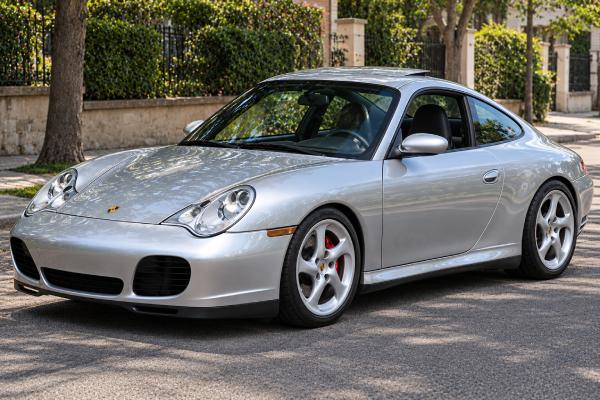
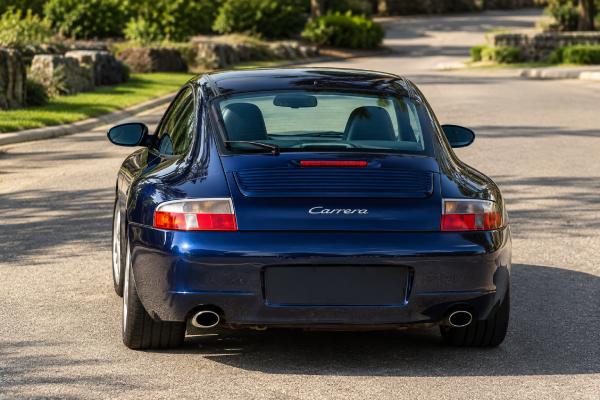
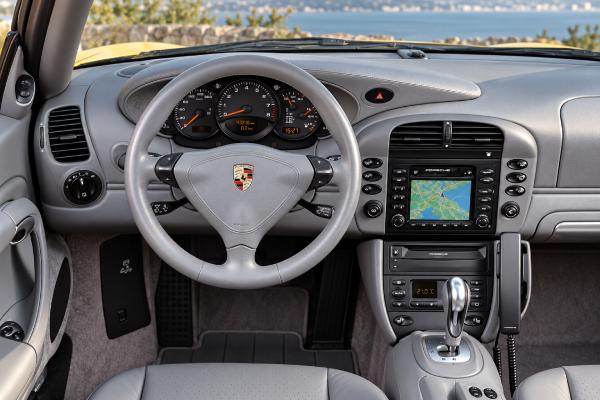
The 2000–2001 Porsche 911 Carrera is the late pre-facelift version of the 996-generation rear-wheel-drive 911, using the 3,387 cc M96.04 water-cooled flat-six. It sits at an important point in 911 development: the 996 had already replaced the air-cooled 993 architecture, but these model years retain the smaller 3.4-liter engine and original 996.1 body before the 2002 facelift brought a 3.6-liter engine and revised front styling. Porsche quoted 300 PS and 221 kW for the 3.4; that converts to about 296 mechanical hp, although North American period specifications commonly describe the car as 300 hp.
This guide covers the rear-wheel-drive Carrera in 2000 and 2001, with the Coupé used for most baseline dimensions and factory performance figures. Cabriolet weight and performance differ. It also separates the six-speed manual from the five-speed Tiptronic S where the transmission changes the result.
Table of Contents
- What defines the 2000–2001 Carrera
- M96.04 engine and drivetrain
- Specifications and technical data
- Performance, chassis, and road behavior
- Maintenance and age-related service
- Engine risks and diagnostic priorities
- Buying and inspection guide
What defines the 2000–2001 Carrera
The 2000–2001 Carrera is a 996.1, not the 2002-onward 996.2, and its defining mechanical combination is the naturally aspirated 3.4-liter M96.04 flat-six driving the rear wheels. That distinction matters because later Carrera, Carrera 4, and Carrera 4S models use the 3.6-liter M96.03 with different output and, in several areas, different parts and service considerations.
The 996 itself was the first production 911 generation to move from air cooling to water cooling. Porsche retained the rear-mounted horizontally opposed six-cylinder layout but adopted four valves per cylinder, liquid-cooled cylinder heads and blocks, and a more modern emissions strategy. The result was a car that was easier to package around increasingly strict noise and emissions requirements while producing substantially more specific output than the regular 993 Carrera.
For 2000 and 2001, the Carrera remained the rear-wheel-drive entry point to the 911 range. That is mechanically significant. It avoids the front differential, propeller shaft, and viscous-coupling hardware of the Carrera 4, while also carrying less mass. The basic chassis still uses front MacPherson struts, a multi-link rear suspension, hydraulic power-assisted rack-and-pinion steering, and large ventilated disc brakes with fixed aluminum calipers.
The exterior is the original 996.1 treatment, with the integrated headlamp/indicator units that are visually different from the later 996.2 lights. Buyers should also be careful with registration year versus model year. A car first registered late in 2001 can be a 2002-model facelift car with the 3.6-liter engine. The VIN, engine number, body details, and original build information are therefore more reliable than a registration date alone.
Body style matters too. Porsche offered the Carrera as both Coupé and Cabriolet. The open car is heavier and has a different roof mechanism and structural package, so a single curb-weight or acceleration figure should not be presented as universal. Unless identified otherwise below, the reference specification is the manual-transmission Coupé.
M96.04 engine and drivetrain
The M96.04 is a 3,387 cc, naturally aspirated, water-cooled flat-six with four valves per cylinder and variable cam timing. In 2000–2001 Carrera application it produces 221 kW at 6,800 rpm and 350 Nm at 4,600 rpm, with the engine mounted longitudinally behind the rear axle.
| Specification | Value | Notes |
|---|---|---|
| Engine code | M96.04 | 2000–2001 Carrera scope |
| Configuration | Water-cooled flat-six | Rear-mounted, naturally aspirated |
| Displacement | 3,387 cc (3.4 L) | 96 mm bore × 78 mm stroke |
| Valvetrain | DOHC, 24 valves | Four valves per cylinder with VarioCam |
| Compression ratio | 11.3:1 | Premium fuel required in period specifications |
| Maximum power | 221 kW at 6,800 rpm | 300 PS; approximately 296 mechanical hp |
| Maximum torque | 350 Nm (258 lb-ft) at 4,600 rpm | Factory peak |
| Fuel system | Electronic multi-point fuel injection | Integrated engine management |
The 300 figure deserves precision. Porsche’s European historical material uses 300 PS, which is a metric-horsepower rating. Since 300 PS is about 296 SAE/mechanical hp, it is inaccurate to imply that the two units are numerically interchangeable. North American databases and period marketing often round or label the output as 300 hp, which explains why both descriptions are encountered.
Two transmissions were offered. The standard six-speed manual gives the most direct mechanical connection and the best factory acceleration figures. The optional five-speed Tiptronic S is a conventional torque-converter automatic with manual selection available from steering-wheel controls. It is not PDK, and its additional mass and wider ratio spacing make the car slower in the factory acceleration tests.
The manual Carrera uses the rear-wheel-drive G96-family transaxle. On a used car, clutch condition matters because a clutch job requires transmission removal, which creates a logical opportunity to inspect the rear of the engine for oil leakage and to establish exactly what has or has not been done to the intermediate-shaft bearing. Documentation is more useful than assumptions: replacement clutches, flywheels, rear main seals, and IMS work should ideally be supported by dated invoices that identify parts and mileage.
Specifications and technical data
The manual Coupé is the cleanest baseline for the 2000–2001 Carrera because body style and transmission materially change weight and performance. The following tables therefore state the configuration where a figure is not common to the entire Carrera range.
| Specification | Six-speed manual Coupé | Tiptronic S Coupé |
|---|---|---|
| Transmission | 6-speed manual | 5-speed automatic with manual mode |
| Driven wheels | Rear | Rear |
| 0–100 km/h | 5.2 s | 6.0 s |
| Top speed | 280 km/h (174 mph) | 275 km/h (171 mph) |
| Seating | 2+2 | 2+2 |
| Specification | Value | Configuration |
|---|---|---|
| Length | 4,430 mm (174.4 in) | Coupé |
| Width, excluding mirrors | 1,765 mm (69.5 in) | Coupé |
| Height | 1,305 mm (51.4 in) | Coupé |
| Wheelbase | 2,350 mm (92.5 in) | Coupé |
| Front track | 1,455 mm (57.3 in) | Standard reference |
| Rear track | 1,500 mm (59.1 in) | Standard reference |
| DIN curb weight | 1,320 kg (2,910 lb) | Manual Coupé baseline |
| Specification | Value |
|---|---|
| Front suspension | MacPherson struts with coil springs and anti-roll bar |
| Rear suspension | Multi-link independent suspension |
| Steering | Hydraulic power-assisted rack and pinion |
| Front wheels | 17 × 7 in |
| Rear wheels | 17 × 9 in |
| Front tires | 205/50 ZR17 |
| Rear tires | 255/40 ZR17 |
| Brakes | Four-wheel ventilated discs with four-piston fixed calipers |
| Specification | Value | Condition |
|---|---|---|
| Fuel | Premium unleaded gasoline | Use the octane grade specified for the car’s market |
| Fuel tank | 64 L (16.9 US gal) | Approximate nominal capacity |
| EPA city/highway | 15/23 mpg US | 2001 U.S. manual-transmission listing |
| EPA combined | 18 mpg US | 2001 U.S. manual-transmission listing |
| Factory oil-service framework | Originally mileage-based | Age now makes elapsed time and condition equally important |
| Brake fluid | Time-sensitive service item | Specialist schedules commonly retain a two-year cycle |
Specifications should be treated as configuration-specific, not as a VIN decoder. Optional 18-inch wheels, Cabriolet construction, Tiptronic S, market equipment, and individual options can alter mass, tire fitment, ride, and measured acceleration.
Performance, chassis, and road behavior
A manual 2000–2001 Carrera Coupé was a genuine 280 km/h car by Porsche’s factory figure, but the more useful ownership point is how the drivetrain delivers that performance. Peak torque arrives at 4,600 rpm and peak power at 6,800 rpm, so the M96.04 rewards engine speed rather than producing the low-rpm surge of a modern turbocharged 911.
The six-speed manual’s shorter and more direct response is reflected in the 5.2-second 0–100 km/h claim, compared with 6.0 seconds for the Tiptronic S. That gap does not make the automatic unusable; it simply means transmission choice changes the character more than a modern dual-clutch comparison might suggest. A buyer who values involvement and the original performance envelope will usually focus on the manual, while a buyer prioritizing relaxed urban use may prefer a well-maintained Tiptronic.
The 996 chassis also needs to be understood in its period context. The wheelbase grew substantially over the 993, yet the car remained compact by current 911 standards. Hydraulic steering provides a mechanical, road-textured feel that later electric systems approach differently. The rear-engine layout still loads the rear tires heavily under acceleration, but the longer wheelbase and revised rear suspension gave the 996 more stability than earlier 911s.
Tire age and specification have an outsized influence on how a surviving example feels. A car can have deep tread and still be compromised if its tires are old, mismatched, or inappropriate for the axle. The standard 17-inch stagger—205/50 front and 255/40 rear—also illustrates how Porsche deliberately gave the rear axle substantially more tire. Optional 18-inch packages change sidewall height and can sharpen response, but they also make bent wheels, tire condition, and ride quality more important inspection points.
Suspension wear should not be dismissed as cosmetic aging. Control-arm bushes, links, dampers, top mounts, and alignment all affect steering precision. Porsche’s own modern 996 buying guidance specifically recommends listening for irregular suspension noises and checking for vague or “spongy” behavior. On a car whose appeal depends heavily on steering accuracy, renewing worn chassis components can matter more than adding aftermarket performance parts.
Maintenance and age-related service
The maintenance question in 2026 is no longer simply whether a 2000–2001 Carrera has reached a factory mileage interval. Every example is roughly a quarter-century old, so time, heat cycles, previous storage, fluid history, and the quality of earlier repairs can be as important as the odometer.
Period factory schedules used relatively long oil-service intervals by modern specialist standards. Contemporary Porsche specialists commonly recommend a more conservative annual oil-and-filter routine for aging M96 cars, particularly where mileage is low enough that moisture and fuel dilution can accumulate between long periods of storage. That is a specialist recommendation rather than a retroactive Porsche factory interval, so owners should keep the distinction clear.
A useful age-based service plan should include:
- engine oil and filter condition, with attention to debris in the filter media;
- brake fluid age and moisture content;
- spark-plug age, ignition-coil condition, and evidence of misfires;
- accessory drive belt condition;
- coolant level, concentration, hoses, expansion tank, water pump, and evidence of dried coolant residue;
- front radiator and air-conditioning-condenser condition, including debris trapped in the bumper openings;
- clutch hydraulics and clutch wear on manual cars;
- Tiptronic fluid history and shift quality on automatic cars;
- engine and transmission oil leaks;
- tire date codes, alignment, and suspension-joint play.
The front cooling package deserves specific attention. Leaves and road debris collect around the front radiators and condensers, trapping moisture and reducing airflow. Porsche’s own buying guide tells shoppers to inspect the front radiators for contamination and damage. Cleaning the ducts and verifying that fans operate correctly is therefore normal preservation work, not merely cosmetic detailing.
For low-mileage cars, service history should be judged by time as well as distance. A 30,000-mile car that sat for long intervals without fluid changes can need more recommissioning than a 70,000-mile car that received consistent annual attention. Conversely, high mileage alone does not prove poor condition. Records showing repeated competent maintenance, stable oil consumption, cooling-system work, suspension renewal, and clean diagnostics are more informative than odometer prestige.
Engine risks and diagnostic priorities
The M96.04 deserves a careful pre-purchase inspection because several expensive failure modes are well documented across the M96 family, but those risks should not be collapsed into the claim that every 3.4-liter engine is defective. The correct approach is to identify which design is present, inspect for evidence, and assess the individual engine’s history and condition.
Intermediate-shaft bearing
The intermediate shaft drives the camshafts through chains. Unlike earlier air-cooled engines that used pressure-fed plain bearings, the M96 uses a ball bearing at the transmission end of the shaft. The 2000 and 2001 model years are transition years in which both dual-row and single-row serviceable IMS bearings can be encountered. The bearing type should therefore not be guessed solely from the registration year.
That makes documentation unusually important. If an IMS retrofit has been performed, the invoice should ideally identify the bearing system, installation date, and mileage. If no reliable record exists, a Porsche specialist can advise what can be determined from engine number, visual inspection, and any previous transmission-out work. An IMS upgrade is preventive work; once a bearing has failed and contaminated the engine, simply fitting another bearing is not an adequate repair.
Rear main seal and oil leaks
Oil between the engine and transmission can come from the rear main seal or other nearby sources. A small damp area is not the same as a major active leak, but any contamination should be correctly traced before purchase. Because transmission removal is labor-intensive, evidence that clutch, flywheel, rear main seal, and IMS-related work were coordinated can be valuable on a manual car.
Cylinder condition, oil use, and smoke
Bore damage is discussed widely in relation to M96/M97 engines, but prevalence claims vary and a few online anecdotes do not establish that an individual car is affected. A sensible inspection focuses on evidence: abnormal oil consumption, one-sided sooty exhaust deposits, persistent smoke, unexplained knocking, low or uneven compression, or suspicious findings on borescope inspection. Borescope images need an experienced interpreter because ordinary vertical marks are not automatically deep scoring.
The air-oil separator is another system worth checking when smoke or crankcase-vacuum symptoms appear. A failing separator can pull excessive oil vapor into the intake and can mimic more serious engine trouble. Diagnosis should distinguish a separator fault from internal cylinder wear rather than assuming the worst from a single puff of smoke after startup.
Cooling-system condition
Overheating history is especially important on a water-cooled 996. Inspect the expansion tank, water pump, coolant cap, hoses, radiators, and underbody for residue. A pressure test and stable operating temperature are more meaningful than a freshly cleaned engine bay. Coolant contamination with oil, repeated unexplained level loss, or signs of previous overheating justify deeper investigation.
Buying and inspection guide
The best 2000–2001 Carrera candidate is the one whose identity, mechanical condition, and maintenance history all agree. The car is now old enough that condition differences between two outwardly similar examples can overwhelm differences in mileage or options.
Start by confirming scope. Verify that the car is genuinely a 2000 or 2001 996.1 Carrera with the expected 3.4-liter engine, not a later 3.6-liter facelift registered early or a car with an undocumented replacement engine. Match the VIN and engine information to service records where possible. Porsche Classic can provide technical-certificate services in some markets that help establish original production information and assess the car.
Then inspect the car as a complete system rather than focusing only on the IMS bearing. A useful pre-purchase inspection should include cold start, hot restart, diagnostic scan, lift inspection, oil-leak assessment, cooling-system pressure check, suspension and steering inspection, brake measurement, tire age, clutch or Tiptronic operation, and evidence of previous accident repair. For an engine with suspicious symptoms, compression, leak-down, oil-filter inspection, and borescope examination may be justified.
On the body, corrosion is not normally the first concern on a well-kept 996 because of its modern galvanized construction, but accident repairs, poorly sealed replacement panels, damaged undertrays, blocked drains, and neglected stone chips can create local problems. Panel gaps, paint depth, headlamp condition, front bumper alignment, and the underside tell more than a casual walk-around.
Interior wear should broadly correspond with mileage and ownership history. Worn seat bolsters, steering wheel, pedals, switchgear, and carpet are not automatically disqualifying, but a very worn cabin paired with unusually low displayed mileage deserves investigation. Check every electrical function, including windows, central locking, climate control, seat motors where fitted, instrument display, rear spoiler operation, and sunroof or Cabriolet top as applicable.
For the manual gearbox, listen for bearing noise, check shift quality when cold and hot, and look for clutch slip, chatter, or a very high engagement point. For Tiptronic S, verify smooth engagement from rest, clean shifts under light and full throttle, and correct manual-mode response. A transmission that “just needs a service” should not be assumed healthy without diagnosis.
Finally, budget according to the car’s condition, not only its purchase price. Tires, dampers, control arms, radiators, air-conditioning condensers, brakes, clutch work, cooling-system components, and deferred fluid changes can accumulate quickly. A lower-priced car with several overdue systems can cost more to put right than a more expensive example with detailed recent invoices.
The 2000–2001 Carrera’s appeal is unusually specific: it combines the early 996 body, the 3.4-liter M96.04, rear-wheel drive, compact dimensions, hydraulic steering, and a conventional manual or Tiptronic transmission. Preserve those distinctions when comparing cars. A 996.2 Carrera, Carrera 4, Turbo, or GT3 may share the generation name, but it is not mechanically interchangeable with this exact variant.
References
- The 996: First 911 with water-cooled flat engine – Porsche Newsroom 2018
- How to buy a Porsche 996 2022
- Modell 911 Carrera (Typ 996) | Porsche Deutschland 2026
- Used 2001 Porsche 911 Carrera Specs & Features | Edmunds 2026
- Recommended Maintenance Schedule Porsche 911 Carrera 996 2026
- Porsche IMS Bearings – The Definitive Guide and FAQ – LN Engineering 2026
Disclaimer
This article is for informational purposes and is not a substitute for professional diagnosis, repair, or inspection. Specifications, torque values, service intervals, fluid requirements, and procedures can vary by VIN, market, production date, transmission, body style, and equipment; verify them against the official service documentation for the specific vehicle.
If this guide was useful, please consider sharing it on Facebook, X/Twitter, or another automotive community to support our work.