
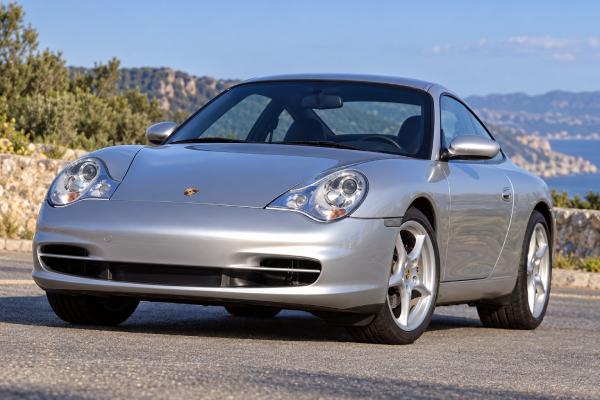
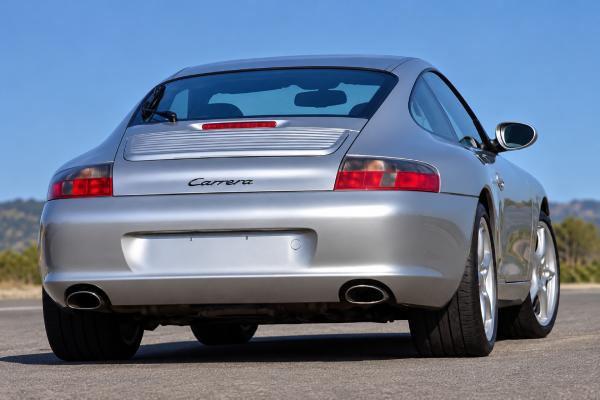
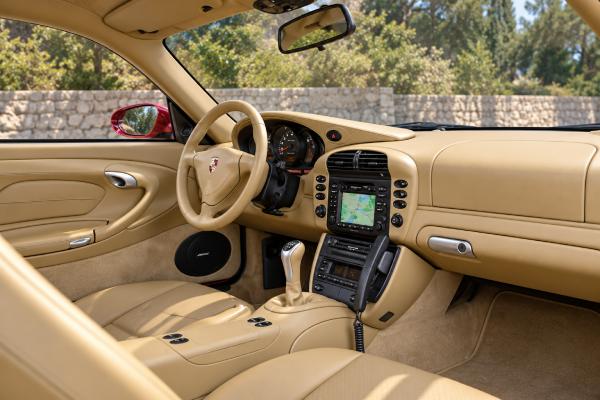
The 2002–2004 Porsche 911 Carrera Coupe is the rear-wheel-drive core of the 996.2 facelift, combining the lighter narrow-body Carrera layout with the enlarged 3.6-liter M96.03 flat-six. The facelift was more than a change of lamps and bumpers: displacement rose from 3.4 to 3.6 liters, output increased, VarioCam Plus added both variable cam timing and valve lift, and the cabin and body received meaningful revisions. Porsche quoted 320 PS (235 kW) in European material; that equals about 316 mechanical horsepower, while North American specifications commonly list 315 hp. “320 hp” is widely used as a shorthand for the model, but the measurement convention matters when comparing sources.
This guide is deliberately limited to the standard rear-wheel-drive 996.2 Carrera for model years 2002, 2003, and 2004. It does not merge the Carrera 4, wide-body Carrera 4S, Turbo, GT3, Targa, or 40th Anniversary model into the specifications below. The goal is to explain what changed, how the M96.03 and chassis work, what age-related service deserves attention, and how to evaluate one today.
Table of Contents
- The 996.2 Facelift Had Mechanical Substance
- Inside the M96.03 3.6-Liter Flat-Six
- Technical Specifications and Performance Data
- Road Behavior, Brakes, and Chassis Balance
- A Service Strategy for an Aging 996.2
- Engine Health and Known Risk Areas
- How to Evaluate a 2002–2004 Carrera Before Purchase
The 996.2 Facelift Had Mechanical Substance
The 2002 model-year update changed the standard Carrera in ways that are easy to feel as well as see. The defining mechanical step was the 3,596 cc M96.03 engine with 320 PS, while revised front styling, later-type headlamps, altered bumper openings, and interior updates separate the 996.2 from the 3.4-liter 996.1.
Porsche’s own historical material describes the 996 as two generations within one type: the first version through 2001 and the facelift from 2002. On the Carrera, the front end adopted headlamps related in appearance to those used by the contemporary Turbo, while the bumper and cooling-air openings were redesigned. The rear remained recognizably narrow-body Carrera rather than taking on the Turbo-width shell used for the Carrera 4S.
That distinction is important when shopping. “996.2” describes a phase of the 996 platform, not a single configuration. A standard Carrera is rear-wheel drive and uses the narrow body. The Carrera 4 adds an all-wheel-drive front driveline; the Carrera 4S combines all-wheel drive with the wider Turbo-derived body and larger brakes. The Targa has its own glass-roof body. The 2004 40 Years of Porsche 911 special edition also uses the Carrera concept but has a higher-output engine and model-specific equipment, so its performance figures should not be substituted for those of a normal 320 PS Carrera.
The standard car’s appeal rests on relative simplicity within the 996.2 range: rear-wheel drive, naturally aspirated power, a six-speed manual as the key enthusiast configuration, and less mass than the all-wheel-drive versions. Tiptronic S was available for drivers who wanted an automatic. A car’s actual transmission, body style, options, and market specification should always be confirmed from its VIN and equipment label rather than inferred from an advertisement.
Inside the M96.03 3.6-Liter Flat-Six
The M96.03 is a water-cooled, naturally aspirated, horizontally opposed six-cylinder engine with four valves per cylinder and VarioCam Plus. Its 3,596 cc displacement comes from a 96.0 mm bore and 82.8 mm stroke, the longer stroke being a central part of the move from the earlier 3.4-liter unit.
VarioCam Plus is one of the meaningful 996.2 changes. It combines variable inlet-cam phasing with two-stage valve lift, allowing the engine management system to alter how the intake valves operate according to speed and load. The purpose is not simply a larger peak number: it helps broaden usable torque while retaining the revving character expected of a Carrera. Peak torque is 370 Nm (273 lb-ft), and period North American data places it at 4,250 rpm.
The engine uses electronic management, sequential fuel injection, twin overhead camshafts per bank, and an integrated dry-sump-style oiling arrangement rather than the separate external oil tank familiar from older air-cooled 911s. Because the M96 architecture packages the crankcase, cylinders, coolant passages, oil system, and intermediate-shaft drive compactly, diagnosis should be evidence-led. A noise, oil leak, or exhaust symptom should not automatically be labeled “IMS” or “bore scoring” without inspection.
| Item | Specification |
|---|---|
| Engine family/code | M96.03 |
| Configuration | Naturally aspirated water-cooled flat-six |
| Displacement | 3,596 cc (3.6 L) |
| Bore × stroke | 96.0 × 82.8 mm |
| Valvetrain | DOHC, 24 valves, VarioCam Plus |
| Compression ratio | 11.3:1 |
| European rated output | 235 kW (320 PS) at 6,800 rpm |
| Approximate mechanical horsepower equivalent | 316 hp |
| North American quoted output | 315 hp at 6,800 rpm |
| Peak torque | 370 Nm (273 lb-ft) at 4,250 rpm |
The PS-versus-hp distinction explains an apparent contradiction among otherwise credible sources. Porsche’s European heritage pages quote 320 PS. A U.S.-market specification source may show 315 hp. Both can describe the same basic engine because PS and SAE/mechanical horsepower are different units and because certification conventions are market-specific. For identification, the model year, M96.03 code, 3,596 cc displacement, and 235 kW figure are more useful than arguing over a rounded “320 hp” label.
Technical Specifications and Performance Data
A manual 996.2 Carrera Coupe pairs the 3.6-liter engine with a six-speed gearbox and rear-wheel drive, and period figures put 0–100 km/h at about 5.0 seconds with a 285 km/h top speed. Tiptronic S changes both the driving character and performance, so manual and automatic numbers should not be mixed.
| Item | Specification |
|---|---|
| Drive layout | Rear engine, rear-wheel drive |
| Standard manual transmission | 6-speed |
| Optional automatic | 5-speed Tiptronic S |
| 0–100 km/h | Approximately 5.0 seconds |
| Top speed | Approximately 285 km/h (177 mph) |
The body remained compact by modern 911 standards. Period dimensional data for the facelift Carrera is about 4,430 mm long, 1,770 mm wide, and 1,305 mm high, with a 2,350 mm wheelbase. Exact curb weight depends on market equipment, body style, transmission, and option load; a U.S. 2004 manual Coupe listing gives 2,959 lb, roughly 1,342 kg.
| Item | Specification |
|---|---|
| Length | Approximately 4,430 mm (174.5 in.) |
| Width without mirrors | Approximately 1,770 mm (69.7 in.) |
| Height | Approximately 1,305 mm (51.4 in.) |
| Wheelbase | 2,350 mm (92.5 in.) |
| U.S. curb weight, representative manual Coupe | 2,959 lb (about 1,342 kg) |
| Fuel-tank capacity | 64 L (16.9 U.S. gal) |
The standard 17-inch tire package uses narrower rubber than the later wide-body 4S. A common factory baseline is 205/50 ZR17 at the front and 255/40 ZR17 at the rear on 7- and 9-inch wheels. Eighteen-inch packages were available, and used cars frequently wear later or aftermarket wheels, so the installed combination should be checked for approved dimensions, correct load and speed ratings, age, condition, and clearance.
| Position | Wheel | Tire |
|---|---|---|
| Front | 7 J × 17 | 205/50 ZR17 |
| Rear | 9 J × 17 | 255/40 ZR17 |
U.S. EPA-era data for a 2004 manual Carrera lists 16 mpg city, 24 mpg highway, and 19 mpg combined. Those historical test-cycle values are useful for specification context but are not a prediction of present-day consumption; driving style, traffic, tires, engine condition, and modern fuel blends can move real consumption considerably.
| Measure | Period rating |
|---|---|
| City | 16 mpg US |
| Highway | 24 mpg US |
| Combined | 19 mpg US |
| Required fuel in U.S. specification | Premium unleaded |
Road Behavior, Brakes, and Chassis Balance
The rear-drive 996.2 Carrera’s chassis is defined by a relatively light front axle, rear-engine traction, direct hydraulic steering, and no front driveshafts. The facelift’s extra engine torque makes it more flexible than the 3.4-liter car, but it still rewards smooth inputs because the engine’s mass sits behind the rear axle.
Front suspension is a strut arrangement with lower control links; the rear uses Porsche’s multi-link design. Four-wheel ventilated disc brakes with fixed multi-piston calipers and ABS provide substantial road braking capability. Porsche Stability Management was available in this generation and is found on many cars; equipment should be verified on the individual vehicle rather than assumed from model name alone.
On a sound example, steering should be precise without wandering, knocking, or a rubbery delay around center. A dull knock over small sharp bumps can point toward worn control-arm joints or links; looseness under braking can also come from aged bushings. Rear alignment is equally important. Uneven tire wear may reflect geometry, tired suspension joints, incorrect ride height, collision damage, or simply a long interval since the last proper alignment.
The engine’s extra midrange compared with the early 3.4 does not turn the Carrera into a low-revving torque car. Its character is still built around a responsive naturally aspirated flat-six and a close relationship between throttle position, engine speed, and rear-axle load. The manual gearbox suits that character when its shift cables, clutch hydraulics, engine mounts, and clutch are healthy. A high engagement point, slipping under load, vibration, or a heavy/noisy release action warrants diagnosis rather than a blanket assumption that every old clutch feels the same.
Wheel choice materially changes the way these cars ride. The 17-inch package leaves more sidewall and is historically correct for a base configuration; optional 18s sharpen response but give tires less compliance. Whatever size is installed, a 20-plus-year-old 911 benefits more from high-quality, correctly aged tires and accurate alignment than from an oversized wheel chosen primarily for appearance.
A Service Strategy for an Aging 996.2
A 2002–2004 Carrera should be maintained as an aging performance car, not merely by replaying the mileage schedule printed when it was new. The historical Porsche schedule remains the baseline for what systems need inspection, but elapsed time now matters for fluids, rubber, seals, cooling-system parts, ignition components, and anything whose condition deteriorates while mileage stays low.
Period Porsche schedules call for recurring oil and filter service, inspections, and larger maintenance events at prescribed mileage points. Today, a specialist should also look at the actual use pattern. A car driven 2,000 miles a year on short trips has different oil-moisture and battery issues from one covering long motorway journeys. A car that has sat for years can need more recommissioning than a higher-mileage example with steady annual care.
| Area | What to establish |
|---|---|
| Engine oil and filter | Known change history, correct specification, leak check, and filter inspection where appropriate |
| Cooling system | Coolant condition, expansion tank, cap, water pump, thermostat, hoses, radiators, and fan operation |
| Ignition | Spark-plug age, coil condition, misfire history, and heat-shield condition |
| Transmission and clutch | Fluid/service record, shift quality, clutch operation, and leak inspection |
| Brakes | Fluid age, hose condition, rotor/pad state, caliper operation, and parking brake |
| Suspension | Dampers, control arms, links, mounts, wheel bearings, alignment, and tire wear |
| Accessory drive | Belt, tensioners, idlers, alternator charging, and related bearing noise |
Front radiator and condenser cavities deserve physical inspection because debris accumulates behind the bumper openings. The Porsche buying guide specifically advises checking the front radiators and looking underneath the car. Cleaning the cavities allows better assessment of corrosion and leakage; cosmetic cleanliness at the visible grille is not enough.
Cooling-system work should be documented carefully. The translucent coolant expansion tank can age and crack, water pumps wear, and a leaking system can introduce air or cause overheating. An owner should not accept unexplained coolant loss as “normal.” Pressure testing, inspection of the cap and tank, and examination of the pump and radiator area are more useful than repeatedly topping up fluid.
Brake fluid is hygroscopic, so elapsed time is relevant even on a garage-kept car. Likewise, old tires can retain tread while losing the characteristics expected of a sports car. Record the tire date codes and inspect for cracking, flat-spotting, repairs, and mismatched models across an axle.
Engine Health and Known Risk Areas
The M96.03 has several well-known inspection points, but a good assessment separates mechanisms instead of treating “M96 issues” as one diagnosis. For 2002–2004 cars, the factory intermediate-shaft bearing configuration, cylinder condition, oil and coolant integrity, crankcase ventilation, ignition quality, and leak sources should each be evaluated on their own evidence.
For the IMS specifically, specialist documentation from LN Engineering identifies 2002–2005 996 engines as using the smaller serviceable single-row factory bearing, subject to exceptions when an engine has been replaced. In this 2002–2004 scope, that means the original engine is normally in the single-row group. The installed condition can nevertheless differ if a prior owner replaced the bearing or the complete engine. Invoices, part numbers, engine numbers, and direct inspection matter more than assumptions from the odometer.
An IMS history should answer precise questions: Is the engine original? Was the bearing replaced? Which product was installed, by whom, at what mileage and date, and was the clutch serviced at the same time? “IMS done” without evidence is not enough to establish what is in the car now.
Cylinder-wall scoring is another concern that deserves disciplined diagnosis. Symptoms can include elevated oil consumption, sooty deposits that are uneven from bank to bank, piston slap-like noise, or abnormal wear seen during borescope inspection, but none is conclusive by itself. A pre-purchase borescope performed by a technician familiar with M96 engines can add useful evidence, particularly when combined with oil-use history, spark-plug appearance, compression/leak-down results where warranted, and filter inspection.
The air-oil separator can also fail or deteriorate, affecting crankcase vacuum and oil control. Heavy smoke, abnormal vacuum at the oil filler, rough running, or oil ingestion calls for diagnosis of the crankcase-ventilation system rather than immediate conclusions about the bottom end. Rear main seal seepage can occur as well; the significance ranges from a minor sweat to a leak that justifies work when the transmission is already out.
VarioCam Plus adds its own diagnostic dimension. Fault codes, timing deviations, rough running, or inconsistent power delivery should be investigated with suitable scan data and mechanical checks. Replacing solenoids or actuators by guesswork can become expensive. The same principle applies to ignition coils and plugs: misfires should be localized, not simply cleared and ignored.
How to Evaluate a 2002–2004 Carrera Before Purchase
The strongest 996.2 Carrera candidate is the one whose present condition can be reconciled with its history, not merely the one with the lowest mileage. A useful pre-purchase inspection should establish identity first, then test the engine, cooling system, driveline, chassis, brakes, electronics, and evidence of previous repair.
Begin with VIN, option label, engine number, transmission type, and service invoices. Confirm that the car is the claimed standard Carrera rather than relying on wheels, badges, or bumpers that can be changed. Verify whether the engine has ever been replaced because that can change the IMS configuration and complicate assumptions based solely on model year.
Inspect the car cold. A seller-prewarmed engine removes useful information about start-up behavior. Observe oil pressure response, idle stability, exhaust smoke, mechanical noises, warning lamps, and coolant behavior. After a full warm-up and road test, look again for fresh oil or coolant leakage. Scan all relevant control modules rather than only checking whether the dashboard has a warning light.
On manual cars, review clutch and flywheel history and test for slip, judder, release noise, and poor shift quality. On Tiptronic cars, check cold and hot engagement, shift quality, fluid-leak history, and whether servicing has actually been documented. Neither transmission should be judged by reputation alone.
The chassis inspection should include the underside. Look for accident repair, distorted jacking points, damaged undertrays, leaking dampers, split boots, play in suspension joints, tired engine or transmission mounts, and corrosion on hardware and cooling components. Measure tire tread across the full width and read the date codes. A fresh set of inexpensive tires can conceal an alignment problem just as easily as worn tires can exaggerate one.
Service history should show more than stamps. Receipts can reveal whether the cooling system, clutch, IMS bearing, suspension, air-oil separator, coils, plugs, brakes, and tires have been addressed thoughtfully. Deferred maintenance on several systems at once can exceed the price difference between two apparently similar cars.
A final road test should include low-speed maneuvering, rough-surface listening, steady cruising, moderate acceleration, braking from different speeds, and enough time for full operating temperature. The car should track cleanly, maintain stable coolant temperature, shift consistently, and show no new warnings. For a 996.2, a specialist pre-purchase inspection with diagnostic scan and engine-focused checks is a rational part of the transaction rather than an optional formality.
The 2002–2004 rear-drive Carrera occupies a distinct place in the 996 range: it has the facelift’s 3.6-liter torque and VarioCam Plus while keeping the narrow body and rear-drive layout. Its age means condition now varies enormously. The right way to understand one is therefore not to reduce the model to a list of internet failure stories, but to identify the exact car, verify its maintenance and engine configuration, inspect the known risk areas, and judge the evidence in front of you.
References
- Fifth generation – Engines – Porsche Newsroom 2023
- Modell 911 Carrera (Typ 996) | Porsche Deutschland 2026
- How to buy a Porsche 996 2022
- Used 2004 Porsche 911 Carrera Specs & Features | Edmunds 2026
- Recommended Maintenance Schedule Porsche 911 Carrera 996 2026
- IMS Bearing Problem Years in Porsche Boxster and 911 – LN Engineering 2026
Disclaimer
This material is informational and cannot replace diagnosis, inspection, or repair by a qualified professional. Specifications, torque settings, fluids, intervals, and procedures may differ with VIN, production date, market, transmission, body style, and installed equipment; use the official documentation for the specific vehicle before service work.
If this article helped clarify the 996.2 Carrera, please share it with other Porsche owners or an automotive community that may find it useful.