
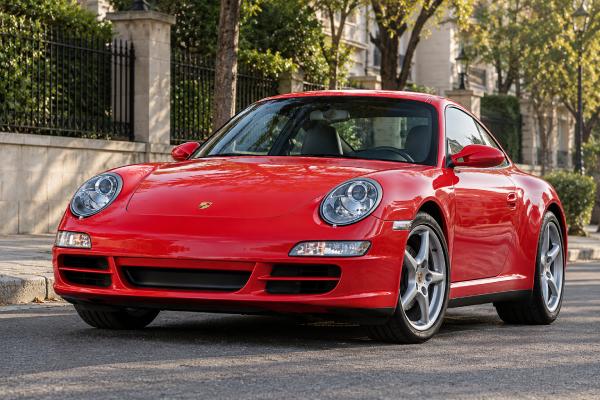
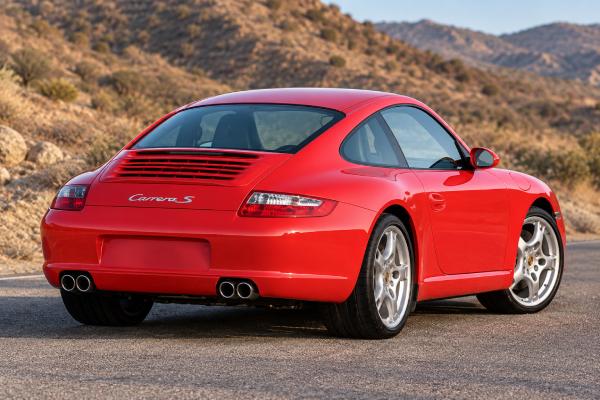
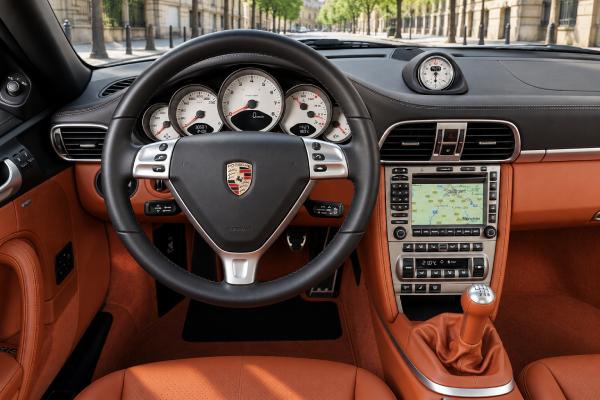
The 2005–2008 Porsche 911 Carrera is the rear-wheel-drive, 3.6-liter foundation of the first-generation 997 range. Its M96.05 flat-six develops 239 kW and 325 PS, retaining the familiar 3,596 cc displacement and VarioCam Plus architecture while the surrounding car moves decisively beyond the 996 in styling, steering calibration, electronics, cabin design, and chassis options. Porsche Active Suspension Management was optional on the standard Carrera rather than standard, which is one of several details that should be verified on the individual car instead of inferred from appearance.
Unlike the 2009-on 997.2, this 997.1 does not have direct fuel injection or PDK. A six-speed manual was the standard transmission and a five-speed Tiptronic S automatic was available. The 997.1 Carrera also spans an important intermediate-shaft transition: some early 2005 M96.05 engines use the earlier serviceable bearing, while later engines use the larger bearing that cannot be replaced externally without opening the engine.
This guide stays with the standard 3.6-liter rear-drive Carrera Coupe. Carrera S, Carrera 4, Targa, Turbo, and GT models have materially different specifications.
Table of Contents
- The Base 997.1 Carrera Defined
- M96.05 Engine and Power Delivery
- 997.1 Carrera Specifications
- Steering, Suspension, and Brakes
- Maintenance by Condition and Time
- IMS, Bore Condition, and Engine Diagnosis
- Buying a 2005–2008 Carrera
The Base 997.1 Carrera Defined
The standard 997.1 Carrera is the narrow-body, rear-wheel-drive 911 with the 3.6-liter engine, 18-inch wheels, and 325 PS output. Porsche separated it clearly from the Carrera S, which received a 3.8-liter engine, wider body treatment, 19-inch wheels, larger brakes, and standard PASM.
Porsche presented the 997 generation in 2004, and its Classic material lists the first-phase Carrera Coupe and Cabriolet as 2005–2008 models. The design returned to rounder separate headlamps after the combined lamp units of the 996. The body remained compact: roughly 4,427 mm long, 1,808 mm wide, and 1,310 mm high with a 2,350 mm wheelbase.
The model designation matters because used-car listings often blur equipment lines. A base Carrera can have optional 19-inch wheels, Sport Chrono, PASM, a sports exhaust, adaptive seats, navigation, or ceramic brakes; none of those turns it into a Carrera S. Conversely, S-style wheels or quad exhaust tips added later do not establish the original specification.
The power unit also marks the pre-facelift era. The 2009 model update brought new direct-injection engines and the optional PDK dual-clutch gearbox. A car described as a 325 hp 3.6 with a factory PDK is therefore a specification contradiction: the 325 PS M96.05 belongs to the earlier 997.1 period, when the automatic choice was Tiptronic S.
| Item | Specification |
|---|---|
| Body/drive concept | Narrow-body Coupe, rear-wheel drive |
| Engine | M96.05 naturally aspirated flat-six |
| Displacement | 3,596 cc (3.6 L) |
| Rated output | 239 kW (325 PS) at 6,800 rpm |
| Torque | 370 Nm (273 lb-ft) at 4,250 rpm |
| Manual transmission | 6-speed |
| Automatic option | 5-speed Tiptronic S |
| PASM | Optional on the standard Carrera |
M96.05 Engine and Power Delivery
The M96.05 is a 3.6-liter, water-cooled, naturally aspirated flat-six with four valves per cylinder and VarioCam Plus. Its bore and stroke are 96.0 × 82.8 mm, the same basic dimensions used by the preceding 3.6-liter Carrera engine, but calibration and supporting details raise Porsche’s rating to 325 PS.
VarioCam Plus combines inlet-cam phasing with two-stage inlet-valve lift. The engine management system can therefore vary both when the inlet valves operate and how far they open. The result is a broad torque curve without abandoning the high-revving response expected of a naturally aspirated 911.
European Porsche material quotes 325 PS, which is about 321 mechanical horsepower. U.S. sources commonly call the engine 325 hp. Because certification and units differ by market, the robust cross-market identifiers are 239 kW, 3,596 cc, the M96.05 designation, and the 6,800 rpm power peak.
| Item | Data |
|---|---|
| Configuration | Water-cooled horizontally opposed six-cylinder |
| Aspiration | Naturally aspirated |
| Displacement | 3,596 cc |
| Bore × stroke | 96.0 × 82.8 mm |
| Compression ratio | 11.3:1 |
| Valvetrain | DOHC, 24 valves, VarioCam Plus |
| Power | 239 kW (325 PS) at 6,800 rpm |
| Torque | 370 Nm (273 lb-ft) at 4,250 rpm |
The six-speed manual uses a dual-mass flywheel and hydraulic clutch. Tiptronic S substitutes a five-speed torque-converter automatic with steering-wheel shift controls. The two transmissions should be assessed separately when comparing acceleration, fuel economy, service history, or future repair exposure.
A healthy manual 3.6 feels progressive rather than explosive. It should accept throttle cleanly, pull smoothly through the middle of the rev range, and become increasingly urgent toward the upper range. Hesitation, recurrent misfires, unstable idle, or timing faults are diagnostic clues, not inherent traits of an old M96.
997.1 Carrera Specifications
The manual rear-drive Carrera was factory-rated around 5.0 seconds from 0–100 km/h and about 285 km/h top speed. It combines that performance with 18-inch wheels and relatively modest mass by contemporary 911 standards.
| Measure | Specification |
|---|---|
| Drive | Rear-wheel drive |
| Transmission | 6-speed manual |
| 0–100 km/h | Approximately 5.0 seconds |
| Top speed | Approximately 285 km/h (177 mph) |
Period U.S. data lists a 2008 Carrera Coupe at 3,075 lb, approximately 1,395 kg. Some trim databases show higher figures because they mix transmission, roof, body, or equipment specifications, so weights should always be tied to a particular configuration.
| Measure | Specification |
|---|---|
| Length | 4,427 mm (174.3 in.) |
| Width without mirrors | 1,808 mm (71.2 in.) |
| Height | Approximately 1,310 mm (51.6 in.) |
| Wheelbase | 2,350 mm (92.5 in.) |
| Representative curb weight | 3,075 lb (about 1,395 kg) |
| Fuel tank | 64 L (16.9 U.S. gal) |
Standard Carrera III wheels are 18 × 8 inches front and 18 × 10 inches rear with 235/40 ZR18 and 265/40 ZR18 tires. The narrower rear tire compared with an S model is another useful baseline when checking a car that has not been modified.
| Axle | Wheel | Tire |
|---|---|---|
| Front | 18 × 8 in. | 235/40 ZR18 |
| Rear | 18 × 10 in. | 265/40 ZR18 |
Standard iron brakes use ventilated discs with four-piston monobloc calipers. A period U.S. specification gives roughly 318 × 28 mm front rotors and 299 × 24 mm rear rotors. Porsche Ceramic Composite Brakes were an option on suitably equipped cars, so brake identification should be physical and option-code based before estimating replacement costs.
Historical EPA data for a 2008 manual Carrera lists 18 mpg city and 26 mpg highway. These figures come from a period test regime and do not predict consumption for every modern driving pattern.
Steering, Suspension, and Brakes
The 997.1 Carrera pairs hydraulic rack-and-pinion steering with a variable steering ratio, a strut-type front suspension, and a multi-link rear axle. Its mechanical steering is a defining part of the model’s feedback, so looseness, notchiness, pump noise, fluid leaks, or inconsistent assistance deserve investigation rather than being dismissed as “old Porsche feel.”
Porsche Active Suspension Management was introduced with the 997 generation. On the base Carrera it was optional; on the Carrera S it was standard. PASM-equipped cars use electronically controlled dampers with selectable behavior. By now, damper condition matters more than the novelty of the system: leaking or weak dampers, failed mounts, worn control arms, and poor alignment can overwhelm any electronic mode choice.
The standard car also uses Porsche Stability Management, ABS, and traction-related functions. Wheel-speed sensor faults, weak batteries, incorrect steering-angle calibration, or damaged wiring can create warning lights whose cause is not necessarily a failed stability-control computer.
Tire selection strongly influences steering and ride. The original 18-inch package gives more sidewall than the S model’s standard 19s. Cars fitted with aftermarket 19- or 20-inch wheels should be checked for correct offsets, tire diameters, rubbing, wheel weight, and alignment effects rather than assumed to be an upgrade.
Brakes should feel firm and repeatable without vibration. Inspect inner and outer rotor faces, pad wear, caliper seals, hoses, fluid history, and the parking-brake mechanism. A low-mileage garage car can still have old fluid and corroded friction surfaces.
The rear-engine layout still shapes the dynamics. Under power, rear traction is strong; under abrupt lift or poor inputs near the limit, the mass distribution remains relevant. PSM provides a safety layer, not permission to ignore tire age or wet-road conditions.
Maintenance by Condition and Time
A 997.1 Carrera is now old enough that elapsed time and inspection findings should supplement the original mileage schedule. Porsche-era service intervals provide the framework, but rubber, plastics, fluids, battery condition, dampers, seals, and cooling components can age while the odometer barely moves.
A current specialist schedule for the 997 recommends annual inspection and oil/filter service, with brake fluid, filters, plugs, drive belt, and transmission fluids layered in at longer intervals. Exact intervals should be confirmed for the car’s market and history; the important point is to avoid treating a 20-year-old car as though its next need is determined by mileage alone.
| System | What to establish |
|---|---|
| Engine oil | Change history, correct specification, filter condition, leaks |
| Cooling system | Tank, cap, pump, thermostat, hoses, radiators, fans, coolant condition |
| Ignition | Plug age, coil condition, misfire history |
| Accessory drive | Belt, tensioner, idlers, alternator and bearing noise |
| Brakes | Fluid age, pads, rotors, hoses, caliper operation |
| Suspension | Dampers/PASM function, arms, links, mounts, wheel bearings, geometry |
| Transmission | Fluid record, clutch or Tiptronic behavior, leaks, mounts |
The front radiator and air-conditioning condenser areas should be inspected for debris and corrosion. The 997’s front openings can collect leaves and road material; trapped debris holds moisture against heat exchangers and may obstruct airflow. Cleaning should be accompanied by inspection rather than simply blowing visible leaves away.
Cooling-system loss should never be normalized. Look for dried coolant residue around the expansion tank and cap, pump area, hose connections, and radiators. Verify fan operation and stable operating temperature under the conditions of the road test.
On manual cars, clutch condition, dual-mass flywheel behavior, shift cables, hydraulic operation, and engine/transmission mounts influence how the driveline feels. On Tiptronic cars, check fluid history, leaks, engagement when cold and hot, kickdown, and manual-mode operation.
Battery condition deserves attention because the 997 contains more electronic modules than the 996. A marginal battery can produce confusing low-voltage faults. For cars stored seasonally, charging strategy and parasitic-draw investigation are preferable to repeated deep discharge.
IMS, Bore Condition, and Engine Diagnosis
The 997.1 Carrera’s M96.05 spans two IMS-bearing configurations, making engine identification especially important on 2005 cars. According to LN Engineering’s engine-number guidance, M96.05 engines up to serial number 69507475 should have the smaller serviceable single-row bearing; engines after that cutoff use the larger 6305-style bearing that cannot be replaced through the external flange with the engine assembled.
That transition means “all 997.1 IMS bearings are non-serviceable” is too broad, while “a 2005 Carrera can always have an IMS retrofit during a clutch job” is also too broad. The engine serial number and visual inspection should determine the plan. By 2006–2008, the larger non-serviceable configuration is the expected arrangement.
The larger bearing is not a reason to dismantle a healthy engine simply because it exists. Diagnosis should be based on oil/filter evidence, engine behavior, documented history, and specialist evaluation. Equally, an early serviceable-bearing car should have any prior retrofit verified by invoice, product type, mileage, and date.
Cylinder bore condition is another separate concern. The 3.6 M96.05 can exhibit cylinder-wall scoring, but prevalence varies with operating history and the term is often overused in advertisements and forum discussions. Useful evidence includes oil-consumption history, plug condition, bank-to-bank exhaust deposits, mechanical noise when warm, borescope findings, and—where justified—compression or leak-down testing.
A borescope is most valuable when the operator knows where and how to inspect these engines. A few photographs without cylinder identification or piston position can be misleading. A strong pre-purchase assessment records which bores were viewed and distinguishes normal polishing or marks from actual scoring.
The air-oil separator, crankcase vacuum system, ignition coils, plugs, mass-airflow sensing, vacuum leaks, and VarioCam Plus components can create smoke, rough running, or fault codes without bottom-end failure. Diagnostic scan data should be interpreted before parts are replaced.
Oil leaks must be traced to source. Cam covers, seals, oil cooler-related areas, and the rear of the engine can all create staining. A rear main seal seep may be convenient to address while the gearbox is removed for clutch work, but a leak should not be labeled RMS solely because oil is visible near the bellhousing.
Buying a 2005–2008 Carrera
A good 997.1 Carrera purchase starts with configuration and engine identity, then moves to condition. The most valuable information is a coherent record showing how the specific car has been used, serviced, repaired, and inspected—not a low odometer number by itself.
Decode the VIN and option list. Confirm that the car is a base 3.6 Carrera, whether it has PASM, Sport Chrono, sports exhaust, ceramic brakes, factory 19-inch wheels, or other significant options, and whether those systems remain present and functional. Modified suspension, exhaust, intake, and wheels should be assessed for installation quality and legal compliance in the relevant market.
For a 2005 car, record the engine serial number. Determine whether it falls before or after the IMS cutoff and whether the engine is original. Replacement engines can invalidate assumptions based on chassis year. If the car has an early serviceable bearing, demand documentation for any claimed replacement.
Inspect the engine cold when possible. Note start-up smoke, rattles, oil-pressure behavior, idle quality, warning lights, and exhaust character. After warm-up, recheck for smoke, leaks, noises, and stable temperature. Scan all relevant modules and review fault history rather than clearing codes before understanding them.
A specialist borescope is sensible when symptoms, history, or purchase value justify it. Ask how much oil the owner adds between services and over what mileage. Inspect the removed oil filter if an oil service is part of the pre-purchase process. None of these checks alone gives a complete answer; together they can reveal whether further work is needed.
The chassis should be evaluated on a lift. Look for worn lower control arms, track-control links, leaking dampers, broken bump stops, wheel-bearing play, damaged undertrays, bent wheels, old tires, uneven inner-edge wear, and collision repair. PASM cars should change behavior appropriately without warnings.
On the road, the steering should be smooth and direct, the manual gearbox should remain clean when hot, and the clutch should not slip or judder. Tiptronic S should engage promptly and shift consistently. Brake vibration, steering shake, rear instability, or a car that follows road cambers excessively can point toward wheel, tire, alignment, or suspension problems.
Finally, compare the cost of deferred maintenance with the purchase price. A car needing six coils, plugs, a water pump, front condensers, suspension arms, four tires, brakes, clutch work, and cosmetic repair can consume a large apparent bargain. The 997.1 Carrera is mechanically straightforward by modern 911 standards, but its condition today is the product of two decades of individual ownership decisions.
References
- Modelo 911 Carrera (tipo 997) | Porsche España 2026
- 6th Generation – Engines – Porsche Newsroom 2023
- The 997: Technology offensive, new design and great variety for the 911 – Porsche Newsroom 2018
- 2008 Porsche 911 Carrera 2dr Cpe Features and Specs 2025
- Recommended Maintenance Schedule Porsche 911 Carrera 997 2026
- 2005-2008 Porsche IMS Bearing Type by Engine Serial NUmber 2026
Disclaimer
This guide is educational information, not a substitute for a professional inspection, diagnosis, or repair procedure. Specifications, service intervals, torque values, fluids, parts, and repair methods can vary with VIN, market, production date, transmission, body style, options, and replacement-engine history. Confirm all service decisions against the official documentation for the exact vehicle.
If this 997.1 Carrera guide is useful, consider sharing it with another owner or enthusiast who is researching the 3.6-liter car.