
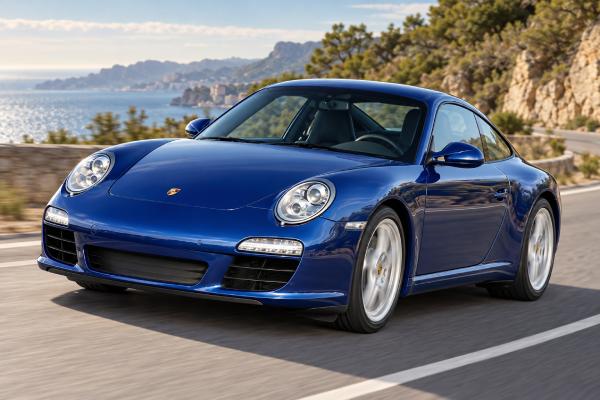
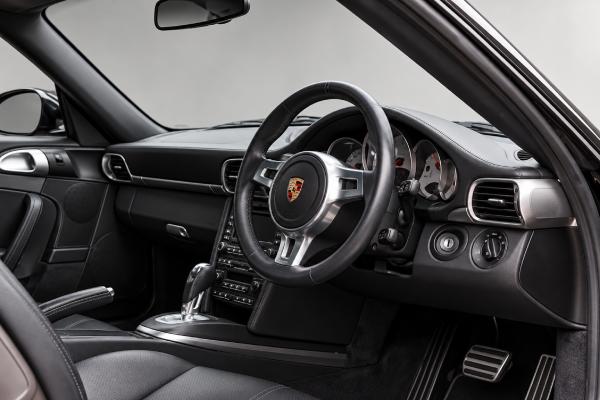
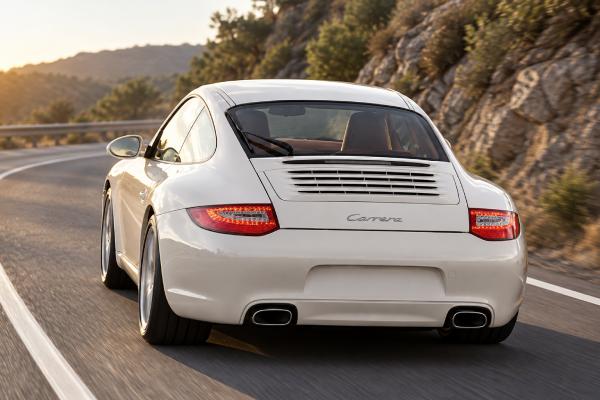
The 2009–2012 Porsche 911 Carrera covered here is the rear-wheel-drive 997.2 Coupé with the 3.6-litre MA1.02 direct-injected flat-six, rated by Porsche at 254 kW (345 PS). It is the facelifted base Carrera, not the earlier 325 PS 997.1, the 3.8-litre Carrera S, or an all-wheel-drive Carrera 4. The 2008 model update was mechanically important: Porsche introduced a new direct-fuel-injection engine generation and replaced the optional Tiptronic automatic with seven-speed PDK, while keeping a six-speed manual available. The narrow Carrera body, 18-inch standard wheel package and rear-wheel-drive layout make this one of the simpler late-997 configurations, but age, service history and option content now matter more than the word “base” suggests. The following guide separates factory data from practical interpretation, explains the manual-versus-PDK choice, and focuses the inspection process on the exact 3.6-litre 997.2 rather than recycling checks from earlier water-cooled 911 engines.
Table of Contents
- Understanding the 997.2 Carrera scope
- 3.6 Carrera specifications
- Direct injection and transmission choices
- Narrow-body chassis and brakes
- Performance, efficiency, and daily use
- Service strategy for a late 997
- How to inspect a used 997.2 Carrera
Understanding the 997.2 Carrera scope
The correct scope is the facelift 997 Carrera with 3.6 litres, rear-wheel drive and either six-speed manual or seven-speed PDK. Porsche introduced the revised range after the July 2008 facelift, and the 997 generation remained in production through 2012 as the 991 replaced it.
That distinction matters because “997 Carrera” can describe mechanically different cars. Early 997.1 Carreras used the M96/M97-era port-injected engine family and were rated at 325 PS in 3.6-litre form. The 997.2 moved to a newly developed direct-injected engine architecture and 345 PS. Advice tied specifically to the earlier engine should not be applied automatically to the later MA1/9A1 family.
The Carrera S is also outside this article’s technical scope. It uses 3.8 litres and 385 PS, along with standard 19-inch wheels and other specification differences. Likewise, the Carrera 4 adds Porsche Traction Management (PTM), front driveshafts and a wider body. The base rear-drive Carrera remains the narrow-bodied version, which affects rear tire size, weight, driveline complexity and the way a buyer should inspect the car.
Model year and registration year can be confused on used listings. A car first registered in 2009 may have been built earlier, while a late car can be advertised by calendar year rather than Porsche model year. The quickest way to prevent a scope mistake is to check the VIN, engine identification, build data and visible facelift features rather than relying on a seller’s title line.
Options are another source of variation. Sport Chrono can change PDK shift strategy and acceleration performance; PASM changes damper behavior and ride height; PCCB substitutes ceramic-composite brakes for the standard steel system; and wheel packages alter tire dimensions. These are configuration differences within the same Carrera, not reasons to blend Carrera S data into the specification.
3.6 Carrera specifications
This Carrera is a naturally aspirated gasoline ICE model with a rear-mounted 3.6-litre flat-six and rear-wheel drive. The six-speed manual and seven-speed PDK are both legitimate factory configurations, so performance and weight figures need to identify the transmission where it changes the result.
| Specification | Value | Notes |
|---|---|---|
| Engine | MA1.02 / 9A1-family flat-six | 997.2 direct-injection generation |
| Layout | Rear-mounted, horizontally opposed 6-cylinder | Naturally aspirated |
| Displacement | 3,614 cc (3.6 L) | 97 mm bore × 81.5 mm stroke |
| Valvetrain | DOHC, 4 valves per cylinder, VarioCam Plus | Variable valve timing/lift system |
| Fuel system | Direct fuel injection | Introduced to Carrera range with 997.2 update |
| Maximum power | 254 kW (345 PS; 340 hp SAE) at 6,500 rpm | Porsche European rating |
| Maximum torque | 390 Nm (288 lb-ft) at 4,400 rpm | Factory specification |
| Compression ratio | 12.5:1 | Premium-fuel high-compression engine |
| Maximum engine speed | 7,500 rpm | Factory limit |
| Specification | Manual | PDK |
|---|---|---|
| Transmission | 6-speed manual | 7-speed dual-clutch |
| Drive | Rear-wheel drive | Rear-wheel drive |
| Launch-control capability | No | Available with applicable Sport Chrono configuration |
| Measure | Value | Configuration |
|---|---|---|
| 0–60 mph | 4.7 s | 6-speed manual, U.S. factory figure |
| 0–60 mph | 4.5 s | PDK, U.S. factory figure |
| 0–60 mph | 4.3 s | PDK with Sport Chrono, U.S. factory figure |
| Top speed | 288 km/h (179 mph) | Manual |
| Top speed | 286 km/h (178 mph) | PDK |
| Specification | Value | Notes |
|---|---|---|
| Body style | 2-door 2+2 Coupé | Narrow-body Carrera |
| Length | 4,466 mm (175.8 in) | 2011 U.S. technical specification |
| Width | 1,808 mm (71.2 in) | Excludes mirrors |
| Wheelbase | 2,350 mm (92.5 in) | 997 platform |
| Height | 1,310 mm (51.6 in) | Base Carrera specification |
| Front luggage volume | 125 L (4.4 cu ft) | Factory figure |
| Fuel tank | 64 L (16.9 U.S. gal) | Rear-drive Carrera |
| Position | Wheel | Tire |
|---|---|---|
| Front | 8J × 18 | 235/40 ZR18 |
| Rear | 10.5J × 18 | 265/40 ZR18 |
| Item | Value | Interpretation |
|---|---|---|
| PDK combined consumption | 9.8 L/100 km | Period European/NEDC comparison figure |
| Service interval development | Up to 30,000 km cited by Porsche for facelift engines | Regional schedules still govern actual servicing |
| Brake fluid | Time-based service item | Use official market schedule |
| Spark plugs | Age/mileage service item | MY09–12 Carrera schedules differ by market |
| Drive belt | Age/mileage inspection/replacement item | Condition matters on low-mileage cars |
Direct injection and transmission choices
The two biggest mechanical changes from a comparable 997.1 Carrera are the direct-injected engine family and the arrival of PDK. Together they make a 997.2 feel familiar as a 911 but meaningfully different to own and drive from the earlier car.
Direct fuel injection meters fuel into the combustion chamber rather than the intake port. Porsche used the change to improve output and efficiency: the 3.6 Carrera rose from 325 PS before the facelift to 345 PS after it. The high 12.5:1 compression ratio and VarioCam Plus help explain why correct fuel quality, ignition health and accurate engine management are important. For a buyer, the practical test is not to assume a particular fault but to confirm clean cold starting, stable idle, smooth response through the rev range and credible diagnostic data.
The six-speed manual is conventional in concept but should not be evaluated casually. Clutch slip under load, excessive judder, noisy release operation or resistance selecting a ratio when hot all justify closer inspection. A short shift action can feel firm without being defective; comparison with another healthy 997 can help when a buyer is unfamiliar with the gearbox.
PDK is a seven-speed dual-clutch unit, not a torque-converter automatic. Porsche highlighted faster shifts without an interruption in drive, and period figures show the base Carrera gaining acceleration while also returning better homologation fuel consumption than the manual. Sport Chrono further changes PDK behavior and enables the quickest factory 0–60 mph claim listed above.
A used PDK car should engage Drive and Reverse promptly and behave consistently at parking speeds, in ordinary automatic driving and under manual commands. Diagnostic scanning is useful because a dashboard free of warnings is not the same as a control unit free of stored faults. Service history should show that transmission-related work was performed according to the car’s applicable schedule, not according to assumptions copied from a newer PDK generation.
The manual-versus-PDK buying decision is therefore not a reliability ranking. It is a configuration choice with different service items, driving behavior and market appeal. Condition and documented care matter more than selecting one solely because it is mechanically simpler or shifts faster.
Narrow-body chassis and brakes
The base Carrera’s narrow body and rear-wheel-drive layout reduce hardware compared with a Carrera 4 and give it a different rear tire specification from the wide-bodied models. Those differences should remain visible in the car you inspect.
At 1,808 mm wide, the rear-drive Carrera is narrower than the 1,852 mm Carrera 4/4S body. Standard rear tires are 265/40 ZR18, not the much wider sizes seen on GTS or special-edition 997s. Many cars were ordered with optional 19-inch wheels, so finding a different diameter is not automatically evidence of modification. The correct question is whether the wheels, offsets and tire sizes match a legitimate Porsche configuration for that VIN.
The 997 uses a MacPherson-strut-type front suspension and multi-link rear arrangement. PASM was available depending on specification; it should not be described as standard on every base Carrera. If equipped, check that the system responds to mode changes and that no damper is leaking. Regardless of PASM, listen for knocks and inspect control arms, joints, top mounts and alignment-related tire wear.
Standard brakes use ventilated discs, while PCCB was optional. On steel-brake cars, inspect disc thickness/condition, pad wear and caliper operation. On PCCB cars, use ceramic-specific inspection criteria because rotor replacement costs and damage mechanisms differ. Brake-fluid history remains relevant to either setup.
Steering is hydraulic rather than the electric system used on the subsequent 991. Excessive looseness, fluid leakage, pump noise or a steering wheel that does not return naturally should be investigated. Tire condition and alignment can also make a healthy rack feel wrong, so diagnosis should separate the hydraulic system from chassis setup.
The relatively modest standard wheel package can be an advantage for road use: more sidewall than the optional 19-inch combinations can improve impact tolerance and ride compliance. A buyer interested in factory originality should confirm the delivered wheel option rather than assuming smaller wheels are less desirable or larger ones are an upgrade.
Performance, efficiency, and daily use
With 345 PS and a sub-five-second factory 0–60 mph time, the base 997.2 Carrera is already a fast road car; the S badge is not required to access the generation’s core performance. The key differences are how quickly the two transmissions deliver that performance and how much tire, brake and option hardware an individual car carries.
The manual’s 179 mph factory top speed is slightly higher than the PDK figure even though PDK accelerates more quickly to 60 mph. That is a useful reminder that “faster” depends on the measurement. PDK’s tightly managed shifts and Sport Chrono launch strategy help from rest, while gearing and drag determine maximum speed.
Porsche specifically used PDK’s efficiency at launch as a technology example: the 3.6 Carrera achieved a period combined figure of 9.8 L/100 km. That number comes from an older test cycle and should not be presented as guaranteed real-world consumption. It is valuable for same-era comparisons, especially because it shows that the dual-clutch transmission was designed for efficiency as well as speed.
Daily practicality remains recognizably 911. The front luggage compartment is 125 litres, rear seats can carry children or function as additional luggage space, and the 64-litre fuel tank gives useful touring range. Cabin technology, however, reflects its age. Original Porsche Communication Management equipment and phone/navigation functions should be tested rather than valued solely for originality; owners may reasonably prioritize a reversible modern connectivity solution.
Ground clearance and front overhang still deserve care, especially on cars with lowered suspension. Cooling openings at the front collect road debris. Regular cleaning and inspection of radiators and air-conditioning condensers is a practical habit, not a performance modification.
Service strategy for a late 997
A sound maintenance plan for a 997.2 Carrera should be based on the official schedule for its VIN and market, then adjusted for age and use. Porsche’s historical material mentions extended service intervals for the facelift engine generation, but that should not be interpreted as permission to leave an older, lightly used car unattended for years.
Keep an annual record of mileage, oil service, brake-fluid age, tire age and battery condition even if the formal service interval is longer. Cars used for frequent short trips can accumulate moisture and thermal cycles without covering many kilometres; stored cars can develop a different set of problems involving batteries, seals, tires and corrosion.
Spark plugs, filters, the accessory drive belt and transmission fluids appear as age/mileage items in Porsche service plans, with exact intervals differing across markets. The safest approach is to obtain the official maintenance sheet applicable to the car and document when each item was actually performed. A statement that a component was “done recently” should be backed by an invoice with date and mileage.
Cooling-system inspection should include the front heat exchangers, coolant level and condition, visible hoses and evidence of dried residue around joints. The air-conditioning condensers share the front airflow path and can suffer from debris exposure. Cleaning should be careful enough not to damage fins.
For the engine, the late 997 architecture is an important boundary. Do not buy or reject a 997.2 based solely on a list of earlier M96/M97 internet concerns. A specialist can inspect the exact car for oil leaks, unusual noises, misfire history, over-rev data where applicable, fuel-trim behavior, cooling performance and evidence of prior repairs. If the history or symptoms justify deeper testing, compression, leak-down or borescope work can be considered as diagnostic tools rather than ritual requirements.
How to inspect a used 997.2 Carrera
A good used-car inspection starts by proving that the vehicle matches the advertised 3.6-litre 997.2 Carrera specification, then moves from body structure to mechanical condition and history. The process is more reliable than beginning with a list of supposed “common faults.”
Confirm the VIN, build date, engine designation, transmission and option list. Verify that a PDK car was factory PDK and a manual car retains the expected gearbox. Check whether PASM, Sport Chrono, PCCB, sport exhaust or non-standard wheels are factory options or later changes. Modifications are not automatically harmful, but they should be understood and supported by appropriate parts and calibration.
Inspect the body in good light. Look for consistent panel gaps, overspray, disturbed fasteners and paint-depth changes that can reveal repair history. Check the underside and front trunk structure, not just outer panels. The 997 is old enough that a cosmetic respray and structural accident repair must not be treated as equivalent events.
A cold engine start is informative. Listen for noises that persist rather than momentary normal mechanical sounds, watch the exhaust after initial condensation clears, and check that idle settles correctly. During the road test, use enough engine speed to confirm smooth power delivery without abusing an unfamiliar car. Monitor coolant temperature and warning messages.
On a manual, test clutch engagement and each gear when warm. On PDK, test low-speed maneuvering, automatic shifts, manual shifts and reverse. Steering should be precise without unexplained vibration or looseness. Brake application should be straight and stable. After the drive, inspect for fresh fluid leaks and unusual smells.
Tires can reveal chassis history. Compare brand, model, production dates and tread depth, then inspect inner shoulders. A matched set of correct Porsche-approved tires is useful evidence of attentive ownership, though it does not replace alignment measurements. Old tires with deep tread should be budgeted for replacement.
Finally, read the paper trail. Regular servicing, invoices for age-dependent work, clear mileage progression and transparent repair documentation matter more than an unusually low odometer with long unexplained gaps. Check the VIN against the relevant recall authority for the car’s market. A 997.2 Carrera bought on verified condition and specification is easier to evaluate than one selected primarily for color, options or a headline mileage number.
References
- The 997: Technology offensive, new design and great variety for the 911 – Porsche Newsroom 2018
- 6th Generation – Engines – Porsche Newsroom 2023
- Double Pleasure – Porsche Newsroom 2019
- Technical Specifications – Porsche Newsroom USA 2026
- Wartung und Verschleiß | Porsche Deutschland 2026 (Maintenance Plans)
- Check for Recalls: Vehicle, Car Seat, Tire, Equipment | NHTSA 2026 (Recall Database)
Disclaimer
This article provides general information, not professional diagnosis or repair instructions. Specifications, torque settings, service intervals and procedures can change with VIN, market, options and production date, so owners should verify all work against the official Porsche service information for their individual car.
Please share this guide on Facebook, X/Twitter, or with another Porsche group if it helped your 997.2 research and you would like to support our work.