
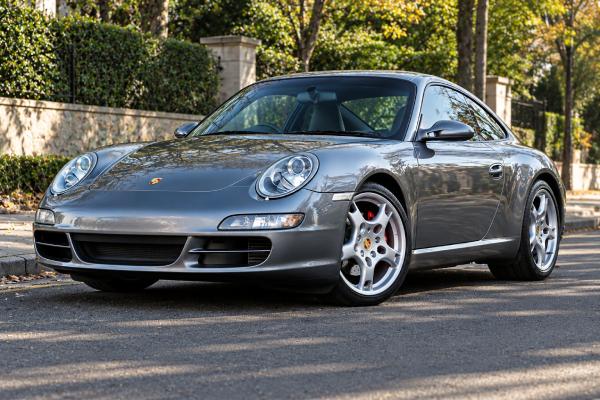
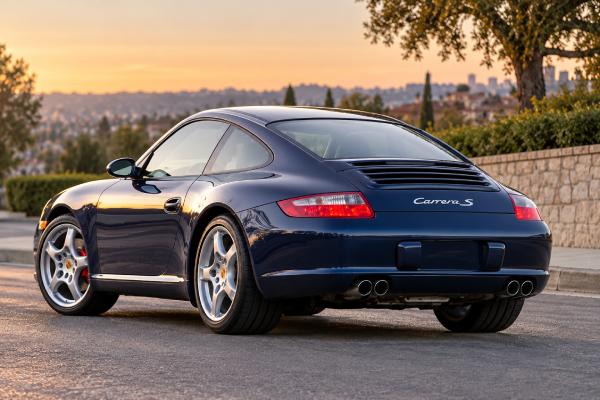
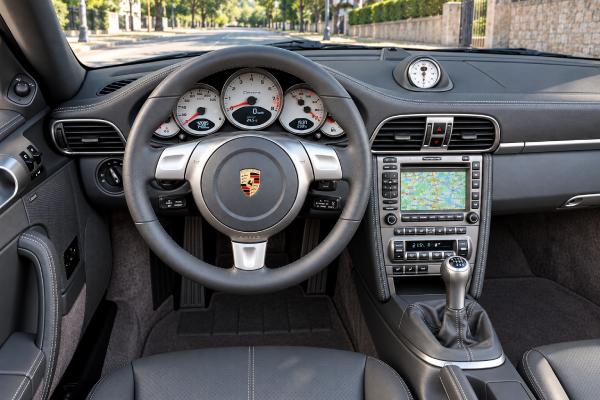
The 2005–2008 Porsche 911 Carrera S is the rear-wheel-drive 997.1 model built around the naturally aspirated 3.8-liter M97.01 flat-six. It sits above the 3.6-liter Carrera not by body width or driven-axle count, but through a larger engine, stronger standard chassis specification, 19-inch wheels, and uprated brakes. In European material Porsche rated the standard engine at 355 PS (261 kW), which converts to about 350 mechanical horsepower; North American period specifications commonly describe the car as 355 hp. That unit convention is why both figures appear in reputable literature.
This article is limited to the pre-facelift Carrera S for the 2005–2008 model years and the standard 355-output engine. It does not merge in Carrera 4S all-wheel-drive hardware, the optional X51 powerkit, Turbo or GT engines, or the direct-injected 997.2 Carrera S that followed for 2009. Representative dimensions and performance figures below use the manual-transmission Coupe unless a condition is stated.
Table of Contents
- What Makes the 997.1 Carrera S Different
- M97.01 3.8-Liter Engine
- Carrera S Technical Data
- PASM, Brakes, Wheels, and Road Character
- Service Planning for an Aging Carrera S
- Bore Scoring, IMS, and Engine Evidence
- Pre-Purchase Inspection Strategy
What Makes the 997.1 Carrera S Different
The Carrera S is the higher-output rear-wheel-drive 997.1 Carrera, not a wide-body Carrera 4S without its front driveshaft. Its key factory distinctions are the 3.8-liter engine, standard Porsche Active Suspension Management (PASM), 19-inch wheel package, and larger 330 mm brakes with red calipers.
That distinction matters when shopping because the badges alone do not tell the whole story. The standard rear-drive Carrera S uses the same basic 1,808 mm body width as the rear-drive Carrera, while the contemporary all-wheel-drive Carrera 4 and 4S use a broader rear body. A car advertised as a “wide-body Carrera S” should therefore prompt a VIN and body inspection rather than acceptance of the description.
The S also should not be confused with an X51-equipped car. Porsche offered a factory power increase for the 3.8-liter S models from the 2006 model year, taking output to 381 PS. That is a materially different engine specification and should be supported by build documentation, option codes, or other reliable factory evidence. The standard car discussed here remains the 355-output M97.01.
Porsche positioned PASM as standard on the S. The system continuously varies damper force and includes a ride height approximately 10 mm lower than the ordinary Carrera suspension. The driver can select a firmer program, but PASM is not simply an on/off “sport shock” switch: the dampers continue adapting within their control range. On a used car, therefore, correct behavior depends on healthy electronic dampers, mounts, links, tires, alignment, and bushings rather than the dashboard button alone.
The brake package is another useful authenticity clue. The Carrera S received red four-piston aluminum monobloc fixed calipers and internally vented, cross-drilled 330 mm discs at both axles. Porsche Ceramic Composite Brakes were optional on some cars, so yellow calipers can be legitimate, but they make condition assessment and replacement-cost planning especially important.
M97.01 3.8-Liter Engine
The M97.01 is the defining mechanical feature of this Carrera S: a 3,824 cc naturally aspirated flat-six with VarioCam Plus and sequential port fuel injection. Compared with the 3.6-liter base Carrera, its larger bore and calibration raise standard output to 261 kW and torque to 400 Nm.
The engine uses a 99.0 mm bore with an 82.8 mm stroke and an 11.8:1 compression ratio. Maximum power arrives at 6,600 rpm, while peak torque is quoted at 4,600 rpm. Those numbers help explain the S driving character: it has more midrange authority than the 3.6, but it still rewards revs rather than delivering the low-speed surge associated with a turbocharged engine.
VarioCam Plus combines camshaft phasing with variable valve lift. In practical terms, Porsche can alter valve timing and lift according to load and speed to broaden torque delivery while retaining the high-rpm breathing expected of a performance flat-six. This is still a port-injected engine; direct fuel injection did not arrive in the Carrera S until the 997.2 update.
The transmission choice also fixes the car firmly in the pre-PDK era. A six-speed manual was standard, while a five-speed Tiptronic S automatic was available. PDK belongs to the facelifted generation and should not appear on a factory 2005–2008 Carrera S. A listing that calls an early 997 Tiptronic “PDK” is using the wrong terminology.
Manual cars use a dual-mass flywheel and self-adjusting clutch. Clutch effort, engagement quality, flywheel noise, shift quality, and driveline lash are therefore useful inspection observations, but none proves engine health by itself. A high clutch bite point can indicate wear; a vibration or rattle can have several causes and should be diagnosed rather than assigned to the flywheel by assumption.
For output terminology, Porsche’s European 355 PS figure equals 261 kW and roughly 350 SAE/mechanical horsepower by direct conversion. U.S. period specifications commonly print 355 hp at 6,600 rpm. Because the assignment and much of the North American market identify this variant as “355 hp,” that wording is retained here while the measurement difference is made explicit.
Carrera S Technical Data
In standard form, the 997.1 Carrera S combines the M97.01 flat-six with rear-wheel drive and either a six-speed manual or five-speed Tiptronic S. The tables use representative manual Coupe data where weight or acceleration depends on body style and transmission; Cabriolet, Tiptronic, X51, PCCB, and other option combinations should not be assumed to share every value.
| Item | Specification |
|---|---|
| Engine code | M97.01 |
| Layout | Rear-mounted, naturally aspirated flat-six |
| Displacement | 3,824 cc (3.8 L) |
| Bore × stroke | 99.0 × 82.8 mm |
| Compression ratio | 11.8:1 |
| Valve system | DOHC, four valves per cylinder, VarioCam Plus |
| Fuel system | Sequential multi-point/port fuel injection |
| Rated power | 261 kW; 355 PS in European Porsche data at 6,600 rpm |
| North American period rating | 355 hp at 6,600 rpm |
| Peak torque | 400 Nm (295 lb-ft) at 4,600 rpm |
| Item | Specification |
|---|---|
| Driven wheels | Rear-wheel drive |
| Standard transmission | 6-speed manual |
| Optional automatic | 5-speed Tiptronic S |
| 0–100 km/h | About 4.8–4.9 seconds, manual Coupe in period European specifications |
| 0–60 mph | About 4.6 seconds in period U.S. specifications for the manual Coupe |
| Top speed | 293 km/h (182 mph) for the standard manual Coupe |
Performance figures are configuration-sensitive. Test method, tire condition, surface, temperature, driver technique, transmission, and optional equipment all affect acceleration. The quoted numbers are useful for identifying the factory performance envelope, not for judging an individual used car from a single full-throttle run.
| Item | Specification |
|---|---|
| Front suspension | MacPherson-strut layout with anti-roll bar |
| Rear suspension | LSA multi-link layout with anti-roll bar |
| Adaptive damping | PASM standard; approximately 10 mm lower S suspension |
| Steering | Hydraulically assisted rack-and-pinion, variable ratio |
| Stability system | PSM with ABS and traction/stability functions |
| Front brakes | 330 mm internally vented and cross-drilled discs; four-piston fixed calipers |
| Rear brakes | 330 mm internally vented and cross-drilled discs; four-piston fixed calipers |
| Front wheels/tires | 8J × 19; 235/35 ZR19 |
| Rear wheels/tires | 11J × 19; 295/30 ZR19 |
| Item | Specification |
|---|---|
| Body style | 2+2 Coupe |
| Length | Approximately 4,427 mm in European Coupe data |
| Width | 1,808 mm excluding mirrors |
| Height | Approximately 1,300 mm |
| Wheelbase | 2,350 mm |
| Representative curb weight | About 1,420 kg (3,131 lb) for a manual Coupe |
| Fuel tank | 64 L (16.9 US gal) |
| Cycle | Rating |
|---|---|
| City | 17 mpg US |
| Highway | 25 mpg US |
| Combined | 20 mpg US |
Those economy values are historical U.S. ratings, not a promise of present-day consumption. Short trips, cold operation, tire choice, traffic, altitude, ethanol content, mechanical condition, and driving style can move actual fuel use substantially.
PASM, Brakes, Wheels, and Road Character
The 997.1 Carrera S chassis is best understood as a coordinated package: adaptive dampers, 19-inch tires, stronger brakes, rear-wheel drive, and hydraulic steering all shape the car more than any single headline specification. A healthy example should feel tied down without needing to be harsh, and its steering should communicate load changes without looseness or persistent kickback.
PASM deserves special attention because age can hide behind electronic functionality. A dashboard with no suspension warning does not establish that all four dampers are controlling the body correctly. Leaking units, tired top mounts, worn control-arm joints, deteriorated bump stops, or mismatched replacement parts can produce float, secondary movement, knocking, or an unnecessarily brittle ride. Compare normal and sport modes on the same road and look for a coherent difference rather than merely a warning-free instrument panel.
The factory 235/35 ZR19 front and 295/30 ZR19 rear setup gives the S substantial tire capacity, but it also makes tire quality and geometry obvious. Uneven inner-edge wear can point to alignment, worn joints, or a history of aggressive settings. Mixed tire models, very old tires with good-looking tread, or a large difference in tire age front to rear can undermine the chassis feel that distinguishes a good Carrera S.
Brake inspection should go beyond pad thickness. The drilled iron discs can develop lip wear and surface cracking; small superficial marks around holes are different from cracks that propagate significantly and require professional judgment. Check disc condition on both faces, pad wear symmetry, caliper condition, fluid history, and the operation of ABS/PSM. If a car has PCCB, confirm that the ceramic system is genuine, inspect rotor condition using Porsche-appropriate criteria, and price future replacement before purchase.
On the road, the rear-drive S should not feel like an all-wheel-drive 4S. There is no front propeller shaft or front differential adding driven-axle hardware. The front end therefore retains the characteristic unpowered steering axle, while traction at the rear depends heavily on tire condition, surface, throttle application, and PSM. That is part of the variant’s appeal, but it also means neglected rear tires or poor alignment can transform confidence into nervousness quickly.
Service Planning for an Aging Carrera S
A 2005–2008 Carrera S is now old enough that elapsed time and documented condition matter at least as much as odometer mileage. The original schedule provides a baseline, but a credible ownership plan should close overdue age-related work first rather than assuming a low-mileage car needs little service.
A specialist schedule for the 997 Carrera describes intermediate service at roughly two years or 20,000 miles and major service at roughly four years or 40,000 miles, while recommending annual inspection and oil/filter changes for cars at this age. That distinction should be kept clear: an annual oil service today is a conservative age-based practice, not evidence that Porsche originally required every owner in every market to follow exactly the same interval.
| Item | Planning point |
|---|---|
| Engine oil and filter | Annual inspection-based service is prudent on an aging car; verify the applicable factory schedule for the VIN and market |
| Brake fluid | Commonly scheduled on a 2-year basis |
| Engine air and cabin filters | Commonly addressed at the 2-year/20,000-mile service level |
| Spark plugs | Commonly addressed at the 4-year/40,000-mile service level on naturally aspirated Carrera models |
| Drive belt | Age and condition matter; specialist schedules commonly place replacement around the 6-year service level |
| Manual gearbox oil | Long-interval item; condition and prior history matter on cars now approaching two decades old |
Service history should show more than stamped booklets. Invoices can reveal oil grade, plug replacement, coil work, coolant repairs, clutch history, brake-fluid dates, suspension renewal, air-conditioning work, and whether recurring faults were diagnosed or simply cleared. A long gap followed by a large “catch-up service” is better than continued neglect, but it is not equivalent to consistent care throughout the car’s life.
Cooling-system age deserves its own visual inspection. Look for dried coolant residue, staining around joints, brittle hoses, damaged front radiators or condensers, and debris packed in the front intake areas. Confirm stable operating temperature during a proper test drive. A pressure test is more useful than assumptions when leakage is suspected.
Ignition coils, plugs, the air-oil separator, engine mounts, accessory-drive components, water pump, coolant tank, and various seals are normal examples of components that can become ownership issues as mileage and age accumulate. They should be diagnosed by symptoms and inspection rather than treated as automatic failures at a universal mileage.
The Carrera S also carries costs that follow from its specification: 19-inch performance tires, 330 mm brake hardware, PASM dampers, and potentially expensive options such as PCCB. A cheap purchase price can therefore be misleading if the car simultaneously needs four tires, four dampers, brakes, a clutch, and deferred engine diagnostics.
Bore Scoring, IMS, and Engine Evidence
For the M97.01, a serious pre-purchase evaluation should address cylinder-bore condition and the exact IMS-bearing configuration separately. They are different failure modes, and a clean history regarding one does not prove the other is healthy.
Cylinder bore scoring is sufficiently associated with the 3.8-liter M97.01 that specialist inspection guidance specifically includes this engine among those worth borescoping. Possible warning signs can include increasing oil consumption, persistent piston-slap-like noise, misfires, or unequal soot at the exhaust outlets, but symptoms alone are not a reliable substitute for inspection. Conversely, a quiet cold start does not prove that every cylinder wall is clean.
A proper scope inspection should be performed by someone familiar with the M96/M97 architecture and what meaningful scoring looks like. Specialist guidance notes that inspecting only through the spark-plug opening can miss the most informative lower-cylinder areas in these engines; inspection technique therefore matters as much as simply stating that a “borescope was done.” The report should identify the cylinders inspected and ideally provide images or video.
The intermediate-shaft bearing requires year-specific nuance. The 2005 Carrera S is a transition case. Specialist engine-serial guidance identifies early M97.01 engines before serial cutoff 68509791 as using the smaller serviceable single-row bearing, while later 2005 production moved to the larger 6305 bearing that cannot be removed through the normal external opening with the engine assembled. For 2006–2008 M97.01 engines, the larger non-serviceable configuration is expected.
That difference changes the maintenance conversation. It is incorrect to tell every 2005 Carrera S owner that the bearing can be replaced during a clutch job, and it is equally incorrect to describe every 2005 car as having the later bearing. Verify the engine number and replacement-engine history. A factory replacement engine can carry the bearing design used when that replacement engine was manufactured rather than what someone expects from the chassis model year.
Do not turn IMS discussion into a prediction of failure. The rational goal is identification and evidence: determine which design the engine actually has, check documentation for any prior work, inspect the oil filter and drained oil when appropriate, investigate abnormal noise or debris, and follow a Porsche specialist’s recommendation for that exact engine. For a larger non-serviceable bearing, casual attempts to extract it through the original opening are not equivalent to a proper engine rebuild procedure.
Oil leaks also need context. A damp engine and a rapidly active leak are not the same condition, and the source may be above the area where oil becomes visible. Rear main seal leakage, IMS-flange seepage, cam-related seals, and other joints can be confused without cleaning and tracing. A pre-purchase report should name the suspected source and severity rather than use “typical Porsche leak” as a diagnosis.
Pre-Purchase Inspection Strategy
The strongest Carrera S purchase is supported by evidence that its expensive systems are healthy now, not merely by low mileage or a long options list. A model-specific PPI should establish identity first, then test the M97.01, chassis, electronics, body, and service history in a sequence that can expose contradictions.
Start with the VIN, option/build data, engine number, and transmission. Confirm that the car is a genuine Carrera S and that any claimed X51, PCCB, Sport Chrono, limited-slip differential, special suspension, or other valuable equipment is documented. If the engine was replaced, obtain the replacement invoice or engine number because that can affect both provenance and IMS configuration.
For engine condition, request a cold start when possible and ensure the engine is genuinely cold. Observe oil pressure behavior, exhaust smoke, idle quality, mechanical noise, and warning lamps, then repeat observations after full warm-up. Diagnostic scanning should include stored and pending faults plus Porsche-specific data where available. On manual cars, experienced inspectors often review over-rev data as one piece of evidence, but those records require careful interpretation and should not be converted into a simplistic pass/fail rule.
Bore inspection is especially valuable on the M97.01. Ask what access method was used, which cylinders were viewed, whether the lower thrust surfaces were visible, and whether images are included. Pair that with oil-consumption history if the owner has it, exhaust-side observations, filter inspection where practical, and a compression or leak-down test when findings justify deeper investigation. No single test should be treated as magical proof.
The road test should cover more than acceleration. Check steering self-centering, front-end knocks, wheel bearing noise, clutch take-up, synchro behavior, Tiptronic operation if fitted, brake vibration, PSM warnings, PASM response, and stability over uneven pavement. A Carrera S on healthy factory-size tires and sound suspension should feel precise; tramlining, pulling, or nervousness warrants tire, wheel, alignment, and joint inspection.
Underneath, look for collision repairs, distorted lift points, corrosion or damaged fasteners, leaking dampers, coolant or oil traces, torn boots, damaged undertrays, and exhaust deterioration. Measure tire dates and tread across the full width. On a car with 19-inch wheels, inspect the inner barrels for bends or cracks rather than judging only the visible faces.
Finally, price the defects as a package. A car needing a four-wheel tire set, brakes, PASM dampers, clutch, cooling-system work, and engine investigation can consume a large maintenance reserve even if each issue is individually repairable. Conversely, a higher-mileage Carrera S with clean bore-scope evidence, coherent service invoices, refreshed suspension, current tires, and properly diagnosed engine condition can present a far more transparent ownership proposition than a cosmetically perfect low-mileage car with missing records.
The 997.1 Carrera S is most convincing when its original engineering remains intact: the naturally aspirated M97.01, hydraulic steering, rear-wheel drive, manual or period-correct Tiptronic, PASM chassis, and strong iron brakes form a specific package that does not need later-generation parts or vague “upgrades” to justify itself. Verification is what separates that package from an expensive collection of assumptions.
References
- Modelo 911 Carrera (tipo 997) | Porsche España 2026
- Sixth generation – Engines 2023
- 2008 Porsche 911 Carrera S Coupe 2D Price, Listings & Reviews | Kelley Blue Book 2026
- Recommended Maintenance Schedule Porsche 911 Carrera 997 2026
- 2005-2008 Porsche IMS Bearing Type by Engine Serial NUmber – LN Engineering LLC Knowledge Base 2026
- How to Bore Scope your Porsche Engine for Cylinder Bore Scoring – LN Engineering 2026
Disclaimer
This article is for informational purposes only and is not a substitute for professional diagnosis, inspection, maintenance, or repair. Specifications, torque values, service intervals, procedures, and equipment can vary by VIN, market, production date, and option content; verify all work and technical data against the official Porsche service documentation applicable to the specific vehicle.
If this guide helped you, please consider sharing it on Facebook, X/Twitter, or another enthusiast community to support our work.