
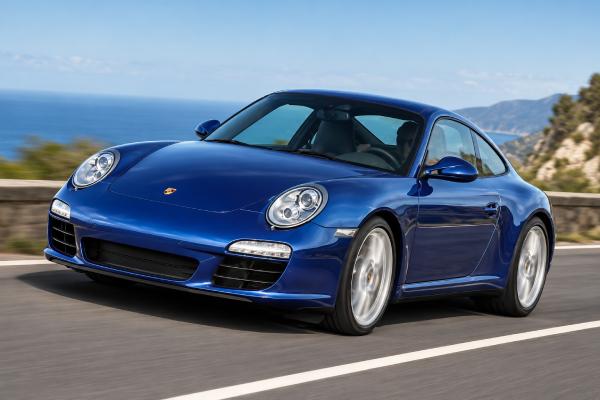
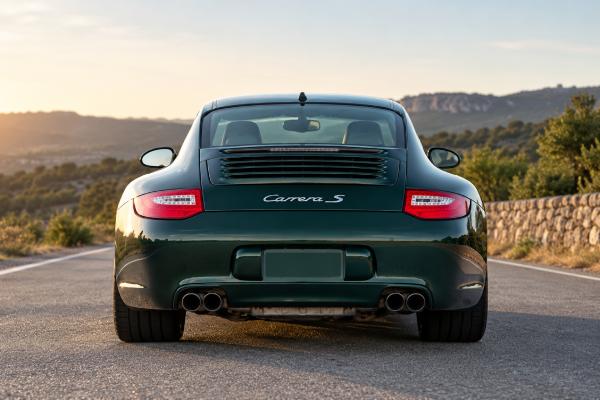
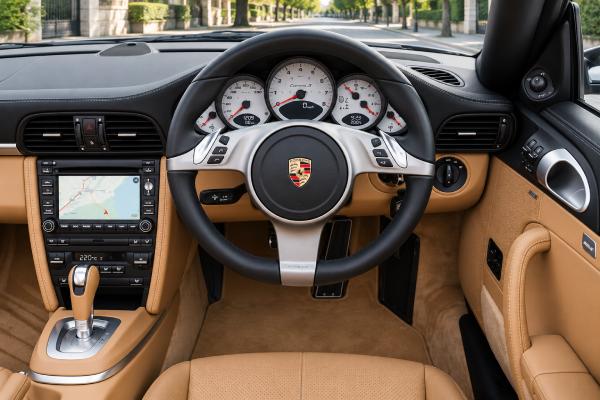
The 2009–2012 Porsche 911 Carrera S (997.2) is the rear-wheel-drive, naturally aspirated S model built around Porsche’s 3.8-litre MA1.01 direct-injection flat-six. Factory output is 283 kW (385 PS), with buyers able to choose a six-speed manual or the then-new seven-speed PDK dual-clutch transmission. It keeps the narrow 1,808 mm Carrera body rather than the broader Carrera 4 shell, yet receives the S model’s 19-inch wheel package, 295-section rear tires, red-caliper brake system and standard PASM adaptive damping. The facelift matters as much as the S badge: this car belongs to the later 9A1 engine family, not the earlier 997.1 3.8-litre M97, and PDK replaced Tiptronic. For today’s buyer, the appeal is the combination of rear-wheel drive, hydraulic steering and a high-revving non-turbo engine, but condition can vary widely after more than a decade of use. The sections below separate factory configuration from options, explain the transmission trade-offs and build an inspection strategy around this exact Carrera S.
Table of Contents
- Why the facelift S matters
- Carrera S specifications
- 3.8 engine and power delivery
- Six-speed or seven-speed PDK
- Rear drive, PASM, and braking
- Fuel use and everyday packaging
- Maintenance and diagnostic priorities
- Buying: options, modifications, and history
Why the facelift S matters
The 997.2 Carrera S is more than a styling update to the earlier 997.1 S. Porsche changed the engine family, introduced direct fuel injection and made PDK available, creating a different technical baseline for performance, diagnostics and long-term ownership.
Before the facelift, the 3.8-litre Carrera S produced 355 PS in standard form. The updated direct-injected engine produces 385 PS, while Porsche’s seven-speed dual-clutch transmission replaces the five-speed Tiptronic automatic. Externally, revised lighting and bumpers help identify the facelift, but build data and VIN information are the safer way to establish exactly what a used car is.
This rear-drive Carrera S also differs from the Carrera 4S in ways that extend beyond traction. It uses the 1,808 mm narrow body and a 64-litre fuel tank, and it does not carry a prop shaft, front final drive or front driven half-shafts. The result is a simpler driveline inspection and a distinct configuration for enthusiasts who specifically want rear-wheel drive.
At the top of the late-997 Carrera range, the GTS raises the same basic 3.8-litre architecture to 408 PS and combines rear-wheel drive with a wide body. The Carrera S therefore occupies a useful middle ground: more engine and chassis specification than the 3.6 Carrera, but without the GTS Powerkit and model-specific hardware.
Option content can still change a particular car substantially. Sport Chrono affects PDK launch performance and control strategy, PCCB changes the brake system, sports exhaust changes sound and exhaust hardware, and seat/wheel choices influence both feel and replacement cost. Treat the factory build sheet as part of the technical specification, not just as sales trivia.
Carrera S specifications
The 997.2 Carrera S is an ICE-only gasoline sports car with a rear-mounted 3.8-litre flat-six, rear-wheel drive and either manual or PDK transmission. The following figures are for the Coupé and should not be transferred automatically to Cabriolet, Carrera 4S, GTS or earlier 997.1 versions.
| Specification | Value | Details |
|---|---|---|
| Engine family | MA1.01 / 9A1 | 997.2 direct-injection architecture |
| Layout | Rear-mounted horizontally opposed 6-cylinder | Naturally aspirated |
| Displacement | 3,800 cc (3.8 L) | 102 mm bore × 77.5 mm stroke |
| Valvetrain | DOHC, 4 valves per cylinder, VarioCam Plus | Variable timing and lift |
| Fuel delivery | Direct fuel injection | Facelift engine system |
| Maximum power | 283 kW (385 PS; 380 hp SAE) at 6,500 rpm | Porsche period rating |
| Maximum torque | 420 Nm (310 lb-ft) at 4,400 rpm | Factory figure |
| Compression ratio | 12.5:1 | Use fuel meeting Porsche requirements |
| Maximum engine speed | 7,500 rpm | Factory limit |
| Configuration | 0–60 mph | Top speed |
|---|---|---|
| 6-speed manual | 4.5 s | 301 km/h (187 mph) |
| 7-speed PDK | 4.3 s | 299 km/h (186 mph) |
| 7-speed PDK with Sport Chrono launch function | 4.1 s | 299 km/h (186 mph) |
| Specification | Value | Notes |
|---|---|---|
| Front suspension | MacPherson-strut type | Independent |
| Rear suspension | Multi-link | Independent |
| Damping | Porsche Active Suspension Management (PASM) | Standard on Carrera S |
| Standard brakes | Ventilated, drilled steel discs | 330 mm, red calipers |
| Optional brakes | PCCB | Ceramic-composite option |
| Steering | Hydraulic rack-and-pinion | Variable steering ratio |
| Specification | Value | Notes |
|---|---|---|
| Body | 2-door 2+2 Coupé | Rear-drive narrow body |
| Length | 4,466 mm (175.8 in) | 997.2 Carrera family |
| Width | 1,808 mm (71.2 in) | Excluding mirrors |
| Height | 1,300 mm (51.2 in) | Carrera S Coupé |
| Wheelbase | 2,350 mm (92.5 in) | 997 platform |
| Front luggage volume | 125 L (4.4 cu ft) | Factory figure |
| Fuel tank | 64 L (16.9 U.S. gal) | Rear-drive Carrera |
| Axle | Wheel | Tire |
|---|---|---|
| Front | 8J × 19 | 235/35 ZR19 |
| Rear | 11J × 19 | 295/30 ZR19 |
| Configuration | Combined consumption | Procedure |
|---|---|---|
| 6-speed manual | 10.6 L/100 km | Period European NEDC |
| 7-speed PDK | 10.2 L/100 km | Period European NEDC; 0.4 L/100 km lower |
3.8 engine and power delivery
The Carrera S engine’s advantage over the base 3.6 is both numerical and experiential: 40 PS more power and 30 Nm more torque, delivered without turbocharging. The engine still needs revs to produce its best performance, which makes throttle response and upper-rpm health central to the road test.
Direct injection allowed Porsche to increase output while improving homologation efficiency. Fuel is delivered directly to the combustion chamber under high pressure, and VarioCam Plus manages valve timing and lift. The system is electronically sophisticated despite the engine’s naturally aspirated character, so modern diagnostic practice matters as much as listening for mechanical noise.
A healthy example should start cleanly, settle to a consistent idle and pull evenly from low speed to the upper rev range once fully warm. A brief sound at cold start should be interpreted in context; persistent knock, repeated misfire, abnormal smoke or a warning lamp warrants diagnosis. Review misfire counters and stored fault history rather than clearing codes before understanding them.
The 3.8’s 420 Nm peak occurs at 4,400 rpm. That is not a broad turbo plateau beginning near idle, and drivers moving from a modern turbo 911 may initially expect more low-rpm shove. The engine’s intended character is progressive. That matters when judging a test drive: needing revs is normal; hesitating, surging or failing to deliver consistent power is not.
Because this is a 997.2, avoid treating earlier M97-specific internet claims as an automatic diagnosis. Inspect the actual MA1/9A1 engine for oil leaks, cooling integrity, ignition issues, fuel-system faults and evidence of prior repairs. Deeper tests should follow symptoms, incomplete history or specialist findings.
Six-speed or seven-speed PDK
Transmission choice changes the Carrera S’s character more than its engine output. The six-speed manual prioritizes direct driver control; PDK delivers faster factory acceleration and lower period test-cycle consumption.
The manual uses a conventional clutch and should be inspected for slip, judder, release noise and consistent gear selection. Test it warm. Second-gear engagement under normal shifts, reverse selection and clutch take-up in traffic can reveal issues that an easy cold drive may not. A clutch replacement invoice is useful context, but the quality of the work matters as much as the date.
PDK was new to the Carrera range in this generation. Two clutches allow the next gear to be prepared before the current one is released, reducing interruption in drive. Porsche’s own historical comparison shows the 385 PS Carrera S using 0.4 L/100 km less fuel in the NEDC cycle with PDK than with the manual, while the factory 0–60 mph figure improves by two tenths.
Sport Chrono adds another layer. On applicable PDK cars it changes shift strategy and supports the quickest 4.1-second factory launch figure. This is why a listing that quotes the best PDK time for every Carrera S is incomplete. The equipment condition must accompany the number.
For a used PDK car, assess low-speed clutch take-up, reverse, automatic operation and manual requests after the transmission is warm. Scan the control unit for faults and confirm fluid/service work against the correct 997 schedule. A smooth drive is encouraging, but documentation closes the gap between a short test and long-term ownership.
Rear drive, PASM, and braking
The rear-drive S has less driveline hardware than the 4S but still carries a more performance-focused chassis specification than the base Carrera. PASM, 19-inch wheels and 295-section rear tires are central to how it feels and to what it costs to refresh.
PASM continuously controls damper behavior and provides selectable modes. A worn suspension can still feel “sporty” to someone unfamiliar with the car, so inspect rather than judge by firmness alone. Leaking dampers, tired top mounts, control-arm wear and alignment problems often reveal themselves through knocking or uneven tire wear.
The standard steel brakes use 330 mm ventilated, cross-drilled discs. Check rotor condition on both faces, pad thickness and whether the car stops straight. Track use or repeated high-temperature operation can accelerate wear even when road mileage is modest. Brake-fluid age remains relevant regardless of how much friction material is left.
PCCB-equipped cars require a different inspection. The ceramic discs are expensive and should be assessed for chips, impacts and allowable wear using Porsche guidance. Refinished yellow calipers do not authenticate PCCB, and a steel-brake conversion should be documented rather than hidden.
Rear-wheel drive also makes the rear tires a useful record of alignment and driver use. Inspect the inner shoulders and compare left/right wear. A car that repeatedly consumes the inside of one rear tire may have geometry or component issues that a fresh pair of tires temporarily conceals.
Fuel use and everyday packaging
The Carrera S can function as a touring car as well as a weekend sports car, but its 19-inch tires and performance chassis carry practical trade-offs. Fuel figures, cargo space and ride quality should be interpreted in that context rather than compared with a modern grand tourer.
The manual’s 10.6 L/100 km and PDK’s 10.2 L/100 km are NEDC homologation numbers from the period. They are valuable for comparing two factory configurations under the same procedure; they are not promises of current mixed-use consumption. Traffic, speed, tire choice, fuel quality and engine condition all influence what an owner sees at the pump.
A 64-litre fuel tank and 125-litre front luggage compartment give the Coupé useful long-distance capability. The small rear seats can also carry soft luggage when passengers are not using them. That packaging is one reason the Carrera S occupies a different role from a two-seat GT model even when performance overlaps older generations of more extreme 911s.
The standard 19-inch wheels reduce tire sidewall compared with the base Carrera’s 18-inch setup. That sharpens responses but increases sensitivity to potholes and wheel damage. Inspect the inner rim barrels for repairs, bends or cracks before assuming cosmetically pristine outer faces mean the wheels are perfect.
Cabin electronics are now old enough to be evaluated on function rather than novelty. Check PCM, audio, climate control, seat functions and every switch. Modern head units can improve connectivity, but a buyer who values originality should look for reversible installation and retained factory parts.
Maintenance and diagnostic priorities
The most useful maintenance record is chronological and specific. A stamp book showing regular visits is helpful; invoices that identify oil, filters, plugs, belts, brake fluid, transmission service and chassis repairs are much more useful when planning the next five years.
Porsche service schedules vary by region, so use the official plan tied to the vehicle’s market and VIN. Spark plugs, air filters, drive belt, brake fluid and transmission lubricants are not all governed by the same interval, and calendar time can trigger work before mileage does. That is particularly relevant to low-mileage 997s now well beyond their original warranty period.
Inspect the front radiator/air-conditioning condenser area because leaves and road debris can collect where they are not obvious from above. Cooling-system repairs should be judged by workmanship and parts quality. Dried coolant residue, unstable temperature or recurring top-ups call for investigation rather than repeated fluid additions.
Engine and chassis diagnostics should be performed with a stable battery voltage. Document faults before clearing them. Low-voltage history can create noise in an old fault log, while repeated current misfire, PASM or PDK codes deserve direct attention.
Consumables can be substantial on an S: four premium tires, 330 mm brake hardware and PASM dampers are not base-economy items. A pre-purchase budget should therefore include measured remaining life, not just evidence that each component exists.
Buying: options, modifications, and history
A Carrera S can be a very different car depending on options and later modifications, so the buying process should establish its factory baseline before judging whether changes are desirable. This is especially important for cars with aftermarket suspension, exhausts, software or non-standard wheels.
Obtain the build specification and compare it with what is fitted. Confirm Sport Chrono, PCCB, sports exhaust, seats, PASM and wheel options. If a part has been changed, ask for the original component and invoice. Reversible modifications with clear documentation are easier to assess than unexplained missing factory hardware.
Check body structure next. The narrow-body shell should have consistent quarter-panel and door alignment. Inspect the front trunk, underside, rear rails and suspension mounting areas for repair signs. Paintwork can be cosmetic or accident-related; evidence from seams, fasteners and structure provides context that a paint meter alone cannot.
Road-test from cold through full operating temperature. Check manual or PDK behavior, engine response, steering, PASM, brakes and air conditioning. Reinspect the engine bay and underside afterward for leaks. A specialist scan can add over-rev or fault-history information where the applicable control units record it.
Tire age, wheel condition and alignment are final but meaningful details. A car on a matched, recent Porsche-appropriate set with even wear tells a different maintenance story from one on four unrelated tires chosen simply to pass inspection.
Check the VIN against the recall database in the car’s registration market and confirm that any applicable campaigns were completed. Then compare the mechanical findings with the asking condition, not with assumptions about rarity or future value. The 997.2 Carrera S is desirable because of its exact driving and engineering configuration; the best ownership outcome still comes from buying the most coherent, well-documented example you can verify.
References
- The 997: Technology offensive, new design and great variety for the 911 – Porsche Newsroom 2018
- 6th Generation – Engines – Porsche Newsroom 2023
- Double Pleasure – Porsche Newsroom 2019
- Technical Specifications – Porsche Newsroom USA 2026
- Wartung und Verschleiß | Porsche Deutschland 2026 (Maintenance Plans)
- Check for Recalls: Vehicle, Car Seat, Tire, Equipment | NHTSA 2026 (Recall Database)
Disclaimer
This article is for research and informational use and does not replace professional diagnosis, inspection, servicing, or repair. Specifications, procedures, torque settings and maintenance intervals can vary by VIN, market, production date and equipment; always verify them using the official Porsche service information for the specific vehicle.
If the guide was useful, please share it on Facebook, X/Twitter, or with another Porsche community to support continued technical research.