
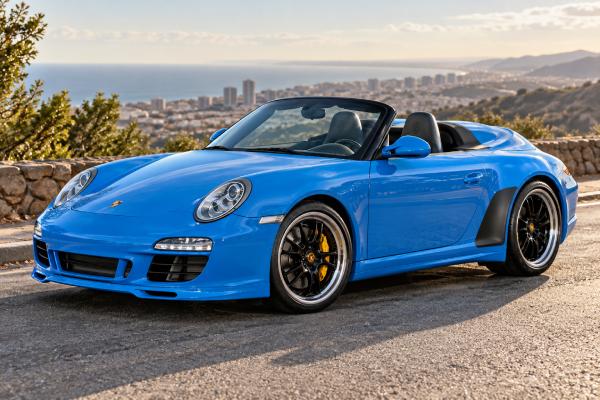
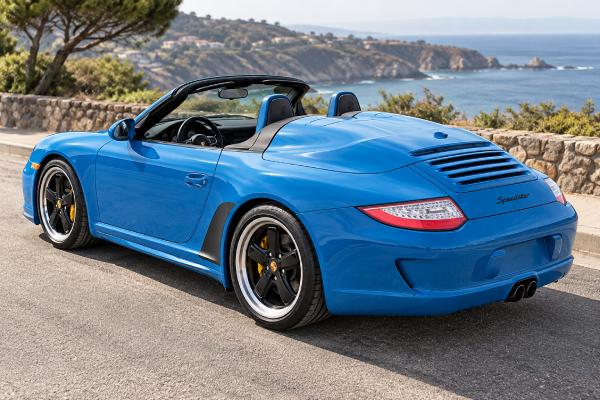
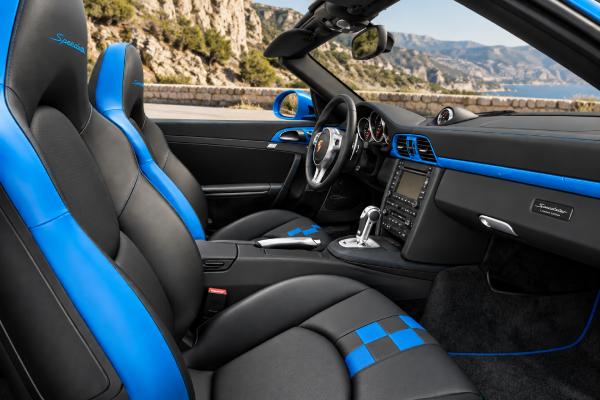
The 2011 Porsche 911 Speedster is one of the most specialized road-going 997.2 models: a 356-car, two-seat Porsche Exclusive series with a 60 mm-lower windscreen, a manually operated soft top, a double-bubble rear deck and the 44 mm-wider rear body. Underneath the visual changes is the 3.8-litre direct-injected Powerkit flat-six rated at 300 kW (408 PS), driving only the rear wheels through a seven-speed PDK dual-clutch transmission. Porsche also made a rear differential lock, PASM adaptive suspension and PCCB ceramic brakes standard. That combination is important because the 997 Speedster is not simply a chopped-roof Carrera S Cabriolet and it is mechanically different from the manual-only 997 Sport Classic. For an owner or buyer today, the rare roof system, Speedster-specific glazing and body panels can be more consequential than ordinary service items. This guide concentrates on those exact features, the correct technical scope, real ownership priorities and the checks that matter before buying a surviving example.
Table of Contents
- Speedster concept and production
- Speedster specifications and data
- Low screen, manual roof, and wide body
- PDK, Powerkit, and chassis
- What ownership demands
- Inspection points before purchase
- Provenance and correctness
Speedster concept and production
The 997 Speedster is a factory two-seater special edition, not a normal Carrera Cabriolet with its windscreen cut down. Porsche limited production to 356 cars as a direct numerical reference to the Porsche 356, and the model helped mark 25 years of Porsche Exclusive.
Porsche unveiled the car in 2010 and sold it as a 2011 model in many markets. The profile is unmistakable: the windscreen is 60 mm lower and more steeply raked, the side glass is correspondingly altered, and the folding fabric roof sits beneath a large double-bubble cover. The roof is manually operated. Porsche described it as suitable for everyday use rather than a token emergency cover, but operating it is still a more involved process than pressing a button in a normal 997 Cabriolet.
The rear body is 44 mm wider than the narrow Carrera shell. Despite that width, the Speedster is rear-wheel drive. The visual package therefore resembles the broad-hipped all-wheel-drive cars while keeping front-axle drive hardware out of the equation. The car is also strictly a two-seater, allowing the sculpted rear deck and roof stowage arrangement that define the model.
Unlike earlier Speedsters that emphasized removal of comfort equipment, the 997 edition was comprehensively equipped. That makes “Speedster” here a combination of distinctive open-body design, exclusivity and performance rather than a pure lightweight philosophy. Standard items such as PDK, PCCB and PASM reinforce that point.
For a buyer, the 356-unit production total changes the inspection priorities. Mechanical parts shared with other late 997 Carreras are generally more supportable than the windscreen, roof mechanism, rear cover, unique trim and Speedster body pieces. A cosmetically damaged but mechanically healthy car can therefore be a more complicated restoration proposition than its drivetrain condition alone suggests.
Speedster specifications and data
The 997.2 Speedster uses a naturally aspirated gasoline flat-six with direct injection and the Carrera Powerkit, but its only factory transmission is seven-speed PDK. Porsche paired that driveline with rear-wheel drive and a standard rear differential lock, then added chassis equipment that was optional or unavailable in many ordinary Carrera specifications.
| Specification | Value | Context |
|---|---|---|
| Engine family | MA1.01 / 9A1-series | 997.2 direct-injection generation |
| Engine | 3.8 L naturally aspirated flat-six | Rear-mounted |
| Displacement | 3,800 cc | Six cylinders, horizontally opposed |
| Fuel system | Direct fuel injection | Powerkit intake and calibration |
| Maximum power | 300 kW (408 PS; 402 hp SAE) at 7,300 rpm | 23 PS above standard Carrera S |
| Maximum torque | 420 Nm (310 lb-ft) | Powerkit output |
| Compression ratio | 12.5:1 | Late 997 naturally aspirated engine |
| Specification | Value | Condition |
|---|---|---|
| Transmission | 7-speed Porsche Doppelkupplung (PDK) | Standard and sole factory gearbox |
| Drive type | Rear-wheel drive | No Carrera 4 front driveline |
| Rear axle | Limited-slip differential | Standard |
| Stability system | Porsche Stability Management (PSM) | Standard |
| Specification | Value | Test basis |
|---|---|---|
| 0–100 km/h | 4.6 s | Factory period figure |
| Top speed | 305 km/h (190 mph) | Factory period figure |
| Combined fuel consumption | 10.3 L/100 km | NEDC |
| CO₂ emissions | 242 g/km | NEDC |
| Specification | Value | Notes |
|---|---|---|
| Body style | 2-door open two-seater | Speedster-specific body configuration |
| Windscreen | 60 mm lower than regular 997 open models | More strongly raked profile |
| Rear body | 44 mm wider | Broad 997 body with rear-wheel drive |
| Roof | Manually operated fabric soft top | Stored below double-bubble cover |
| Seating | 2 | No rear seats |
| Production | 356 units | Worldwide limited series |
| Specification | Value | Standard or condition |
|---|---|---|
| Adaptive suspension | Porsche Active Suspension Management (PASM) | Standard |
| Brakes | Porsche Ceramic Composite Brake (PCCB) | Standard |
| Front suspension | MacPherson-strut type | 997 architecture |
| Rear suspension | Multi-link independent | 997 architecture |
| Sports exhaust | Valve-controlled sports exhaust | Speedster standard equipment |
| Area | What to preserve | Why it matters |
|---|---|---|
| Roof system | Correct folding procedure, seals, latches and cover fit | Speedster-specific and scarce |
| PDK | Service history, clean shifts and fault-free diagnostics | Only transmission fitted |
| PCCB | Rotor condition and correct pads | High replacement cost |
| Tires | Correct high-performance fitment and age | Low-mileage cars may have old rubber |
| Cooling | Clear front heat exchangers and healthy coolant system | Age-related inspection point on 997s |
Low screen, manual roof, and wide body
The Speedster’s body is its most difficult-to-replace asset. The lower windscreen and altered side glazing change the entire upper profile, while the double-bubble cover and manual roof create parts and sealing requirements that a normal Carrera Cabriolet does not share.
Roof operation should be demonstrated in full before purchase. Do not accept “I never use it” as proof that it is healthy. Watch how the top releases, folds and stores; inspect the fabric around hinge points; check latches, tensioning points and weather seals; and confirm that the painted rear cover seats correctly without rubbing or requiring force. Water staining around the cabin, damp carpets or musty trim can indicate sealing or drainage issues even when the roof appears visually tidy.
The lower windscreen deserves close inspection for chips, scratches, delamination or evidence of a poor replacement. A conventional 997 windshield is not a substitute. Check the frame and surrounding paint for repair marks and inspect the side windows for correct operation against the roof seals. Misalignment can create wind noise or water entry, but it can also reveal prior body work.
At the back, the 44 mm-wider shell provides the Speedster’s muscular stance. Because the car is rear-wheel drive, the width should not be taken as evidence of Carrera 4 running gear. Examine rear quarters from inside and below where possible. Uneven seams, disturbed factory coatings or inconsistent paint depth are reasons to investigate prior collision repair rather than immediate proof of damage.
The model-specific front and rear aprons, sill treatment and double-bubble cover should all be included in an authenticity check. Paint-to-sample or market-specific details may exist, so the factory build record is more reliable than assuming every deviation from a familiar press car is wrong.
PDK, Powerkit, and chassis
Mechanically, the Speedster combines the GTS-level 408 PS Powerkit with first-generation seven-speed PDK, a rear differential lock, PASM and PCCB. The important ownership lesson is to inspect each system on its own terms instead of judging the car as a standard Carrera S Cabriolet.
The Powerkit raises the 3.8-litre engine from the Carrera S’s 385 PS to 408 PS. Its intake tuning is designed to improve cylinder filling and preserve a broad torque curve rather than simply increase the peak number. In normal road use, the engine should rev cleanly and respond progressively. Persistent misfires, warning lights, unstable idle, abnormal smoke or unexplained oil/coolant loss require diagnosis; rarity does not make ordinary mechanical evidence less important.
PDK was a major 997.2 development. It uses two clutches to preselect the next ratio and can shift without the long interruption in drive associated with a traditional manual change. In the Speedster it is not an option—it is part of the factory formula. During an inspection, evaluate cold and hot behavior, low-speed take-up, reversing, manual paddle/selector commands and full-throttle upshifts where safe. Harshness or hesitation should be investigated with Porsche-capable diagnostics rather than dismissed as “normal PDK.”
PASM electronically varies damping. A car that sits unevenly, knocks over broken surfaces or shows damper leakage needs closer attention, particularly because low annual mileage does not stop seals from aging. The broad rear tires also make alignment and inner-shoulder wear worth checking. Uneven wear can point to geometry, worn joints or previous damage.
PCCB gives the Speedster a brake system more often associated with higher-performance Porsche models. Ceramic discs require specialist assessment if there are chips, impacts or suspicious surface changes. Confirm the actual rotor material and specification rather than relying on caliper color. If steel conversions have been fitted, establish why, retain documentation and understand that the car no longer matches its original brake hardware.
What ownership demands
A 997 Speedster can be used on the road, but ownership rewards preventive care more than mileage preservation for its own sake. The car is old enough that time-dependent servicing, storage conditions and correct operation of rarely used systems matter directly.
Porsche service schedules vary by market. Official plans for late 997 Carrera models include recurring brake-fluid work and age/mileage items such as spark plugs, air filtration, drive belts and transmission-related service. Rather than importing a single interval from another country, use the service book and official schedule tied to the VIN and registration market. That is especially sensible for a car that may have moved across borders.
Low-mileage Speedsters need a storage-aware routine. Fuel should not be left indefinitely without consideration for quality; batteries need proper maintenance; air-conditioning seals benefit from periodic operation; tires age even without tread wear; and brake surfaces can deteriorate in damp storage. The roof should be exercised according to correct procedure rather than left untouched for years.
The front cooling openings can trap organic debris. Inspecting and cleaning the radiator/air-conditioning condenser area helps prevent corrosion and airflow restriction. Cooling hoses, expansion components and plastic fittings should be judged by condition, not by the idea that a collector car “has not done enough miles” to need attention.
For the engine, keep oil-service records clear and consistent. The 997.2’s direct-injected MA1/9A1 architecture differs from the earlier 997.1 engine family, so broad internet checklists can easily mix unrelated concerns. Diagnose the actual car with leak inspection, diagnostic data, compression/leak-down testing when justified, fluid analysis if useful and a specialist’s review of service history.
The interior and roof materials also deserve preservation. Cleaners or treatments should be appropriate for the particular leather, plastics and fabric; aggressive cosmetic refurbishment can damage original surfaces. For a numbered limited edition, retaining sound original material is often preferable to replacing it purely to make the cabin look new.
Inspection points before purchase
The most effective pre-purchase inspection is staged: first prove identity and special-edition hardware, then establish body and roof integrity, and only then assess normal mechanical condition. That order reduces the risk of spending heavily on mechanical testing before discovering a major provenance problem.
Begin with the VIN, registration papers and factory build information. Confirm the car is a genuine 997 Speedster and that its market specification is plausible. Inspect the limited-edition identification and compare equipment with documentation. A seller’s claim that a piece was “factory special order” should be supported rather than accepted because Porsche Exclusive offered extensive personalization.
Next, concentrate on the body:
- Inspect the windscreen and its frame for correct glass, chips and repair evidence.
- Operate the manual roof from fully closed to fully stowed and back again.
- Examine the double-bubble cover, hinges, latches and paint contact points.
- Check side-window alignment and seals with the roof both raised and lowered.
- Inspect wide rear quarters, aprons and underside for signs of structural repair.
- Verify that drainage paths are clear and carpets are dry.
Then assess the driveline. Start the engine from cold if possible. Observe idle quality and exhaust behavior, scan control units, and confirm no warning lamps have been suppressed. Test PDK in automatic and manual modes. Check for leaks after the road test and listen for wheel-bearing, driveline or suspension noise that changes with speed or load.
Measure tire age and wear across the full tread. Inspect the PCCB discs carefully and have questionable rotors evaluated by a Porsche specialist. Look at the inner faces of wheels for damage from careless tire fitting, because rare wheels can be cosmetically perfect on the outside while having repairs or impacts inside.
Finally, review the service chronology. Long gaps should lead to questions about storage and recommissioning, not just a demand for a recent oil change. An invoice file showing brake fluid, tires, battery, cooling checks, PDK servicing and age-dependent work is more informative than a row of stamps with little detail.
Provenance and correctness
On a 356-unit car, provenance is a mechanical ownership issue as well as a collector concern. Correct documentation helps identify whether expensive Speedster-specific components are original, properly replaced or simply missing.
Look for original books, both keys, service invoices, build records, delivery paperwork and records of any accident or paint work. If the car has changed countries, establish when it was imported and what modifications were required. Lighting, emissions hardware, speedometer units or other market-specific details may have been altered legitimately; the goal is to understand the history, not to assume every change is improper.
Check recall status by VIN in the country of registration. U.S.-market recall databases are useful only for vehicles within their scope, while other countries maintain their own systems. The existence of a recall or campaign does not mean a specific car remains unrepaired, so documentation of completion matters.
Replacement parts require context. A new roof fabric fitted by a recognized specialist because the original aged out is different from a non-original roof assembly installed after crash damage. Steel brake rotors fitted to reduce running cost are different from original PCCB still present and healthy. Refinished wheels are different from incorrect wheels. Record these distinctions rather than reducing the car to a simple “original/not original” label.
The Speedster’s strongest buying case is a coherent one: authentic body and unique equipment, sound roof operation, correct PDK/rear-drive mechanical specification, documented servicing and repairs that can be explained. Mileage should be read inside that story. A rare car that has been preserved intelligently can be a better ownership proposition than one whose low odometer has been achieved through years of unattended storage.
References
- Porsche Exclusive makes nearly all dreams come true – Porsche Newsroom 2014
- Porsche Speedster: driving pleasure for more than six decades – Porsche Newsroom 2019
- Sporty, light, minimalistic – Festival of Speedster – Porsche Newsroom 2018
- The 997: Technology offensive, new design and great variety for the 911 – Porsche Newsroom 2018
- Wartung und Verschleiß | Porsche Deutschland 2026 (Maintenance Plans)
- Check for Recalls: Vehicle, Car Seat, Tire, Equipment | NHTSA 2026 (Recall Database)
Disclaimer
This guide is informational and does not replace a professional inspection, diagnosis, maintenance procedure or repair. Specifications, service intervals, torque values and procedures can differ with VIN, market and equipment; confirm them in the official Porsche documentation for the exact vehicle.
If you found the Speedster research useful, please share the article on Facebook, X/Twitter, or another Porsche community to help support our work.