
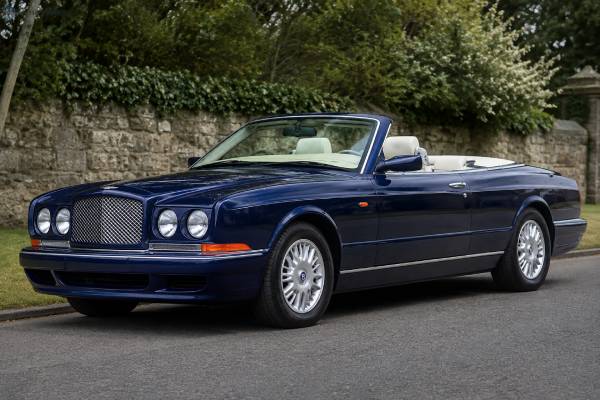
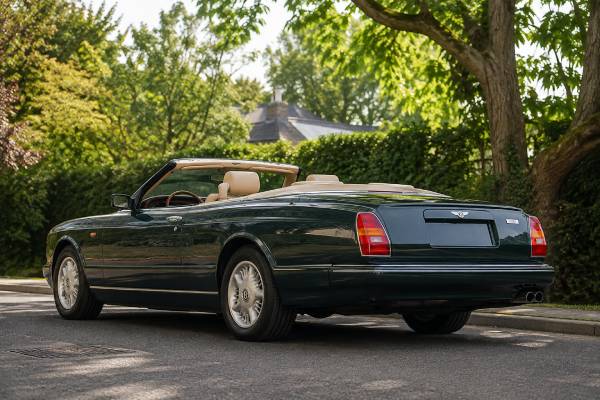
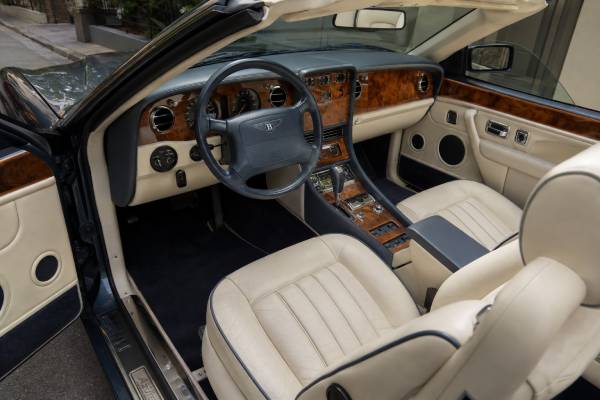
The 1995–1997 Bentley Azure is the original version of one of the most extravagant four-seat convertibles ever put into regular production. It combined the Continental R’s turbocharged 6.75-litre V8 and rear-wheel-drive chassis with a Pininfarina-developed folding roof, extensive structural reinforcement, and the hand-finished cabin expected of a Crewe-built Bentley. The result was not a lightweight sports car. It was a 2.6-ton grand tourer designed to cover distance quickly while keeping four occupants surrounded by leather, veneer, and remarkable open-air presence.
This early L410M1T model is also the purest point of entry into the first-generation Azure story. Its 384 hp output is lower than that of later 400 hp and 420 hp cars, yet its 750 Nm torque, relaxed four-speed automatic, and adaptive chassis still deliver effortless performance. Buyers should focus less on headline power and more on condition, hydraulic-system health, roof operation, service history, and the quality of previous specialist care.
Table of Contents
- What Defines the Original 384 hp Azure
- L410M1T Specifications and Technical Data
- Performance and Road Manners
- Body Engineering, Roof, and Craftsmanship
- Maintenance Priorities for Reliable Use
- Pre-Purchase Inspection and Common Faults
- Buying, Valuation, and Ownership Strategy
What Defines the Original 384 hp Azure
The first Azure is best understood as an open Continental R rather than a conventional luxury convertible. It retained the coupe’s long-wheelbase platform, turbocharged Bentley V8, imposing proportions, and four-seat touring purpose, then added a highly engineered power-operated fabric roof and substantial reinforcement.
Bentley introduced the Azure at the 1995 Geneva Motor Show. Pininfarina helped transform the Continental R body into a pillarless convertible and assembled the body shell, installed the roof mechanism, and painted the car in Italy before it returned to Crewe for final trim and completion. Bentley later stated that about 190 kg of reinforcement was added through the floor, sills, and windscreen structure to compensate for the missing fixed roof. That extra mass explains why the Azure weighs around 2,610 kg despite having only two doors.
The 1995–1997 assignment covers the earliest 384 hp engine calibration identified by the L410M1T code. Power delivery is deliberately unobtrusive. The large single turbocharger builds a broad wave of torque rather than encouraging high engine speeds, and the four-speed automatic keeps the V8 in its strongest range. The experience is defined by quiet force, not by aggressive shifts or a dramatic exhaust note.
This version also preserves several details that distinguish the launch-era car from later Azures:
- 17-inch wheels with relatively tall 255/55 tires rather than the wider, lower-profile 18-inch Mulliner setup.
- A 384 hp tune with 750 Nm of torque, before the later 400 hp and 420 hp developments.
- The original body treatment without the most obvious Mulliner flared arches, wing vents, and sportier cabin instruments.
- A softer, more formal grand-touring character than the later performance-oriented special editions.
The model’s appeal is therefore not based on rarity alone. It represents the moment when Bentley moved from the long-lived Corniche-derived convertible to a much more modern, faster, and structurally stronger open grand tourer. It is still enormous by sports-car standards, but its speed, steering response, and body control were striking for a luxury convertible launched in the mid-1990s.
L410M1T Specifications and Technical Data
The 1995–1997 Azure is a petrol-only, front-engine, rear-wheel-drive ICE vehicle. Its technical center is Bentley’s 6,750 cc pushrod V8, assisted by a single intercooled turbocharger and paired with a four-speed automatic transmission. The most important ownership context is that the powertrain is understressed in normal driving, while the surrounding hydraulic, cooling, electrical, and roof systems require specialist knowledge.
| Specification | Value |
|---|---|
| Engine code | L410M1T |
| Fuel type | Premium unleaded petrol |
| Layout | Front-mounted 90-degree V8, 2 valves per cylinder |
| Displacement | 6,750 cc (6.8 L) |
| Bore × stroke | 104.1 × 99.1 mm (4.10 × 3.90 in) |
| Compression ratio | 8.0:1 |
| Induction | Single Garrett AiResearch turbocharger with intercooling |
| Maximum power | 384 bhp (286 kW) at 4,000 rpm |
| Maximum torque | 750 Nm (553 lb-ft) at 2,000 rpm |
| Fuel-tank capacity | About 107–108 L (28.3–28.5 US gal) |
| Specification | Value |
|---|---|
| Transmission | GM Turbo Hydra-Matic four-speed automatic |
| Drive type | Rear-wheel drive |
| Final-drive ratio | 2.69:1 |
| Front suspension | Independent wishbones, coil springs, anti-roll bar |
| Rear suspension | Independent semi-trailing arms, coil springs, anti-roll bar |
| Damping | Electronically controlled adaptive ride system |
| Steering | Power-assisted recirculating-ball steering |
| Brakes | Ventilated front discs, rear discs, ABS |
| Specification | Value | Standard or condition |
|---|---|---|
| 0–100 km/h | About 6.7 seconds | Period production specification |
| 0–60 mph | About 6.3–6.4 seconds | Period quoted figure |
| Maximum speed | Up to 249 km/h (155 mph) | Governed; market figures can differ |
| Combined fuel consumption | About 17.8 L/100 km (13.2 mpg US) | Period European catalog figure |
| Urban fuel consumption | About 25.8 L/100 km (9.1 mpg US) | Period European catalog figure |
| Extra-urban fuel consumption | About 13.1 L/100 km (18.0 mpg US) | Period European catalog figure |
| Specification | Value |
|---|---|
| Body style | Two-door fabric-roof convertible |
| Seating | Four seats |
| Length | About 5,342 mm (210.3 in) |
| Width | About 1,872 mm (73.7 in), excluding mirrors |
| Height | About 1,475 mm (58.1 in) |
| Wheelbase | 3,061 mm (120.5 in) |
| Front and rear track | About 1,549 mm (61.0 in) |
| Kerb weight | About 2,610 kg (5,754 lb) |
| Turning circle | About 12.1 m (39.7 ft) |
| Specification | Value | Notes |
|---|---|---|
| Wheel diameter | 17 in | Launch-era standard fitment |
| Tire size | 255/55 ZR17 | Confirm the exact approved specification for the car |
| Wheel bolt pattern | 5 × 130 mm | Factory wheel fitment reference |
| Wheel fastener thread | M14 × 1.5 | Verify torque in official service data |
Several published figures differ slightly because period sources use different markets, measurement conventions, and pre-production or production cars. For example, maximum speed is sometimes listed as 150 mph and sometimes as a governed 155 mph. A buyer should treat the numbers as historical specifications, not as a promise that a 30-year-old example will still reproduce them without careful preparation.
Performance and Road Manners
The early Azure is fast because of torque, not because it revs hard. With 750 Nm available at only 2,000 rpm, it accelerates with a steady surge that suits motorway passing and long, open roads far better than stop-start driving or tight circuits.
The four-speed automatic is an important part of that character. Its ratios are broad, and the transmission normally avoids unnecessary activity. A healthy car should move away cleanly, engage Drive and Reverse without a long delay, and shift without flaring or harsh impact. It will not feel as quick-witted as a modern multi-speed automatic, but it should feel decisive and composed once moving.
At speed, the Azure’s mass becomes less intrusive. The long wheelbase helps straight-line stability, while adaptive damping firms the suspension as cornering loads increase. Period testers noted that the car was more structurally solid and more controlled than the old Corniche-based convertible. There can still be some low-speed windscreen shake on poor surfaces, but pronounced shudder, steering wander, or repeated clunks suggest wear rather than normal character.
The steering is relatively high-geared for such a large car, yet it remains filtered and deliberate. Tall-sidewall tires also help absorb sharp impacts and protect the ride quality. Owners who replace the original wheel setup with larger aftermarket wheels may gain visual drama but often lose compliance, introduce tramlining, and complicate tire sourcing. For a car intended to travel in comfort, the factory-size 17-inch package is part of the engineering balance rather than an outdated compromise.
Braking performance depends heavily on condition. The Azure’s discs, hydraulic assistance, tires, and suspension all have to manage more than 2.5 tons before passengers or luggage are added. A sound car should stop in a straight line with a firm, progressive response. Pulling, pulsing, warning lamps, or a pedal that feels inconsistent should be investigated immediately by a Bentley specialist.
Open-roof refinement is unusually good for a mid-1990s convertible. The high windscreen and deep cabin protect the front occupants, although rear passengers experience more turbulence. With the roof raised, wind sealing should be respectable, but it will not match a fixed-head Continental R. Worn seals, poorly adjusted side glass, or a roof that does not fully latch can create far more noise than the design intended.
Body Engineering, Roof, and Craftsmanship
The Azure’s most complex feature is not its engine; it is the conversion from a very large pillarless coupe into a durable power-operated convertible. The roof, reinforced shell, frameless glass, deck cover, seals, and interior trim must all work together, so cosmetic inspection alone is not enough.
The electrohydraulic roof retracts beneath a flush body-colored cover. This gives the car a clean profile with the hood down, but it also creates a long sequence of motors, pumps, hydraulic cylinders, switches, catches, and moving panels. A test should include several complete cycles with the car level and the battery fully charged. The movement should remain synchronized, the deck panel should clear the surrounding paint, and the roof should finish positively at both ends of its travel.
The original rear window is flexible plastic rather than glass. That choice allows the roof to fold compactly, but the window can cloud, crease, or crack with age. Aggressive polishing can distort it, and folding the hood when the plastic is cold may accelerate damage. Replacement quality matters because the window, stitching, and hood tension affect both appearance and weather sealing.
Water control deserves equal attention. Check the header rail, side seals, rear roof well, carpets, seat-belt mounting areas, and luggage compartment after rain or a controlled hose test. Dampness can damage leather and veneer, create odors, corrode electrical connections, and overwhelm the car’s already complex wiring. Water marks around the rear quarter trim often indicate a long-standing issue rather than a one-time spill.
The cabin should feel hand-made, but hand-made does not mean immune to age. Veneer can fade or crack, leather can dry around seat bolsters, lambswool overmats can conceal damp carpet, and switchgear may become sticky or intermittent. Correct restoration is expensive because colors, grain, stitching, and book-matched wood need to be reproduced with care. A slightly worn but original cabin may be more desirable than a brightly retrimmed interior with incorrect leather or poorly matched veneer.
Exterior panel alignment should be judged with an understanding of the car’s mixed production process. Small hand-finished variations are possible, but uneven door gaps, paint cracking near structural joints, damaged sill seams, or a deck cover that sits high may point to accident repairs or roof-adjustment problems. Because the doors are long and heavy, worn hinges or striker adjustment can also affect sealing and create wind noise.
Maintenance Priorities for Reliable Use
A dependable early Azure needs preventive, time-based servicing rather than mileage-only maintenance. Many examples cover few miles, but seals, hoses, fluids, electrical connections, tires, and hydraulic components continue to age while the car is parked.
Start with a baseline service if the history is incomplete. That should include engine oil and filter, careful inspection of coolant hoses and drive belts, brake-fluid condition, hydraulic-system checks, tire age, battery and charging tests, and a diagnostic review of stored faults where compatible equipment is available. The correct fluids and procedures must be confirmed by VIN and market because Bentley specifications and system details can vary.
The following priorities have the greatest effect on both reliability and cost:
- Cooling system: Inspect the radiator, expansion tank, hoses, clamps, water pump, thermostat operation, and evidence of dried coolant. A large turbocharged V8 produces substantial heat, and overheating can turn a manageable hose or radiator problem into major engine work.
- Engine lubrication: Use the oil viscosity and specification approved for the car’s climate and service documentation. Annual changes are sensible for low-mileage collector use because short trips and long storage periods contaminate oil even when mileage is modest.
- Turbo and intake plumbing: Check intercooler hoses, vacuum lines, clamps, and oil seepage. A split hose or control leak can reduce boost, disturb fueling, and make the car feel flat without causing an obvious mechanical noise.
- Transmission: The GM automatic is generally robust, but fluid condition, leaks, cooler lines, mounts, and shift behavior matter. “Lifetime” assumptions are inappropriate for a three-decade-old car; fluid service should be based on condition and specialist guidance.
- High-pressure hydraulics: The braking and ride-control systems use specialized components and fluid. Warning lamps, frequent pump operation, leaks, or poor ride height require proper pressure testing rather than random parts replacement.
- Roof mechanism: Keep drains clear, seals clean, pivots lubricated with approved products, and the battery strong. Do not repeatedly operate a struggling roof in the hope that it will free itself.
- Electrical supply: Maintain a fully charged, correctly rated battery and clean grounds. Low voltage can produce misleading symptoms in the roof controller, seat modules, alarm, windows, and engine management.
Regular use is usually better than static display. A monthly drive that brings the engine, transmission, brakes, and hydraulics to normal operating temperature helps circulate fluids and exposes developing faults early. However, repeated short idling sessions are not a substitute because they add moisture and fuel dilution without exercising the whole car.
Storage should be dry, ventilated, and protected from rodents. Keep the roof raised so the fabric and rear window are not stored under permanent folds, but follow specialist advice before leaving the latches under tension for very long periods. Use a quality battery maintainer designed for the battery type, maintain tire pressure, and move the car periodically to reduce flat-spotting.
Pre-Purchase Inspection and Common Faults
The best Azure is the car with documented specialist care, fully functioning systems, and no signs of deferred maintenance. A low purchase price cannot compensate for a failed roof, hydraulic faults, water-damaged trim, and an overheated engine arriving at the same time.
Roof and water ingress
Operate the hood from fully closed to fully open and back again. Watch both sides of the mechanism, listen for changes in pump tone, and inspect the ground and roof well for hydraulic fluid. The sequence should not pause unexpectedly or require manual assistance. Confirm that all side windows drop and raise correctly, the header locks securely, and the deck cover sits flush.
Inspect the fabric for shrinkage, abrasion, weak stitching, and prior patching. Examine the plastic rear window in daylight from several angles. Then look under carpets and inside the luggage compartment for dampness, corrosion, or water staining. A seller’s statement that the car “is never driven in rain” is not evidence that the sealing system is sound.
Hydraulics, suspension, and brakes
Warning lamps must illuminate during the startup check and then extinguish normally. Listen for pump operation and ask how often hydraulic accumulators, hoses, and related components have been replaced. The car should sit level, ride without repeated bouncing, and remain controlled over undulations. Knocks may come from worn bushes, ball joints, anti-roll-bar links, or mounts, while a harsh ride can point to damping or hydraulic problems.
Check all four tires for matching brand, specification, age, and even wear. Old tires may look perfect while offering poor grip. Uneven wear can reveal alignment, bush, or structural issues. Brake discs are large and costly; inspect for heavy lips, cracking, corrosion, vibration, and seized calipers.
Engine, cooling, and transmission
Insist on a cold start. The V8 should establish a stable idle without persistent smoke, heavy tapping, coolant odor, or fuel smell. Check for oil leaks, coolant residue, brittle hoses, and evidence that hot components have damaged nearby wiring. During the test drive, boost should arrive smoothly and the engine should pull strongly without hesitation or warning lamps.
The transmission should engage promptly and shift cleanly at light and heavy throttle. Flared shifts, delayed engagement, vibration under load, or burnt-smelling fluid justify a specialist diagnosis before purchase. Also inspect the differential and driveline for leaks or clunks when moving between acceleration and overrun.
Documentation and authenticity
A proper history is more than a stamped booklet. Look for dated invoices that identify the work, parts, mileage, and specialist. Important records include cooling-system renewal, hydraulic repairs, roof work, tires, brake overhaul, transmission servicing, and electrical diagnosis. Confirm the VIN, engine identity, paint and trim codes, books, tools, keys, and any market-specific compliance labels.
Originality affects value, but functionality comes first. Factory wheels, correct badges, original color combinations, and complete accessories are desirable. Poorly integrated audio systems, alarm modifications, aftermarket wheels, or improvised hydraulic repairs can create faults that are difficult to trace.
Buying, Valuation, and Ownership Strategy
Buy on condition and history, not merely on mileage or color. The difference between an inexpensive driver and an excellent car can be far smaller than the cost of correcting a neglected roof, hydraulics, cooling system, and interior.
Values vary widely by market, specification, provenance, and presentation. Launch-era cars can sit below rare Mulliner and Final Series versions, but a superb early Azure with original trim, desirable colors, and uninterrupted specialist records may be more satisfying than a rarer car with hidden needs. Price guides are useful only as broad context because bespoke options and restoration quality can move individual cars well outside published ranges.
Before making an offer, budget for three separate categories:
- Immediate safety and reliability work: Tires, brakes, fluids, leaks, cooling, hydraulic pressure, battery, and any roof fault.
- First-year preventive work: Hoses, belts, aged mounts, alignment, weather seals, air-conditioning service, and correction of deferred electrical issues.
- Cosmetic preservation: Leather feeding, veneer repair, hood cleaning, rear-window care, paint correction, and replacement of missing tools or books.
A pre-purchase inspection should be performed by a workshop that regularly services SZ-era and Continental R/Azure Bentleys, not simply by a general exotic-car garage. The specialist needs the correct hydraulic knowledge, wiring information, diagnostic capability, and familiarity with parts that are shared with or unique from Rolls-Royce models of the period.
Ask for a written estimate that separates urgent work from desirable improvements. This prevents a beautiful cabin or low odometer reading from overwhelming the mechanical evidence. It also gives you a realistic basis for negotiation and for deciding whether the car fits your annual running budget.
Ownership is most rewarding when the Azure is used as intended: long journeys, dry-weather touring, and regular exercise rather than hard circuit driving or indefinite storage. Fuel use is high, parking requires planning, and many routine jobs consume more labor than on an ordinary car. In return, the early Azure offers a combination that has not been repeated in quite the same way—a traditional low-revving Bentley V8, genuine four-seat accommodation, Pininfarina-influenced open bodywork, and the atmosphere of a hand-finished 1990s grand tourer.
The 384 hp version is not the fastest first-generation Azure, but it does not need to be. Its value lies in the original concept and in the effortless way a healthy example delivers it. Choose the best maintained car you can verify, preserve its factory character, and treat every developing fault as a prompt for diagnosis rather than something to postpone.
References
- BENTLEY NEWSROOM : 2003 Azure Mulliner C2BML 2026 (Heritage Collection)
- Bentley Story | Bentley Motors 2026 (Manufacturer History)
- The 1996 Bentley Azure Exists in a World of Its Own 2026 (Archive Road Test)
- 1996 Bentley Azure: detailed specifications, performance and economy data 2026 (Technical Data)
- Bentley Continental and Azure (1991 – 2003) Review | Honest John 2026 (Model History)
- Search Safety Issues | NHTSA 2026 (Recall Database)
Disclaimer
This article is for informational purposes and is not a substitute for professional diagnosis, repair, or inspection. Specifications, torque values, service intervals, fluids, and procedures can vary by VIN, market, production date, and equipment; verify every service decision against the vehicle’s official Bentley service documentation and qualified specialist advice.
Please share this guide on Facebook, X/Twitter, or your preferred enthusiast community if it helped you evaluate or preserve an early Bentley Azure.